There are days you just need to take some time out, and as the year rolls towards a close it feels like they are needed just that bit more. After half a day’s work I was out and about heading south. Joined by Craig, who was also very grateful for a bit of time in nature, allowing us a bit of long overdue catch up time. Our destination was Augusta, a place Lisa and I had spent an overnight getaway in December last year. We had been thinking of repeating that trip next weekend, but the lack of available accommodation thwarted that idea:
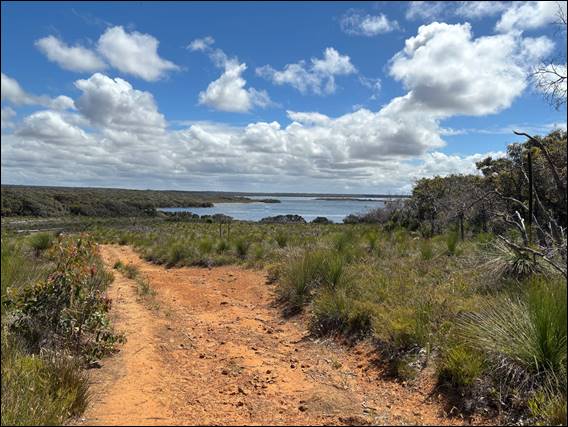
No doubt we will think of an alternative location. In the meantime I was still keen to drive the three hour round trip to see if a few of the later flowering orchids down this way may be out. There were two in particular species that I am yet to find. With only one way to see if they are about, and that is get out there. The main area we focused on was Flat Rocks. The low scrub broken up by clear areas created where the underlying granite was exposed. As the name suggests, not standing proud about the ground, but laying down on the ground:
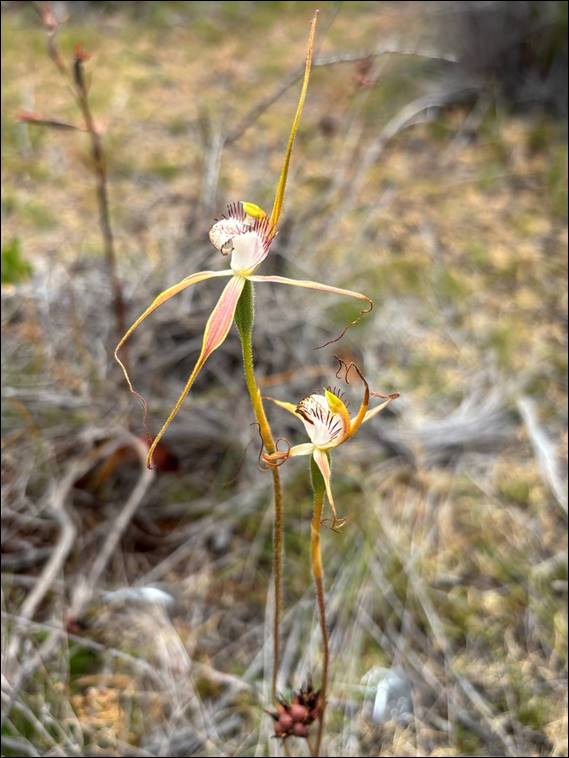
It is an area I should probably come to earlier in the season, with raft of orchids having been found in a relatively small area. Many of which are not found where we live, which is just shy of half a degree of latitude further north, or 50km. It didn’t start too well, stands of dried up sun orchids were all over. On the plus side for next year, their ovaries had swelled up suggesting pollination had occurred. The best we could find, with a little assistance, were a few Christmas Spider Orchids (Caladenia serotine) that were starting to get a little bedraggled:
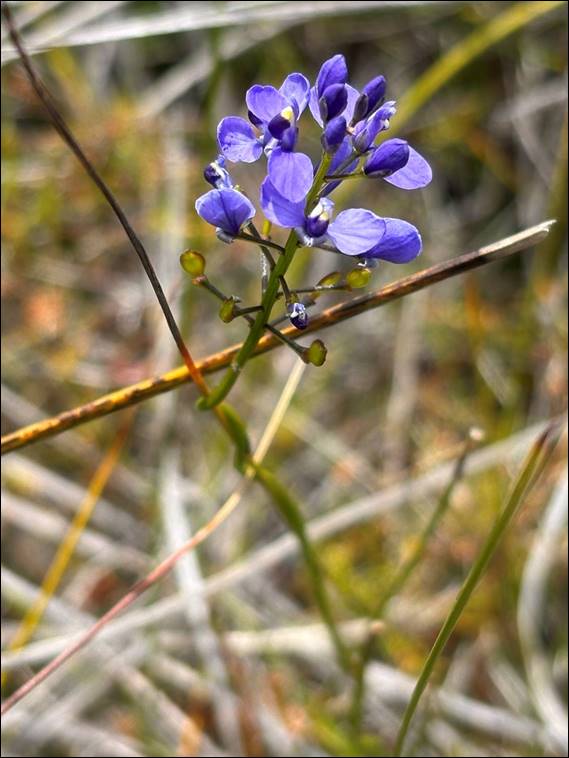
Being one of the later flowering spiders, they were donned with a very literal species name of serotina. Meaning happening late in Latin. Other small flowers peppered the area, such as the above Love Creeper (Comesperma volubile). It makes use of the vegetation around it to gain height. This a twining plant also has a very literal Latin word for its species name, with volubile meaning twining. Even though the long slender stems that can reach three meters in length, and because it has no leaves, it is not until it blooms that it is really noticeable:
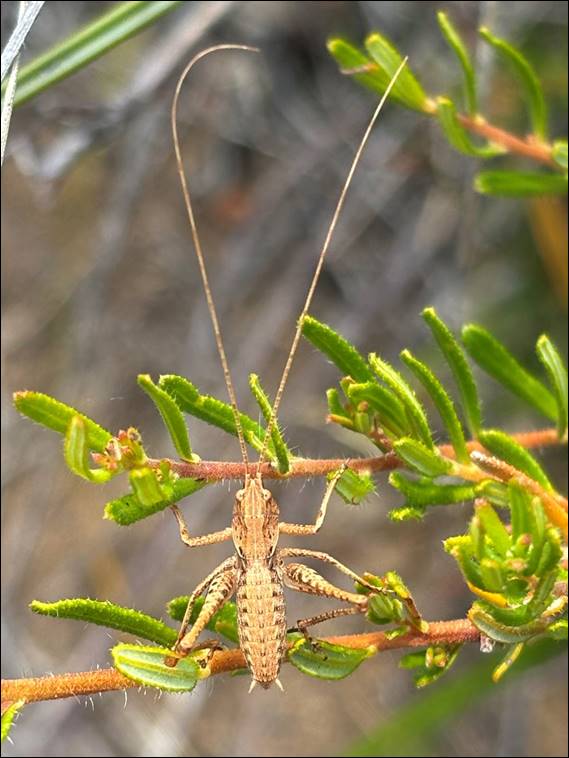
For the above and other than the family name of Tettigoniidae, commonly called Katydids or Bush Crickets, of which there are approx. a thousand species in Western Australia, I have no idea. Katydids are easily distinguished by their long slender antennae, commonly longer than their bodies. Whereas grasshoppers and crickets have shorter and thicker antennae. They are however more closely related to crickets, and the location of the ears or tympanum for both is just below the knee on the front legs. Grasshoppers ears are on their abdomen:
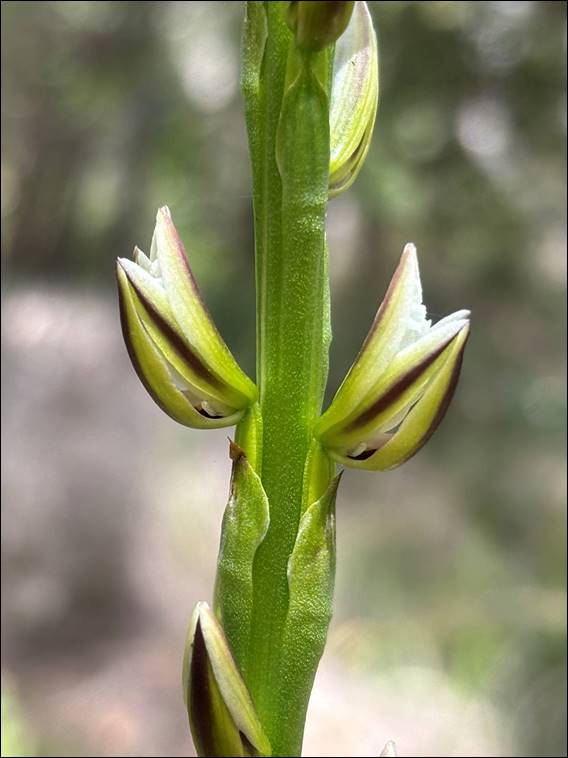
Moving along we found quite a few Christmas Leek Orchids (Prasophyllum brownie), and like the Christmas Spider Orchid, this species is one of the last of their genus to flower in Western Australia. Today only one specimen had its flowers open, of which there can be as many as eighty on one stem. If you want to see the flowers out you’ll need to go back in time to December last year https://sandbagged.blog/2024/12/16/a-pick-and-mix-weekend/. Leeks are amongst the tallest of the orchids in Western Australia, and this species can reach 1.2m:
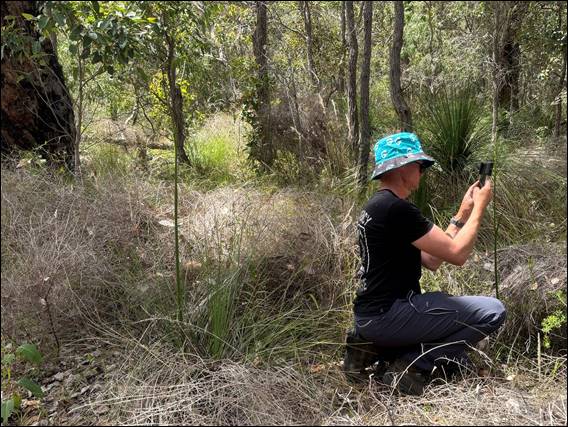
We did a fair bit of wandering through bush, trying to avoid the many webs. This included the webs of a very pretty arachnid called a Silver Orb Spider (Leucauge dromedaria). The light green translucent legs of this creature, no more than three fifths of an inch long, drew our attention. Glowing when they caught the sun. The humped abdomen helped with the identification, and it is also being known as the Humped Silver Orb Spider. While the upper body was fully of intricate patterns and colours, the underside is where it gets its name from:
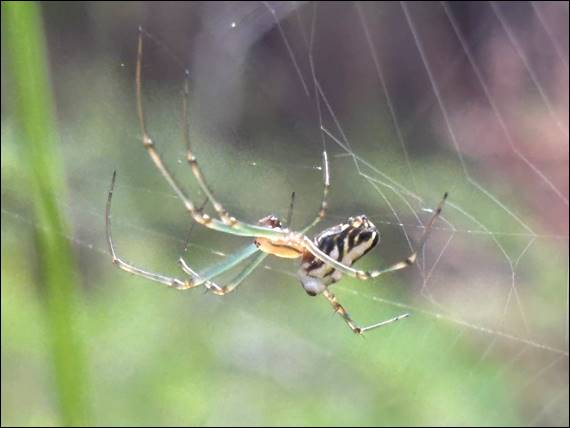
This is mostly a plain slivery colour, and intentionally so. Building horizontal webs, from below the colour merges with the sky above making it hard to see and providing a degree of camouflage as insect fly up from the ground. Another colourful find were the flowering Tall Kangaroo Paw (Anigozanthos flavidus), of which there are gazillions about. There are eleven species, and a few sub-species, in the genus of Anigozanthos. This includes both kangaroo and cats paws and the name was derived to describe their unique flower:
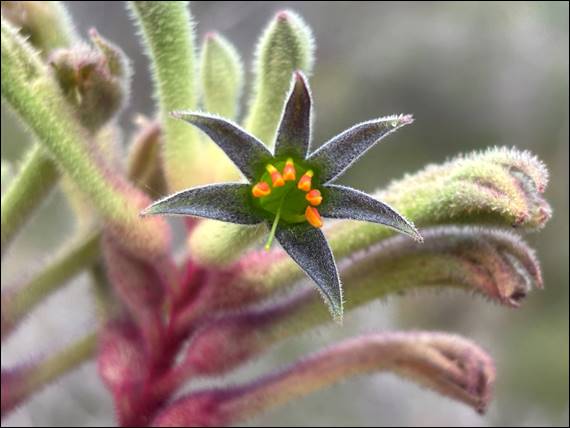
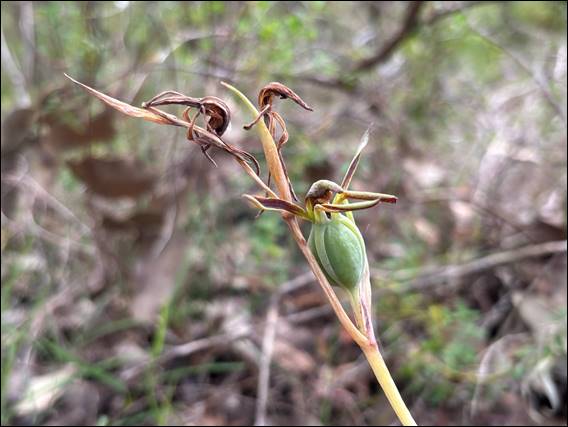
Two Greek words of anisos and anthos being combined, which mean unequal and flower. Craig and I continued to scour the areas that the elusive orchid species I was after have been found in previous years. Sadly they alluded us this time, and I do wonder if just like this Rattle Beak Orchid (Lyperanthus serratus), the hunting season may be drying up. Although I imagine there may be a wander in the bush or two still to come. After all the local ocean conditions are still pretty pants, so my attention has not as yet been diverted to underwater discoveries:
 Sandbagged