Back in August it was claimed that spring and potentially summer would end up a tad wet across all of Australia. So far that prediction is proving right in our south west corner. Forecast of the back of a negative Indian Ocean Dipole forming, which a phenomenon that not surprisingly occurs across the Indian Ocean. Created by the temperature difference of the ocean surface in the west and east. It can form three phases of positive, neutral, and negative. The negative cycle is created when the ocean is warmer in the east than west:

Australia has had its hottest year on record for ocean temperatures between July 2024 and June 2025. In West Australia we experienced the longest, largest, and most intense ocean heatwave on record. Starting in late 2024 and peaking in early 2025, with surface temperatures of the sea being as much as 4 degrees Celsius higher than average. As such the negative Indian Ocean Dipole was not all that unexpected. However, then came along another quirk of mother nature. A sudden stratospheric warming over Antarctica:
This resulted in the air temperature soaring by more than 30 degrees Celsius. Sounds catastrophic, however sudden is probably an exaggeration. It can takes weeks for these sort of temperature shifts. Also this is a warming of the stratosphere, which is the layer of the atmosphere between 10 and 50km above the surface of the earth. So we are not talking an Armageddon weather shift. While these events occur approx. every two years in the Northern Hemisphere, they are however rare in the Southern Hemisphere:

Over some 45 years only three moderate to major such events have occurred in the southern hemisphere. Being in 1988, 2002, and 2019. The phenomena has the greatest impact when it occurs in spring, with the worse recorded impact being in 2019. Off the back of a drought this was the catalyst for the devastating Black Summer over east, during which some 19 million hectares of bush burned. As should hint that the sudden stratospheric warming over Antarctica results in a drying and hot climate in Australia:
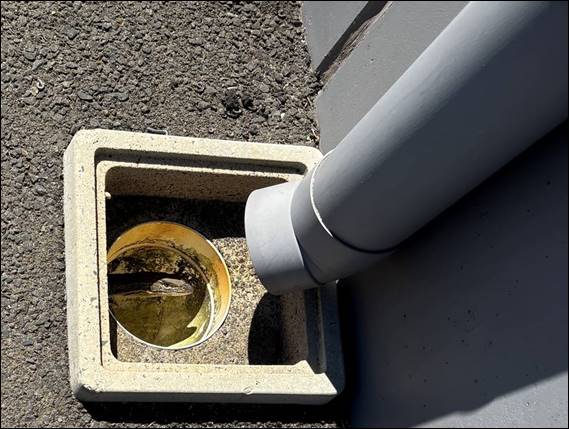
The opposite effect of a negative Indian Ocean Dipole. Which one of these mighty weather systems wins out is yet to be seen. For now no one is game to predict the outcome. Indeed most of us, just like the Sand Monitor (Varanus gouldii) in the first image, simply carry on with life. Blissfully unaware of any of this stuff. I find it funny how I spend so many hours traipsing round the bush looking for wildlife. Then as I sit at work a monitor casually walks past the one and only window in our concrete box of an office. Unable to resist I wandered outside:

Oblivious to goings on in the atmosphere above, but the close proximity of a person was enough to make the monitor hide away in a stormwater drain. At least it would have been nice and cool in there, as the temperatures were on the rise. Closing in on thirty degrees on Monday; the day the monitor walked past. On Tuesday it crept higher and after work I headed to Crook Brook where the car thermometer told me it was edging to the mid-thirties. Not put off I wandered round a couple of the loops, to see what I might see:

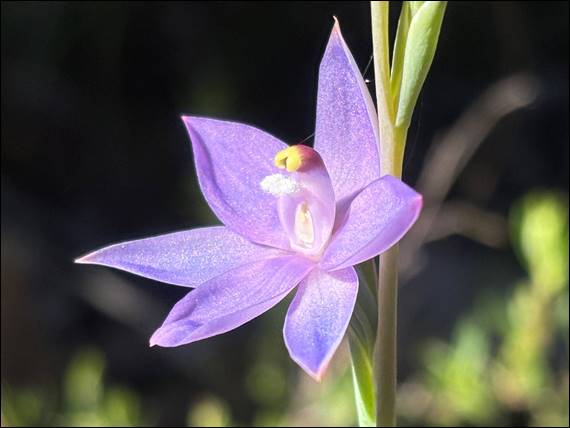
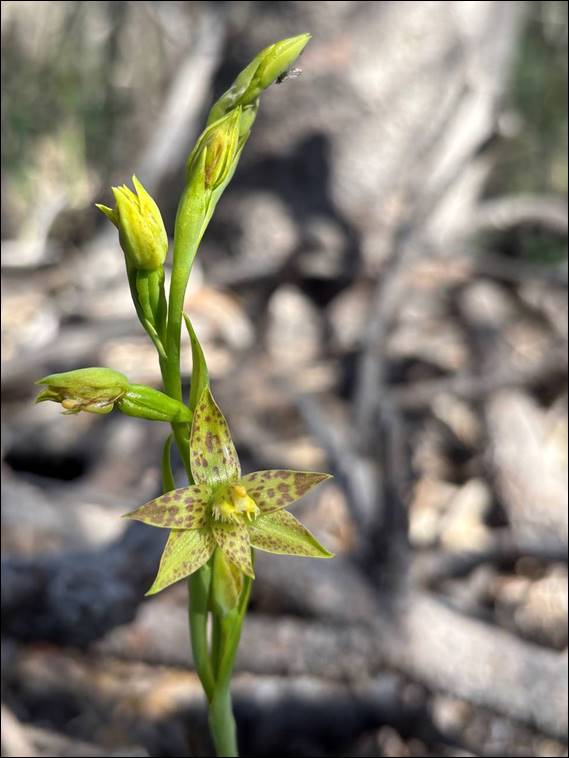
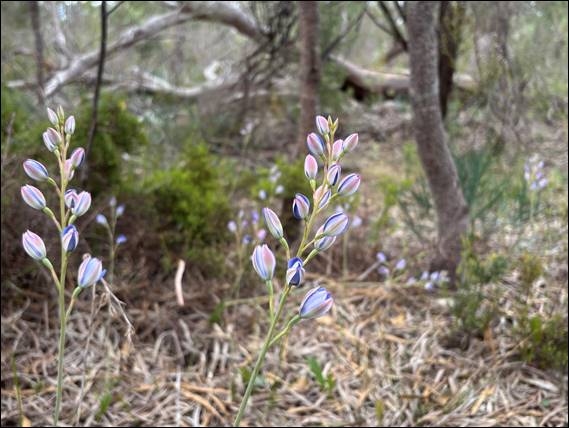
Not as much as I had hoped. With a blistering sun you would expect the sun orchids to be loving it, but no. They were by far the most prolific of the orchids out, but very few had their flowers open. I only spied one Scented Sun Orchid (Thelymitra macrophylla) and a couple of Shy Sun Orchid (Thelymitra graminea) open, shown in the images. I realise they do not do great in extreme heat but didn’t feel it was ridiculously hot today. Although warm enough for the Bobtail (Tiliqua rugosa) to be active and not wanting to put up with me hovering about:
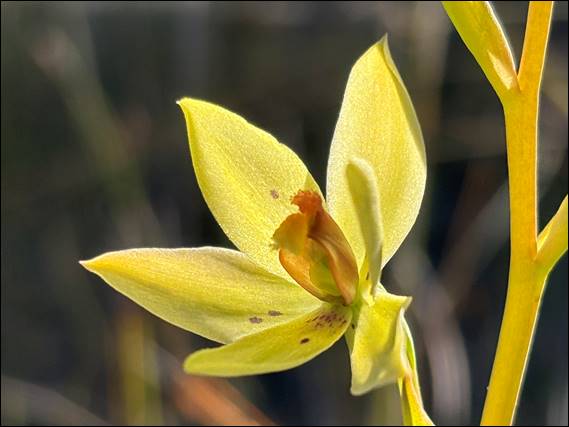
Both the Slender Sun (Thelymitra pauciflora) and Blue Lady Orchids (Thelymitra crinita) were out, but again their flowers were closed so there are no images. However, the icing, or should I say custard, on the cake was my first ever sighting of a Custard Orchid (Thelymitra villosa). Three plants all up with only one flower open, such a good find there are two images. I knew they pop up here but until this sighting I had not been lucky enough to find one. Despite having found five suns, as with the two big whether systems, this didn’t spell destruction:
I should explain the Aztec myth of creation of the Five Suns is based on the cycles of creation and destruction. Four sun gods, called Tezcatlipoca, Quetzalcoatl, Tlaloc, and Chalchiuhtlicue, each failed to create a world that lasted. The fifth sun god, Huitzilopochtli, was however successful. Although it is said that sacrifices are required to keep the sun (god) moving across the sky, including human sacrifices. Moving onto brighter topics as I finished my wander at Crooked Brook I stumbled across one of the two tallest spider orchid species:
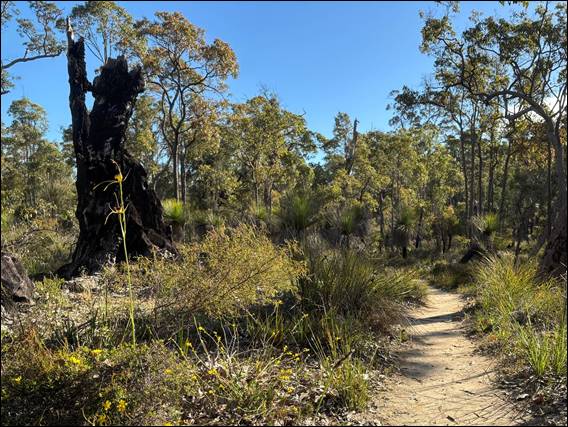
Standing proud at the side of the track two images up, you should be able to make out a magnificent Carbunup King Spider Orchid (Caladenia procera) with two flowers. The only spider orchid I saw, and then at Manea Park on Wednesday in half the temperature I didn’t see any. And despite being not as hot but still sunny, none of the many sun orchids were in flower. Other than one Leopard Orchid (Thelymitra benthamiana), being the sixth sun of the week. The Sixth Sun referring to the next era after the world of the Fifth Sun ends:

The era of the Sixth Sun provides an opportunity. Either move toward destruction or gain a higher state of being and understanding of the world. If it ever came to it I wonder what path the human race would take. For now my path at Manea Park didn’t offer anything else on the orchid front but I did get to see a swarm of bees, which I didn’t dare get any closer to than shown above. Then at the Capel Nature Reserve on Thursday I only found repeat sun orchids. It was raining so this time at least I could understand why they were all clammed shut:
 Sandbagged