I really had no idea what I was in store for. Having previously only ever had a stopover at the airport for a few hours in Singapore on the way to and back from England. All I knew was the airport was grand in scale and display, so maybe that was a hint. Lisa on the other hand likes to have an idea of what we may be heading into. As such she had researched our destination and had an inkling of what to expect. That said no amount of research can prepare you for what to truly expect when heading overseas to a different country and culture:
Singapore is suggested to be one of the most westernised countries in Asia. This is a result of the long history as a British colony, which started way back in the early 1800s. Traditional Asian values are however promoted, creating a blended culture that sets it apart from other Asian countries. Singapore started to break free from British rule in the late 1950s, and became part of Malaysia. This only lasted a for a short period, after which it was expelled due to ideological differences. Primarily due to two reasons, the first being Singapore’s free-market approach:
The second, which became abundantly clear to us, was Singapore’s inclusive approach to different races. Values, morality, and respect aren’t so much preached, but there is evidence as you look round the place, as well as the signage, that there is a strong expectations that we treat each other with kindness and thoughtfulness. And it shows in the communities energy and approach to life, from what we experienced. It was very refreshing and certainly for our six brief days of exploring the area, we were made to feel welcome and safe by all:
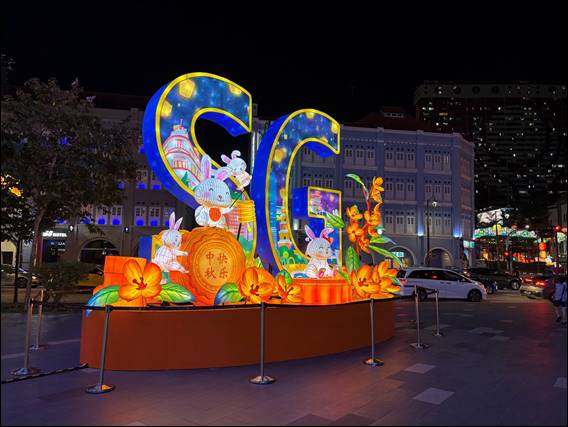
Not just those that we engaged with because they happen to be working, but also the general public. After being expelled from Malaysia, Singapore gained independence in 1965. This meant they celebrated their 60th National Day in 2025, which was on 9 August. Evidence of this was still all about the place, such as the display in the first image. Oblivious to this fact we missed the date and we also unintentionally missed the Singapore Grand Prix. Over a week after the big race, evidence of it remained round the city centre:
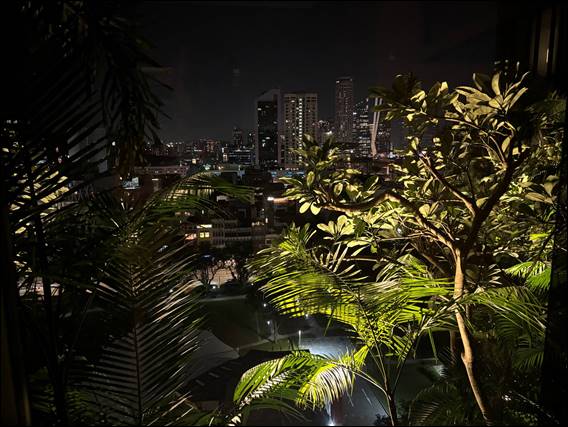
Even though we got in late on the Monday evening, we were keen to get our first sample of the place. After dumping our bags in a hotel that was way more fancy than either of us had stayed in before, check out the view from our room in the second image, we ventured out. Singapore’s climate comprises abundant rainfall, uniform temperatures, and high humidity all year round. The tropical climate sits between a humid 25 to 32 degree Celsius, something that would normally knock me out. Lisa on the other hand does well in humid climates:

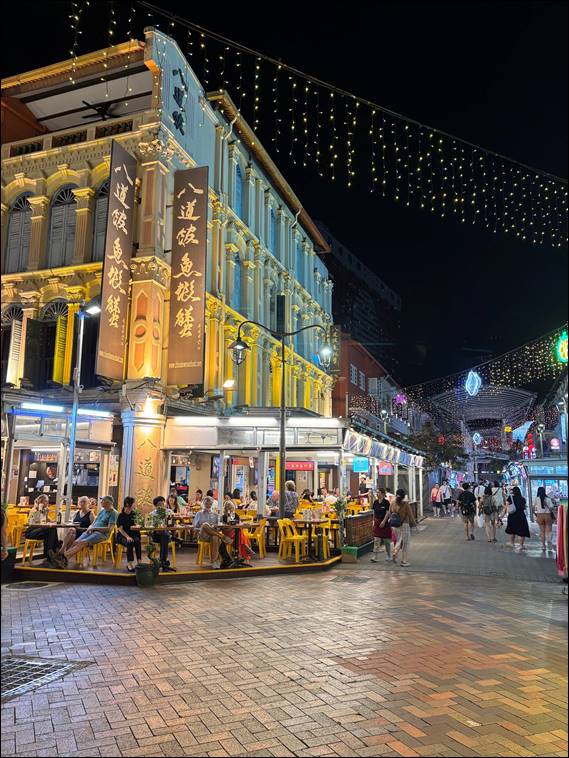
While it was humid it was fortunately not too bad for most of our stay, more of a comfortable muggy feel. Our hotel was right next to China Town, which was a hive of activity. Things take a while to get moving here in the evenings but once they do the place is bustling with locals and tourists alike. Eating out seemed to be the norm for many, with so much choice on offer that it was difficult to know where to try. Not that we needed any food this time, but each day thereafter we tried new places and different foods. None disappointed:
For our first full day we decided to have a wander, to very much a touristy spot of Gardens by the Bay. Lisa had a few things she had spotted that took her fancy, and each day we would have a think about what we felt like we were up for. As we walked through what may be regarded as the heart of the city, it was difficult not to be impressed with the concrete jungle that spread out in every direction. Immense is probably the word. Towering high rises. More than you can poke a stick at, creating incredible skylines to make you dizzy as you looked up:
Despite being a city, and we have both been in plenty across multiple continents, this one was different. It was immaculate, clean, neat as a pin, and green. The tropical climate assists with maintaining plant health but the sheer amount of greenery, which had been purposefully and carefully integrated into the street and building designs was stunning. Even the green roofs, green walls, and street scape garden beds were in pristine condition. Something that I hear back home is aspired too, but has never been achieved in any great scale:
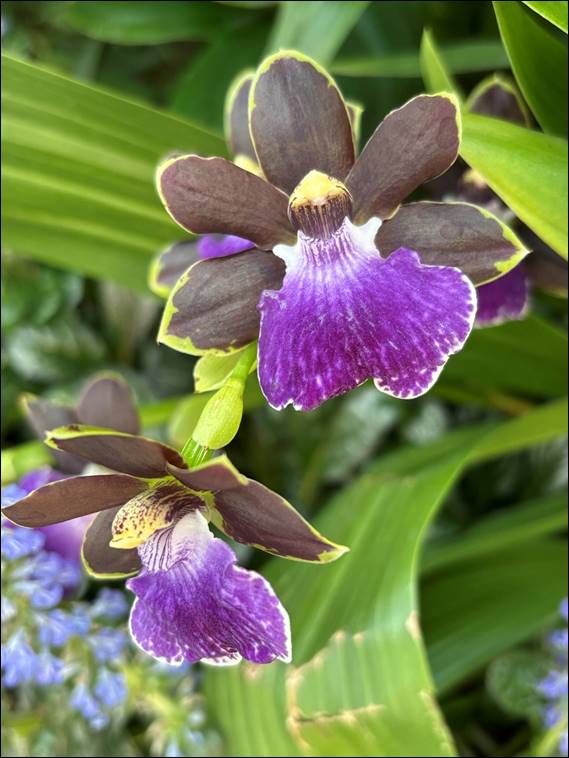
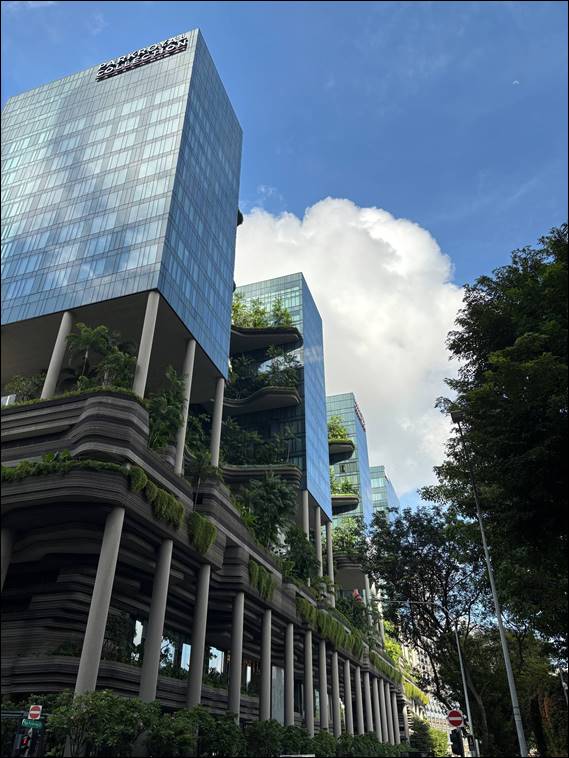
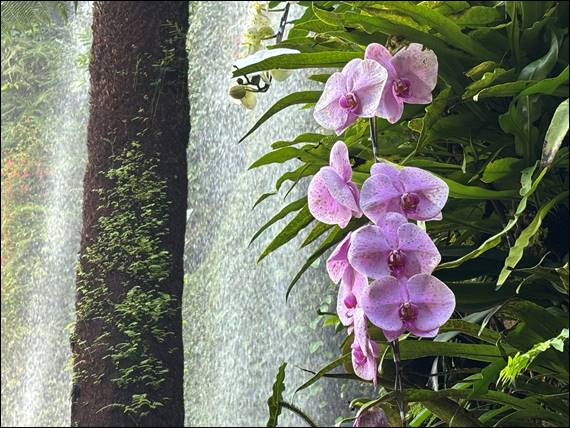
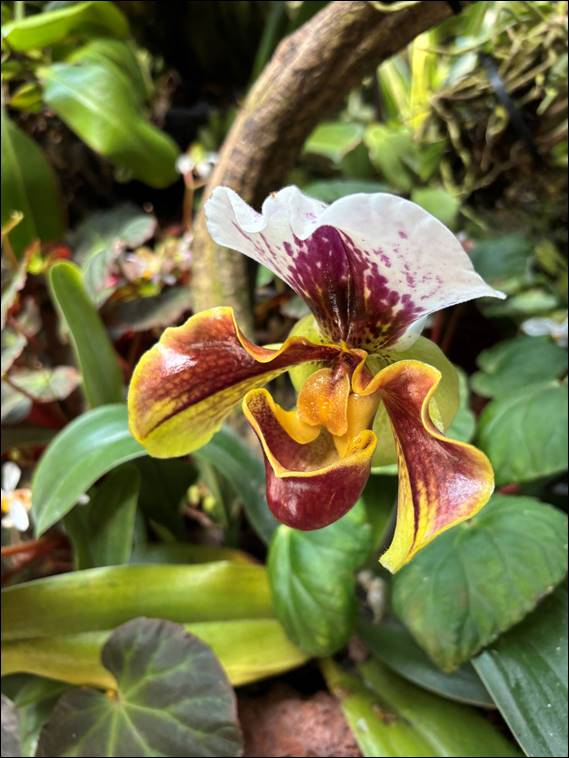
There’s an image of the hotel we are staying at with greenery draped all over it, and then one of the skyline as we walked along the main road to our destination. The flowers are however not from the vegetation we saw, as we walked down, but at the Cloud Forest. One of two huge glass domed gardens at Gardens by the Bay, that provide a celebration of plants from every continent other than Antarctica. The other was closed to allow a change in display, but no matter we spent ages in this one which opened my eyes to a whole new world:
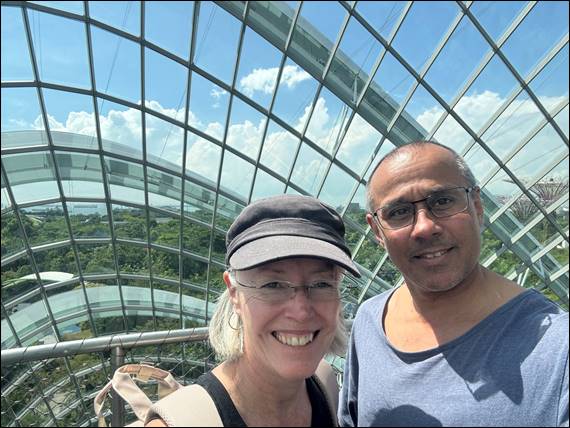
I wasn’t even aware of what a cloud forest was. Typically found at between 1,000 and 2,500m above sea level, and as the name suggests they are frequently covered by clouds. Found in tropical or subtropical regions, these mountainous forests are evergreen and sport exceptionally high biodiversity. I was of course drawn towards the many orchids, but the carnivorous plants also really drew my attention particularly the pitcher plants. Waterfalls cascaded 35m down, and a walkway spiralled from above to the deck:
Having been to many a botanical garden, this one blew me away. Well worth the money, and as with everything else we saw it was so well maintained. Lisa is not keen on heights, and not wanting to miss out did well to navigate the walkways. The waterfalls and misters kept the dome a lovely cool temperature, so eventually walking out into the midday heat was a shock. With the sun out too, the humidity felt a little higher and there was no escaping it. As such we avoided the sun were possible and wandered to a hawkers place in the gardens:
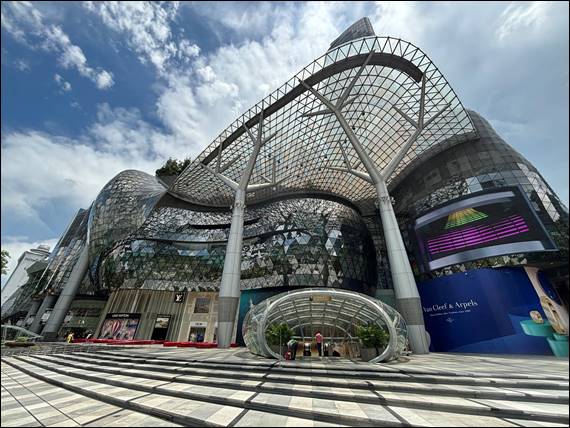
Here we were keen for some local cuisine, of which there was a good variety including a stall with only frog stews. Singapore is not just impressive above ground, but also below. The public transport system has a network of underground trains, with immense stations. And each one seemed to be linked to or right next to a shopping plaza of equally gobsmacking scale. Two images up is just one of so many we saw and had to walk through. Multiple floors of shops and eateries, so many you have to wonder how they are all able to make a profit:
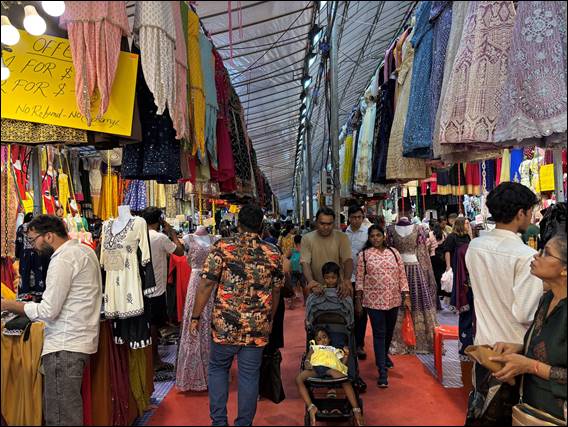
In contrast and as we experienced that night there is Little India. Similar to Little China and Arab Quarter, which we went to later in the trip, these locales were not a sprawl of high rises. The buildings looked old, and indeed the three areas date back to the early 19th century. Little India was established as a settlement for the Indian community that migrated here during the British colonial era. Whereas China Town was a settlement for Chinese immigrants under the 1822 Raffles Town Plan, which was in stark contrast to Singapore’s current inclusive approach:

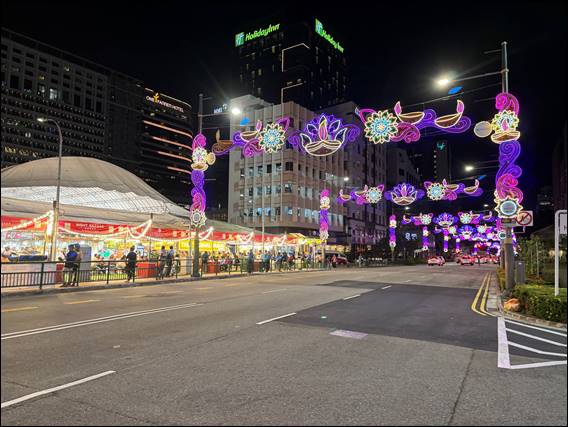
The concept was to design a structured town plan with racial segregation in mind that was applied to the Arab Quarter too. Not surprisingly there is a strong Chinese, Indian, and Arabic influence and feel in each place, while the rest of Singapore is more diverse. Little India was aglow with light and colour, in preparation for the Diwali festival of lights on 21 October 2025. Another spectacle we missed out on, although we did see Little India fully prepared with the streets lights up. These three districts certainly had a different feel, so were well worth a visit:
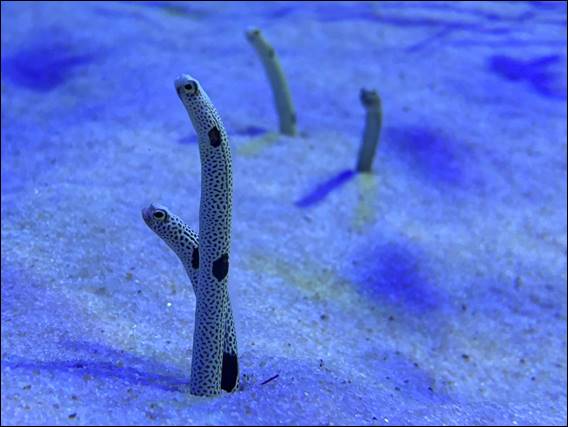
Day two dawned, and we were once more tourists doing the real touristy things. We headed to Sentosa Island located the southern coast. A place where the locals flock to for a local holiday. Beaches and theme parks abound but it was the aquarium that was calling us. Where we whiled away nearly five hours. You’ll get tired of hearing it but again the scale was insane. A network of tunnels that led past exhibitions and tanks covering 22 distinct habitats, the biggest having a 36m wide viewing panel holding back just short of 19 million litres of water:

It was then time for a bit of culture, as we headed to some of the older colonial buildings. Nowhere near as high and with architectural designs that stood out against the more modern buildings of the seemingly never high rises. But standing their own, and equally cared for to ensure they are well maintained and presented. There is a pride of place that came through in every area we ventured. That evening we popped back to China Town for more local cuisines, mind you the variety of cuisine could leave you asking what is truly local:

There is of course plenty of western food on offer, and to be expected with any city all the main food chains are on offer. Part of the trip expectations for me was to eat local, and as such we didn’t have any western food during our visit. While we made use of the public transport, we also realised that there was still going to be a lot of walking. Just to get from one platform to the next in the underground caverns was often a trek. Lisa was struggling a bit for various reasons, so we needed to slow the pace on day three:
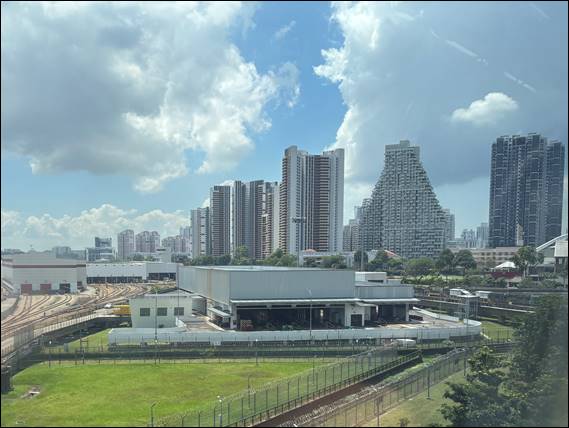
Not wanting to slob about at the hotel, we hatched a plan to see a bit more of Singapore without needing to walk. While the vast majority of the rail system in underground, one line called the north south line is mostly above ground. This actually does a loop round the island, so we sat on the train for nearly an hour as we watched the landscape pass us by. Singapore is small, coast to coast being 49km from east to west and 28km from north to south. Depending on the source I’ve looked at it ranks as the 21st smallest country:
However, the 2025 world population review ranked it third in the world in relation to population density. A staggering 8,177 people live per square kilometre. Not surprisingly with the massive amount of outback Australia has a lowly density of just 4, and Western Australia’s capital city of Perth has a density of just 371. Melbourne has the highest population density of all Australian cities, and even that is only 521 people per square kilometre. Urban sprawl in Australia is an issue, but we seem to have a culture opposed to higher density:
In Singapore they have gone up, and not just in the main city centre. As we sat on the train and rolled along the 27km of above ground tracks it was clearly everywhere, see three images up. There were some areas of lower buildings, mostly industrial areas and a few green spaces but it was mostly up, up, and up. With so many more buildings going up all over the place. The building sites were kept just as neat and tidy as the already built environments, pride of place shone out everywhere, despite four-fifths of the population living in public housing:

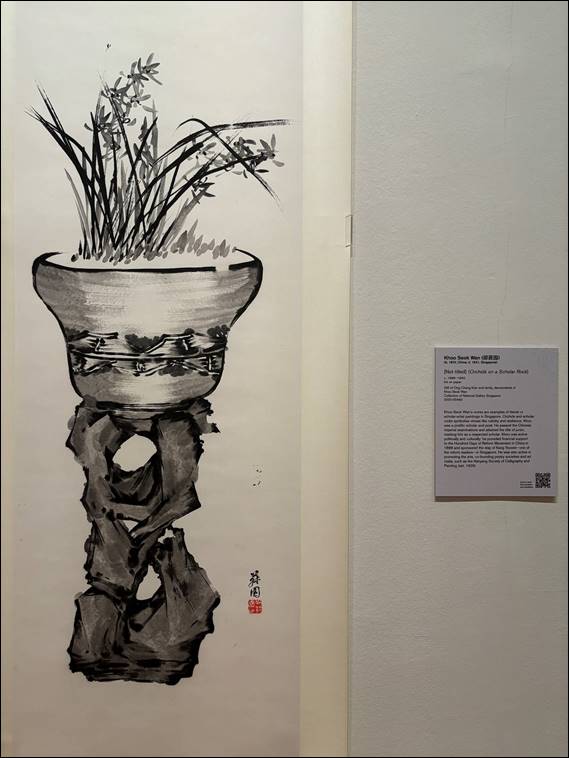
We left the trains behind and headed back to the older buildings, Lisa was keen to find out a bit more about Singapore’s history and culture so we went to the museum. It was incredibly informative but not focused on Singapore. It had a lot about the general geographic area and trade connections. Plus a very cool exhibitions on the history of games, which really tickled our fancy. I’ve included a single image from the museum of one of the many ink on paper artworks, this one dates to 1929 and was called Orchids on a Scholar Rock:
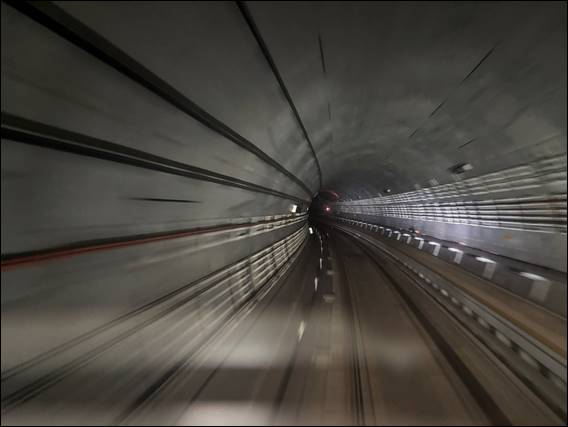
Even the underground train tunnels shown a few images up were neat and tidy. There was a distinct lack of litter in the vast majority of places, despite a relative absence of bins. A complete contrast to the state of the London Underground, which I worked on for near nine months. This was admittedly mostly down to the mindset of the general public about littering. It was time to head back to the room for a rest, and sometime later we hit the trains again to get back to Gardens by the Bay. Being keen to see the Supertree Grove at night:
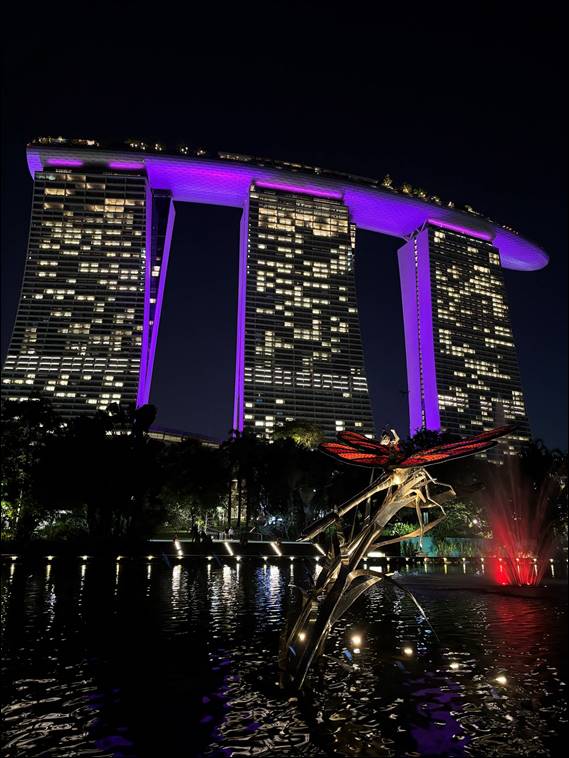
Arriving to find people laying all over the ground, and only then finding out that the daily light show was to start in ten minutes. We laid back to enjoy the show. The metallic trees above not just being for show, as the globes flicked on and off changing colour in time with the music, but also acting as vents for the biomoass energy plant used to generate power for the park. It seems that things here are not just designed in isolation, but as part of the bigger picture. As we wandered back we admired the Marina Bay Sands two image up:
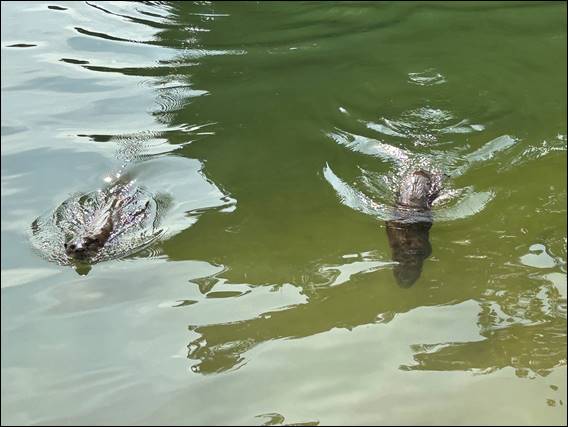
Day four, and we aimed to stay close and observe a bit of both nature and the city. The nature part was manufactured, as we returned to the Gardens by the Bay to visit the second dome, being the Flower Dome. On the way from the train station to the dome we spied some Smooth-Coated Otters playing in the canals. One of the two species that can be found on the island. Both were near to extinction in the 1960s due to the waterways being polluted. A concerted effort to clean up the waterways has resulted in the otters now thriving:
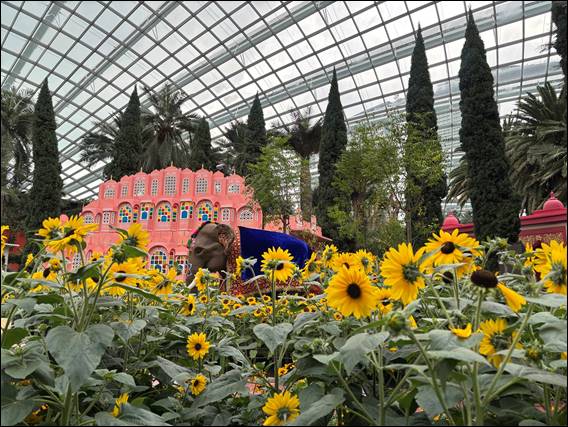
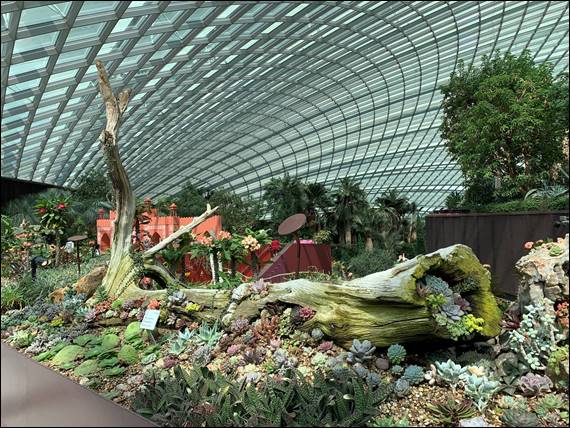
It was more humid today by far, but we sat and watched them for quite a while before escaping to the cool of the Flower Dome. An impressive display of global flora, with two new displays being prepared and near complete. The Aloes in Wonderland and Hindu Diwali festival of lights, the latter surprising me as I had no idea just how many different variety of sunflowers there were. It was very different to the Cloud Forest dome, but equally worthy. Back out in the humidity we started towards the Marina Bay Sands, mentioned previously:
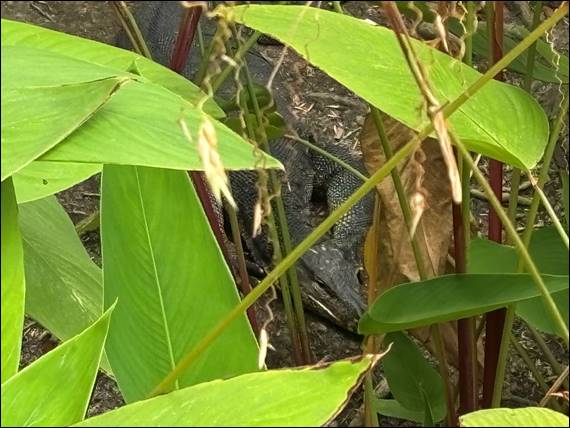
Along the way we took in a few more sections of the outdoor gardens, spotting a couple of reptiles including the above Malaysian Water Monitor. The second largest lizard, behind the Komodo Dragon, and capable of reaching up to 3m in length. Most adults are between 1.5 to 2m, and this one was in that range. The otters were however sadly nowhere to be seen, as we continued. Level 57 of the Marina Bay Sands resembles a boat, perched on three towers. The north tower is where we went up off which the boat hangs 66.5m past over the edge:

Making it the world’s largest public cantilevered platform. I mentioned how Lisa was not keen on heights, so why on earth would we come here. Several reasons, all of which she agreed with. The building is insane and has to be seen to be believed, the views from above are second to none, and it was the perfect place for us to have a drink. When we got to the bow of the boat, Lisa kept her eyes facing inwards and sat well away from the edge. I however wandered round and soaked up the views, and then got soaked myself:

The hot sticky feel in the air was released as a storm cloud came over and huge droplets of rains pounded and splashed off the deck. Some people headed for the lifts to get back down, others found shelter. Allowing me the entire bow to myself. It was atop this mighty position that Lisa and I cheers our near twenty fifth wedding anniversary. First with a champagne for Lisa and local beer for me. Then we decided this was the best place to have a Singapore sling, after which Lisa became more comfortable and got closer to the edge to admire the views:

I say near twenty fifth, as the actual date was still two weeks away. October being a busy month for us with both our birthdays and anniversary, so this holiday was a present to ourselves and is also our first ‘just us’ holiday. With the rain having passed over the next load of people arrived to take in the views, and we headed back down. Wandering through yet another crazy looking shopping plaza on the way to the train. This one including a canal and gondolas. We found out the ground floor of all high rises provide for public facilities:
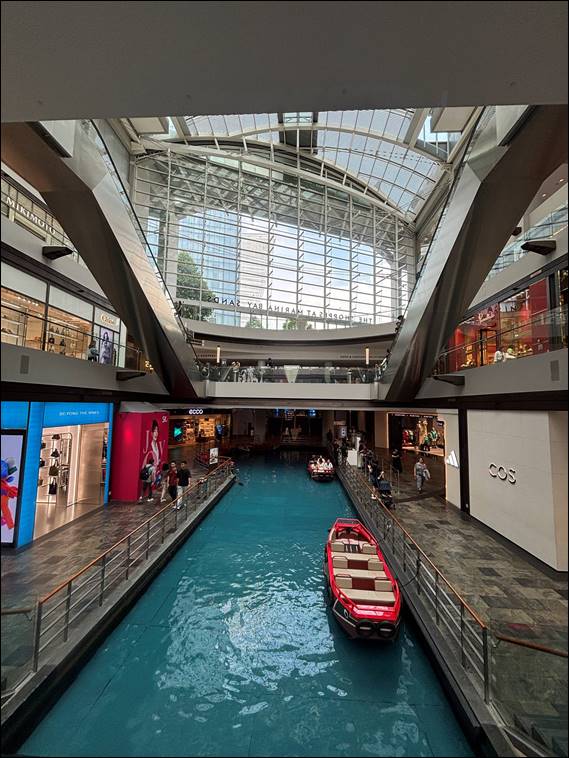
This includes office and residential high rises, again the whole concept has been carefully thought out. The final day arrived, and for this one we headed north to Coney Island. A relatively natural area that displays coastal forests, grasslands, and mangroves. With tracks running around the place, and several bike stations from where you can pick up and drop off hire bikes to get around. As we walked from the station to the island we finally got to see insects, something that seemed strangely absent in all the other areas we had been:
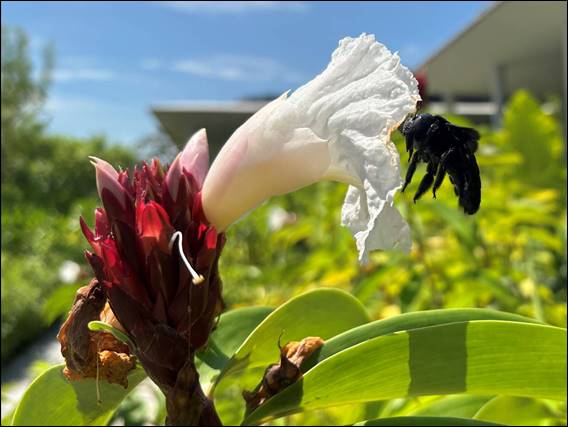
The above Broad-handed Carpenter Bee was somewhat easy to spot, being an inch and a half long and having a wingspan greater than two inches. Once on the island the shade of the tall trees was very welcome, as we pottered about stopping in a few of the small bays and shelters for a rest and to take the place in. It is home to a heap of estuarine and terrestrial land fauna, reptiles, and mammals. Arriving in the heat of the day we didn’t see many, as most of the animals are more active in the early morning and late evening when it is cooler:
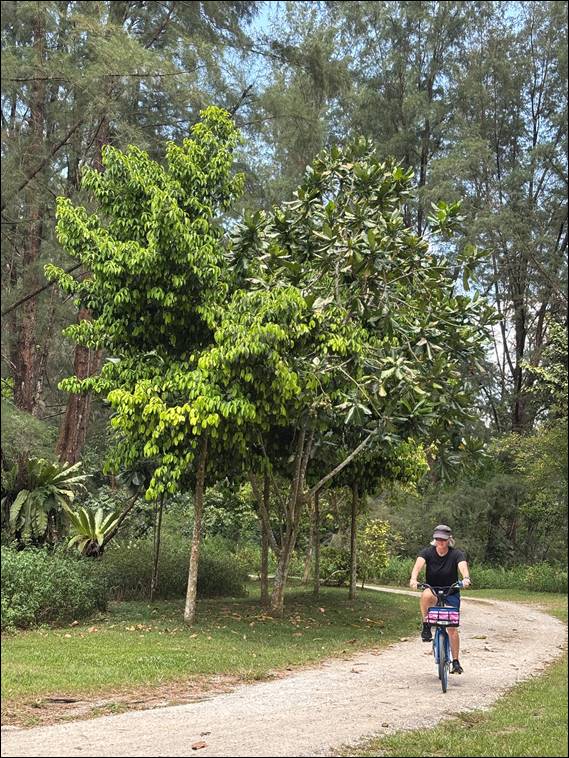
Birds could be heard all over, hidden in the foliage. So other than flashes of colour as birds flew off, and a single Plantain Squirrel the only other creatures we saw were lizards. I thought we had seen a few species of lizards, only to discover most were Oriental Garden Lizards. This lizard can be found in an amazing variety of colours, and has earnt another common name of a Changeable Lizard. Like a chameleon, although not as dramatically, they can change their coloration to match the surroundings or to display its mood:
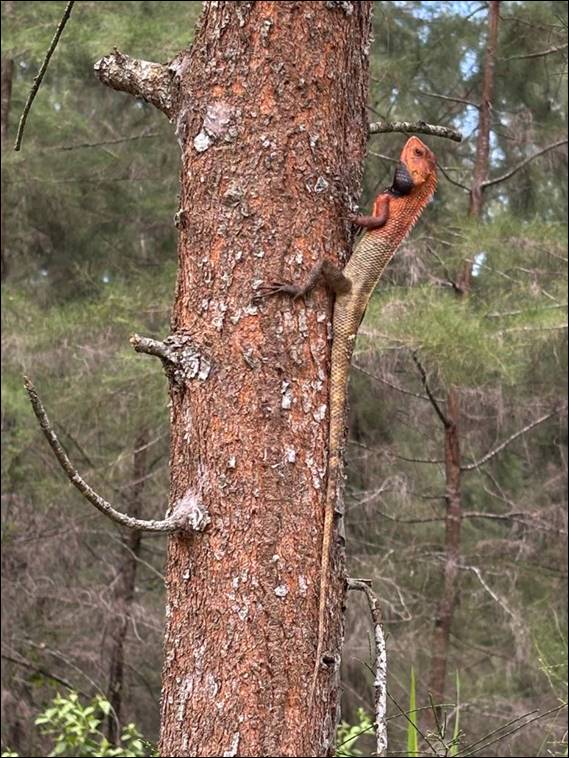
The above Oriental Garden Lizard is displaying its mating colours. We also had a good meter long Clouded Monitor walk across the path as we cycled along. Not caring too much about us as it lazily went on its way, not changing its pace. A good thing as Lisa didn’t see it until I could point it out in the bush right next to the track, where she had stopped after I had excitedly told her to brake. Singapore is separated from Malaysia by the Strait of Johor, an estuarine water body that is 1.6km and 0.6km at its widest and narrowest points:
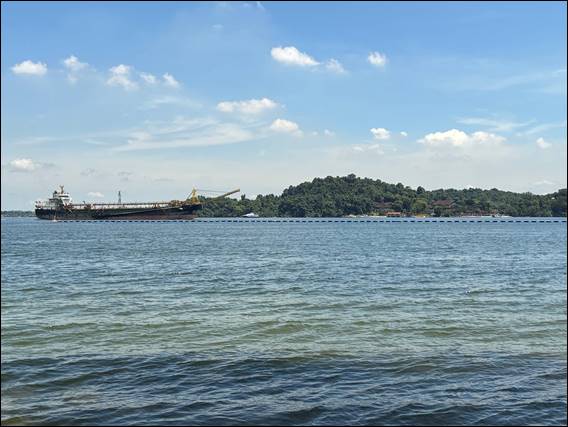
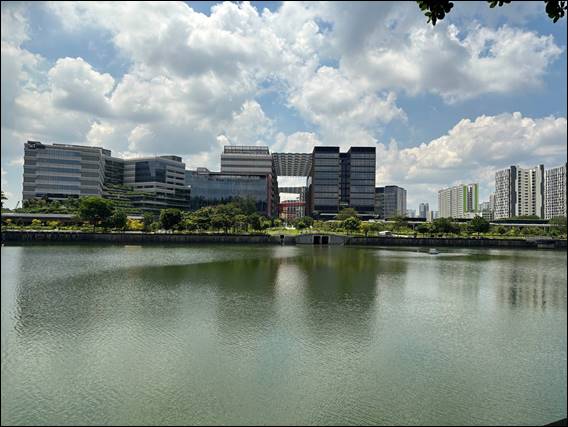
Above looking north Malaysia can be seen. Despite having expelled Singapore sixty years back, the two countries enjoy a complex but generally cooperative relationship. And continue to have a strong trading partnership. It is hard to understand how Singapore finances the continual growth and development and on such a grand scale. Looking south from Coney Island is Punggol. Designed and built as walkable precinct with a network of pedestrian walkways, cycling paths, and shaded trails. The rail station only opened in December 2024:
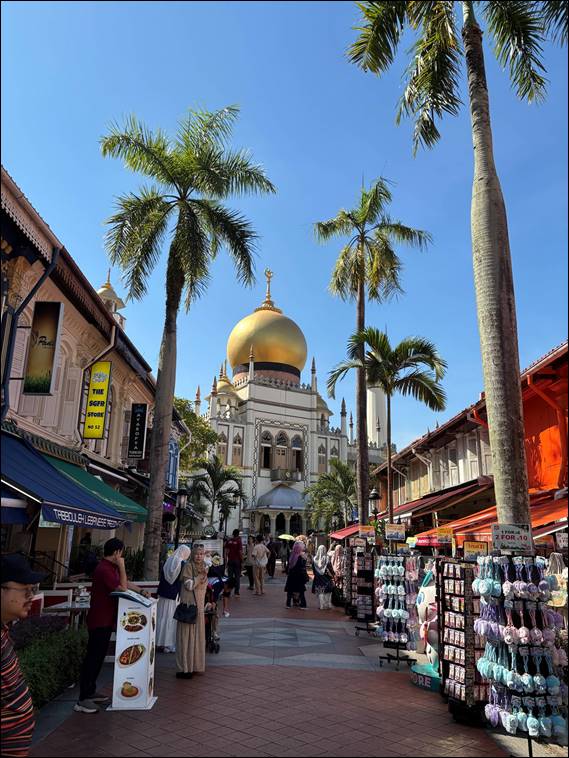
We headed back to the station, and started to get a little desensitised from the grandeur of the infrastructure all around us. We wanted to get to the Arab Quarter, for yet another change in culture and feel. The buildings here took on a different appearance to that of China Town and Little India. As did the wares and food on offer, but not the trinket shops that seemed to be the same everywhere. Lisa only had one aim in mind, and that was to find the place that was reputed to sell the best coffee. We found it and she loved it:
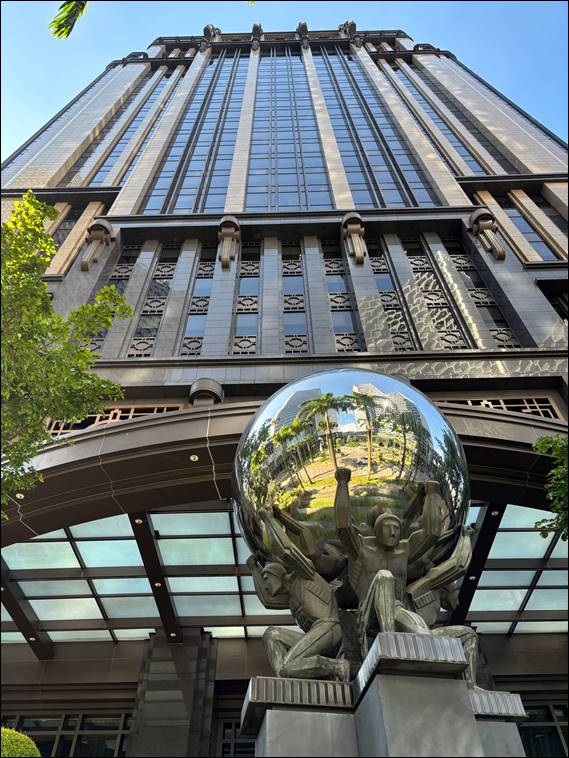
Getting a little weary from the heat, we wandered towards the station to sit in the shade of yet another monstrous building. As Lisa supped her very tasty coffee, I joked that I could see batman emerge from this one. But I am not alone. The locals call Parkview Square ‘Gotham City’ as the architectural style resembles that of the infamous town the superhero watches over. It is one of the most expensive office buildings in Singapore, and home to the Honorary Consulate of Oman and the embassies of the United Arab Emirates, Austria, and Mongolia:
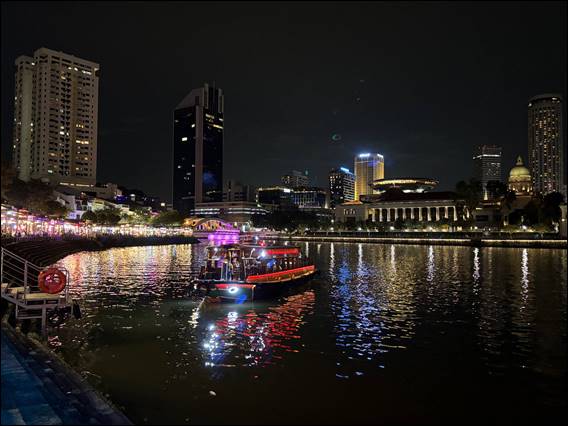
On our last night we wandered through the balmy air to Boat Quay on the south side of the Singapore River. Lined with way too many choice of cuisines, where we plumped for a traditional Singaporean meal. Watching no end of Singapore River boats, known as bumboats, pass by with mostly tourists ogling the city lights and sights. The next morning we were up and out as daylight was coming in. Well and truly satisfied with our fill of city life during a very worthwhile visit. But now looking forward to heading home to our small and sleepy hamlet:
 Sandbagged
Good to read your thoughts on Singapore. Unlike Western Australia, a place I know relatively well! Happy 25th Anniversary. Fabulous. You’re both looking in fine fettle. 😊👍🏻
LikeLike
Thanks Goffy 😁, it was a great trip and we packed in a bit considering we were only there for five full days. Certainly very eye opening as to what can be achieved. Hope your much longer travels are going brilliantly 👍🏽
LikeLike