Things might be drying up at Welly Dam but the Capel Nature Reserve is still full of water. In mid-October I would not usually have too much of an issue wandering round, wherever the fancy takes me. Not today, while I had in mind to visit some of the lesser frequented places it was a mission to try and get to them. Often I had to turn back, thwarted and needing to work my way through at times thick bush. The promise I made, as I walked out the door, that I’d only be an hour was dashed. It turned into a lot longer walk both in distance and time:
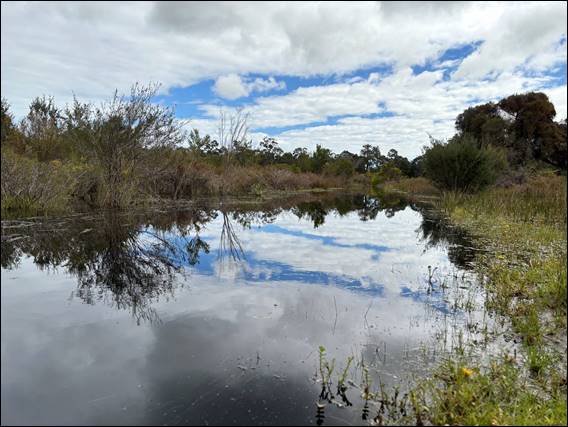
I was keen for some wet areas, just not as severe as they were. My rationale being that I may spot something unusual due to the wet soils persisting as long as they have. Working my way along the edge of the water, being careful not to sink in sodden soils, I only found two orchids. A Rusty Spider Orchid (Caladenia ferruginea) and soon after what might be considered an aptly named Swamp Spider Orchid (Caladenia paludosa). The former can grow in a wide range of habitats, the latter however likes thick scrubland that is swampy in winter:

Not only is the common name appropriate the species name of paludosa also is, being a Latin word for swampy or marshy. It is stated to be one of the last of the similar spider orchids to flower. That said it has a long flowering period of over three months, from September to early December. Most of the others have a flowering window of two months finishing in October, with a few stretching into three and still about in November. This species is pretty easy to identify, as the fringes and calli are both heavily clubbed:

Calli is derived from a Greek word kallos, which means beauty. It is often used as a prefix for words that relate to something beautiful whether letters, exercise, singing, poems, etc. In the world of plants however it is used as a word in its own right. Mostly however for orchids. Not to be confused with a callus, which is used to described a hardened and thickened area of plant tissue that is often a result of a wound or pathogen infection. In orchids calli are a natural part of the plant and they have a specific and important role in pollination:
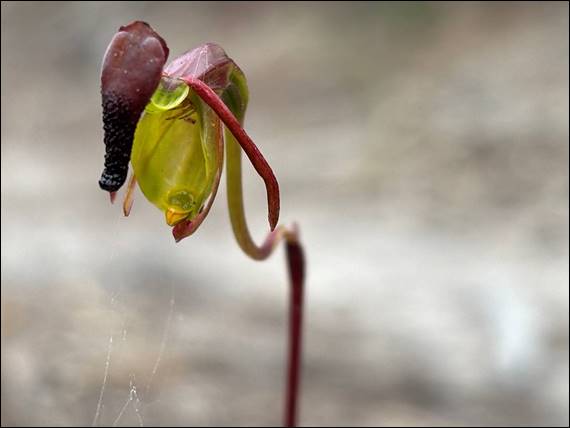
In the Swamp Spider Orchid, they are the raised red bits on the labellum. Looking like upside down shoehorns all neatly lined up in rows. The next image is of a Blue Lady Orchid (Thelymitra crinita), for which the calli are the mauve tuffs that look hairlike. Followed by a Hort’s Duck Orchid (Caleana hortiorum), hosting a spider, on which they present as deep purple glands or balls along the ‘beak’. Finally the Glossy-leaved Hammer Orchid (Drakaea elastica) below on which they are at the top of the labellum again deep purple glands or balls but with fine hairs:
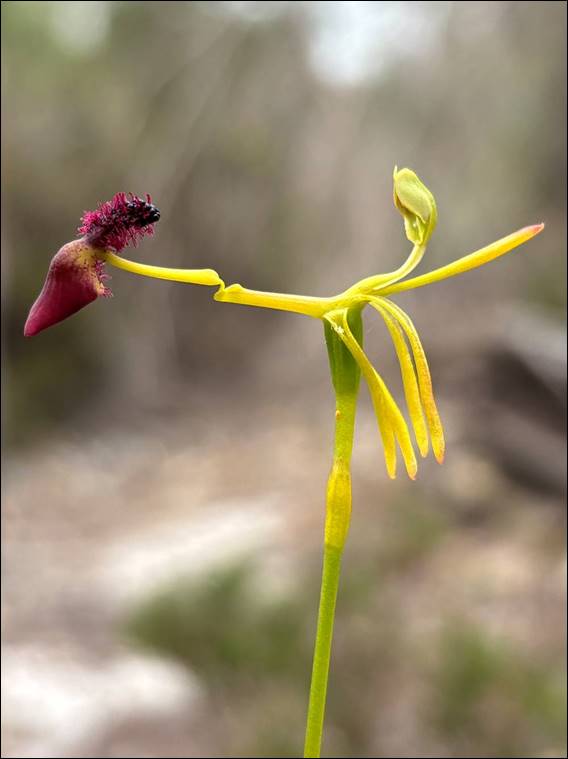
All of the above images are fortunate finds from today, and help to show the range of forms calli can appear in. The way they achieve their purpose can also vary. At times used to attract pollinators, their colour, texture, and/or shape designed to trick the pollinator. Both into thinking the plant may be a mate or a food source. In other orchid species they can be strategically placed and sized. Helping to manoeuver the pollinator to a specific area or part of the flower such as the parts to pick up or spread pollen, i.e. the anther and stigma:

I did not get an image of the calli for the above Twisted Sun-Orchid (Thelymitra flexuosa). Unlike the other orchids I have included in this post, this one is self-pollinating. Yesterday at Welly Dam I saw hundreds of plants, here I saw just two and only one had a flower open. The flowers can grow up to 15mm wide, are short-lived, and open slowly on hot humid days. Today was feeling stickier than yesterday, working in my favour. Not that I would like to climb at Welly Dam in these conditions, I hope I don’t miss the spectacle of seeing them open:
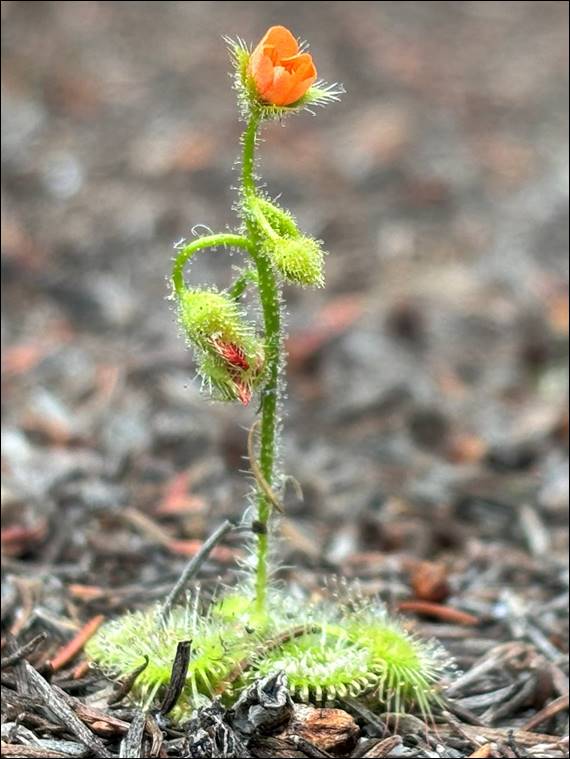
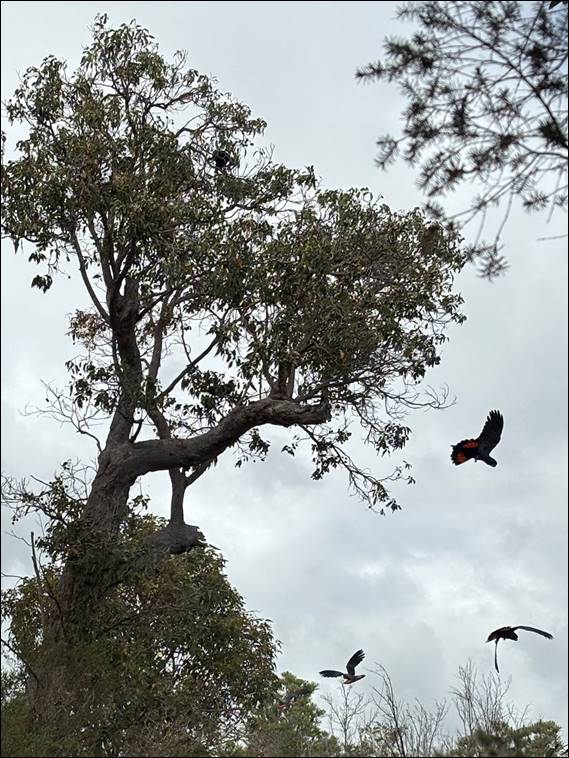
I couldn’t resist an image of the above Pimpernel Sundew (Drosera glanduligera) but didn’t hang about. The combination of bush bashing and being humid meant I was a bit sweaty. Staying still for too long taking images was not wise. The smell of lactic acid and ammonia was the perfect attractant for mosquitoes. There were plenty of them about, although I did stop for a while to listen to and watch the Forest Red-Tailed Black-Cockatoo (Calyptorhynchus banksii naso). Hoping to catch a glimpse of their namesake tail flash its colour:
 Sandbagged