Yesterday was a great day to catch up with general stuff. The things that need sorting but you seem to put off just one more day. In my mind while it was a wet rainy day I did think a quick trip down to Iron Gully Fall might be nice. That is a not too far away, but first I focused on the other bits. Doing pretty well until my phone, which I really do not use too much other than organising climbing trips, started suggesting a bunch of messages dropped. It was Josh, climbing Josh this time. He sent me a load of images of orchids that Kellie had spotted:
One of the species was still on my tick list for this season, and I had to ask where she had been. Yallingup Siding was the spot. Funnily enough a short three to four kilometre drive north of the place I checked out last weekend for the first time, Yelverton National Park. It is not part of this park but sits alongside it, and is part of the same continuous bit of bush. I had noticed this area last weekend, because from the aerial imagery it looked to be more open. So while connected it was likely to have a different vegetation complex:
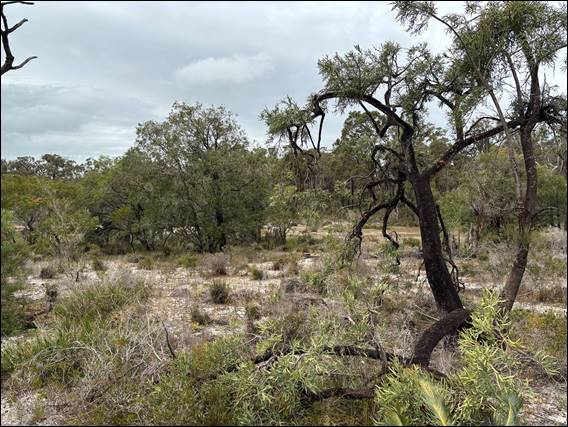
Lisa was having a lazy day and more than happy to have the house to herself. Especially seeing it was peeing it down outside, and had been all morning. This meant I went prepared with rain gear, thoroughly expecting to get thoroughly wet. Not put off by the dampness and being geed up by the chance of another species to add to the tally. It rained the whole way down, and it was not until I got closer to my destination that the windscreen wipers could be turned off. I timed it perfectly not even needing a Granny’s Bonnets (Isotropis cuneifolia):
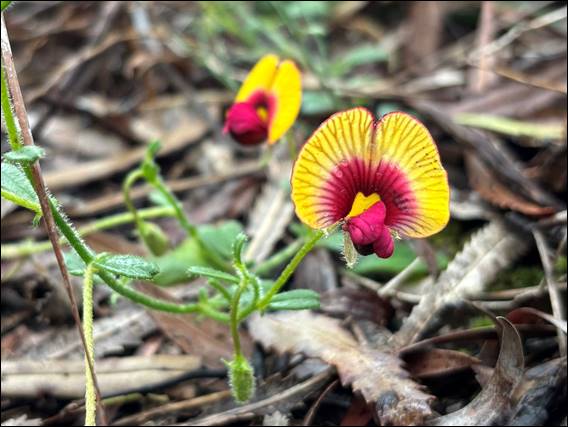
This particular pea was very pretty, as they all are, but seemed more so. The structure of the broad petals being visible on the back of the flower was extremely striking. I didn’t find a cluster of flowers that allowed me get a front and back shot at the same time. Although the above starts to give an idea of what the back looks like. So you get the best of both worlds, so to speak. There is always a risk of going somewhere with a preconceived idea of what you will see, and I tried to push those thoughts of what Kelly had seen to the back of my mind:
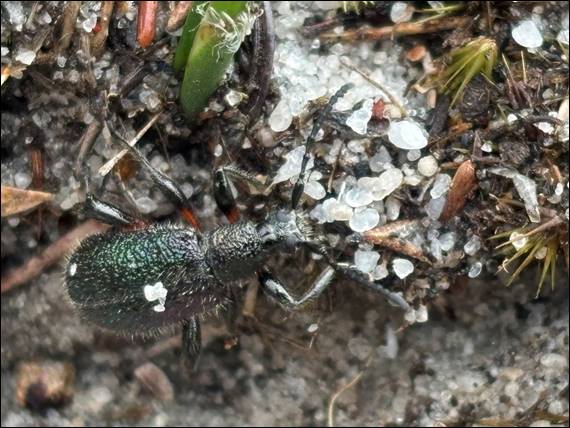
It was a bit of a slow start as I shuffled along scouring the ground. Pleased the rain looked to have finished, with only the lightest of sprinkles when I first arrived. My first spot was diverted by the an Australian darkling beetle, Ecnolagria aeneoviolacea that I can find no specific name for. Darkling beetle is the general name given to beetles in the Tenebrionidae family. It is not surprising they do not all have common names. There are over 30,000 known species worldwide of which 1,500 have been observed so far in Australia:
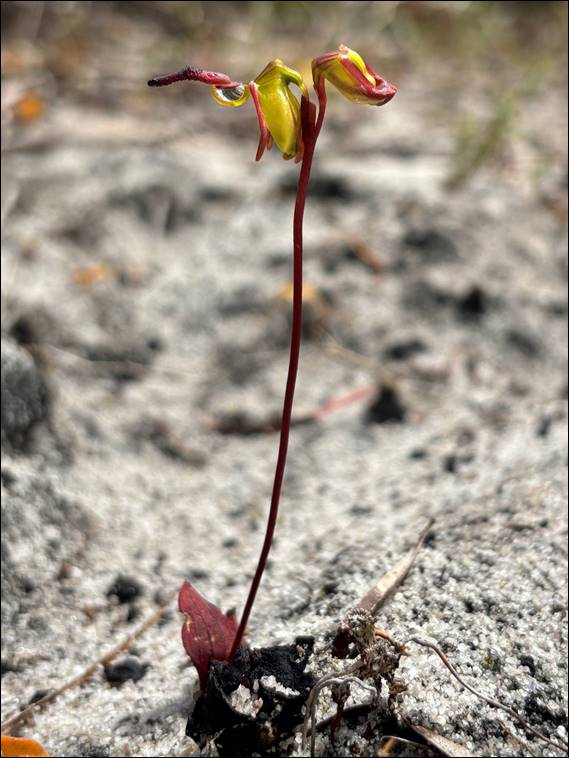
I’m getting side-tracked but will mention that there are currently over 400,000 described species of beetles, which makes up a quarter of all known animal species. This makes me wonder how they can allude me considering all the time I spend in nature. Above is another specimen of the orchid that the Darkling Beetle had drew my attention from. This really is a Flying Duck Orchid (Caleana nigrita), and unlike my rookie error a few weeks back the image includes the basal leaf. A wider leaf than the Hort’s Duck Orchid (Paracaleana hortiorum):
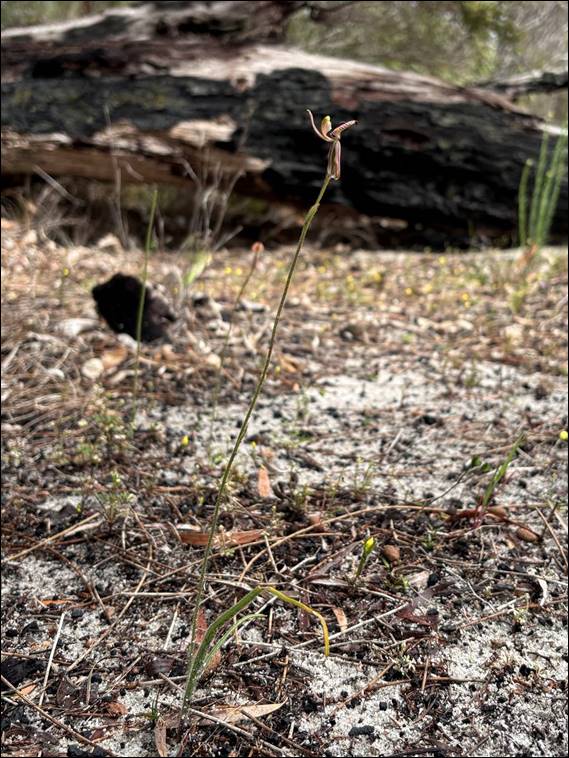
The hump in the labellum is also more pronounced in the Flying Duck Orchid. Making me think that at the Capel Nature Reserve I have only seen the Hort’s Duck Orchid. While there are plenty of images online to check these details out, it is not until you see things for yourself that some of these subtle differences really start to stand out. Another orchid that Kelly spotted, which is known for not standing out is the above Zebra Orchid (Caladenia cairnsiana). While its range extends from Bunbury and Esperance it is not often seen here:
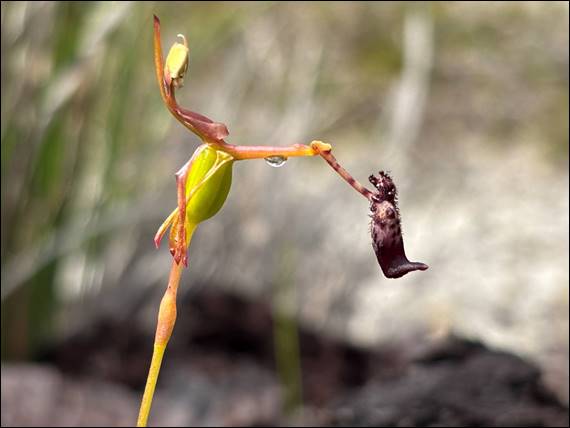
I saw it a few weeks back for the first time in our local area, so when she had spotted one I was keen to come down and check out how many I might find. They can easily be missed, being such a small and compact flower with colours that blend in with its surrounds. So while there may have been more I only spotted one. As I did with the above Warty Hammer Orchid (Drakaea livida), which was the species that made me decide to come down this way today. The ovary at the top of the stem is starting to swell indicating it has been pollinated:
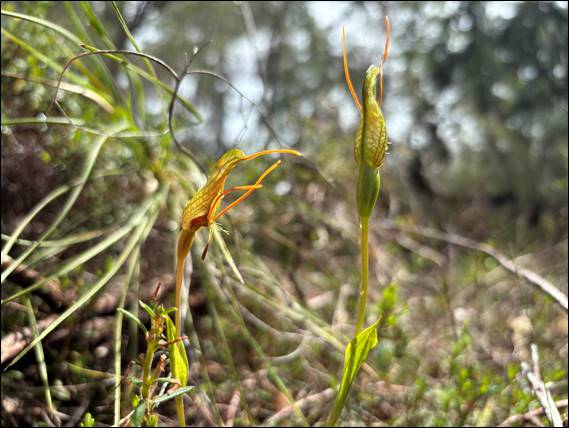
As such I was pleased I had made the effort to come down today. In a matter of days some species of orchids can wither and disappear. The above Bird Orchids (Pterostylis barbata) had also been pollinated, and were starting to recede with the lateral sepals already pointing upwards. Kelly had found one still flourishing, and despite finding five specimens today they were all on the way out. It was only after my visit that I asked Josh when Kelly had come down, and it was only four days back. It was still very worthwhile, with one more find:
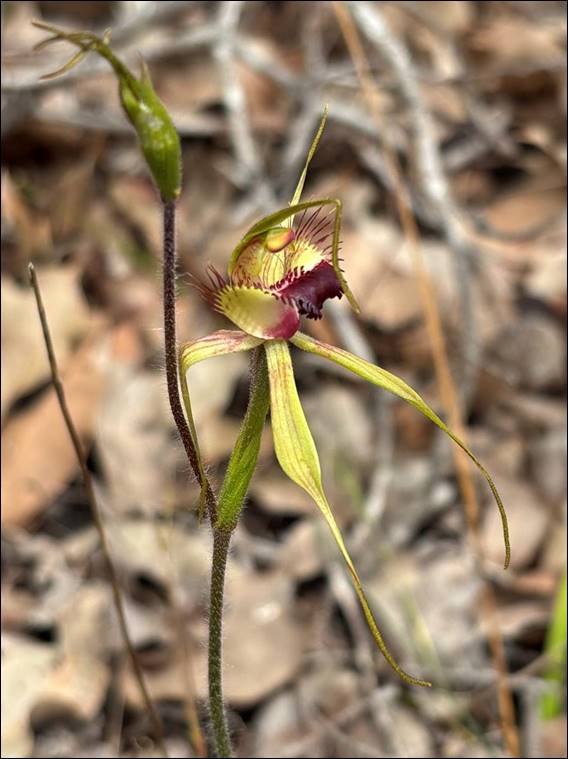
Just as I was about to head off, I spotted a single Karri Spider Orchid (Caladenia brownii). Making me even happier about having made the trip down, if that was possible. You may recall in my post from a few days back, this is the species that had been claimed to be found at Minninup Tuart Woodland https://sandbagged.blog/2025/10/02/a-sticky-ending/. Flicking between posts you can see what I meant about the calli on the labellum, in addition the underside of the labellum has a green tinge in the above. Thanks Josh and Kelly for the info:
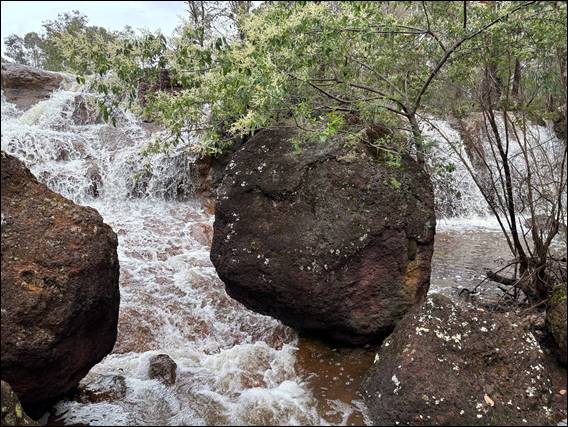
On the way home I decided a quick stop in at Iron Gull Falls was worthwhile. It is our closest waterfall, and in twenty years this was only my second time here. The catchment was already saturated and I hoped the overnight and morning rain would result in more flow cascading over the lateritic rocks, which give the falls their name. It was very overgrown and seemed weedy. We last came here in 2017 and those images suggest it has become more overgrown. Indeed it took a bit of effort to get to the base of the falls to take the above picture:
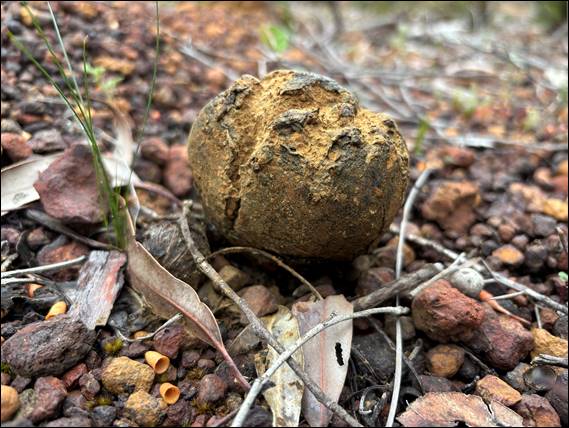
The last image I wanted to include is another species to add to the list this season. As such the above Dyeball (Pisolithus arhizus) is just a filler because I seemed to have prattled on too long. I spied a heap of Splendid Spider Orchids (Caladenia splendens) in a patch of weed free bush on the side of the road, just a short distance on the way home. Alongside the Giant Spider Orchid (Caladenia excelsa) it is the largest of the spider orchids. The flowers can reach just shy of 300mm, which this one did with wonderfully long drooping sepals and petals:

 Sandbagged