After an amazing morning at Moses Rocks I intended to go for a wander to look for some orchids. Not sure that I could top the mornings sights, I went anyway thinking the afternoons time in nature would be stunning in its own way. In part urged to go being keen to head to a place I was told about by an elderly couple some years back, orchid enthusiasts I had bumped into in another patch of bush. There is very little information about the Yelverton National Park. Managed by the state government even their website doesn’t give much away:
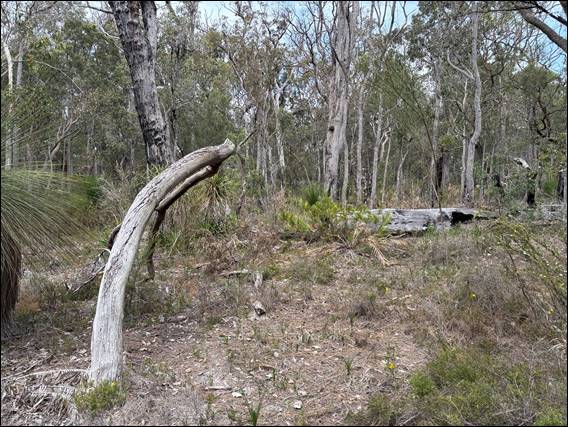
It has a single track, which is part of a near ten kilometre one way walk trail that gets good reviews. Other than that this seven square kilometres of bush has no other facilities. In 2004 a timber reserve was put aside to create the national park, there is no detail as to why this occurred. However, the current website describes the park as a ‘native forest containing a particularly diverse range of vegetation types and a high concentration of declared rare and priority flora species’. My hopes were raised as I parked up and wander up the track:
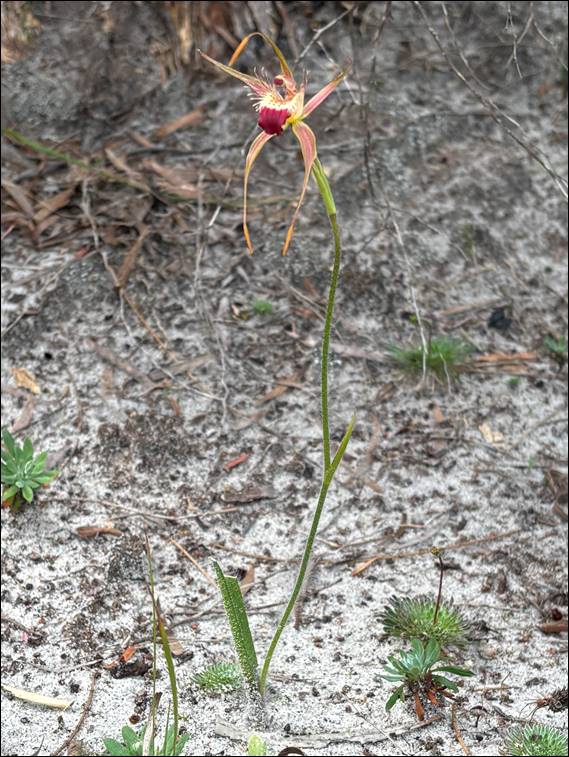
Not far along the track, which also gets vehicle traffic, I spotted a Rusty Spider Orchid (Caladenia ferruginea) and on finding this I went off track to wander through the bush proper. The first find was not the one above, as that was a more bedraggled specimen unlike the one I have included that is looking in great shape. A relatively commonly found spider orchid, found across much of the South West both coastal and inland. I saw a few of these dotted about, mostly along the side of the track when I eventually re-joined it on my return:
The condition of the park was great, being mostly weed free and having a wide range of plants. What I liked even more was that on the insect front there were no mosquitoes. This was noticeable, as when looking for orchids and moving slowly these pesky insects can be very irritating. Even more so when you stop to take images. It is the first patch of bush I have wandered through this season where I have not been hounded by them. There is a creekline in the lower areas that would have had water in it. Even close to that I didn’t notice any:

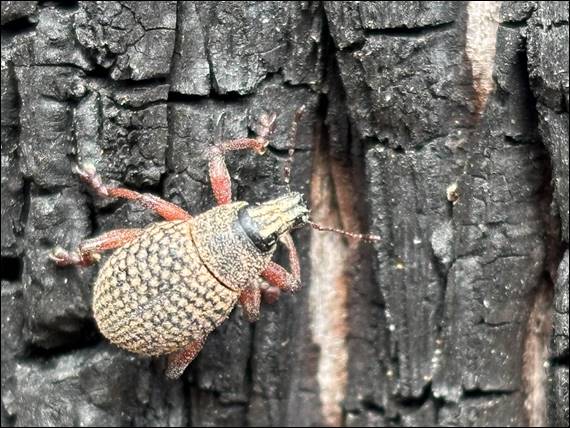
It could be the healthy biodiversity, with natural predators keeping them at bay. Or possibly some of the plants species contain essential oils that repel them but I am not skilled up enough to identify those. Regardless it made a very pleasant change. Sticking with insects for just a moment, because like the park I found it in there seems to be a lack of information about the species. The Redlegged Weevil (Catasarcus impressipennis) is found across southern Western Australia although there not a huge amount of recorded observations:
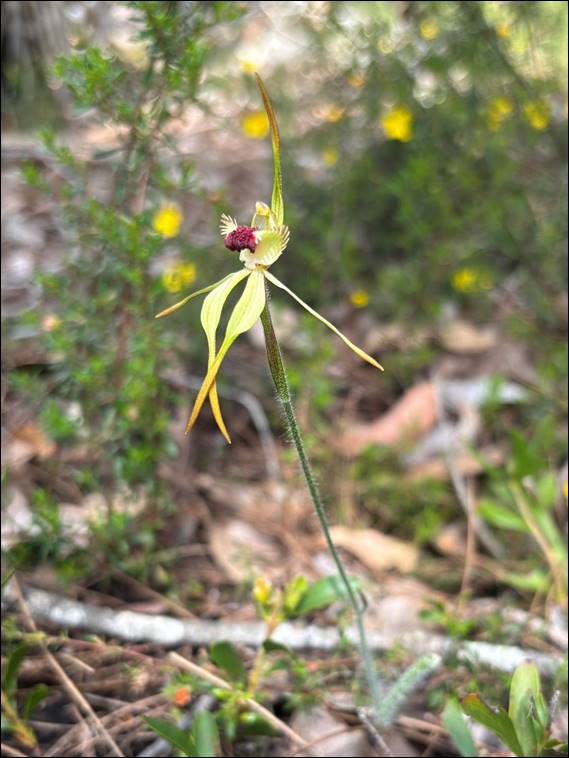
Now back to orchids, notable finds included just two King-in-his-carriage (Drakaea glyptodon) and a single Silky Blue Orchid (Caladenia sericea). It seems amazing that there could be so few specimens of a single species, yet germination still occurs successfully for them to come out the next year. Granted I would not have seen all of them, but with their stand out colour if there had been more on my path I would have spotted Silky Blue Orchids. Then there was a single Carbunup King Spider Orchid (Caladenia procera), above:

Despite the meaning of the species name procera, meaning tall, slender, or long in Latin, this specimen, unlike the only other one I have previously seen, wasn’t very high. It hit the bottom of the scale of the plants possible 350-900mm height range. Being only my second sighting made it a very good find of yet another nationally recognised critically endangered species. We sadly seem to have too many species that are at risk. But not the above single Forest Mantis Orchid (Caladenia attingens subsp. attingens) that I found, they are common:

As is the above Rattle Beak Orchid (Lyperanthus serratus), which I found on my way home as I popped into the Ambergate Reserve. Where there was even less on display, and hardly any orchid spikes waiting to flower. Hopefully as we roll into October there may be more late comers. The below Wood Hedgehog (Hydnum repandum) however made the pit stop extremely worthwhile, even though it is looking a bit old and decrepit. Being one of the toothed fungi species, the spine-like projections that produce the spores are still visible:

 Sandbagged