In keeping up with our promise to each other for regular trips, Lisa and I had a night away booked for last weekend. It turned out to be a bit of a wash out in several ways. Regardless of that we still enjoyed being away, and a changed environment always helps to recharge the batteries. I slept through most of our time down in Pemberton, doing my best to shake whatever it was I went down with on Friday. While this may seem a wasted opportunity not to be wandering under the tall Karri Trees (Eucalyptus diversicolor), it was raining:

Not just a drizzle or passing shower. Over the course of Saturday a neat two inches fell. And Sunday morning was not shaping up any different. We have been known to go for a walk in the rain, but all things considered we agreed it wasn’t worth it this time. So we slobbed out instead. On the way back we did however stop in at Beedelup Falls, I was keen to stretch my legs before we hit the journey back in earnest. Plus with the great winter rainfall we have had I was keen to see how the falls were shaping up since the last time we saw it in 2017:

This made me search through my posts to see what it looked like back then. To my surprise the email with images from that trip had not been added to this blog. That has now been rectified. Like this visit it was wet, the difference being that time we did go out for a walk. Finding some great fungi making it definitely worthy adding. I can also now link it to this post for a contrast of how the waterfall was looking: https://sandbagged.blog/2017/07/16/a-few-nights-away-from-it-all/. Indeed this year it was pumping:

I have been through the monthly rainfall records and 2017 looked to be a decent rainfall year, not far off what we have been seeing this year for the Pemberton area. I’m going to guess that having gone there in July last time the streamflow had not risen to the rate we saw in September this year. Sounds obvious but on the drive back the soils on both sides of the road were saturated, to the point water was cascading into the roadside drains. A sight I have not seen, and long-time locals also say is a welcome sight harking back to a proper winter of old:

Certainly where we live, a mere 100km to the north as the crow flies, it has been a winter of old. At I have the ‘pleasure’ of dealing with enquiries from people complaining about wet properties, due to both groundwater coming to surface and creeks and drains overflowing. The people who have lived here for more than thirty years say it is a welcome sight; those with shorter memories are not so happy, looking for someone to blame. As to be expected the wetter conditions are however resulting in a slightly different orchid season:

Unlike the wet weekend just gone, the proceeding week was shaping to be quite nice. Sunny days with temperatures over twenty degrees. Of course I had recovered enough to head back to the office, maybe in part due to my moral compass and work ethics. I did however decide to not keep adding silly amounts of hours to increasing bank of leave. Blocking out my calendar from 2pm each day and making a conscious effort to get out for an afternoon wander to visit a few of the good spots we have, which worked on most days:
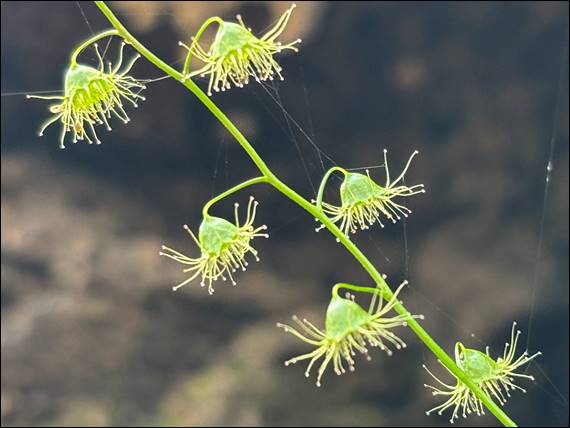
I was urged on even more to go for daily walks by the promise of, what a surprise, another wet weekend coming our way. One that looks likely to stretch into next week. It seems that rambling is the theme of this post, as I have babbled on while the images have been slipping past. With only one having been referenced. It is now time to make amends and play catch up. The first image is one that I really wished it had not been raining for, as I would have got down on the ground and spent more time getting shot from differing angles:
A simple Karri Snail Orchid (Pterostylis karri), and we didn’t too much more in flower during the short walk to and from the waterfall. However, this one is not in its usual form. To start with there is only a single lower sepal, or antenna, unusually located at the front of the galea or hood instead of two at either side. The hood, which is usually made fusion of the dorsal sepal and two lateral petals looks to have split. The lateral petals having separated and spread to the sides to form what looks like two floppy ears. It’s finds like this that I find so fun:

These are the only two images from our weekend away. After that and for my first weekday wander, on Tuesday, the images are from Crooked Brook. Here I was greater by a glorious floral carpet, with more coverage that I can recall before. Or is that just my short-term memory taking control? Mostly provided by Glow Wattle (Acacia lasiocarpa), and what I believe may be Beard Heath (Leucopogon pulchellus). I was going to add a close up image of the latter just because I loved the small fluffy petals of this flower:

This feature is where the genus name of Leucopogon comes from, being derived from two the Greek words of leuco (white) and pogon (beard). I’ve included a species from this genus in a previous post. This one is however in my humble opinion more beautiful and little, which is what the species name means in Latin. There are many species in this genus and I have read that the greatest diversity can be found in the south western of Australia, lucky us. I did think with all that shrubbery in bloom I would struggle to see much else:

It was hard to get the eyes to focus away from the colourful lower storey vegetation, and look closer at the ground. There were a few orchids out, mostly repeat finds and in low numbers. The one that was in greatest abundance was a first time find for this season. The wonderful Bird Orchid (Pterostylis barbata). It seems Crooked Brook is the place to find these, and on this one walk I found close to twenty. It did feel that the orchids were lacking, perhaps waiting for a longer period of drier conditions, so I started to look for other gems:

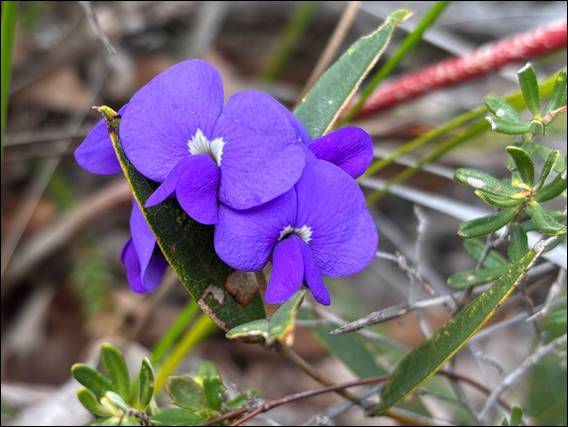
I’ll skip an image and jump to the sundew, it has taken some time to have the confidence to say it may be a Bridal Rainbow (Drosera marchantii). We have many species and it would be easier to identify if the flower had been out. Even without the pink flower the leaf blades with their tentacles are still a very pretty sight. For this species they occur singular along the stem and generally dangle downwards. I am also daring to venture into the enormous variety of pea flowers, and the purple ones I believe are Elliptic-Leaved Hovea (Hovea elliptica):

I personally like the other name it gets of Karri Blue Bush, and feel the shape of the leaves gives this one away. There is however an abundance of peas making it tricky business. It is time to move along, as the train driver would instruct us to do during the rush hour commute as we crammed into the London underground trains. Everyone trying to stay close to the doors, rather than getting packed in like sardines further away and risking not being able to get out at your stop. I really do not miss those days:

The cluster of brown bark resembling fungi has had me stumped, and the closest I can get is Coltricia cinnamomea. The fringe like edge, slightly radial pattern, and sponge like underside make me think I am close. But I am not overly convinced. And now I’ll go back to the lone fungus that is starting to emerge from the gravel. This one I have had absolutely no luck with, maybe it is still in the early stages of development. The spongy like stem and potential for a cap makes me wonder if it is the same genus of Coltricia:

Back into more familiar territory of orchids I have included the Reaching Spider Orchid (Caladenia arrecta). This is a very easy one to identify. I’ll confess that I know where this one is found at Crook Brook, and due to the lack of other first time seasonal finds I sought this one out. I did however also find one at Manea Park during another afternoon walk, the first time I have seen them there. It is one of my favourite spider orchids, taking pride of place as the background image on my phone:

Another orchid out, although I only found the one, was the Fringed Leek Orchid (Prasophyllum fimbria). A tall and elegant spike with seventy or more flowers arranged along the upper section of the spike. The images shows a weevil doing exactly what the plant has developed to encourage it to do, delving into the flower for pollen transfer. I have stopped short of trying to identify the weevil, and will instead speedily get to the Common Brown Pea (Bossiaea eriocarpa) and a random image of some tadpoles as I came to the end of the walk:

Wednesday afternoon it was time to visit Manea Park. A place renowned in Bunbury for being the place to go to see orchids in spring time. There were certainly heaps of donkeys and cowslips out. Other than that it was very thin. There are usually lots of white spider orchids here. Not only did I not see one, but I also saw very few spikes indicating that they were on their way. There was the old faithful Dancing Spider Orchid (Caladenia discoidea), again I know where to look but this year the patch had grown bigger and spread wider:

It was good to know that some species were liking the conditions this season. Due to the lack of orchids I again dipped into the peas. Finding the Skinner’s Pea (Pultenaea skinneri). The stem and leaf structure making this one a relatively easy one to work out. A good find for me, as it is listed as a Priority Four species, being considered rare or near threatened. I continued to wander through the park for near to two hours with little having been found. Yearning for some colour next up is a Brick Red Laccaria (Laccaria lateritia):

I’ve also included a repeat find of a Kemerton Donkey Orchid (Diuris cruenta), only due to the striking deep purple labellum of this specimen. I really was keen to see and include more colour. To wrap up the images for Manea Park is a plain green basal leaf, with a spike forming and silhouetted behind it. I saw these popping up everywhere, so maybe there is another species that is liking these wetter conditions. I guessed while waking, and was pleased to find I was correct in thinking, they were Leopard Sun-Orchids (Thelymitra benthamiana):

Thursday it was the Franklandia Nature Reserve, a place I only came across last year. Here I spent about the same length of time, scouring all over. A few usual suspects were out but you really had to look for them. The best finds being the two above images of wispy spider orchids. Known for their thin, thread-like sepals and petals. I believe they may be the Pendant Spider Orchid (Caladenia pendens) and Noble Spider Orchid (Caladenia nobilis). However, like so many similar species of spider orchids they are tricky to tell apart:

Before hitting the road to drive home the above female Wandering Percher Dragonfly (Diplacodes bipunctata) kindly posed for me for a considerable duration. Friday came and it was time for a local jaunt at the Capel Nature Reserve. Despite the varying number of images I have included for each place, I had spent one and half to two hours at each. You could say I had a healthy dose of nature this week, and feel all the better for it. Of all the places this one seemed to have the best abundance and variety, hinting a promise of more to come. And it was the same last year:

The ones that are tantalising close to coming out can wait for another time. And hopefully this next week of wet spring weather doesn’t impact their willingness to fully bloom. Above is a Pink Rainbow (Drosera menziesii), for me one of the more striking erect sundews. There were plenty of specimens out with pink flowers on display at the top of their stems but it was the deep red leaves that caught my attention. Among the promise of what is yet to come were way more spider orchid spikes than I had seen collectively in the other three locations:
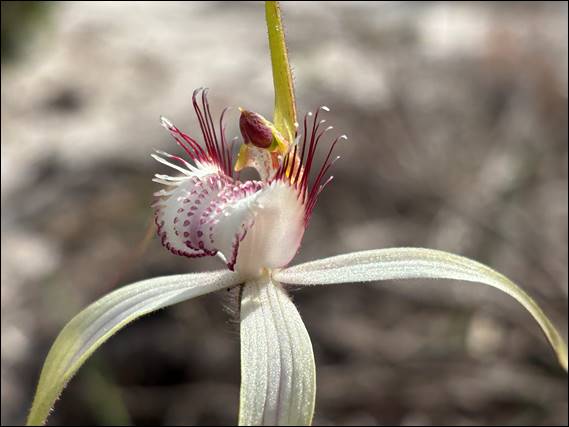
Very few were out in bloom but a few were about. I believe the above is a White Spider Orchid (Caladenia longicauda subsp. longicauda) and below is a Hill’s White Spider Orchid (Caladenia longicauda subsp. Clivicola). As I mentioned before similar species of spider orchids get tricky, and the white spiders are no different. The latter of these two has a narrower labellum with shorter fringes, so it does look to fit the bill. And like the earlier weevil I am not going to try and identify the photo bombing Crab spider (Thomisidae):

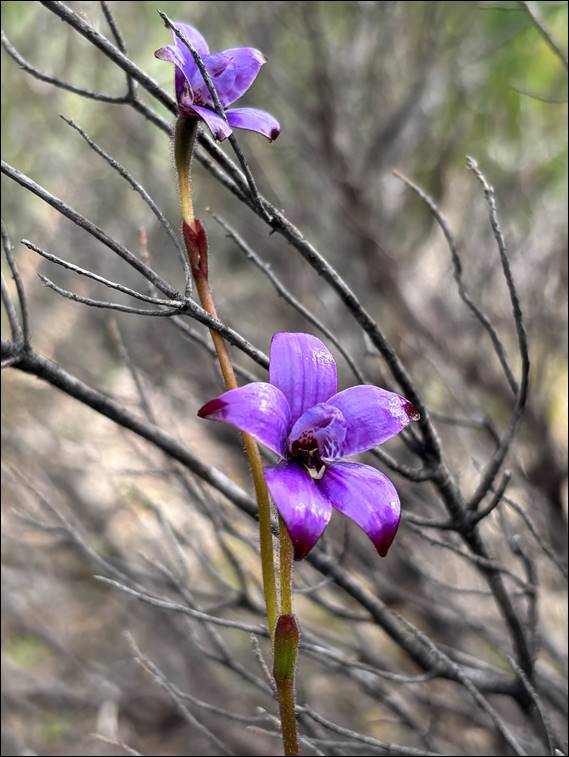
I of course had to check the elusive Glossy-leafed Hammer Orchids (Drakaea elastica), and they are still looking like they will flower. They are one of the later flowering Drakaeas. Not due to come out until October. To wrap up this rather lengthy ramble is the Purple Enamel Orchid (Elythranthera brunonis). Lots and lots of these were scattered about with lot more looking to bloom. While I have a few reserves I can head to, a bit like a pick and mix selection there is usually a favourite. It’s pretty obvious which is mine and where I’ll head if I get a chance next week:
 Sandbagged