Was I hoping that now spring had arrived, I might get away without catching one of the many bugs that have been going round. I had done well despite people dropping like flies round me and Lisa’s best efforts by bringing bugs home for weeks on end. But no, although not taking hold till Friday allowing me a Thursday wander. While my current condition affords me a hoarse or raspy voice, I will still not be able to get away with mimicking the distinctive nasal delivery style of the singer who is the focus of the film that has the same title as this post:

Bob Dylan was given the title of “King of Folk Music” after his 1963 appearance at the Newport Folk Festival. A happy coincidence in that the only new seasonal find at the Ruabon Nature Reserve was the King-in-his-carriage (Drakaea glyptodon). Locally it seems to be the earliest of the hammer orchids to flower. I’m still waiting for those elusive endangered species at the Capel Nature Reserve to even form a full bud. The King-in-his-carriage is the most commonly seen species here, distinct from the others by the shorter and more swollen labellum:
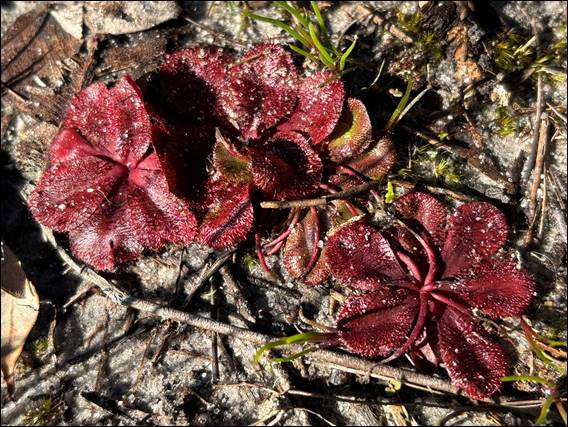
The above is also a common endemic species of the south west. It may not look like anything special. However, a work colleague that has taken to hitting the many tracks in the general area has been testing my ability to identify finds that stand out to him. The Red Leaved Sundew (Drosera bulbosa) can have as many as twelve leaves that start pale green to yellow in winter. When spring brings more intense sunlight anthocyanin, a water soluble pigment, is produced. Changing the leaves to this wonderful deep red, and providing a sort of sunscreen:
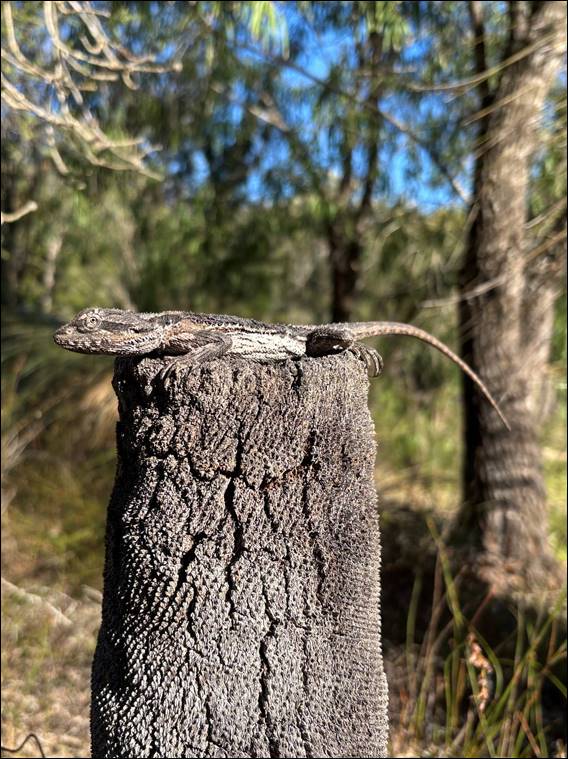
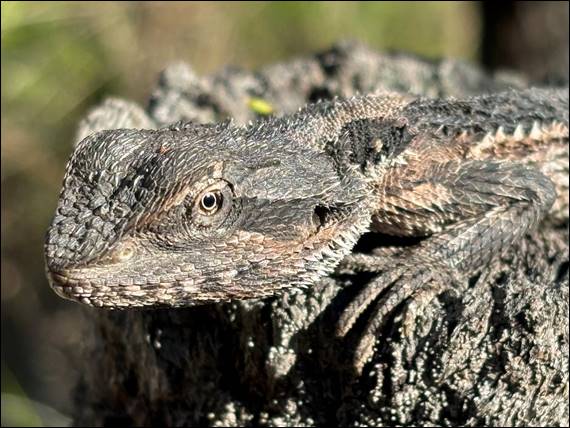
In the lowering sun of my later than usual wander the above Western Bearded Dragon (Pogona minor minor) was in no need of sun protection. Indeed soaking in and relishing its warmth. Not moving a muscle while I got really close and observed it for some time. Only it’s eye moved, following me carefully. It is the largest of three subspecies. But even with a body length of up to half a foot, it would still be an easy prey for overhead predators. If I could see it then they certainly could. This does not however stop them basking on fence posts or alike:
Walking back towards where I had parked, I stumbled across a few cages. Similar to those I found in the Capel Nature Reserve, which were protecting the endangered hammer orchids. There was a lonely spider orchid leaf in one that I will come back to check in a few weeks to see what species it may be. I assume it must be something unusual, unlike this Common Dampiera (Dampiera linearis). Yet another endemic floral species of this corner of Australia. So common that it seems no one has bothered to published any interesting facts about it:
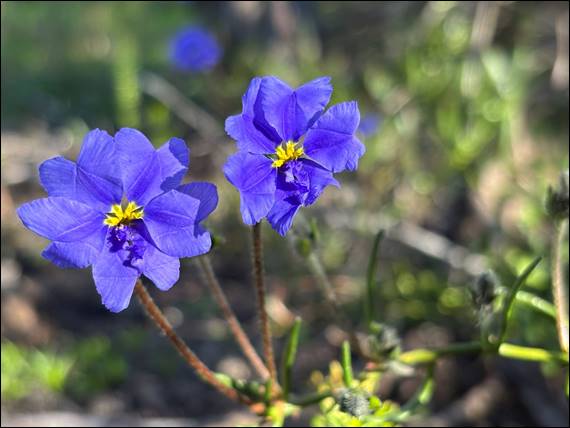
Very pretty and delicate nonetheless, so more than worthy of inclusion. I took the image at the Capel Nature Reserve. Being kinda on the way home I thought why not stop in. Secretly hoping to find my first ‘true’ spider orchid in flower. I say that as while I spotted the Cowslip Orchid (Caladenia flava) in full bloom, as well as Dwarf Pink Fairy (Caladenia reptans), it is the Caladenia species with the long petals and sepals that really stand out. This week Mario, having been on his lunchtime walks in Perth, sent me photos of some amazing specimens:

The orchids come out earlier in Perth. Where it warms up quicker than here, being further north. There are many species found there that do not extend to our area, and vice versa of course. So I will admit to having a bit of orchid envy, not enough however to make me drive the 400km round trip. I did not find any of the more dramatic spiders in bloom. Plenty were getting very close, such as the above Sandplain White Spider Orchid (Caladenia speciosa). The name speciosa meaning “beautiful”, “handsome”, “splendid”, or “showy” in Latin:
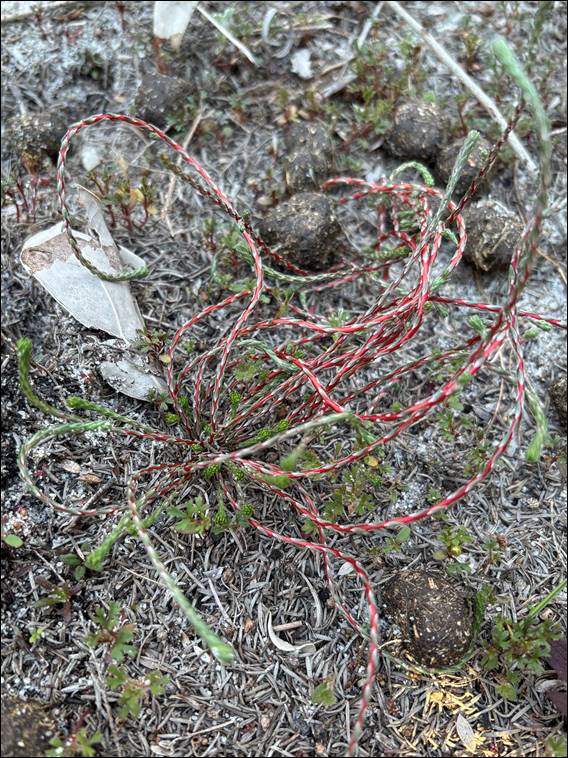
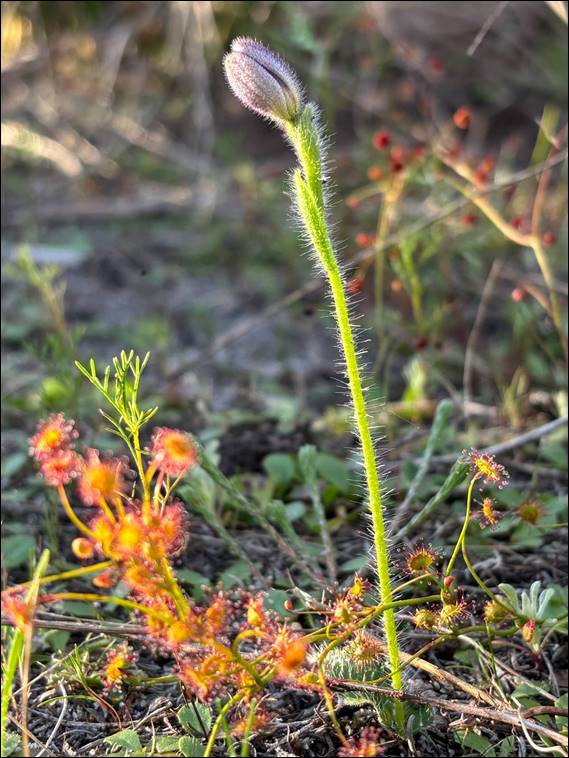
An apt name and one that makes me feel a bit more justified in distinguishing between the more attractive species of spider orchid. The Sandplain White Spider Orchid is a regular here, I have however only just realised that it is classified as rare or near threatened. So we are lucky to have it in relative abundance in our local nature reserve. This post ends as it started, with some complete unknowns. Even with Howsie’s help we have no idea what the above may be. The below has also alluded me, looking both orchidy and not orchidy:
 Sandbagged