Due to Howsie having changed his job he is now working a five days a week. This has scuppered our geologically focused weekday excursions, which we were lucky to have enjoyed for quite some time. However, with the return of Rongy and Sarah from their near twenty months of travel, the chance to squeeze in the occasionally weekday climb has been rekindled for the immediate future at least. Picking the right day to head out is still feel a bit like playing Russian roulette, well maybe not quite to that extreme:
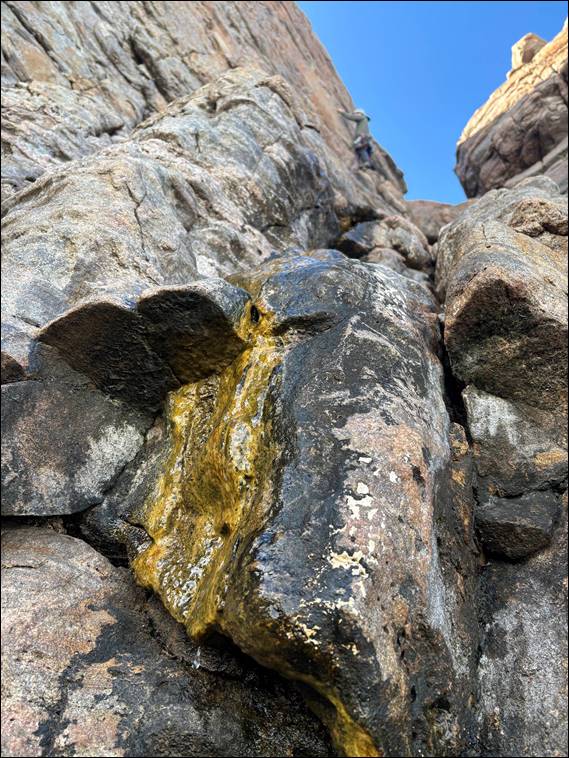
But it is hard to predict what the conditions will be like on any given day at a particular location. In the end Friday won out although it was still a little hit and miss as to where we would go. A decision left till the last moment, as we were driving down. Mind you watching gloomy clouds, rainbows, and raindrops dancing on the windscreen it did not inspire that we had made the right choice. I was quietly hopeful, and indeed we had chosen wisely. As we parked up and looked west the clouds were parting to let some blue sky show:
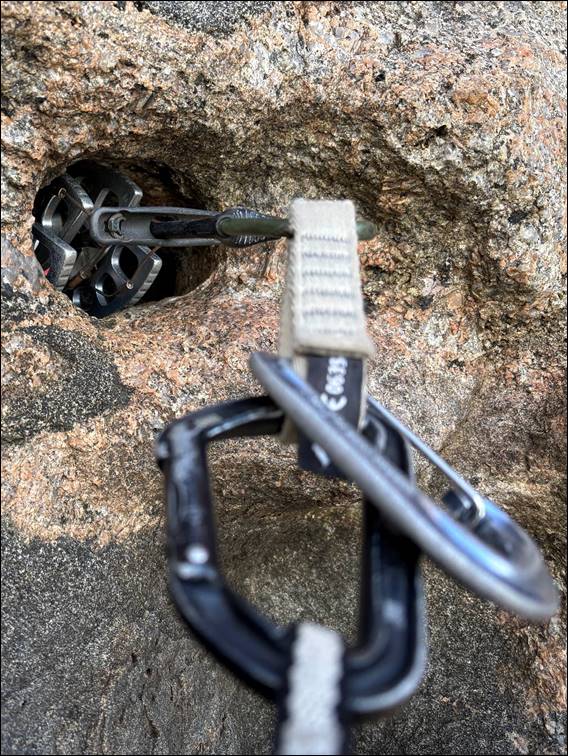
There was the occasional sign of the seemingly continual wet winter months we have had. The orange slime had me wondering and from what I have found it is could be a result of leached mineral deposits. I do not recall seeing such a vivid orange here before, and this was the only place on the crag where I saw it. I am doing a bit of guess work, and it may have been enhanced due to the near continual flow of water through the fissures and cracks in the granitic genesis, over a number of months:
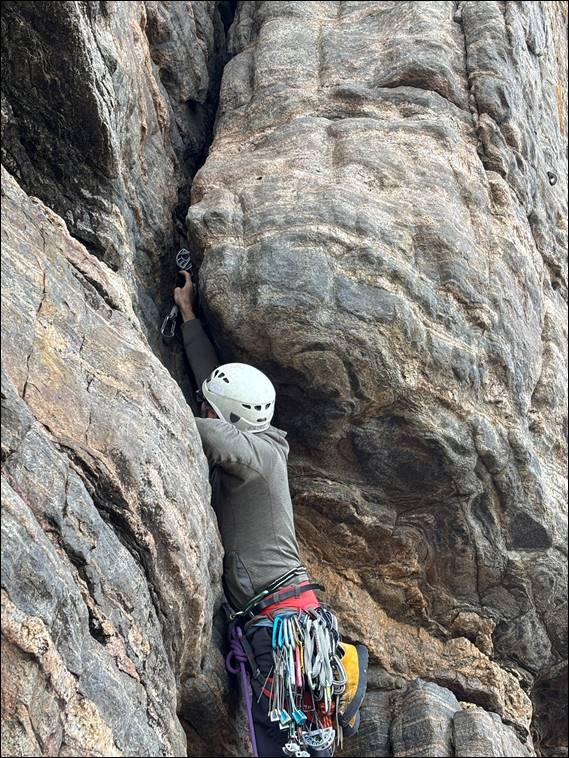
Other than the occasional bit of rock with water seeping down, the rock was mostly in near mint condition. As Rongy has been away, and this was his first climb at Wilyabrup since his return I let him choose the lines and also lead them. Not that he was short of getting climbing in during his travels. It did however mean I could relax a bit more on the routes. As may be evident from the images he had set himself a task to place the No.4 Camelot on each climb. A piece of traditional climbing protection that does not get the same following as the pink tricam:
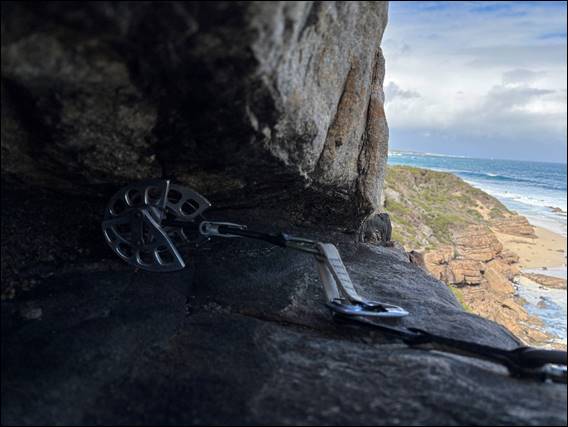
Yes there really is a following for the small pink tricam, which I have mentioned in a past post: https://sandbagged.blog/2025/01/25/weighing-up-the-choices/. That said Mario will be happy to see us paying homage to what is often the biggest bit of gear on someone’s harness, and which in his mind is one of the best. He will endeavour to place this beast on most routes, although sometimes it is just too damn big to find a spot. For the climb below, a two pitch route, the trusty bit of hardware was placed in the exactly the same spot on both pitches:
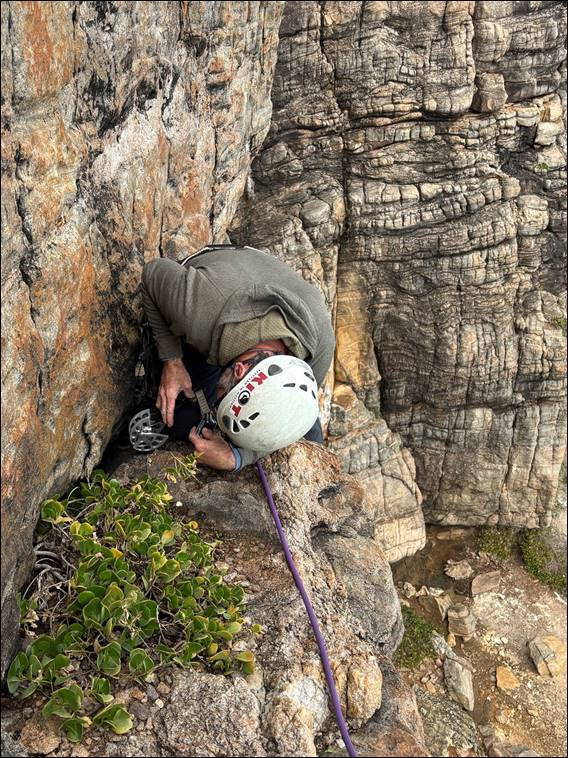
We guessed Mario would not been too upset with this approach, as there was nowhere else on either pitch it would fit. For the second pitch it was needed more as a directionally piece to avoid a zipper effect. Meaning having all the gear rip out due to where the belayer is standing, if the leader fell and the rope went tight. The belay stance for this line is off to the side. The route follows a great seam it is but very thin and only takes the tiniest and tinniest of wires for quite some distance. It looks like Rongy is contemplating how good they may be:
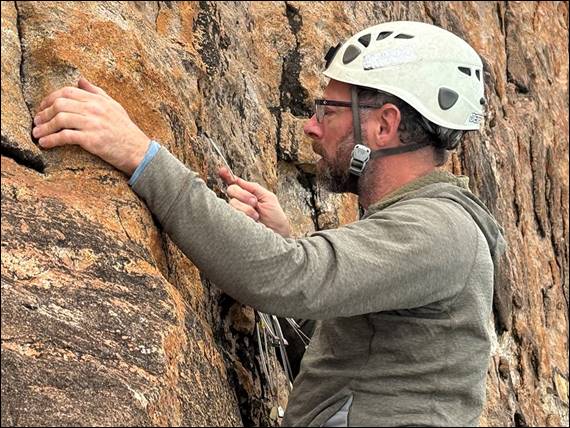
These wires are in complete contrast to the might No.4 Camelot, but if placed well are great. Some of these small wires have brass heads, which are designed to mould to the rock to increase the friction, in a fall situation. Camelot’s will also increase the friction with the rock when arresting a fall, by virtue of the camming movement. For the last climb of the day Rongy offered me the pointy end, there was of course only one option. The obvious finale that would allow us to climb out with packs, and look for a friend:
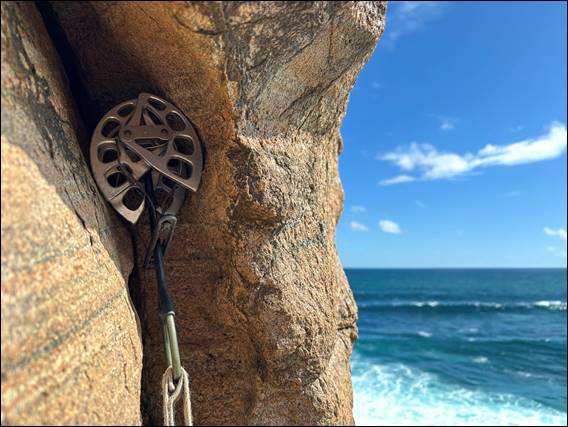
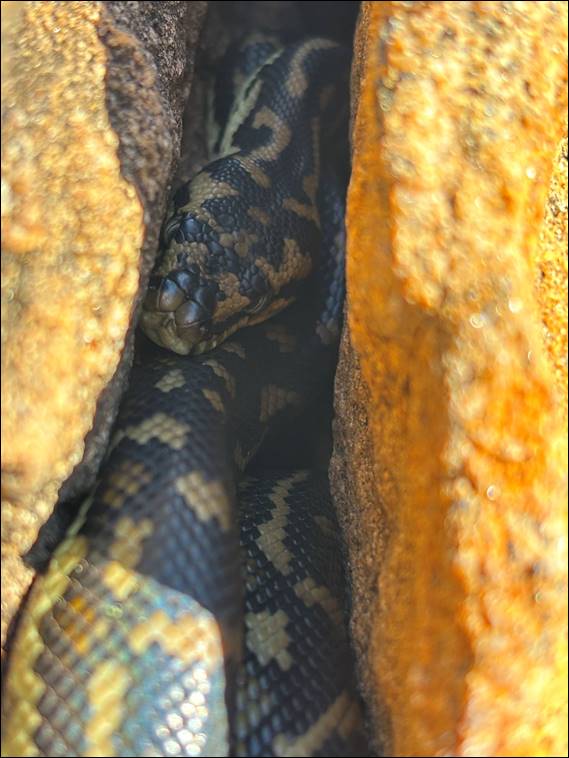
I am of course not referring to the first commercially successful camming devices for climbing; the Wild Country Friends that were released in the mid-70s. I added a raft of these friends to my arsenal when I bought my first rack in the early-90s. The Camelot’s were released several years later. No the friend we were looking for, as you may have already guessed, was of course of the a scaly type. Sure enough a Southwestern Carpet Python (Morelia imbricata) was, like the above No.4 Camelot, snuggly placed in the big flake:
 Sandbagged