A distinctive noise came from above at daybreak, as I started my walk at Manea Park. But not one that I expected to hear from above. I was a bit surprised to see a male and female Australian Shelduck (Tadorna tadornoides) high up in a tree. I’ve had to do a bit of reading up and found that they are known to roost in various places including rabbit burrows and holes in cliffs, but they prefer tree hollows both to roost and nest. In this regard they are similar to what may be regarded as the aptly named Australian Wood Duck (Chenonetta jubata):

These two species are in contrast to most other duck species that prefer to nest near water, and will only on occasion use tree hollows. I left them to it and very soon after stumbled on another nice surprise. A Silky Blue Orchid (Cyanicula sericea) with just one flower. Last year because we seemed to go from winter to summer temperatures, without much in-between, we didn’t get to see too many of these. Similarly this year, as it has been wet for longer, it seems that some of the more common Snail and Greenhood species are not very common:

Not too far down the way I found a solitary Dwarf Pink Fairy (Caladenia reptans), the earliest pink fairy species to flower. The spot was more out of luck, seeing I had taken a wrong turn that took me back out of the park and I only spied it as I came back the same way. I’ve got a few local places lined up that I know I will have a reasonable chance of finding particular species. But heading back to the same ole haunts for repeat finds takes the joy out of going to new patches of bush and unexpectedly stumbling across what it may have to offer:

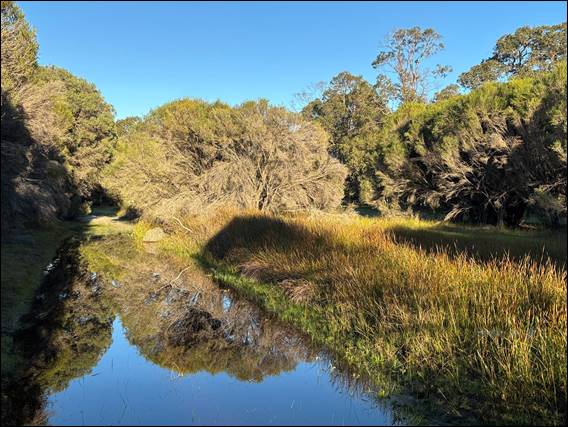
Intending to be out for a short walk, the two early finds got me keen to take a bigger loop into a few parts of the park that I had not been too before. This included some very swampy areas. Where there were tracks, long stretches of them were under water. Undeterred I marched on. When I wasn’t watching my step to avoid getting too wet, I was looking all over for something fun. The orchids seemed to dry up on me for this area, although I did spot quite a lot of Earthball (Sclerodermataceae) and Earthstar (Geastraceae):
I believe the one that I have included below is a Smooth or Onion Earthball (Scleroderma cepa). I have not been able to find out to much about this species, but as they age they turn from white to a pale brown or yellowish brown. The outer skin can have tiny scales or be smooth, hence it’s common name. I did wonder if it was a Puffball (Agaricaceae) because of the small opening at the top. However, the thicker and more leathery skin, which is called the peridium, made it clear that it was not a puffball:

My next image clearly of a Sundew (Drosera). The plant had a small basal rosette of leaves, from which five equal length stems came out. Not upright but extending out horizontally, being held just above the ground. This gave the plant a star like form, which stood out from other sundews I have seen. Along each stem the small green leaves had delicate pink tentacles each with a sticky dewdrop, called mucilage, at the end. From a distance the cluster of leaves at the end of each stem, as shown below, made the stems look clubbed:

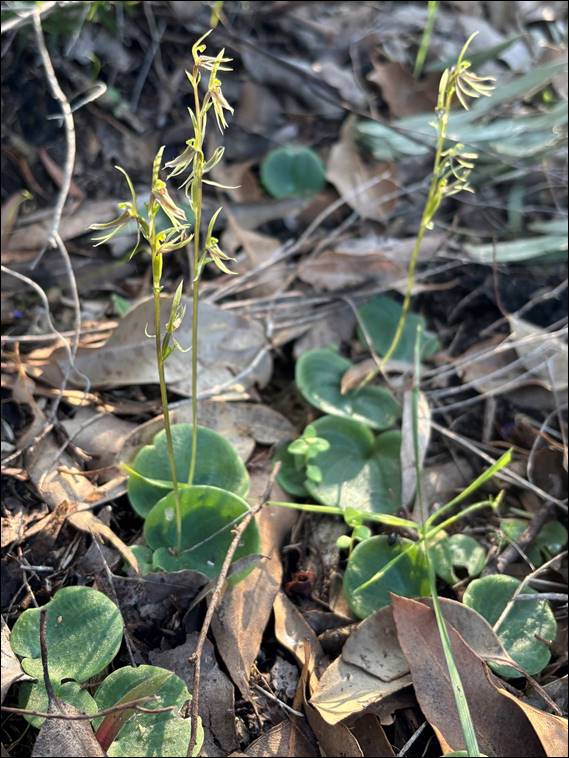
Despite all the detail I took note of, I have not been able to link this plant with the more commonly found sundews in this area. Mind you there are over 150 species in the South West of Western Australia, so I am not all that surprised I didn’t find it. I may have failed with the identification, but I did come across another orchid. The Midge Orchid (Cyrtostylis huegelii) is normally out in July and can be found in big numbers. This year it has taken till today, mid-August, for me to find any and even then I only found a couple flowering:
While some species seem thin on the ground, I’m hoping that the slightly different seasonal conditions this year may bring out a few other species. Whether ones I have not seen so much, or if I am lucky species I have yet to stumble across. I will do my utmost to hunt them out, but the success or not of the orchids coming out are at the mercy of the weather gods. We will have to wait and see how favourably they look down on us. But for now, as I ended my two hour walk I was super happy to find a second Silky Blue Orchid (Cyanicula sericea):

 Sandbagged