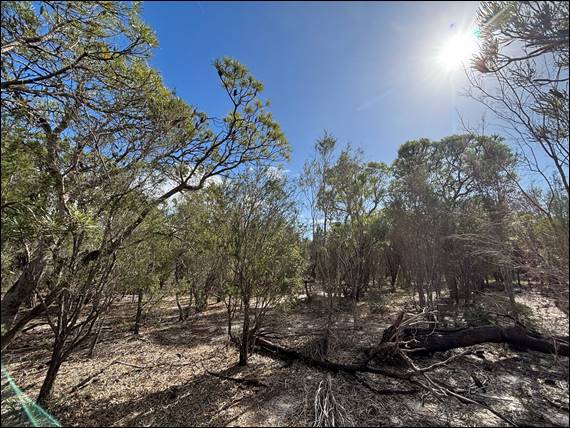
Sunday morning arrived and I felt the need to get out in nature, without the need to drive too far. The Capel Nature Reserve beckoned, with an unexpected fine day and the sun beaming down on the world. I hope I don’t jinx things but maybe we might start to have a few good days align with the weekend. There’s been some chatter at work about how the winter weather seems to come in that bit harder on the weekend. Not surprisingly there is no scientific evidence to support this conspiracy theory, but sometimes it sure seems to be the case:
I wasn’t feeling overly hopeful on the orchid front, so as not to be disappointed. The usual flurry of greenhood species in July, just haven’t wanted to play. Maybe it has been a tad too cool and wet for them. And today’s short burst of glory wasn’t going to make them suddenly spring out the ground just for me. But such warm weather will result in a less joyful find, or was it that they found me. We’ve got about 100 species of them in Western Australia, and this one is an Aedes camptorhynchus that can carry Ross River virus and Barmah Forest virus:
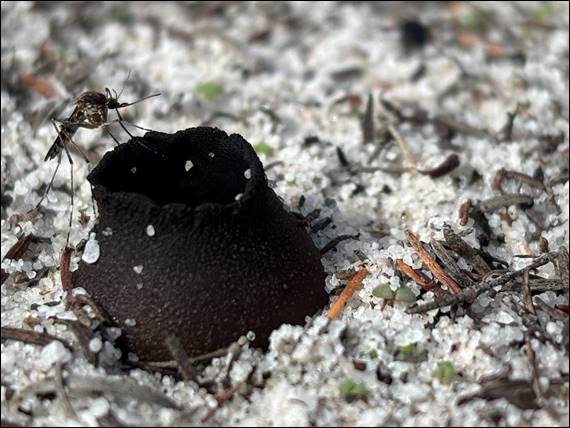
In order for the blood sucking females to infect me, they first need to have taken blood from a mammal that carries one of the viruses. In this area that is most likely to be from a kangaroo, wallaby, or possum. I didn’t however take the image to go on about one of the most annoying creatures I am aware of, other than at times humans, but the fungi that it landed on. The cup shaped body told me it was a species within the genus Peziza, which belongs to the Pezizaceae family. It took a little digging but I identified it as Peziza psammobia:
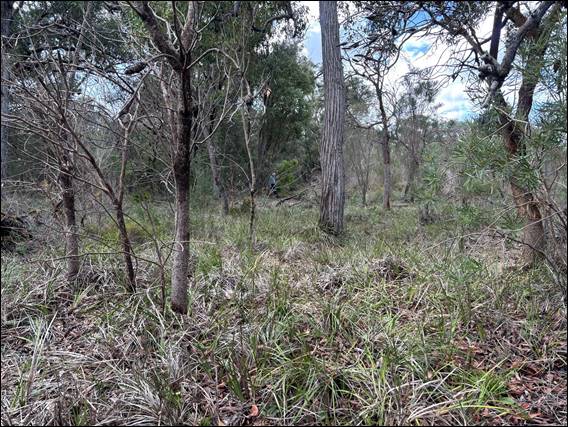
This species is native to Queensland but also found in Western Australia, which in part was why it took a little more work to figure out. The reason for the cup is to focus the force of raindrops, and this in turn helps to spread the spores. Quite literally splashing them out and into the surrounding earth. And while I am on the topic of earth, I was quite taken by my next find that looked like the globe, with landmasses and a watery ocean. I’ve pinned this one down to being a Horse Dung Fungus (Pisolithus marmoratus):
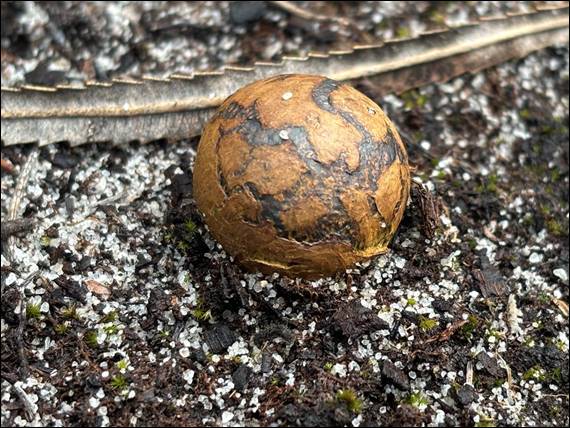
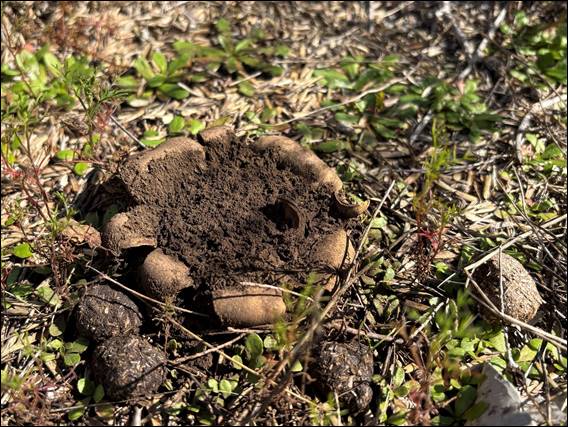
It is described as having a ‘roughly spherical fruiting-body mottled with shades of black, brown and gold and with a rough surface texture’. And is another species within the same genus as the Dead Man’s Foot (Pisolithus arhizus) that I found last time I came here, which had a very different surface pattern (https://sandbagged.blog/2025/07/26/a-winning-streak/). The next find was a repeat from that walk being a Star Earthball (Scleroderma polyrhizum), only this time the dark brown spore powder had as yet not been dispersed and filled the crater:
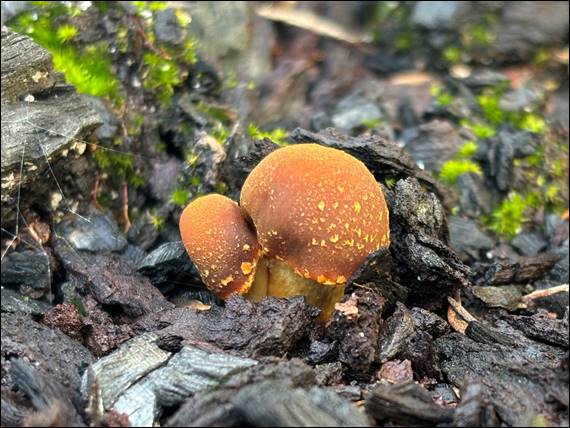
After the relatively dull coloured fungi finds I was hankering for a change, preferable something with a splash of brightness about it. I’m not entirely convinced about what I found, but it fitted the colourful bill. The thick stem with vertical looking stripes makes me think I could be right. That along with the flecks, almost scaly looking features, on the small bun shaped cap. And finally being found in a decomposing tree stump, makes that three traits indicating it could be a Spectacular Rustgill (Gymnopilus junonius):
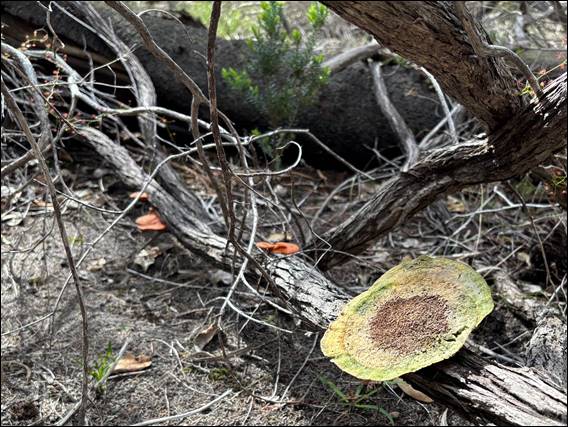
Next was a common Scarlet Bracket Fungus (Pycnoporus coccineus), another decomposer fungus. It was found to secrete enzymes that aided the degradation of softwood, in a study in 2015. The bright and vibrating younger specimens were no doubt enjoying slowly breaking down the fallen limb, but it was the older specimen that I focused the image on. Rather than having a bracket shape it was like a plate. Having dulled with age but still showed the radial pattern, and underneath continued to display the same orange colour of the younger ones:
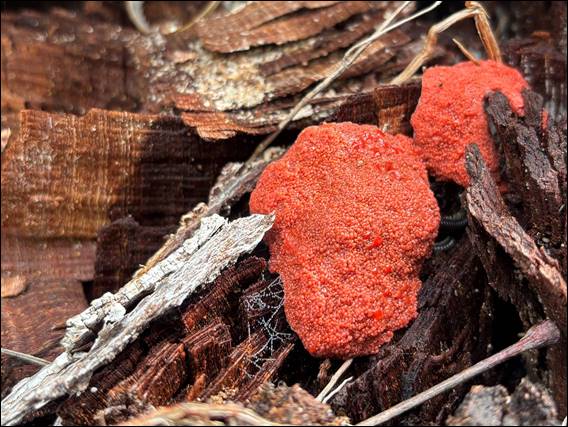
At the end of yet another fallen tree I found a third colourful display. Not a fungi this time, but a Red Raspberry Slime Mold (Tubifera ferruginosa). Found across the globe it is reputed to be the most widely known and distinct slime mold. While it resembles a cushion made of bubbles, it is actually constructed of gelatinous rods called sporangia. Tightly clumped together each rod is no more than 0.5mm in diameter and 3-5cm long. While called Red Raspberry, specimens can be a wide range of colours including silver, black, gold, or pink:
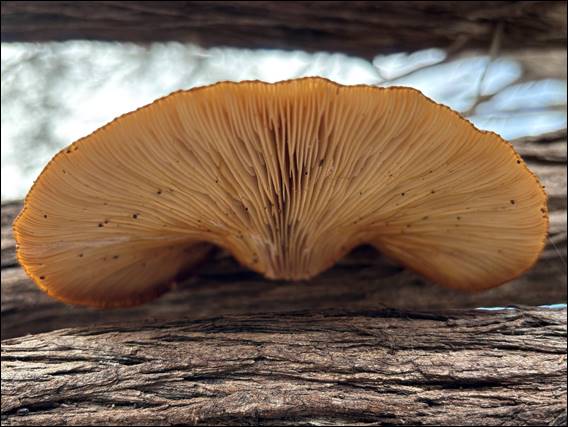
The last fungi is from the Crepidotus genus. Seven species have been identified in Australia and this one is Crepidotus eucalyptorum. Rightly or wrongly in England these were sometimes called slipper mushrooms. While I’ve read the Latin word crepid means slipper, but can also mean a base or shoe. Some say it can also refer to something being burst or cracked. The verdict on otus being more conclusive meaning ear in Latin. Despite so many options for a fun common name, like my first find today this one does not seem to have one:
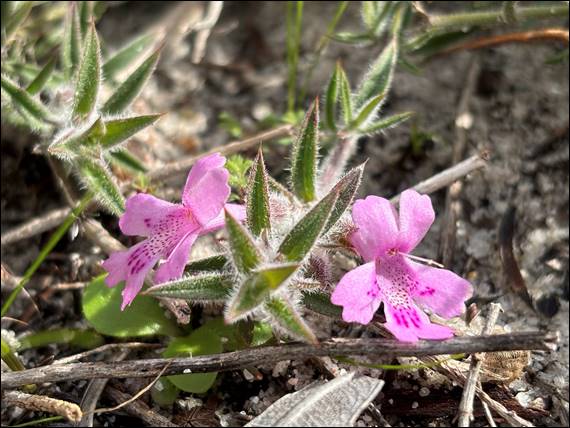
All in all it was a pretty good wander, no orchids were out but I spied some nice finds nonetheless. I was kind of hoping that a scaly friend might be tempted out of brumation by the sun. Despite scouring the ground, trees, and especially fallen logs and hollows none were to be found. So instead I’ll finish with something that does have a common name, and that is aptly called a Snakebush (Hemiandra pungens). A prickly little plant, so one I had to careful walk round in my safety sandals:
 Sandbagged