The title may suggest to some that I am being contentious, but that is not the intent. Like most outdoor pursuits there are many forms of climbing. Speed, sport, and bouldering have being brought to the attention of the wider community through inclusion in the Olympics, but there is also trad, aid, soloing, mixed, ice, alpine, and more. I’m certainly not putting one above the other, so what is this all about? Well blame John Morris, who has very kindly allowed me to review and provide feedback on every word in a climbing book he is writing:
If you want to find out about the book, you’ll have to check out a past post called The photo shoot. As this post evolves there are likely to be a few more links, as I dip even further into the past. Other than that catch up with John back in April 2022 for which I have Howsie to thank, and I mean thank in a positive light, John and my paths have not crossed physically. Until the end of July 2025, when he was in the west for work. I drove to Mandurah late one afternoon for a catch up, and we whiled away a few hours talking about climbing, family, and life:
But mostly climbing. If you had not guessed both John and I have rocks in our blood. One of the last subjects was me reliving an epic experience I had, courtesy of Howsie and Kym. The term epic being relevant to John’s book, and is a word that I do hope will get used. Reliving that unforgettable experience set my mind thinking. And it is for that reason I am writing this post. But before I let slip what the purest form of climbing is for me, it makes sense to go back to where it all started. And for that I have Andy Bulgin to thank, again in a positive light:
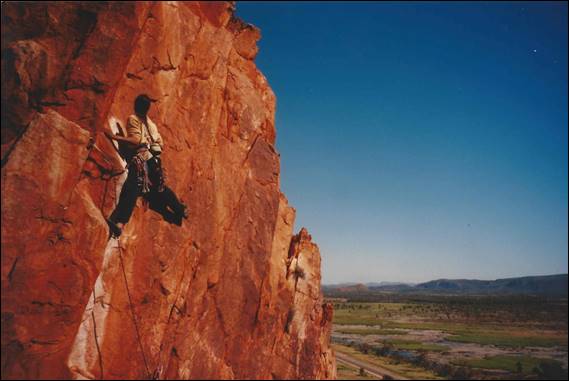
You’ll see a young Andy in the first image of this post Part 1 – North Wales – were it all began. He introduced me to climbing, specifically trad climbing. This was the major form of climbing at the time in the British Isles, and it probably still is. The ethics of the people I climbed with were simple, ground up ascents and have fun. We didn’t chase grades or glory, we relished the situations. And since my first climb on rock in April 1993 with Andy I have been lucky to have had a huge amount of awesome experiences, mostly on trad:
There are more great times ahead to add to the memories, I am sure. While there is always that thought that we could have done more in our past life, there is no point in looking back. But on occasion our eye’s will flick a peek at the rear view mirror. I have been guilty on occasion of having done this, which has taken me back even further to late 1986. I had just arrived in Coventry to start student life. Bringing a new meaning to freedom. And this of course included house parties, and at one I remember people climbing all over the stairs:
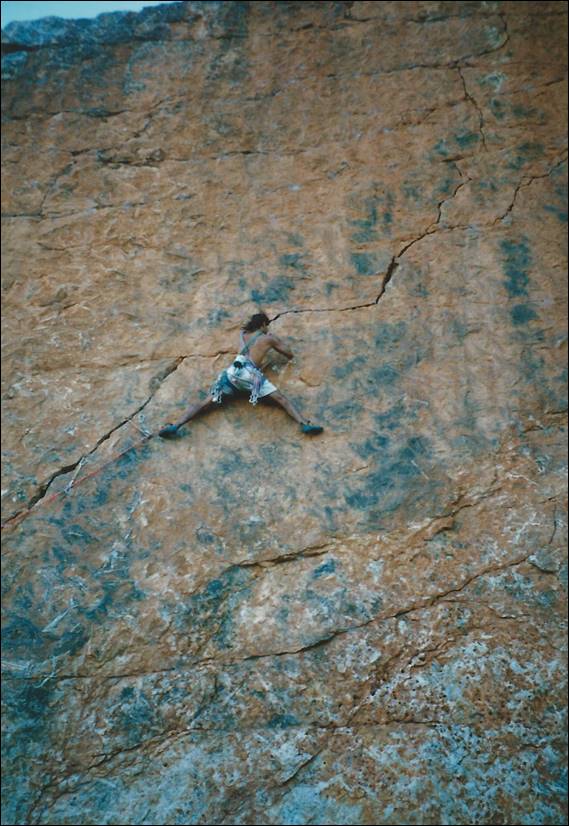
I heard they were ‘climbers’ and it came across to me that they were just showing off. I paid them no heed. Fast forward to 1993, after Andy had unwittingly changed how I would live my life. When at a party at our house I was the one ‘showing off’. Traversing across the second storey of the front of the building, reaching between and pulling into each window recess. Finding myself completely unaware of anything but the movement. Totally absorbed and if I am truthfully happier in that moment, than I was at the party itself. I finally understood:
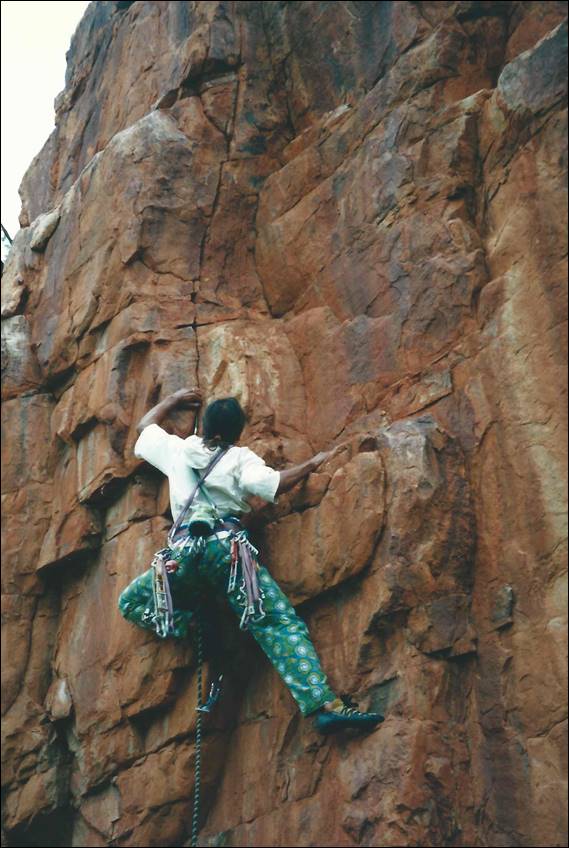
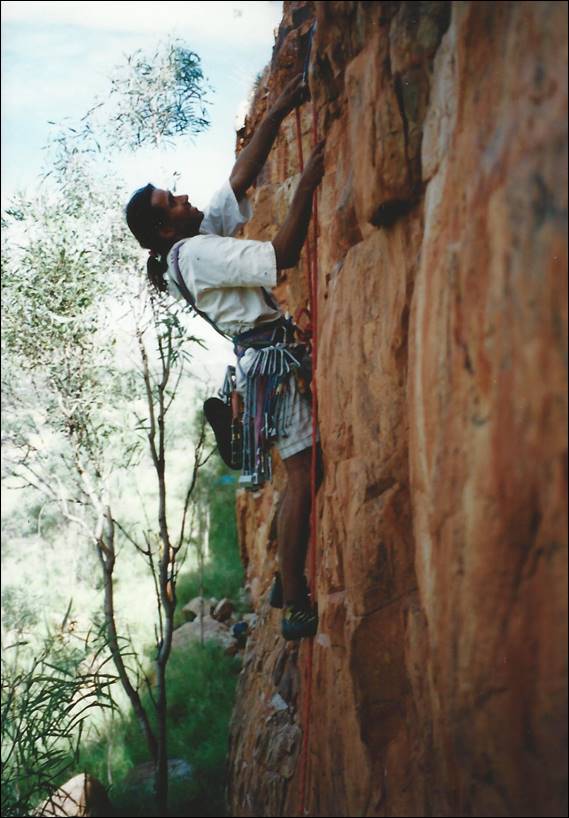
Like I said, for me, it is not the glory nor is it the desire to climb harder. There are no goals, the only wish is to be on rock. If I had understood all that back in 86’ I might have had another seven or so years of enjoying being on rock, but I didn’t. Having started climbing in England, ground up trad is what I knew. I very rarely dipped into sport climbing. It just didn’t have the same draw. Trad offered an added component of placing protection. Needing total and utmost confidence in your skills, honing the mind even more than when there is preplaced protection:

It is true that soloing hones the mind even further, and I have been known to solo some climbs that people have thought were a little silly. However, I am always drawn back to trad. With its rich and long climbing history, my time in England was spent climbing routes detailed in guidebooks. As such I knew it had already been climbed and what grade people have given it. Step back in Andy. On a trip to Skye, we had an experience that he was lucky to survive. This has been detailed in this post Part 6 – Scotland – the long road:
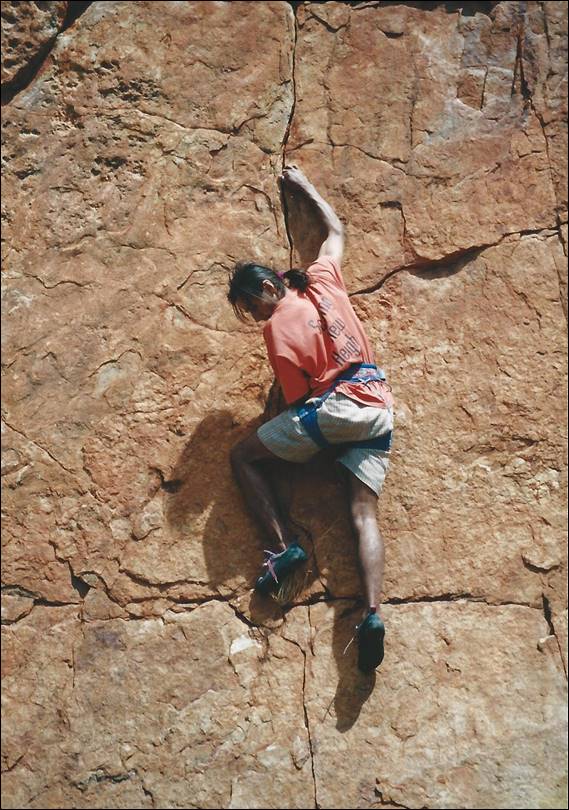
After that, the big mountainous routes we had driven so far to reach were not so appealing to him. He was still keen to visit a much smaller crag. One we had no knowledge of whether there were even any routes on. Walking along I spied a line, and was deadest that it would go. It felt tough, and going up not knowing what may lie ahead added a whole new dimension. Would there be any gear of worth, would it even be climbable, are there any loose sections? Andy below waived and tried to get me to come down, but I continued upwards:
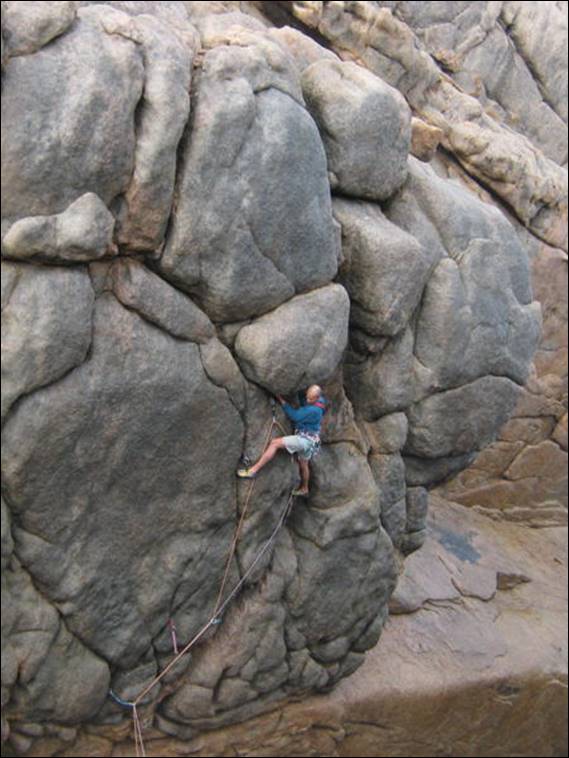
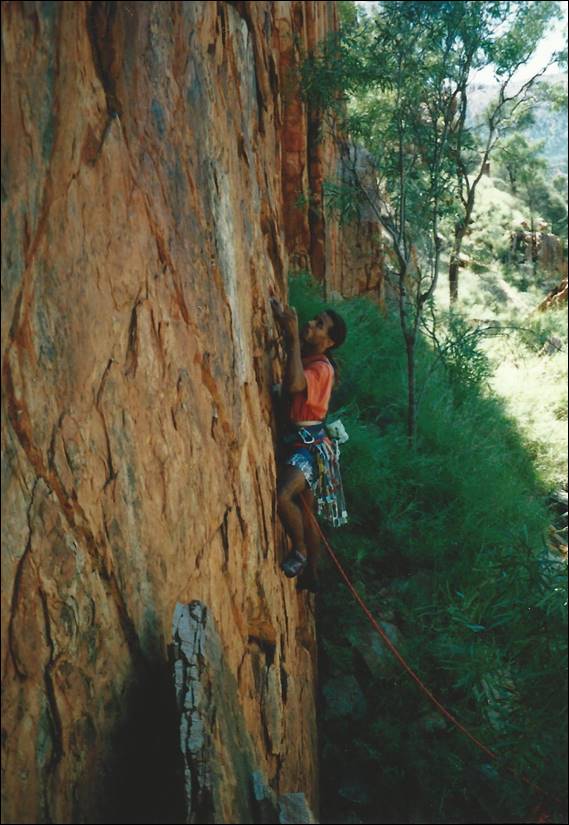
So became my first ever first ascent. The Freezer, which I think was 15-20m tall and we gave it HVS 5b (Aus 18/9). Done with the ethics that had been etched into my very soul, ground up. It was the only first ascent I did in England. And not until I moved to Alice Springs in 2000, did I started to bag more first ascents. A playground with more rock and opportunities that you can poke a stick at. Other than the harder routes we established on Left Wall, where I even placed a couple of hand drilled bolts, all my new routes were established ground up:
Some people liked to inspect the lines first. After all the Heavytree Quartzite rock in the centre may be incredible hard but it is also at times very brittle and broken. My ethics weren’t swayed by this. Navigating the rock quality on top of finding gear, while figuring out how to get up the line, merely added to the experience in my mind. My near five years of climbing in the great Red Centre is well documented here Part 11 – Alice Springs – rock, rock and more rock! And I’ll likely need to refer back to this post a few times:
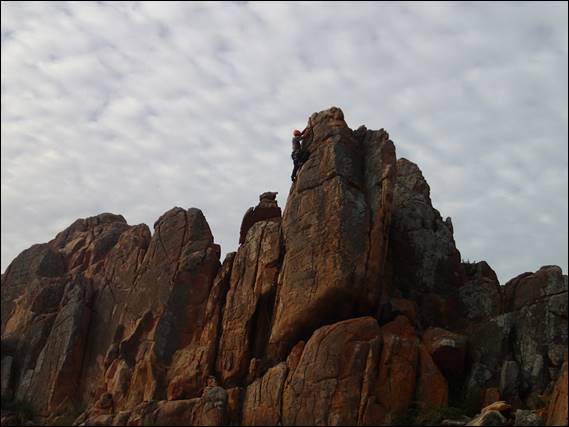
In late 2005 Lisa, Elseya, and I arrived in the South West of Western Australia. Before we left Garn Cooper told me that we were moving to the place in Australia with the least amount of climbing potential. Having had the chance to read John’s book I am beginning to understand why he said that. However, there are pockets of joy to be had here. My energy for discovery has been satisfied, as I found new lines and a few new areas. Also delving into sport climbing a bit more, even establishing a handful of routes with this one in my view being a standout:

The Northern Territory and Western Australia may not have the abundance of rock to match other states. But they both have relatively small climbing communities, and that has offered me the opportunity feast on bagging first ascents. With well in excess of a hundred to my name, which is more than most climbers could hope for. Many may fall into oblivion, while some will live on. I may even find one day that some have become highly regarded. Being sought out by climbers who seek the classics that have been awarded a healthy dose of stars:
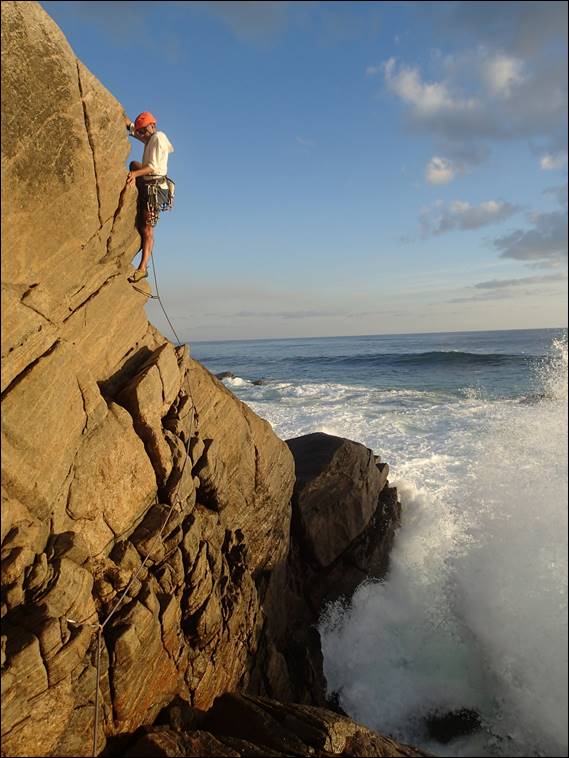
So where does this all lead? As you may have been able to unpick from this longer than expected introduction, the purest form of climbing for me is a successful trad on sight first ascent. There is no better feeling than looking up and not knowing, but having the confidence to give it a go. Pushing fear to the back, living in the moment, becoming one with the rock, and blocking everything else out. A healthy mixture of adrenaline and fear helps, to both get you through and keep you safe. And if all goes well you’ll reach the top with an ear to ear grin:
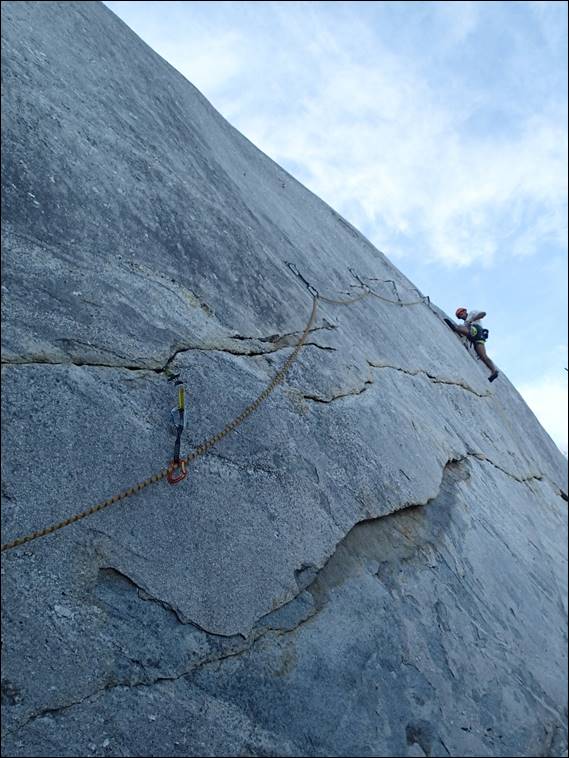
This resulted in me reflecting on routes I’ve established, and which ones stood out. Within minutes and not needing to try too hard, I had scribbled a selection of eighteen on a post note. There was no turning back so next I scoured my images to find choice shots, avoiding repeat uses from past posts or guides. Preferable of the first ascent, which was not always possible. The images used so far have all been on sight first ascents, other than one solo first ascent, one sport climb first ascent, and two I was not successfully on the first attempt but the images were too good not to use:
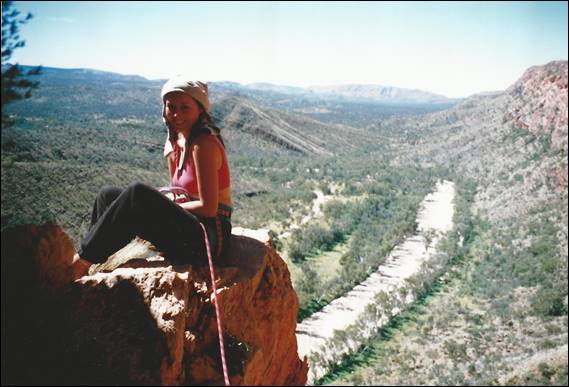
Direct Crack Line 125m 14 (UK VS 4c), Dan Ewald and Krish Seewraj (alt) Apr 2000
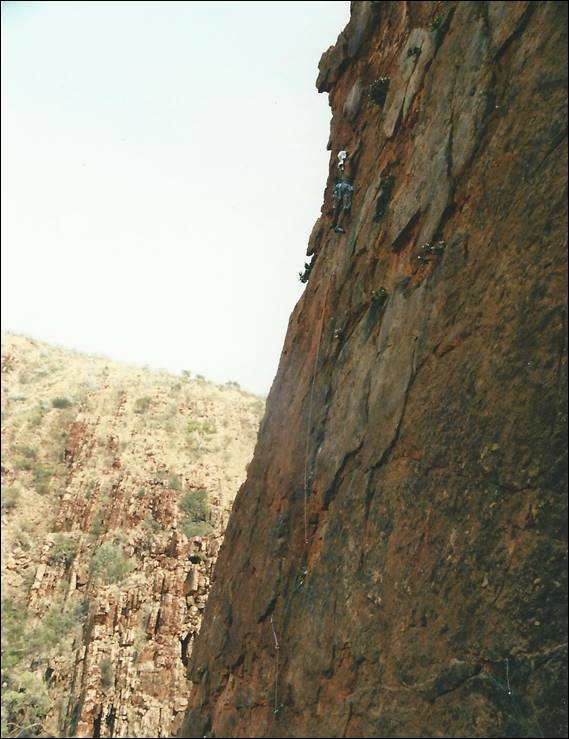
Listed in chronological order, the first nine are in the Red Centre. For more background and images on all of these check Part 11 – Alice Springs – rock, rock and more rock! Dan Ewald was one of a few that took advantage or my unwavering enthusiasm. This route is special being the longest route in the centre, other than an obscure line on the remote Mt Zeil. Unbeknown to us we were not first, finding an aging piton. Despite that it still warrants inclusion, with three divine pitches of equal grade and length. So good I took Lisa up it soon after, and here she is perched on the second belay:
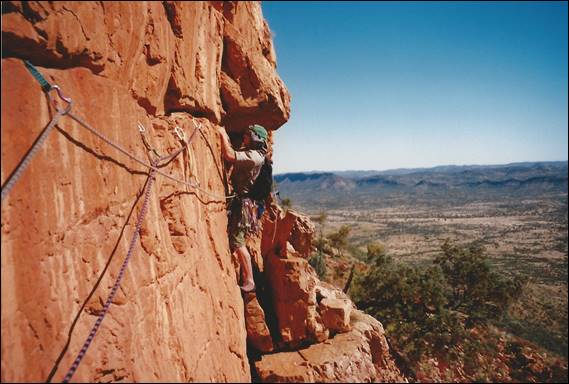
A Most Unlikely Journey 50m 17 (UK HVS/E1 5a), Krish Seewraj, Mark Rewi (alt) Aug 2000
I did many stunning climbs with Mark Rewi. He had more go-go juice than me, so pushed me to test and go beyond my limits. Any route on Mt Gillen, overlooking the town of Alice Springs is worthy. This climb being no exception. A true alpine style ascent with route finding being worked out along the way. It doesn’t always go as you planned, and the rock can quickly turn to choss. But with a level head it will always result in an epic, in a good way. The line provided a wonderful meandering adventure up the red stained Heavytree Quartzite:
Batten Down the Hatches 15m 19 (UK E1/2 5b), Krish Seewraj, Jason Geres Mar 2002
This is the only climb I have not been able to find an image of a climber on. Jason Geres and I made an effort to have midweek climbs, allowing time to explore many areas. Some were obscure and we never returned. Not this small face. High on the range, it diverted us from getting to the Garden Wall. And this was the first route I established on it, following the slanting crack in the middle of the face. Steep, sustained, and with bomber protection. Also the only route I’ve ever found a bat on. We managed to leave in peace, and I can still hear it squeaking:

Where’s the Gardener 25m 18 (UKE1 5a/b), Krish Seewraj, Jason Geres Mar 2002
Here is Jason himself, at the Garden Wall just a week after we put the above route up. Never overly keen to lead but always happy to give me a belay. No matter how sketchy things became. Doing ground up first ascents meant you might need to do a bit of cleaning as go. Not only checking for and removing loose rock, but at times clearing naturally formed mini garden beds to enable protection to be placed. This route had the most gardening required of any route I put up, but it was oh so worth it. I hear it is now considered a must do route:

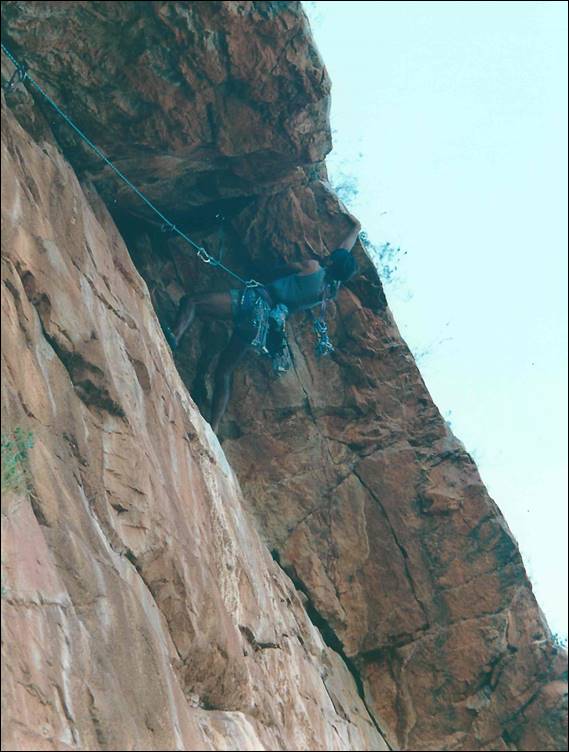
Pear Drop 20m 20 (UK E2 5b/c), Krish Seewraj, Pat Spiers Apr 2002
This image was taken on Jason’s birthday, and is the first ascent of pitch one of Mee-Gwitch 50m 19 (UK E1/2 5b). Just over a week later I returned with Pat Speirs. A master of keeping a calm head in some of the most ridiculous situations. After leading the first pitch, and where the route heads right up a bouldery mess, he looked up and suggested a different path simply saying ‘your lead’. I can’t recall the width, but the roof felt huge. With no way to see the headwall above I climbed out several times before committing. Truly exhilarating, an absolute must do for those seeking a real out there experience:
Avoiding a Greek Wedding 25m 23 (UK E4 6a), Krish Seewraj, Pat Spiers, Jason Geres May 2002
It felt like I put a new route up most weeks. So it is interesting most of the standout lines are from 2002. Granted, thanks to Mark and Pat, it was the year I climbed with more confidence than ever before. Maybe that is why these ascents stick in my mind more than others. This route is by a long way the leader of the pack and not because it’s the hardest. Utterly, utterly absorbing due to its position, steepness, sustained nature, and at times barely sufficient gear. Words will never do justice in explaining my feelings on the route. My most impressive on sight first ascent, without doubt:
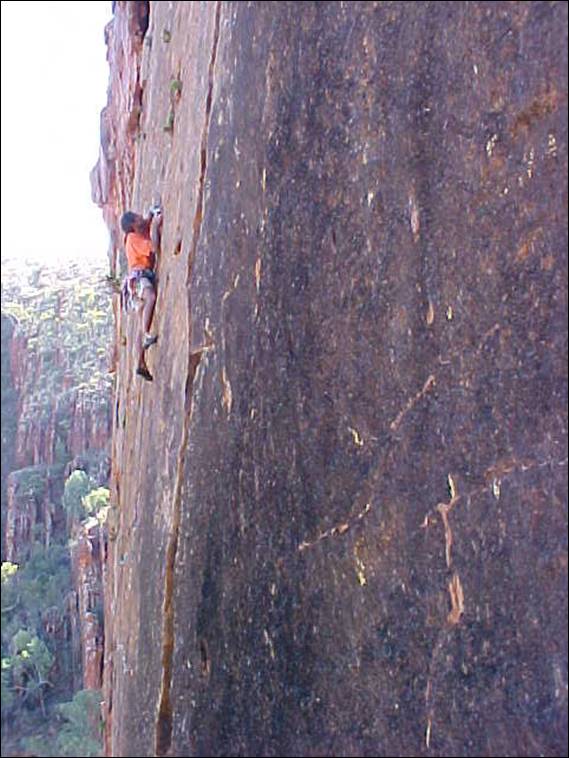
Stitching Time 22m 19 (UK E1/2 5b), Krish Seewraj, Dan Ewald Jun 2002
I am usually the one taking photos. But as I climbed this beautifully blocky looking chocolate mudcake wall, three cameras followed my every move. At the start, and despite being careful, a big block came away in my hand. Big enough to do damage, but it fortunately didn’t. The scene was set. Not a word was ushered as I went on. I didn’t even hear the shutters of the old film cameras taking enough pictures to give me a catalogue of every move, some from several angles. From my time in the Alice this comes in at number 2, and is now another sought out route:
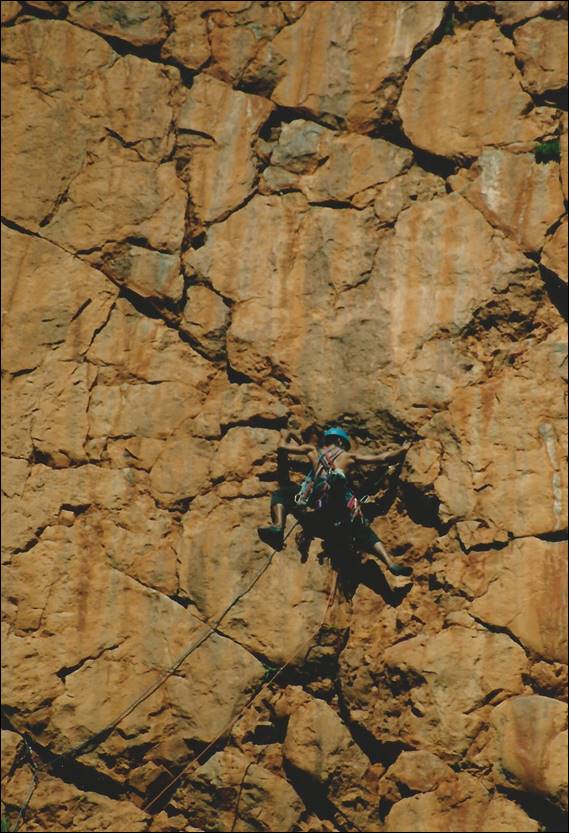
Lazy Sunday Morning 20m 22 (UK E3/4 5c/6a), Krish Seewraj, Jason Geres Jul 2002
This route typifies how Jason would calmly, or was it out of ignorance, accept that if I said something would go, that it would go. I could have been torn between this line and Block Head 25m 19 (UK E1/2 5b) just to its right, but that route had a big, scary, and stubborn block that thwarted the first attempt. While the bottom half of this line may be considered a little scrappy, the top half is sublime. Thin for holds and on gear, delicate and technical, and hugely committing. Plus any route that makes Pat need to consider his next move has to be worthy:

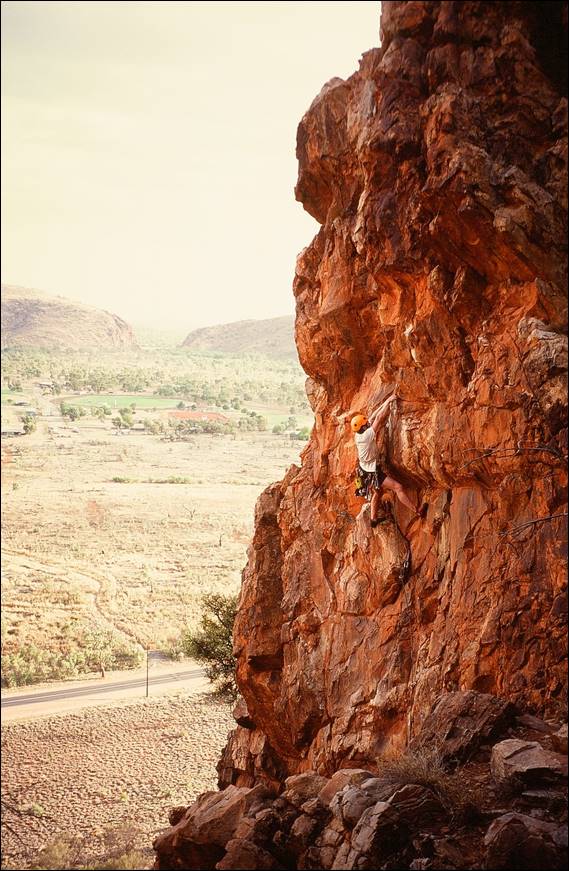
A Matter of Time 14m 17 (UK HVS/E1 5a), Krish Seewraj, Mark Rewi Aug 2002
Technically some may say I did not climb this route as a true on sight first ascent. That is because for four years Jock Morse had called dibs on it. He and others had top roped it, so I knew it would go, but he never had the gumption to lead it. That said I had no idea what grade he thought it may be. When I did lead it, which happened to be by accident as I didn’t know exactly where it was, I did so with no prior information. It really was so worthwhile, being the best line on the small scattered crags on Blatherskite Range. Jock missed out:
The Beach 10m 16 (UK HVS 4c/5a), Krish Seewraj, Ryan Doe Dec 2010
Having climbed in the South West of Western Australia with its limited number of areas and routes for nearly twenty years, some ask if I ever get bored. Every time the answer is no. Something is always different. Ryan Doe and I happen to be in the right place at the right time to witness conditions only seen once in two decades. There’s an image of me on a new route to the climbers left in the introductory ramble, with no beach. We bagged a route each on rock normally waves washed, thinking they will never be repeated. Howsie has repeated mine, having to contend with a damp start. Man it felt tough:
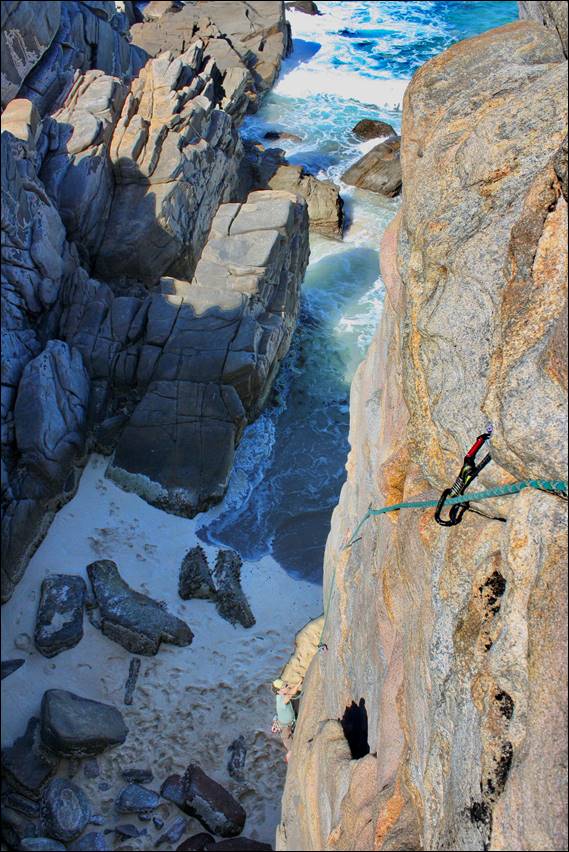
Billowing Sails 15m 17 (UK HVS/E1 5a), Krish Seewraj, Craig Johnson Jan 2011
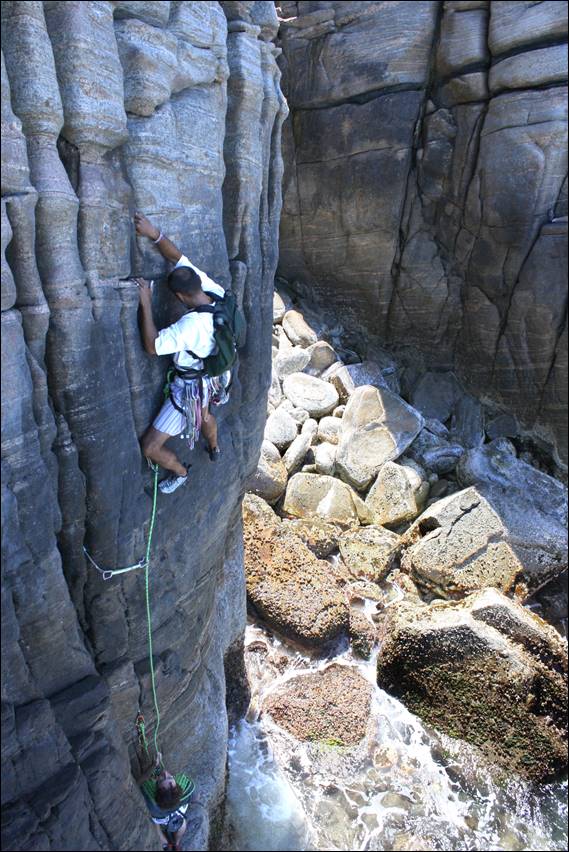
I’ve been lucky to have established a few new areas in the South West. Smith Beach is my favourite. I love every route here even though some scare me, more so with age. It is the place that tested my resolve to maintain an on sight ground up first ascent ethic more than anywhere else. Images I have of Craig Johnson’s facial expressions coming up on second during my ascents, shows the intensity required. Rounded holds, steep lines, flared cracks, and a flaky coastal granite feel. Quite a few people who come here do not return. A traditional style trad climbers place, requiring true grit. This route won out due to its epic position above the ocean:

The Unbolted and The Beautiful 20m 16 (UK HVS 4c/5a), Krish Seewraj, Andrew Malone Mar 2011
I like to stay away from politics, including climbing politics. However, this line dragged me into the great bolting debate. Anyone can bolt, many do, and at times in places and on routes that do not need them. This occurred here, including a retro bolt of a trad line, just before I put this route up. It was created a little out of protest and to make a point, hence the name. What transpired is a wicked route in its own right, a very direct and well balanced climb. Enough gear to be sane if you know how to use trad, after all it is an art form. Although one runout may make some think twice:

Three Little Birds 15m 15 (UK VS/HVS 4c/5a), Krish Seewraj, Chris Howe Nov 2016
The above three lines in the South West were established before I started writing up my adventures. From here on in, if you want a bit more information I’ve linked the related post in the title to each blurb. In England I was accustomed to seasonal climbing bans in areas where seabirds frequented. Being relevant when Howsie spotted a nest on a face we wanted to climb, in which we saw two fledglings being fed. This resulted in us exploring and finding another wall with two hidden gems, one each. Both beautiful clean lines, a reward for respecting nature:
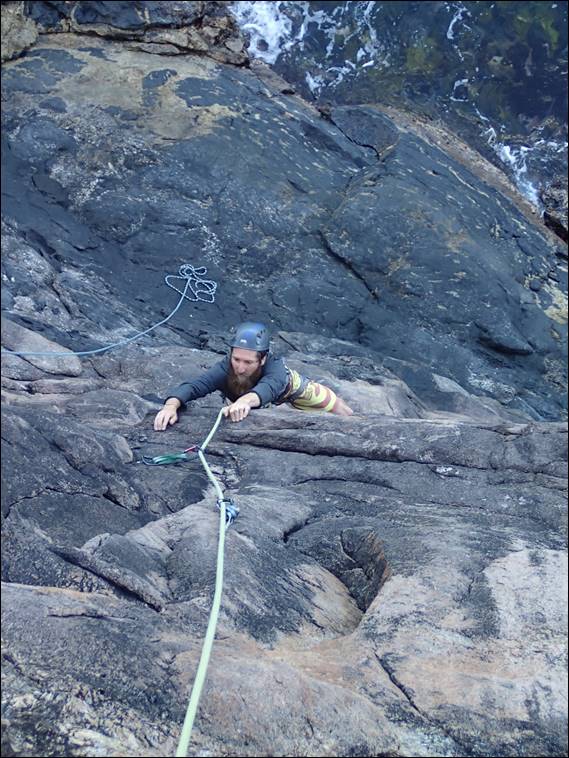
Knocking on Heavens Door 15m 17 (UK HVS/E1 5a), Krish Seewraj, Chris Wiggins Aug 2018
Wilyabrup is visited by many. The vast majority of those who come here flock to the main area, unaware or not interested in a number of great neighbouring outcrops scattered along the coastline. For me these tend to have a more trad feel to them. Not having been climbed as much, care is required. This route typified that need, which is why it appeals to me. Before trusting them I knocked on every possible hold, as did Chris Wiggins when he followed up. Every time I have repeated the climb I have again felt the need to check each hold. Despite the care taken, the last time I led it one popped off sending me flying:
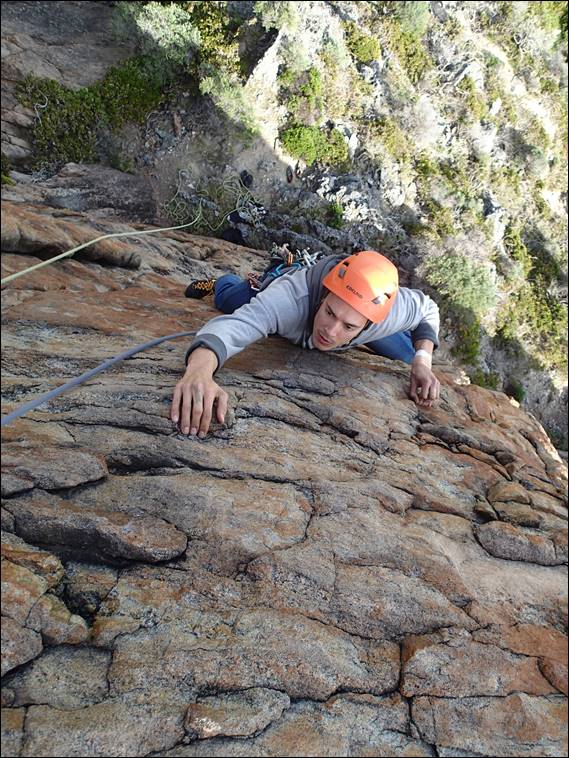
Two Piece Suit 10m 18 (UK E1 5a/b), Krish Seewraj, Ryan Doe Jun 2021
While a trad line, this is on a quarried face. The original routes here were all bolted, then someone put up a trad line that followed a blast hole. I was a bit miffed that I hadn’t consider trying this before. Where the cylindrical blast holes were intact enough, meaning anything more than half, cams fitted perfectly. Now that my eyes had been opened to this possibility, I found two more blast holes that I thought may be OK. This one is my favourite of the two, and it not only sticks in my mind due to the pure novelty factor but also because the climbing is great. If not a little intense:
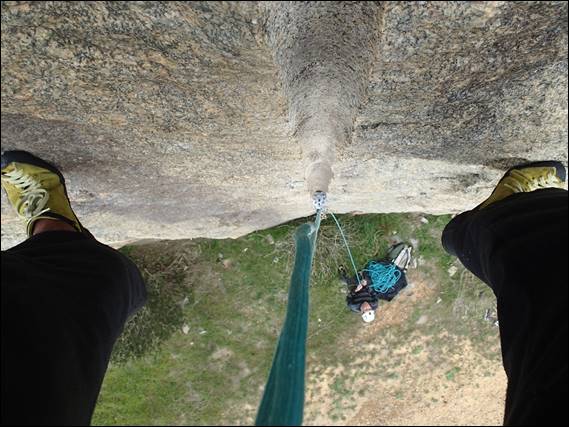
Drag Netting 25m 20 (UK E2 5b/c), Krish Seewraj, Mario De Decker, Ryan Doe Sep 2022
Of all the other crags neighbouring Willyabrup main cliffs, the Terrace and Northern Blocks see the most action. Kym Hartley loved this area and I helped him put up a few serious additions. In truth I felt the walls were climbed out, until Mario De Decker pointed out a possibility. A link route, but different enough to warrant giving it a go. Mario doesn’t have the same desire for new routes, so encouraged me to go for it. The long traverse was exposed with just air below, getting pumpier and harder. Finishing with a big move into the final corner. I was exhausted, but pleased that both Rongy and Mario were equally stuffed when they followed:

Flash Dance 10m 20 (UK E2 5b/c), Krish Seewraj, Andreas Roilo Jan 2023
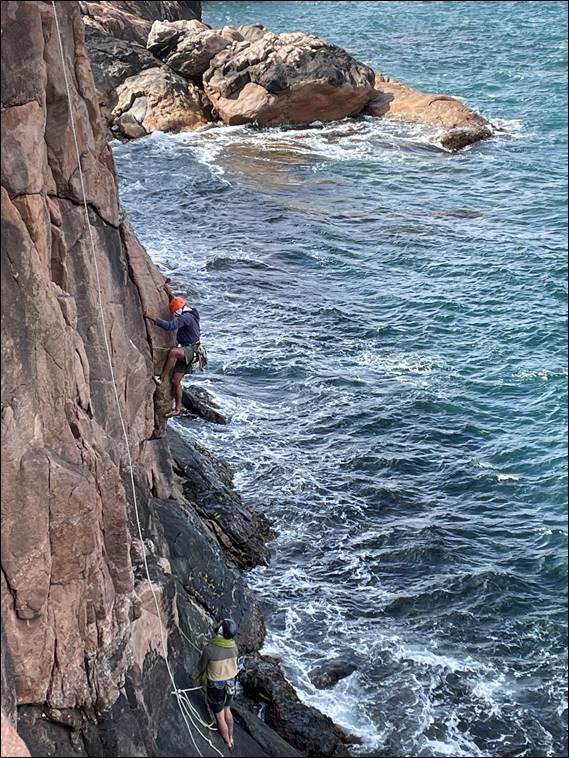
I would have plumped for the Traditionalist 20m 19 (UK E1/2 5b), but Kym felt the rock was too suspect and wanted to top rope the line first, so it wasn’t on sight. But before bagging that route, I jumped on another potential line. Up steep to slightly overhung twin cracks on a boulder, above a wave washed platform. From below Kym and I thought it may be grade 17, but looks can be deceiving. It turned into one of the best climbs I’ve done in terms of having to focus on body position for each and every move. Only just managing to deal with the pump, before topping out:

Power Up 35m 19 (UK E1/2 5b), Krish Seewraj, Chris Howe, Kym Hartley Mar 2025
This is the route I relived when I caught up with John, which initiated this post. Kym says that whenever we head out on rock together ‘great things happen’. He’s not wrong, and great things happened during our last catch up. Wicked ground up on sight ascents for Howsie, Kym, and me, it’s infectious! As soon as we walked up to this wall, I saw the line and knew I had to climb it. Howsie and Kym looked a little less certain, and despite it raining when I started I refused to back off. Skies cleared, gear was found, and I slowly worked out each move to reach the next hold. It went on, and on, and on. This successful trad on sight first ascent deserved a huge whoop and holler when I got to the top:

 Sandbagged