We are experiencing a bit of a lull. I had a fair bit of success in April and May. Now with most of the early orchids having been and gone things have eased up during June and into July. The next batch are starting their journey of coming into bloom albeit a bit slowly, which is fair enough being a reasonably wet winter. I suspect that towards the end of July and into August more of them will come out to play. With the boom time of course being the big months of September through to November, when the greatest number of species spring into action:
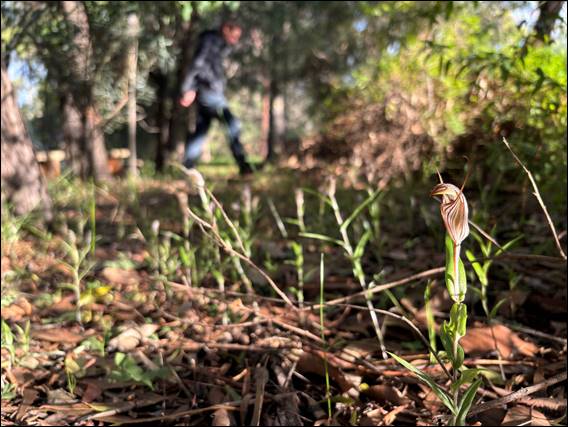
That is not to say that I’ve given up completely. It does get a little trickier to find days that I am motivated enough to get out for a slow walk. Balancing using the better day to hit rock, with of course the majority of the week being taken up by work. It doesn’t always leave too many options on these shorter, wetter, and windier days. I’m not alone on this, and our orchid chat group at work has been extremely quiet of late. Although a few weeks back Rob sent me an image from his place, a mostly vegetated block with five acres of bush and pines:

This led me to pop round, seeing it was on the way back from work and it was one of those not to bad afternoons. As he gave me the grand tour round the block, it reminded me of when we lived in Capel and had just over an acre. It took a lot of our free time looking after the place. Mowing, weeding, tending fallen branches, and then there was the menagerie, veggie garden, and fruit trees, not to mention the usual domestic duties. It was never ending for us, and I can’t begin to imagine how much time five acres takes up or how Rob does it:

He mentioned, as we wander round, that it had been a very long time since he had simply strolled round to look about. Most other times he’s busy with some form of maintenance that demands his attention. Being rewarded by finding quite a few good finds, in order of the images being Brown-veined Shell Orchid (Pterostylis aspera), Yellow Fieldcap (Bolbitius titubans), Collinitus Slippery Jack (Suillus collinitus), and the below what at the time I had hoped was the Green-veined Shell Orchid (Pterostylis scabra):
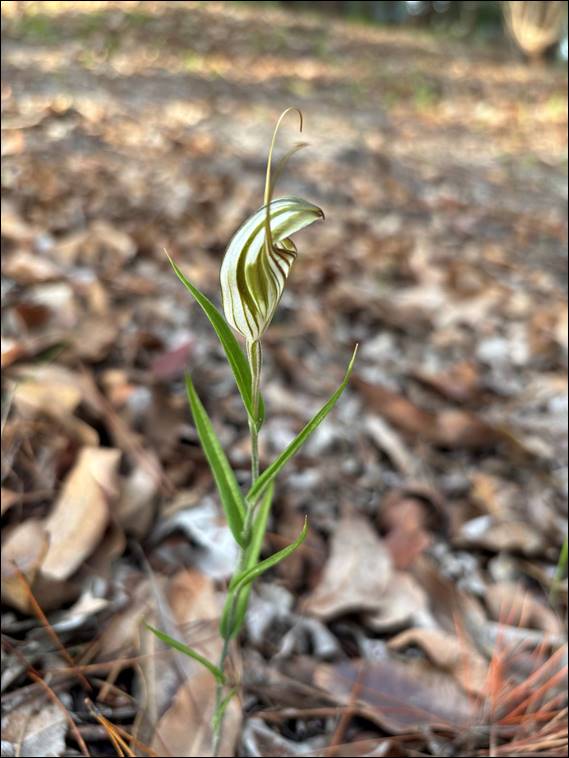
I’ve only seen the Brown-veined Shell Orchid once or twice, probably because I have never specifically gone out looking at the right time of year. The heart of winter. While the Green-veined Shell Orchid is common in the Wheatbelt, it has on rare occasions been identified towards the coast and in our area by citizen scientists. Hence my added word of potentially. Sadly upon a bit more research and interrogation it is more likely my find was a Brown-veined Shell Orchid. I suspect the other recorded observations in this area are also wrong:
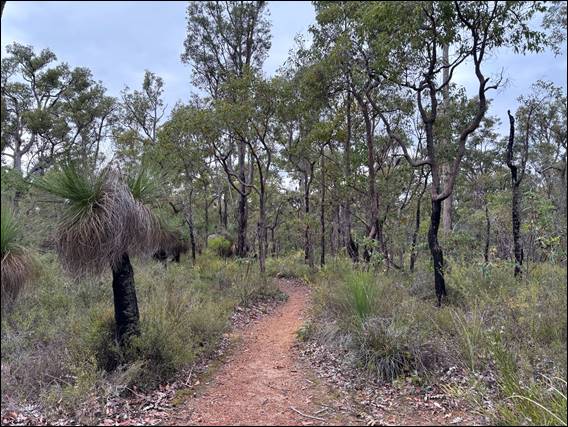
When something like this happens I tend to dig into a particular genre a bit more. For shell orchids there are two other species that can be found round here. Maybe next year I’ll try a bit harder to see if I can spot them. Saturday was the first day of Lisa’s break from school, and with a forecast dry morning I suggested a wander. This meant she didn’t have enough time to reheat her core after the usual 7am bob in the ocean. So rugged up in her buffalo we had the heating on in the car as we drove along. On arrival and she was still cold, while I felt hot:

Despite being a bit hot I still donned my buffalo when we got out of the car. It was a cool morning. I imagine it was a very cool dip for Lisa in the ocean too, something that really does not appeal to me. Armed with a hot sippy cup of tea to help heat her up from the inside, we set out on the flower walk at Crooked Brook. I was keen to check out the lateritic country. And as per my above chitchat, I wasn’t expecting too much. Although with a bit of luck there may be a Blue Fairy out, a lonely species seeing there is only one in the pheladenia genre:

While it is winter the Scarlet Kunzea (Kunzea baxteri) two images up, is known to flower from July to September but can be seen in bloom earlier. We are lucky to have relatively quick access to different land forms and geology, which helps to mix up what we might see. This one is an endemic myrtle of the south-west of Western Australia, found near granite outcrops and hills. That said it is also a very popular cultivated plant, so is not really an uncommon find. It did however add a splash of colour to the otherwise mostly brown and green bush:

Not surprisingly the ground was littered with fungi, lots of regular finds and a few not so. I’ve limited my images to mostly the ones I have managed to identify. Two images up is the not so exciting Field Mushroom (Agaricus campestris), a well-known edible species for the fungi aficionado. But for a lesser person such as myself I would not risk it. There are, of course, some similar poisonous species. The above was the fungi of the day with its vibrant purple coloured cap, more interesting to observe due to the slime coating that made it glisten:
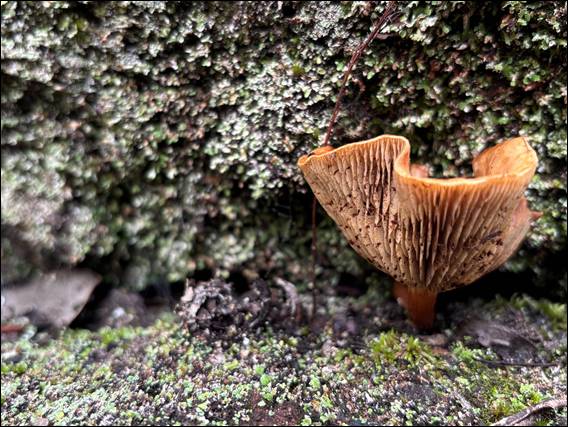
The above is nothing new, but I did like the way this Terracotta Mushroom(Lactarius eucalypti) was framed against the moss covered fallen limb. With its cap, due to the stem having come up next to the limb, being forced outwards and also upwards in a fan shape to expose its deep and well-spaced gills. The next image is of a Fleshy Cup Fungus (Aleurina ferruginea), something I have been keen to see for some time but have never really known what to look for. This may sound strange as it looks quite distinctive:
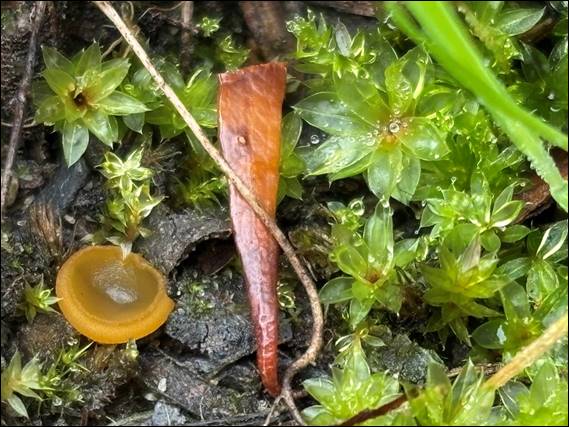
But sometimes until you have seen something for the first time it seems impossible to find. Then suddenly you start seeing it everywhere. I only spotted it as I was looking at a much bigger fungi specimen. Afterwards, due to its size, I didn’t find them everywhere. The cup of this fungus was only half a centimetre in diameter, and they do not get a whole heap bigger. So unless you get down and look closely it is easily missed, despite it lovely colour. It’s funny as Lisa has in the past told me I also need to also look up and see the wider views:
It is true that I tend to keep my head down looking at the ground for the hidden finds. However, knelling down and observing the Fleshy Cup Fungus there is yet another scale beyond that, still available to the naked eye. The beautiful green and almost translucent leafy moss in which it was sat was equally amazing. It is likely to be a moss of the Rosulabryum genus, of which there are three main species in this area. Based solely on how commonly it is found I think this one is going to be the Twisting Thread Moss Rosulabryum torquescens:
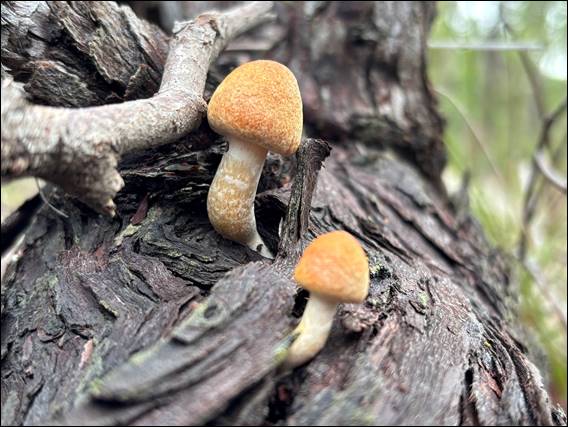
So do you hike and look at the big stuff, wander slowly and look at the smaller stuff, or scour a confined area looking for the micro sized gems. The latter is probably something for me to spend my own time on, while I can get away with the other two when out walking with Lisa. There is one more image of a fungi that we have gone past as I ramble on, and this one I have not been able to identify. Despite the delicately coloured and evenly textured dome and matching mottled coloured stem, I’ve had no joy in pinning this decomposer down:
Lisa sent me a great cartoon once to show what it was like to be out on a walk with a botanist, not that I profess to being one. At best I would say I’m a very amateur scaled enthusiast. But I reckon it would be a step backwards to ‘walk’ with a mycologist. I’ve refrained from expanding my arsenal of research tools to more books or potentially identifier apps. While it may aid my ability to work out what I have found, it would open up whole new world. One that would no doubt only result in me slowing down on the track even more:
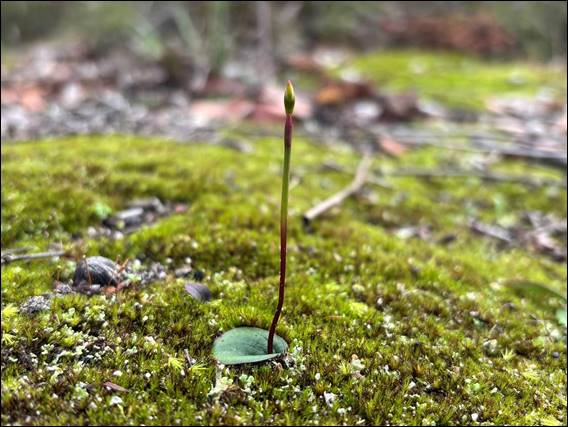
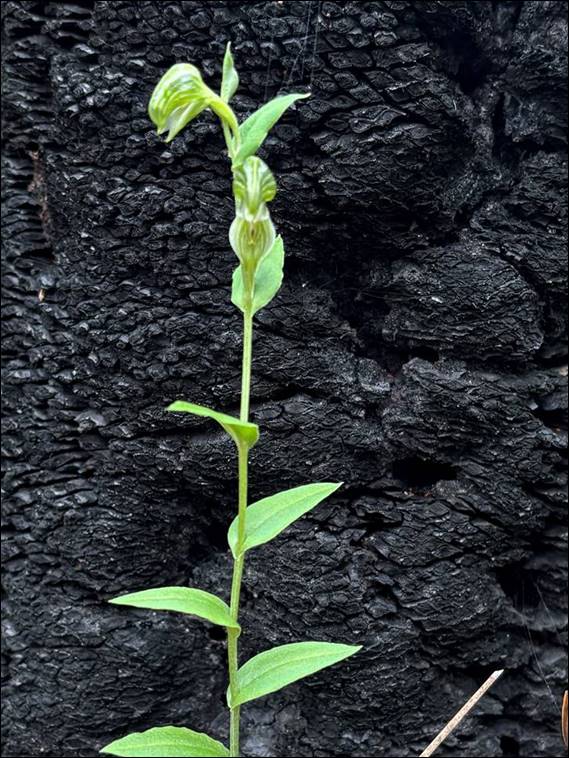
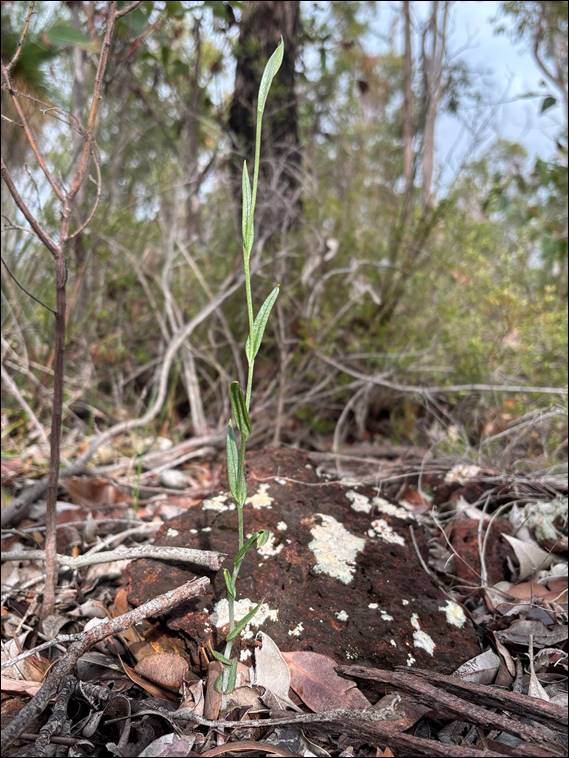
Moving on, as we must. I have included the few orchid specimens we spotted. A single Banded Greenhood (Pterostylis vittata). Common as they are to see, I liked the image due to the background of the brunt stump of a Grass Tree (Xanthorrhoea preissii). One of ten species of grass trees found in the southwest of Western Australia. Next is my first and only sighting of a Jug Orchid (Pterostylis recurve) this year. A few weeks away from blooming, and again a common species to see. Finally a tiny Slender Hammer Orchids (Drakaea gracilis):

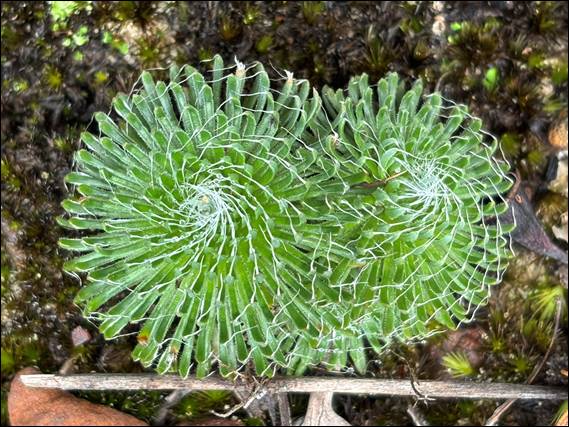
One of two spotted, at least I am assuming that is what it was. The Slender Hammer Orchid is a bit tricky to differentiate from the Warty Hammer Orchid at this stage of growth. The former is however more likely to be found in mossy ironstone environments. Only time will tell if I am right. Onwards, passing the above lookout where we stopped for a while, the last image is of a plant Lisa particularly liked. The basal leaves of a Golden Triggerplant (Stylidium ciliatum), which when we come back in spring will have lovely white, cream, or yellow flowers:
 Sandbagged