The Peppy Plungers only dared to go into the water waist deep this morning. It was a tad wavy, and the less than ideal weather continued into the morning. On her return Lisa and I pottered about and finally got round to breakfast as we played a game. When she then hinted it was time to hit the books to prepare for next week’s study load, it was the perfect segue for me to head out the door. Armed with a brew in my sippy mug, and not put off by the patchy rain nor the rainbow that hung low in the sky over the Capel Nature Reserve:
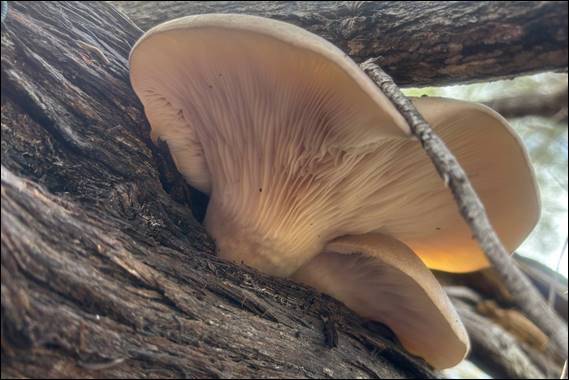
The wet weather of late had started to bring out some familiar fungi. The above being an edible Southern Oyster Mushroom (Pleurotus ostreatus), if my identification is correct. As I just had breakfasts I felt no need to test that. This species crosses over two of the three main types of fungi, being both a decomposer and a weak pathogenic. Due to being found on both dead and live wood, but more generally the former as it was today. Decomposers are an essential part of the forests ecosystem, breaking down dead organic matter to make it more bioavailable:
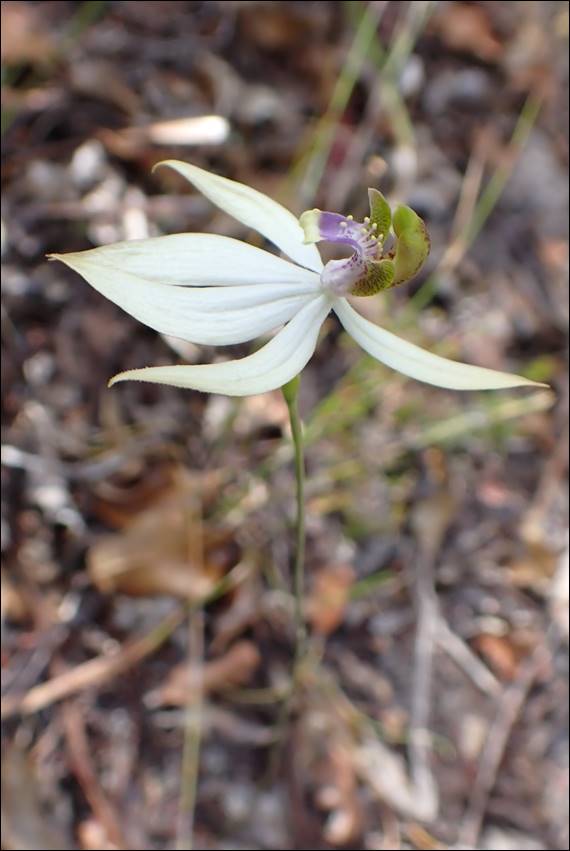
Needless to say pathogenic, or disease, fungi have a negative impact by invading and often killing their hosts. This can be trees, insects, and/or other organisms. As for the third main type of fungi, I’ll get to that later. A few weeks back I thought the first orchid spike I saw, as shown in the second image of this post https://sandbagged.blog/2025/04/12/the-tortoise-and-the-hare/, was a Hare Orchid. Much to my surprise and delight it was in fact the above Leafless Orchid (Praecoxanthus aphyllus). Only the second one of these that I have seen:
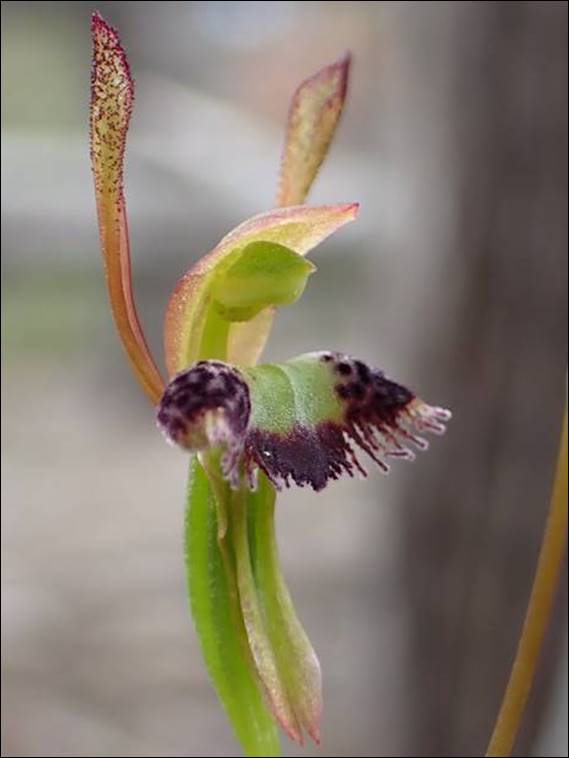
There were many Hare Orchids (Leporella fimbriata) in flower today. Lots in full colour, not just sporting the beard that gives this orchid its species name of fimbriata, a Latin word meaning fringed, but also having the delicate spotted pattern on the side of the broad labellum on proud display. During recent wanders its amazed me how rare it is to find any insects, so I was happy to come across this one. Even when, after a lot of digging about, it turned out to be nothing more than a Common Gum Tree Shield Bug (Poecilometis patruelis):
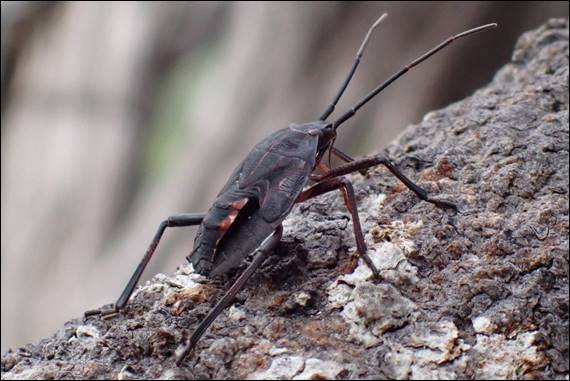
There are many genera and species of Shield Bugs that like to live on gum trees, and they share many similarities. The way to tell them apart, like some orchid species, is the detail. This can be the wing numbers and arrangements, segments of antennae, and placement of mouth parts. This one was a bit trickier, being in the nymph stage. From the time of hatching they go through up to five nymph or instar stages, each time moulting their exoskeleton. Not getting their wings until they become adults, and I’d suggest this one is at the 5th instar stage:
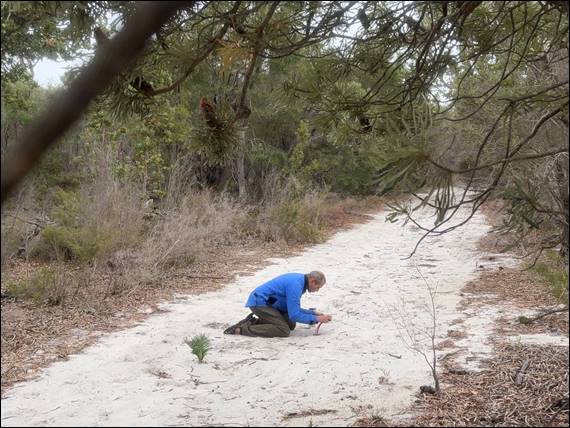
After a while I followed a track toward an area I’ve not been before, marvelling at the patches of little basal leaves that I recognised as Hare Orchids. And then I noticed the ones shown below, which are from the Glossy-Leaved Hammer Orchid (Drakaea elastica). Just a few weeks back I discovered that they are located in the general area, but I’ve never seen them. With only 42 known places in which they are found and a total population size of around 230 plants across these areas, they are listed as “endangered” by the state and federal government:
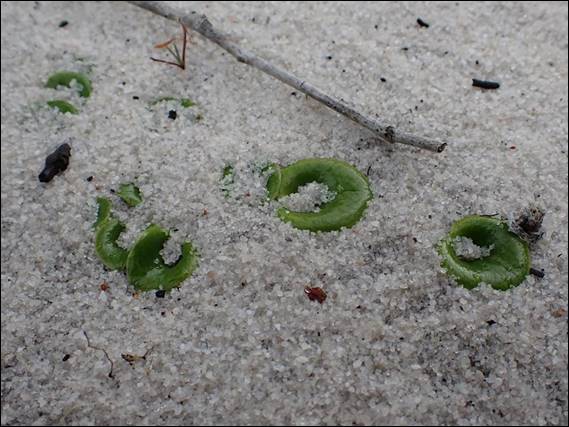
This listing means the probability of extinction of the species in the wild has been assessed to be greater 20% within in 20 years or within 5 generations of the species, whichever is longer. Hence why I was so delighted with my find of ten plants, and I went so far as to mark a pin of the location. I will however have to wait till September or October to see if any of them flower. Next up is a fungi belonging to the third main type, a mycorrhizal or symbiotic fungi. Without these many plants and animals would struggle to thrive, so they too are essential:

This one is an Erupting Russula (Russula erumpens), bursting into the light from under the earth. Fungi in this type can act like a secondary root system, extracting nutrients from the soil and supplying them to plants, including orchids. In fact many orchids are highly reliant on specific fungi, just like they are on specific insects to pollinate them, another area of their fascinating life I have yet to delve into. In the world of conservation and management we often refer to flora and fauna, many feel it is time to change that to the three Fs of flora, fauna, and fungi:
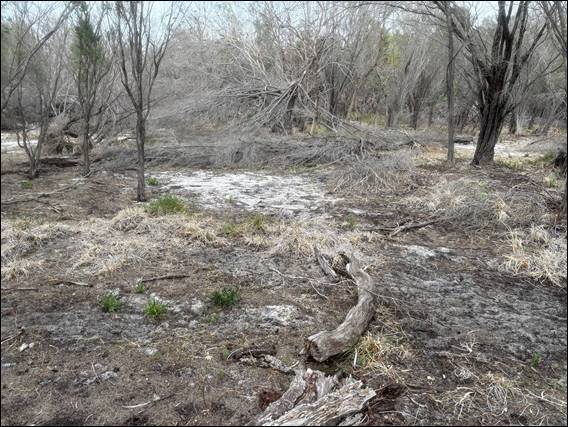
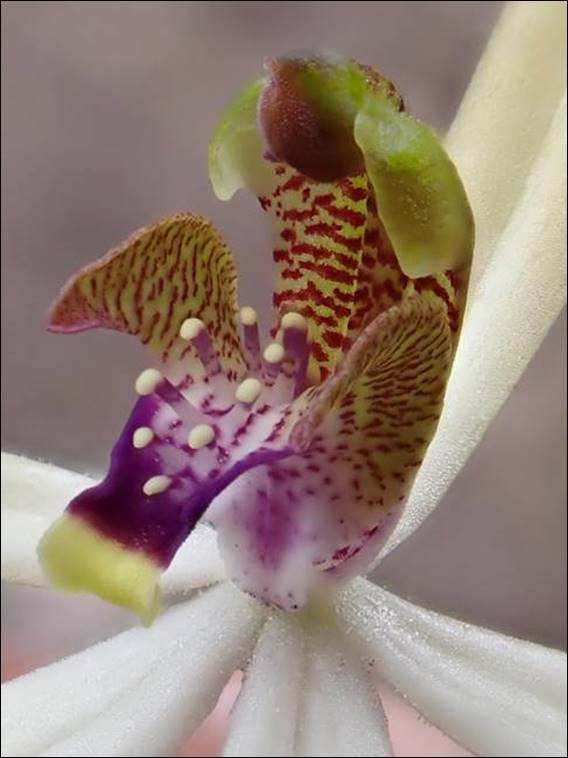
Deep into my second hour or walking, and to be honest I had no idea I’d been wandering about that long, I almost missed a second Leafless Orchid. Not that they are easy to spot, it’s there in the above image if you can see it near the base of the picture. This one was more mature, with petals that had a bit more colour in them. These orchids are highly fragrant, to help them attract native bees for pollination. The purple labellum has yellow calli to resemble pollen-bearing stamens, but there is no nectar so any bees attracted by the scent get no reward for their services:
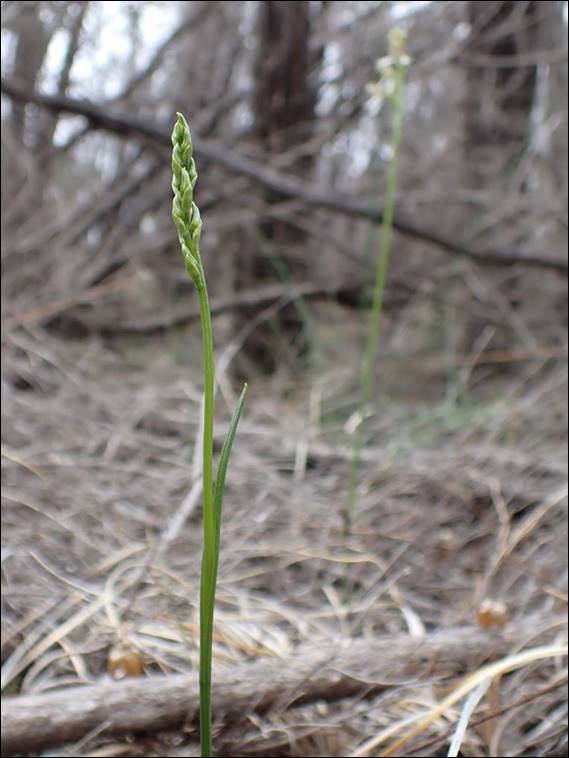
For my last image, I found one Scented Autumn Leek Orchid (Prasophyllum sp. ‘early’) starting to bud. These flower in autumn, April to May, and should not be confused with the similar looking and incorrectly named Autumn Leek Orchid (Prasophyllum parvifolium). Incorrect because it does not flower until winter arrives. In the background was one of the many Common Bunny Orchids (Riochilus dilatatus subsp. Multiflorus), showing why it is named so. The most number of flowers I saw on a single plant was six, a far cry from the twenty flowers one plant can have:
 Sandbagged