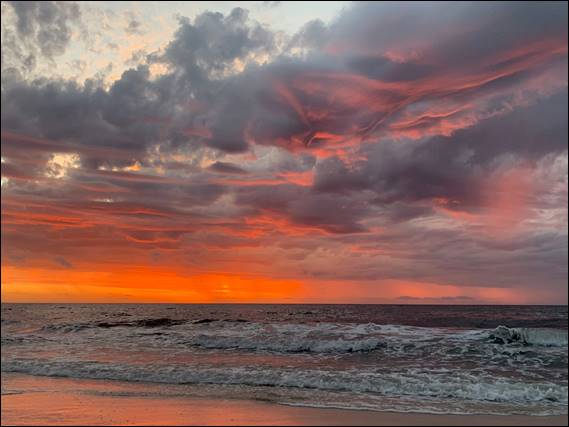
The sun is rising later and once up staying lower in the sky. The swell is also looking that bit bigger and as a result the beach is transitioning towards wintery conditions. The writing was on the wall and the snorkel gear was packed away last weekend. It has been a pretty disappointing season for swimming with the fish. But when you get to see the sky as it was when Lisa and I took the poodles down the beach on Wednesday night all that was forgiven and forgotten. It is still a glorious place to be even if the underwater visibility was pants:
I’ve now shifted my gaze to terrestrial treasures. Having had several wanders at the Manea Park and the Cape Nature Reserve. My first trip to Manea Park, conveniently on the way home from work, didn’t yield any flowering orchids. But I did enjoy watching the bees bury themselves deep into flowers of this Swamp Banksia (Banksia littoralis). A species endemic to the south-west of Western Australia, which I’ve read may be a bit more resistant to dieback than other western banksias. A good thing considering the impact the disease is having:

Manea Park is well known for its biodiversity and boasts quite a range of banksia species. While the above Swamp Banksia was in bloom many others were not. The various species flower anywhere from late summer through to winter, with some species flowering as late as spring. Another plant out in flower, this time of the Orchidaceae or orchid family, was the Common Bunny Orchid (Eriochilus dilatatus subsp. multiflorus). On my first walk I only found one spike with no flowers, but during the next wander I found a couple of plants flowering:

There are six species of white bunny orchids, including six subspecies. Each having flowers that look very similar, and the best way to distinguish them are by the stems and leaves. To date I’ve only found two of the subspecies. Then there are the pink species, and I have never seen any of them. The pinks generally only flower after a hot summer fire, so tend to be more difficult to track down. For my next adventure I decided to try a bit of night time herping. On advice from Sarah I headed out all hopeful at 8pm to the Capel Nature Reserve:

I spent in excess of an hour, wandering round checking the leaf litter, trunks (live and fallen), and foliage. Wondering what insects and/or reptiles may come out at night for a feed. The answer, at least from my observations, was none. Not even a possum, kangaroo, nor wallaby could be heard or seen. In fact it was deafeningly quiet, as I slowly walked round keeping an eye on where the beam of my torch landed. The only find being a solitary Common Bunny Orchid, whose subspecies name comes from a Latin word that is apt and should be obvious:
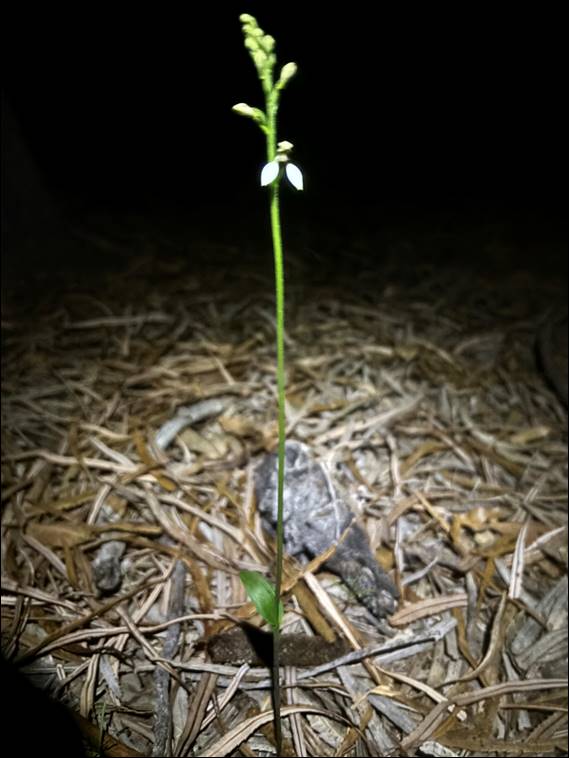
The common name of common is also apt. Today when Lisa I wandered round the Ambergate Reserve we spotted a good number of them. I won’t lie and got a little excited when I thought the leaf of a few specimens indicated I’d found a different subspecies, but that was never the case. As it warmed up we caught the movement of commonly seen Buchanan’s Snake-eyed Skinks (Cryptoblepharus buchananii), scurrying off the path and through the leaf litter. They hunt small insects and are very agile, even being able to leap into the air to catch flies:
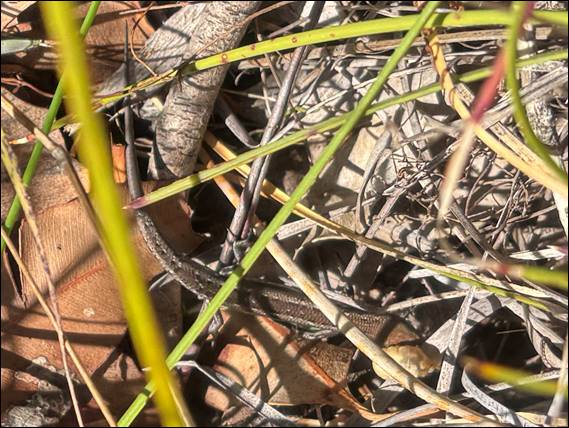
The above one is carrying a snail, and once happy we were not going to intervene or come any closer it allowed us to observe it nibbling away. We sadly didn’t spot any bigger reptiles, but this flower caught my attention. Looking to be sprouting straight out of a tuber. It was not till I got home that I spotted the leaves of a sundew round the base. Not yet fully matured, and as such not creating the distinctive rosette of sticky leaves of this carnivorous Drosera rosulata. Yet another plant that is endemic to southwest Western Australia:

The next find is however not endemic, being introduced. Although I have no idea of when or whether by accident or on purpose. Native to North and South America the Banded Orb Weaving or Banded Garden Spider (Argiope trifasciata) has successfully spread round much of the globe. I’ve seen one before, so if you want to see the distinctive pattern of the top of the spider check this post https://sandbagged.blog/2022/04/07/the-beach-shack/. I liked this image that shows the zig-zag pattern of the stabilimenta, i.e. web decoration:
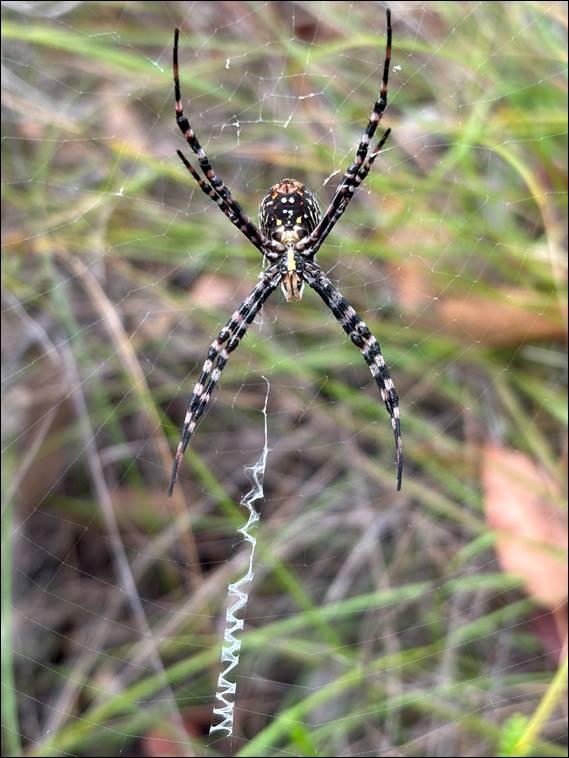
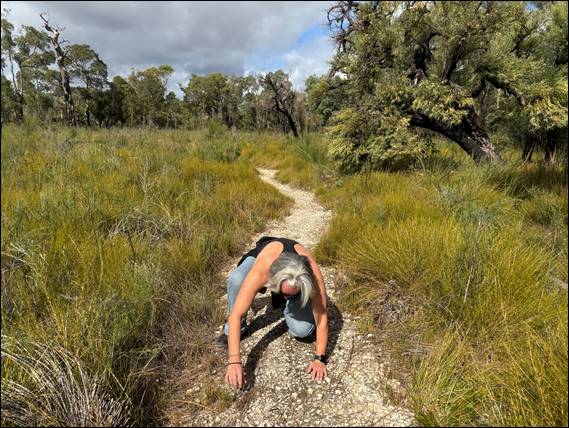
The feature is not made of the same silk that the web is constructed, and isn’t even sticky. Its purpose is not clear. Some say it could be used to attract prey while others think it may provide a degree of camouflage, although I don’t see that. We also spied quite a few Australian Golden Orb-Weaving Spiders (Nephila edulis), and the path had a fair few of these much bigger webs spanning across the track. Not keen to walk into them, Lisa kept a careful eye out to try and avoid disturbing them. On occasion taking a bow, as we crept under them:
 Sandbagged