Encouraged by yesterday’s ocean conditions, which had finally settled down to what we would normally expect it be like, I decided to walk past the point to the more intact reefs. I could have driven. A sand bar had formed across the Capel River mouth. as usually happens during the low rainfall period of the year. What with my sedentary job, I didn’t mind walking down and it was only a couple of kilometres. Beside if I drove I’ve have to let the tyres down and then pump them back up, and that becomes a phaff that I just can’t be bothered with:
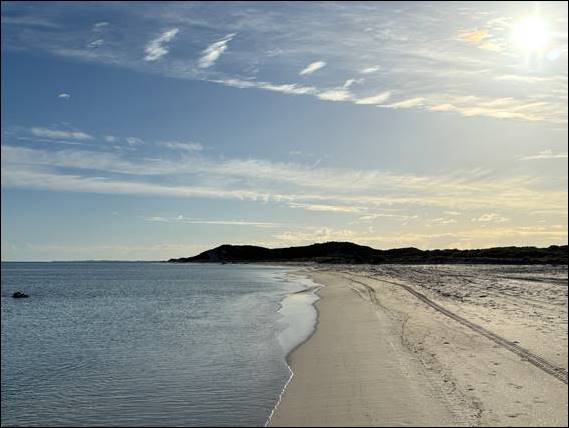
Only a few cars were parked up by the water’s edge as I wandered along. Most people were fishing, using a rod and reel. One person however was using a drop net. If you look carefully you can see where he is aiming for, the surface being broken by the fish as they nibble at the bait he’d thrown in. This reminded me of when I watched this technique being used in Ghana. One part of my role was installing dry season gardens, which required us to install pipes through the walls of existing dams. This of course meant lowering the water level:

We held community sessions to warn of over fishing the reservoirs as it became smaller, but it was hard to prevent the onslaught. The main fish being catfish and tilapia, and the fish stocks took a serious hit each time. I’ve read that tilapia is estimated to provide 60% of the protein intake of Ghanaians, being one of the main staple foods. In 2012 the Global Affairs Canada invested significant funds to boost the tilapia market in both the Upper East and the Upper West regions, I lived in the latter. I wonder if any of the villages I worked were included:

One day I hope to dig out my dairies and slides, and write about my two years in the Upper West region. But for now my head was underwater. Yesterday in boardies I got goose bumps as I snorkelled, so today I wet-suited up hoping that would also keep those stinging filaments at bay if they were about. In writing this post I have looked back through past finds and found I previously used a very similar image of the above impressive plate coral. I guessed back then it was of the Astreopora genus, and like then haven’t managed to pin it down any further:
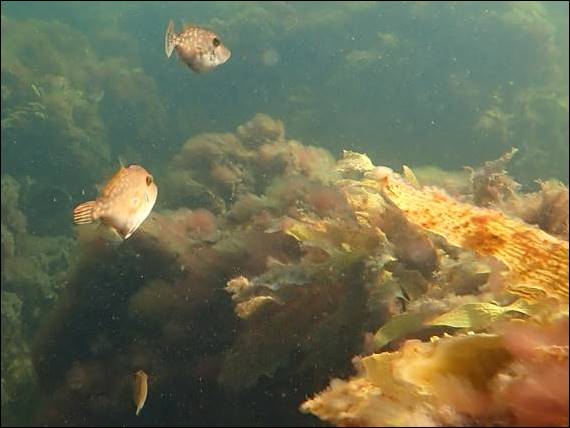
Despite being great conditions, and this reef being way more intact, the fish life wasn’t up to its usual standard. Even checking in the caves and under ledges there was very little to be seen. A few fish that were out in numbers were the Western Gobbleguts (Ostorhinchus rueppellii) and Banded Sweep (Scorpis georgiana), the latter following me about in case I stirred up the sediment and released a tasty morsel. Above there were also quite a few juvenile Horseshoe Leatherjacket (Meuschenia hippocrepis):

For a while they had me guessing as the body shape had a distinct lobe where the pelvic fin usually is. However, they had the namesake horseshoe marking on the midside and it seems as they mature this lobe is drawn back into the body. Unlike yesterday’s Spinytail Leatherjacket (Acanthaluteres brownie), these were less inclined to allow me close. Something I’d observed when I last wrote up about the Spinytail Leatherjackets. Another fish out in numbers were juvenile Brownfield’s Wrasse (Halichoeres brownfieldi), shown above:

Wrasses generally do not group, or shoal. The Brownfield’s Wrasse breaks this rule with both adult and larger juveniles commonly forming large schools. I gave it a good half hour in the deeper water. Hoping that a shoal of bigger fish might appear or that I may stumble across something bigger. It was not to be. So I wandered towards the shallower reefs, where eye-popping colours greeted me. Maybe due to having less of a water column to hide in, things came into sight. Such as these juvenile Silver Drummer (Kyphosus sydneyanus):

I did wonder about these as the back of the tail was not fully dark, as my research indicates they would normally be. Then I noticed how many of the drummers look alike, and also cross over in their range. Two species are found further north, but with warming seas they may be drifting down. Then some thirty years back a new species was identified that shares the same range, and looks to me practically the same. Despite my research I was not able to confirm if this was a juvenile of a different species, so I am left guessing:
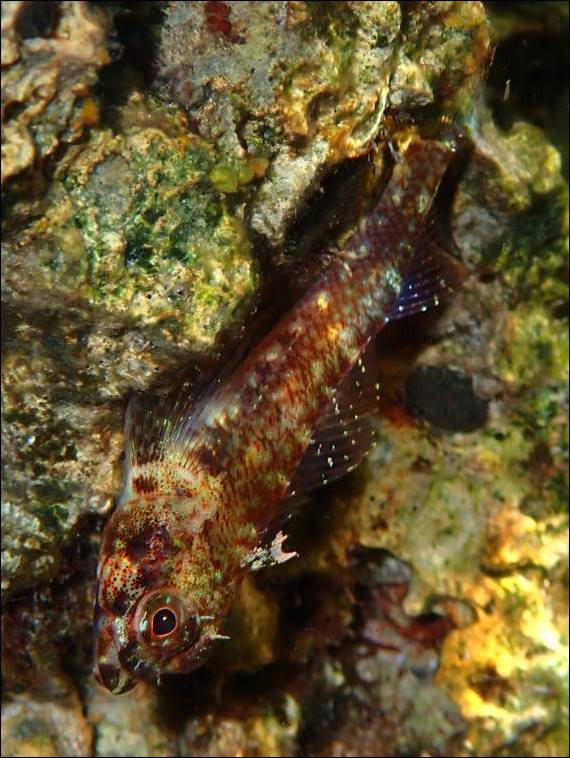
The shallows allowed me to get close up, and above is a Leeuwin Triplefin (Norfolkia leeuwin), only two inches long. Again looking back I may have seen this before. This time noting it is missing the bands on the face, I had incorrectly identified it back then as the Common Threefin (Forsterygion lapillum). Below is an Eleven-armed Sea Star (Coscinasterias muricata), nothing new but being so shallow the colours really stood out. Next time I get such a chance I need to look much closely, as it has small appendages with claws round the spines:

I’ve zoomed in but the image quality is not good enough to see them. These small claws are used for defence but also to catch food. Holding on to it until it dies or one of the many arms can reach it and pull it towards its mouth. Another interesting fact I found out is that smaller specimens can split themselves in half. Each half then regenerates the missing tissue, a form of reproduction called binary fission. Larger specimens reproduce by releasing sperm and eggs into the sea, as to why it uses two methods at different periods of its life is not clear:
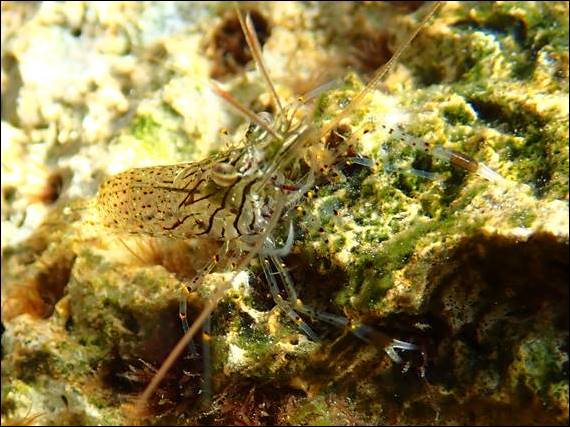
Above is what I had previously thought may have been a type of Boxer Shrimp, it is however a Red-handed Shrimp (Palaemon serenus). Being so named due to the red marks just above the claws, which are on the elongated second pair of legs. This is where it gets it’s common name from but the scientific name comes from a Latin word serēnus. This means clear, bright, serene, tranquil, or calm. Quite apt for today’s dive. I got out, due to feeling a little chilly, after an hour in the water and even after I had walked back, the water still looked serēnus:

 Sandbagged