I bumped into a long term local when I came out of the water after the dive in which I saw the least, out of my three recent dips. They told me of memories of diving here in the 80s and seeing abundant and diverse marine life. Claiming something changed in the 90s, and since then the underwater ecology has never recovered. This made me want to see if I could pin down something that could have resulted in such a change. I’ve heard commercial seine fishing is to blame, which uses a vertical net with weights on the base and floats at the top:
The net is placed in the water to create an enclosed areas. Off our beach one end of the net is held on the beach, a boat takes the rest out and drops it in a large arch bringing the other end back to beach. The net is then dragged to shore. This technique can disturb the life cycle of fish if carried out in spawning or nursery grounds, or by capturing juvenile species of fish that stay close to the shore. This practise has however occurred here for decades before the 90s. It is also restricted to specific areas and times of the year, presumably to lessen impacts:

Other risks to the environment are the sediment and pollutants that come out of the Capel River. This historically didn’t directly connect to the ocean, instead flowing south west through a series of wetlands behind the primary dunes. Eventually meeting the ocean via the Wonnerup Inlet 12km along the coastline. To assist in draining the land cuts were made through the primary dune, with two in close proximity. The first, in 1865, was call Higgins Cut, which has a Grade A heritage listing. This no longer has direct connection with the ocean:

The second was called McCourt Cut, constructed approx. ten year later, and is where the Capel River now flows. This cut does not have any heritage listing, but is still connected to the ocean with seasonal closures due to band bars forming during low flow periods. The drainage enables agricultural land uses, and a pathway for organic matter to enter and significantly change the local marine ecology. This change occurred over a hundred years before the 80s. Although more intensive agriculture has been adopted with time, which may contribute:
So it was back to the drawing board. A 2019 report provides a review of the ocean temperatures round Australia. The data from 1870 is not surprisingly coarse, but three stations provide fine scale data since 1940. For the South West, between 1930 and 2019 there has been a steady increase in temperature of approx. 0.8 degrees with no notable sudden changes during this period. Again drawing a blank, I noted the residential properties were first created in 1965, and development expanded from 1975. So maybe this is the cause:
After all the area does not have reticulated sewer, so all our waste is infiltrated into the dunes and through the groundwater system is connected to the ocean. It’s hard to pin it down a definitive cause. It is more likely, based on what I’ve read, to be an accumulation of land and climate factors. As such I have been unable to verify the claim that there was a significant impact of change in the 90s, by the local I bumped into. It has however finally made me look into this a bit more, so when people make random claims I am a bit more informed:

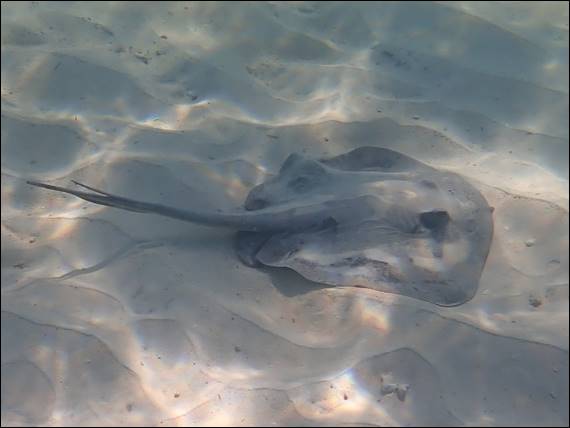
Regardless of the state of the local area, I’m still getting out there to see what I can find. With a recent low’ish swell period during my first dive on late Thursday I saw a fair bit, despite the surface bobbing up and down. The first image is of a Juvenile Smooth Stingray (Bathytoshia brevicaudata). Also known as a Short-tailed Stingray, with the species name coming from brevis and cauda , meaning short and tail in Latin. As it swam off, a small school of Tarwhine (Rhabdosargus sarba) crossed between us. At only 15cm long they too were juveniles:
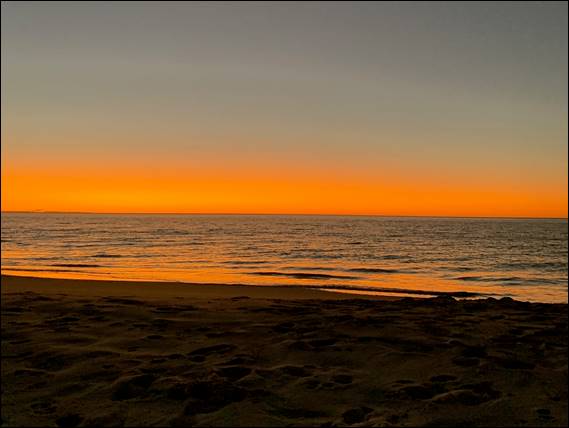
As I came back to shore and right off the beach a Southern Bluespotted Flathead (Platycephalus speculator). This too was quite young being only 30cm long, which is a third of what they can grow too. Speculator is Latin for explorer, searcher, and investigator. It is said this may have been used because this species has larger eyes than others. Later in the day Lisa went for a sip and dip with the Peppy Plungers, and took the sunset image. Telling me when she got back that the water looked flat and very snorkelable, however I would disagree:

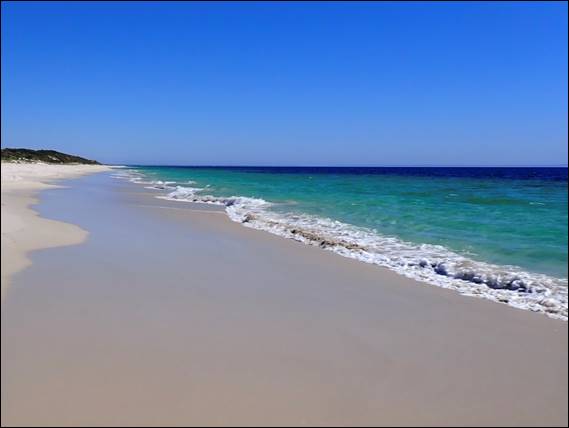
The next image explains why. The flat surface occurs when there are no wind waves. These are created by local winds and are choppy and frequent. The other factor is swell, which is generated by distant winds and results in water movements that are smoother and more spaced. One way to check for swell on seemingly calm days, is to see how far up the beach the water goes, and it was coming up a long way. On Friday the swell and wind waves, as shown by that and the next image, were against me but I chanced is anyway:

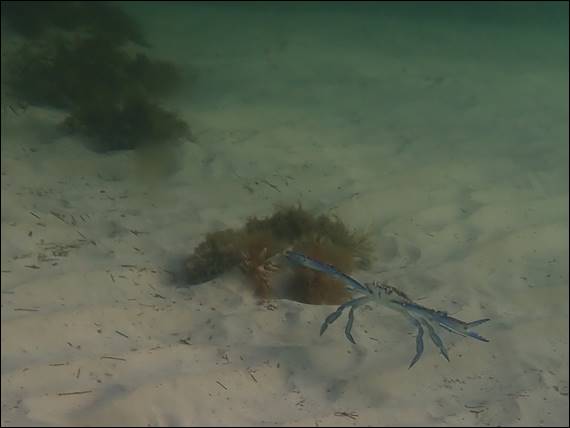
Lucky enough to spot a dolphin swim past me, but there wasn’t much else. Not one image was taken. I guessed they were staying protected in amongst the crevices and caves of the reef. Not put off a Saturday morning dive seemed in order. Providing the calmest conditions, and almost immediately I saw a Blue Swimmer Crab (Portunus pelagicus). Hop and glide away from me before standing its ground pinchers stretched out and ready for action. Next a small Striped Stingaree (Trygonoptera ovalis) remained calm and allowed me to get close:
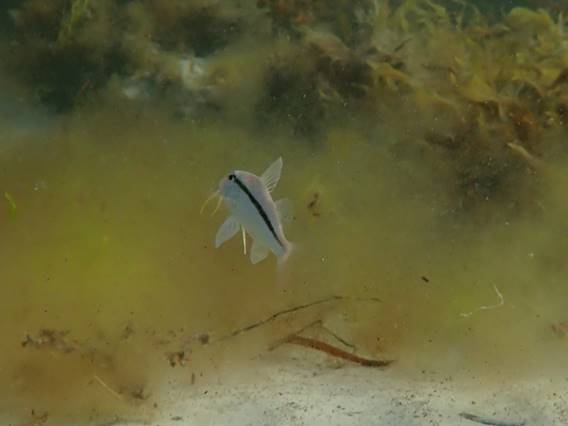
Fish that did not darting for cover when I got close were Old Wifes (Enoplosus armatus), Magpie Morwongs (Goniistius gibbosus), Globefish (Diodon nicthemerus), Horseshoe Leatherjackets (Meuschenia hippocrepis), Western Talmas (Chelmonops curiosus). The last ones looked to be playing chasey, although I have read they are pretty territorial so it may not have been playful. In the above images are an adult Moonlighter (Tilodon sexfasciatus) and juvenile Bluespotted Goatfish (Upeneichthys vlamingii), which also shows a cloud like algae:
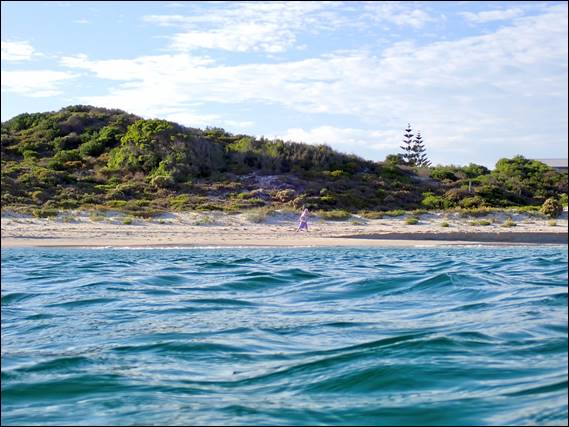
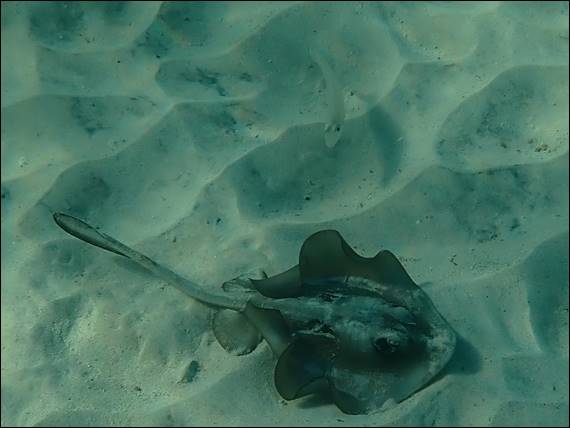
This algae seems more prolific this year, a sign of poor water quality. Above Lisa was walking back from her Saturday morning dip with the Peppy Plungers, where just earlier commercial fishers had driven looking for a likely catch. Reminding me of two of the probable causes for the ecological decline. My exit was delayed by this very young Striped Stingaree displaying its flexible margins. So flexible that it is the most agile stingaree species. A juvenile Yellowfin Whiting (Sillago schomburgkii), which are known to shelter along shorelines, also watched the display:
 Sandbagged