Not for lack of trying it has been close to two and a half years since Kym and I have managed to catch up. To be honest I was a little shocked when I realised just how long it had been. My memory has failed me, and I have no recollection of what went wrong the last time in Nov 24. Luckily for me, Howsie had also been keen to tag along meaning that trip down south still occurred. We just didn’t see Kym. This time Howsie was again keen to join in the fun, as we again attempted to reconnect with our elusive south coast friend:
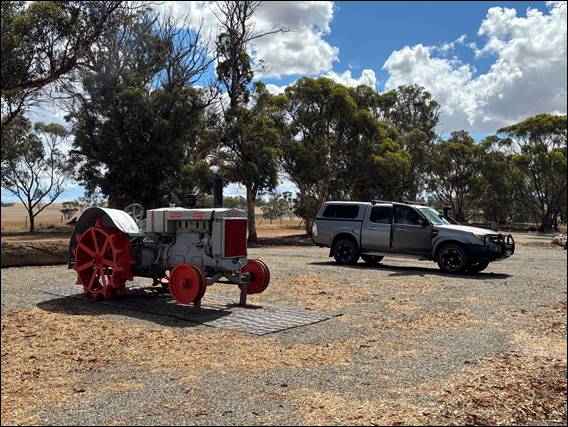
The journey was somewhat longer this time. Kym and his family having made a move from Albany to Ravensthorpe. This meant a slightly more inland road heading that bit further east for some six hours. With part of the journey following the Horsepower Highway helping to break up the scenery with a range of vintage and quirky tractors. There are currently twenty seven, not that we saw all of them as we didn’t drive the full 75 kilometre trail. Turning off when it headed south to the Stirling Ranges, so we could continue our journey east:
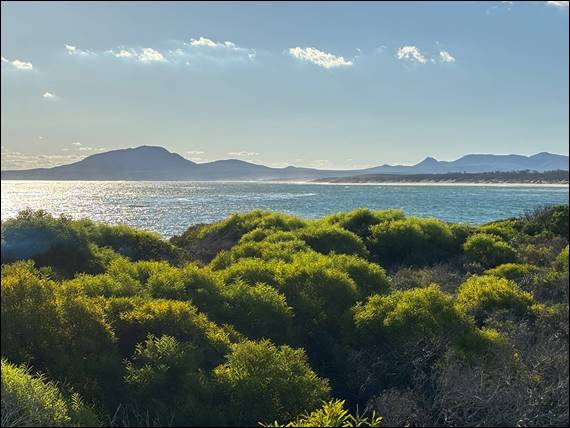
Our destination was not Ravensthorpe. Kym and Meg’s house was full this weekend with family visiting, so Howsie and I booked into a caravan park in Hopetoun. On the eastern edge of the mighty Fitzgerald River National Park. So vast that it stretches all the way back west to Bremer Bay, where Lisa and I had headed to a few years back for a very relaxing get away. The distance between the two towns being 85 kilometres, as the crow flies. The park covers some 330,000 hectares, but that is not the only impressive number it boasts:

It may not be the biggest national park in Western Australia, but it is the most botanically significant. In fact it is a well-known for being a haven for botanists. Containing a whopping twenty percent of the species described in Western Australia. And of the near 1,750 plant species identified here, so far, a staggering seventy five percent are endemic or in layman terms only found in the general area. With approximately 250 being very rare or geographically restricted. Needless to say a trip in spring time will definitely be on the cards:
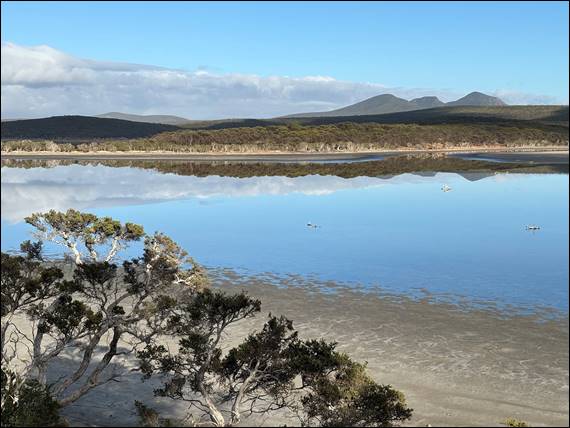
As a result of its size there are three Noongar groups recognised as traditional owners of the Fitzgerald River National Park, being the Goreng, Menang, and Wudjari people. While the coastline was explored by the Dutch, British, and French in 1627, 1791, and 1792 the likely first non-indigenous explorer was William Baxter in 1823. Who was aptly a plant collector, lucky enough to stumble on what is now a listed International Biosphere Reserve. Kym is relishing all the amazing natural wonders in his new playground, and kept reeling off facts to us:

The only plant I will mention in this post is the above Royal or Lantern Hakea (Hakea victoria). It was first recorded by western society in 1847 by botanist James Drummond, who wrote ‘The variegation of these bracts is so extraordinary, that I almost fear to attempt a description’. The leaves may have a cabbage-like appearance, but seen at the right time of the year the leathery and veined leaves can display striking colours ranging from green to yellow, orange, and red. This plant is known to grow in quartzitic or lateritic soils:

This gave us a hint as to the type of rock we may encounter, although just like the flora here the geology across the park is also quite varied. We were however sticking to the confines of the coastal crags. These are made from the younger rocks in the area, being a mere 1100- 1800 million years old. Best described as metasedimentary rock, they started out as siltstones and sandstones. After being placed under extreme heat and pressure they were transformed into Phyllitic Schist and Quartzite, in formations that tilt towards the land:
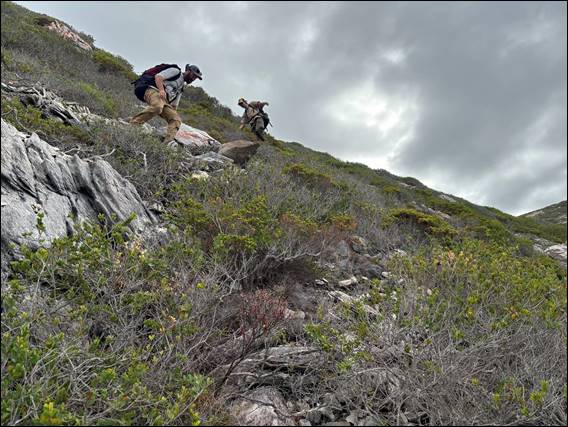
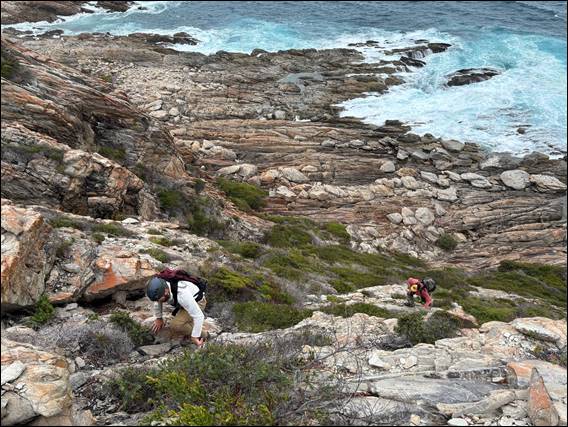
This was my first time of coming here, and Howsie had only driven through once when he was on the road with the family. As such both of our eyes were popping out of their sockets at the vegetation, while our minds were racing as to what we might encounter in terms of rock features to climb. And it has to be said the landscape is also pretty stunning, resulting in our drive in on the first morning being made all the bit longer due to stopping here and there to take it all in. The coastal foreshore is mostly elevated, providing wonderful panoramic views:

Steep inclines dip down to a mostly rocky shoreline that comprises bays in which beaches have formed. Erosion over time has resulted in scattered cliffs of various sizes, as opposed to a continuous rocky defence against the ocean. While this was all new to us, Kym had been provided some intel from Lord Jim. A long, long, long time explorer and climber of the amazing places the great southern region has on offer. As such we did have a notion of where to head and how to get there. That said we took our time and were careful:
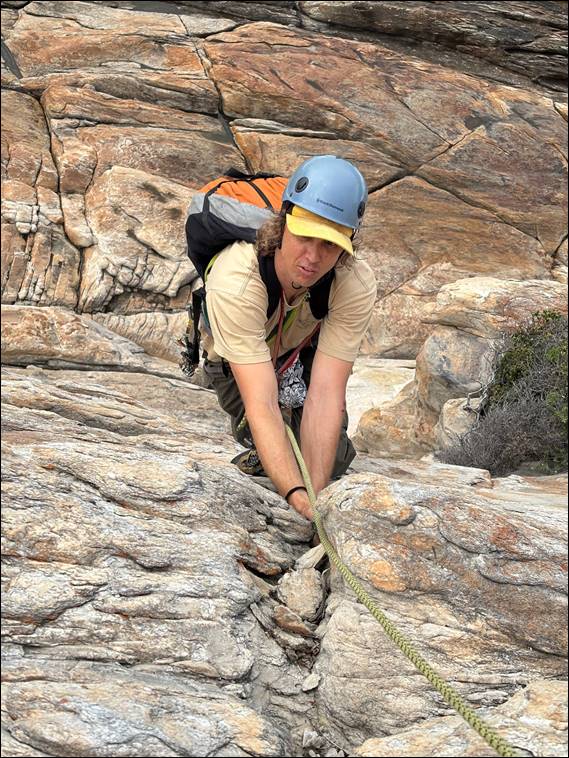
It was important not to go crashing in. The delicate environment here, as with so many placed we go, is at risk of Phytophthora dieback. It is recognised as the biggest threat to biodiversity in Western Australia. We needed to be, and were, cautious in our approaches. Scoping the way down to the shoreline to avoid vegetation and soil, by sticking to places with exposed rock, as much as possible. This was an adventure trip after all, and that meant slowing down. Our enjoyment being measured in far more ways than the meters we managed to climb:

From the top of the ridge, the cliff we were aiming for looked small. The size seemingly growing as we approached, and with the finer features becoming more apparent our finger tips started to tingle at the thought of what might be possible. I was lucky enough to be first to rack up, and had my sights set on what looked like the line of the crag. Kym and Howsie looked at it a bit more cautiously, suggesting we should maybe start on something a little more forgiving. Holding my urges inside I went along with it, and so became Ease Up:
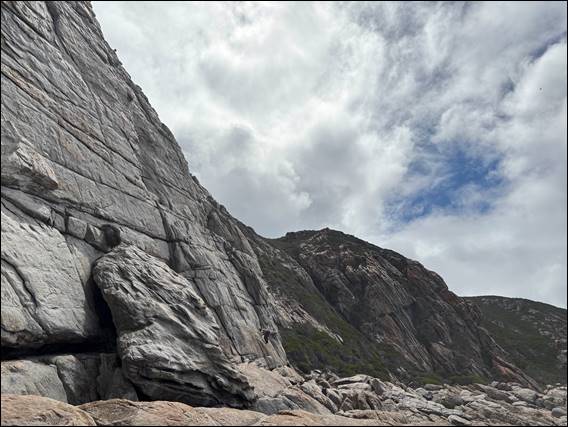
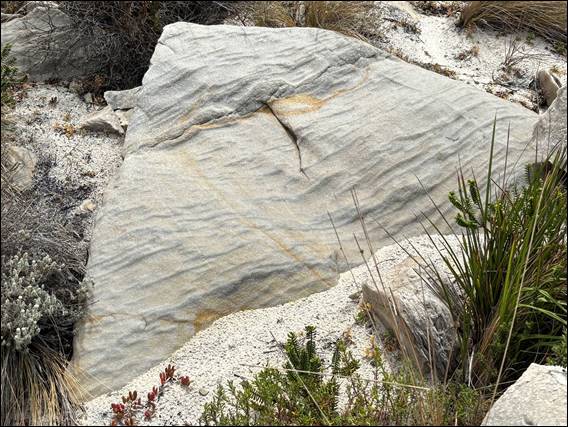
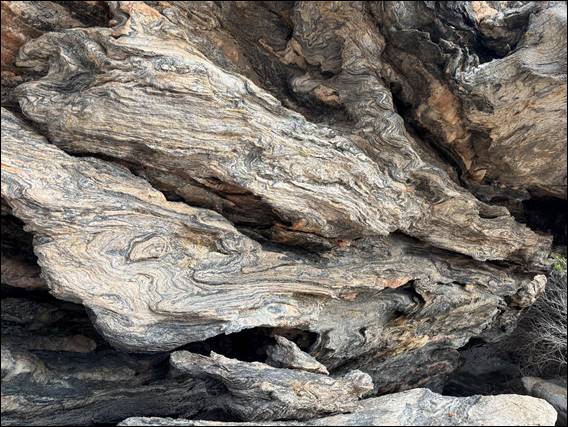
A nice gentle warm up at grade 10, or VD in UK grades, and being a nice 35m long. The bright rock felt on first touch solid and clean. There were of course some loose parts, but these were surprisingly few and far between for such a large untouched cliff and there was nothing to worry me for the whole climb. The rock seemed to be a quartzite. Nowhere near as hard as the Heavytree Quartzite I have climbed on in the Red Centre, and also having more texture and friction. The block below caught my eye and showed the features of the rock nicely:
To avoid having to scramble down after each climb we set up a rap line, avoiding having to disturb any vegetation with multiple descents. Howsie was next up and had already spied his line. Again trusting his instincts and sticking with something that looked a sensible first sample of the rock on lead. It was again a nice clean line, the rock and the cliff was proving to be a bit of a gem in that regard. He lead a longer 45m route, that was nicely consistent and had some very pleasant sequences and moves and plenty of gear to make it safe:
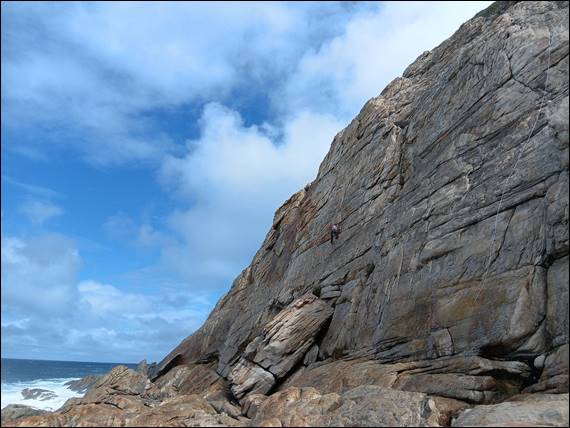
We pondered the grade thinking 13 was fair, and it was not until after our trip that Kym found Lord Jim’s records. And only then finding out they had bagged the very line, over thirty years back in January 1994 and there was even a photo of them on it. They had named it Banish Misfortune at grade 14, VS 4c in UK grades. Having only ascended the first 30m, Howsie had at least lengthened it by 50% with equally enjoyable climbing. What with all the scoping we were going slow, the last thing we wanted was to rush a decision and end up in a pickle:

Kym had spied a line that was drawing him in, but on closer inspection there were elements that made him nervous. It is worth being aware that he hadn’t climbed in some four months, and as such jumping on the pointy end of a rope at a new crag on long routes was probably not the best way to get back into it. As such he offered up the lead and I jumped at the chance knowing exactly what I would climb. Just as the rain started to come in, not that the images give that impression:
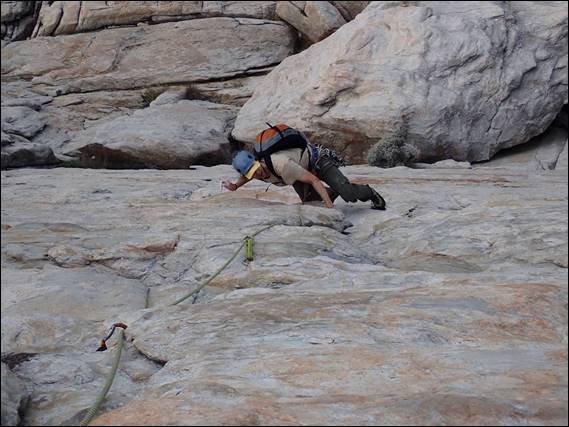
My mind was however set. While water dripped off the overlaps above me, and the rock was getting proper wet, I started up the line that had caught my attention when we first got here. It started behind a large block that was leaning against the cliff hiding a wonderful finger crack in the main wall. Above this and out in the open, as I was being hit by the elements, spaced horizontal breaks were separated by seemingly blank slabby sections. Water trickled down these as I tested my options, and Kym below suggested I wait till the rain eased off:
My mind was set and I pushed all that to the back of my mind. I’m not sure what Kym or Howsie thought when I started up the slab gingerly reaching as far as I could to curl my fingers round the horizontal breaks. Hoping to find a reasonable hold and also gear. Everything was quiet in my head as the first, second, and then third break was reached. Tentative, delicate moves being made between each, and each time being rewarded with good gear. Above a broken looking vertical crack, which I thought from below would be were the grade eased:
I was mistaken, this was where I spent most time, testing options. Also as the gear was already at my feet, I chewed up more time trying to fiddle in tiny brass RP wires to no avail. Finally plucking up the courage to go for it, when I spotted a number one wire placement, which could only fit half the head in. It was enough to push me through, as I reached as high as I could by twisting my hips and extending my ankle on the one marginal foot hold. While holding onto a low and very thin under cling that I could fit a third of my finger pads under:
Even then when the holds finally became big and chunky, it really didn’t easy up. Underclings allowed a traverse into side pulls, with feet at times on holds of pure friction. And then for the final section a wonderful series of flakes that made you switch your body from left to right to left as you weaved up the final wonderful finale to the top. You can probably guess that this line was all absorbing and totally amazing, and my finger tips are starting to sweat as I replay each move in my mind to describe it here:

So became Power Up, a nice long 35m route. In UK terms it was easy, I would give it E2 5b hands down. Earning it due to the multiple cruxes of differing styles, and beautifully varied and sustained climbing. With no move harder than 19 how do you translate the sustained nature into the singular numbered Australian system. We contemplated long and hard, as to whether it was worthy of 20 but went with 19. I would love to see someone else lead it. Can you tell I was on a high, it is up there with the best on-sight first ascents I have done:
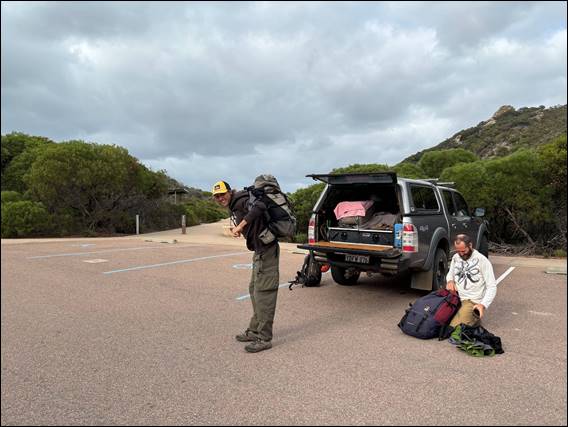
I almost feel as light headed and euphoric as I did after completing the line, and have had to hold myself back from adding even more detail. The only dampener at the time being that rain came in again, and even harder this time. So we decided to bail despite Howsie having had his eye on what was likely another classic route. It may have been raining, but we continued with the slow and steady approach to the day as we packed up and made our way back up the ridge to the car. What an adventure, and we had another day in hand:
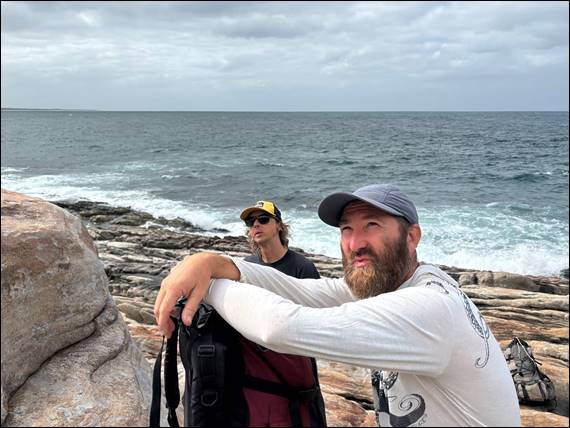
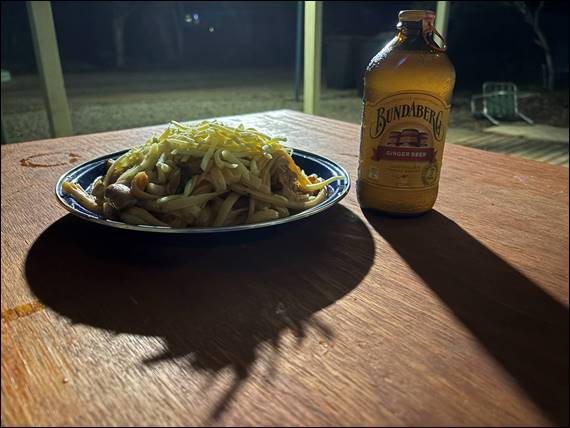
Kym headed home and Howsie and I settled into the campsite and cooked up another storm. A well-deserved almost overflowing plate full of pasta, which went down very well after such a great day in nature. That night our sleep was interrupted by the pitter-patter of rain on the canvas, but that seemed to ease and then hold off as light crept into the sky and we made our way out for a second day. In my usual fashion I was up before first light each morning and put a brew on. We saw some birds, but it was a relatively lack lustre dawn chorus:
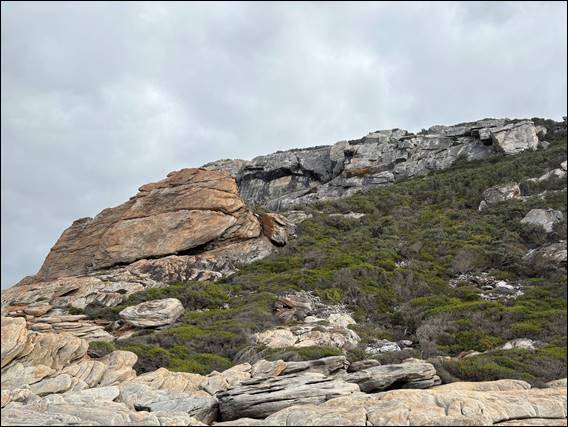
We were also surprised not to see any other wildlife. Insects were about but there was little else, and not for want of looking. Taking on Sarah’s more enthusiastic approach to herping, we checked cracks and crevices as we went. Maybe the cooler and slight damper days had kept them all at bay. For our second day in the expansive park the approach to the coastline was much easier. It involved a very pleasant rock hop, passing numerous very impressive boulders before we came across our quarry. A series of cliffs, very different in appearance:

There were cliffs that were well in excess of a rope length, with huge foreboding roofs for which it was hard to see if it was possible navigate a way over them. As such we aimed for the shorter of the cliffs. Finding the shortest and easiest access, made possible by rocky outcrops and sections of scree leading up the slope to the base. And while the vegetation looked to be right up against the cliff, there was enough room to easily manoeuvre along the base. From here even on the lines that looked reasonable from the coast became more daunting:

Similar to the first day it was agreed to start slow and Kym picked the first line. His first lead in way too long. As such his nerves were tingling, and for good reason. The rock was slick even when dry, and water was seeping down the line in places. He kept going, working his way up a fine slabby corner, which included a few fun traverses under roofs before taking on the next corner system. The rock was smooth but the gear was plentiful, and we had somehow stumbled across another route that maintained a consistent grade for most of its length:

So became Army Surplus (14 40m), VS 4c in UK grades. Hats off to Kym for sticking at it and keeping his nerve. After enjoying hr lofty views we found a way down that included a couple of fun scrambles, and as with all adventure routes the down climb is part of the experience and makes it twice as fun. Back at the base the big question was what next. It all looked quite improbable. I had however spotted what I felt might be a fun route. But it did start in the same corner as Kym’s line:
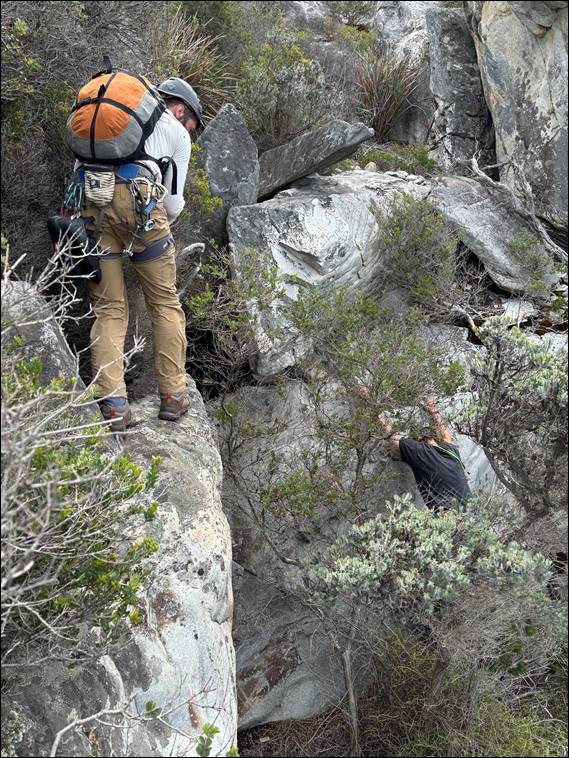
I had suggested it to Howsie, and while he looked about at what else might be a reasonable route he finally came back to it and racked up. He was not put off by the start being the same. It was more that the higher up the corner he went, where Kym had move left into the next system, the wetter it got. And the top of the climb was an exposed traverse on a hand rail with what looked like not much, if anything, for your feet. Howsie will confess that when it comes to steep juggy lines his stamina is quickly eaten up:
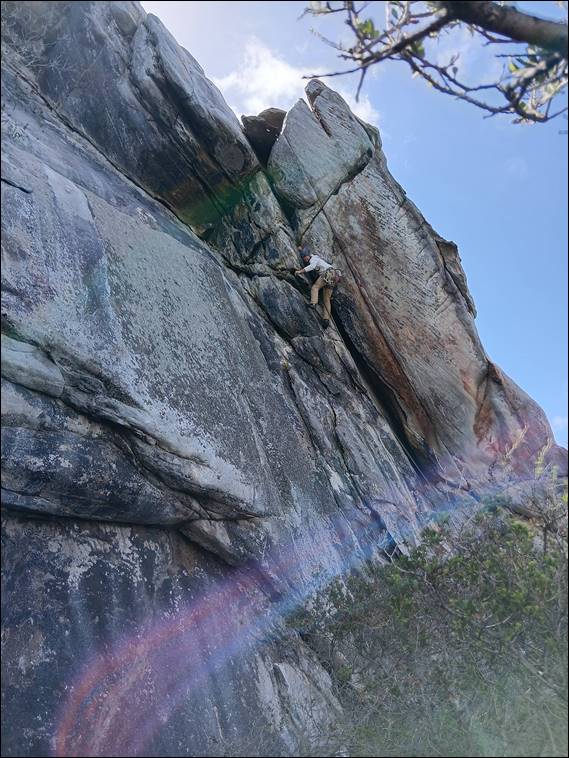
He set off and soon passed where Kym had ducked off left, and from here up to the traverse it was soppy. Making it extra nervous, as he had no choice but to trust what little friction was on offer and step above his gear. I think I held my breath watching him make these moves, as I belayed. Then each time his foot slipped I sucked in that bit more air, preparing myself to catch a fall. He may not like steep jugging but Howsie has a talent for keeping a cool head when it gets like this. Reaching the traverse, it was time to get some more gear in:

He gingerly moved his hands out on the rail, keeping his feet so high on the opposite wall that he was practically horizontal. When it was no longer possible to reach that wall he started to heal hook the same crack his hands were in. It was not until he had to swing round the arête in a wonderful exposed position that his feet were once again below him. And when he was established on the slab and dry rock it was a short section to reach to the top. Here he allowed himself to breathe normally again, or was that just me as I watched from below:
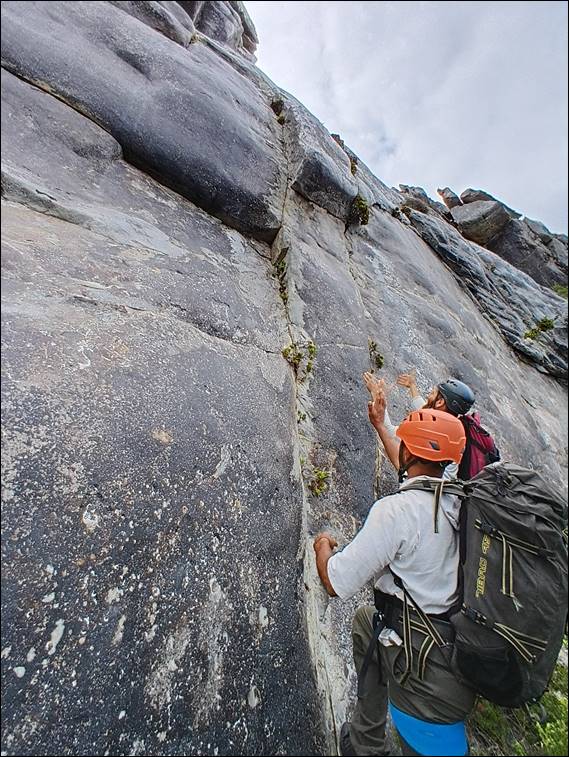
It was a brilliant on-sight first ascent, and I feel that those lingering thoughts about the line he didn’t get on yesterday were washed away. After all there is always next time. I went next and it certainly was as slippy as my words above indicated. Several moves had me on edge, it would have been so easy to pop off the rock. Then traverse out was as wonderful as I had envisaged when I first spotted the line. A cracking lead indeed, made even more impressive because of the conditions. Once up I scampered off like a mountain goat to get some images:

Howsie named that line Victorinox (18 20m), E1 5a in UK grades. A line that would be worth coming back for, but as for the other stuff on this upper wall it was hard to see much else. Two images up, Howsie and I were mentally climbing the crack system in front of us. Hands moving about in the air to show how we could tackle it, despite the fact that the system was closed and didn’t off any gear placements. The image does however show just how smooth the rock was on the lower part of this cliff, more akin to what I would expect quartzite to be:

Back at the coastline, we munched on some food before tackling a small outcrop halfway up the hill to where we had just climbed. A couple of low grade fun lines awaited us. Howsie jumped on first with a finger crack. Allowing me to snap some images of not just him but also some super impressive cliffs further down the coast. Kym and I have already been thinking about them, and when the next trip may be. Howsie named this line Ferrous Bueller (13 15m), HS 4b in UK grades. And while it was an easy line I couldn’t resist finishing on a lead:
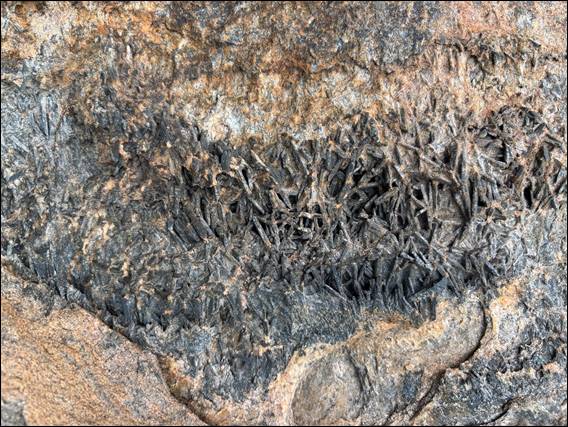
So became Iron Age (6 15m), which is classed M in UK grades and is the lowest UK climbing grade that can be assigned. However, as you may realise I don’t care about the numbers, it was a very fun climbing made all the more interesting by the rock we climbed on. Unlike yesterday’s cliffs and the upper walls today this little outcrop had bands of amazing crystals. I’ve unsuccessfully tried to find out what they may be called, but can say they have an iron component hence the route names. Each exposed needle being very sharp and strong:
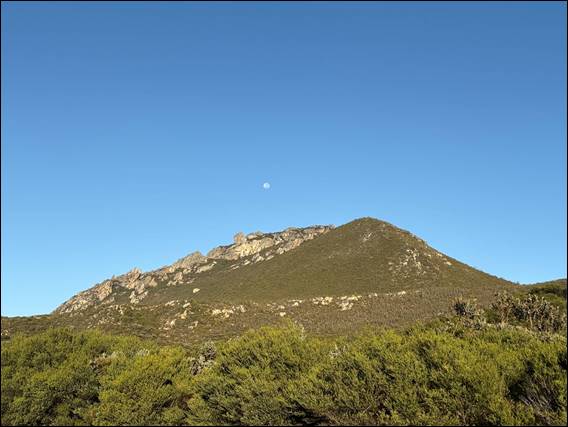
So care was needed as we padded our way up. It felt a little sad to be walking out. We could however not complain as it had been a storming couple of days. For Howsie and I at least we also had a hearty pub meal to look forward to that evening. Kym headed back home, and as we said our goodbyes it was time to sort all the gear, as we aimed to have an earlier start in the morning. Not for climbing but to have a dip in the ocean. There was a great looking lagoon, and the conditions may be just good enough to make it worthwhile:
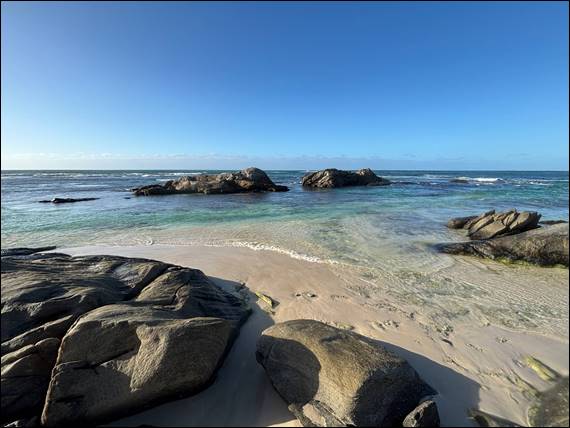
But as with most of this snorkelling this season, and climbing, a front had been pushing its way down from up north. Another tropical low had resulted in the cool wet conditions, just for this weekend, and the swell was up at 2m. You may think I am being a bit of a broken record about this, but just today a news article came out to say it has been the busiest cyclone season off the west coast in 19 years. And there is more to come. The image above is very deceiving, the sand was being pushed around obscuring our visibility way too often:

Still it was very refreshing being in the water, even if we needed to work hard against the channelling waters. I did however spot what may be a tubeworm that was holding its own against the shifting sands in the lagoon. Venturing further out we found an abundance of fish in both numbers and variety. Being that bit too surgy to get down, and claggy to take reasonable images, we admired them from above. Sadly we did have to face the fact there was a big drive ahead of us, and finally it was time to say ‘so long, and thanks for all the fish’:

 Sandbagged