We have longed talked about going for a snorkel off the iconic Busselton Jetty. At 1841m long, in approx. 8m of water, and with no major rivers the general area to pump in fine sediments from the agricultural lands, the clarity of the water is generally better and more reliable than the shoreline waters of our local beach. Yesterday’s blip in the conditions resulted in a late check in from Gav about whether to go in or not. There may have been a near 2m swell, but the light winds forecast for the morning sealed the deal and it was finally happening:
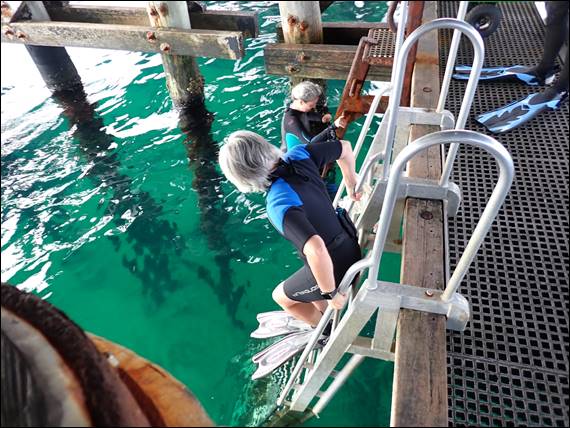
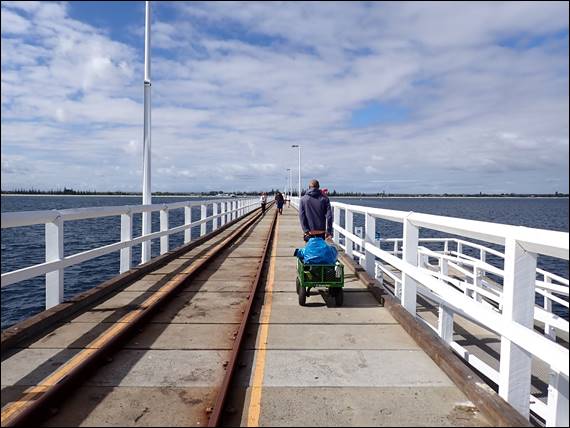
Walking out at 8am, it was amazing just how many people were out already walking, running, or fishing along the jetty. But once kitted up and in the water there was no one else about other than Lisa, Moni, Gav, and myself. The jetty was built in 1865 stretching out 176m into the ocean. Since that time for various reasons including natural accumulations of sand and the bigger draughts of larger vessels using the port, the jetty has been extended numerous times. The shortest extension was a mere 16m in 1960 and the largest was 353m in 1887:
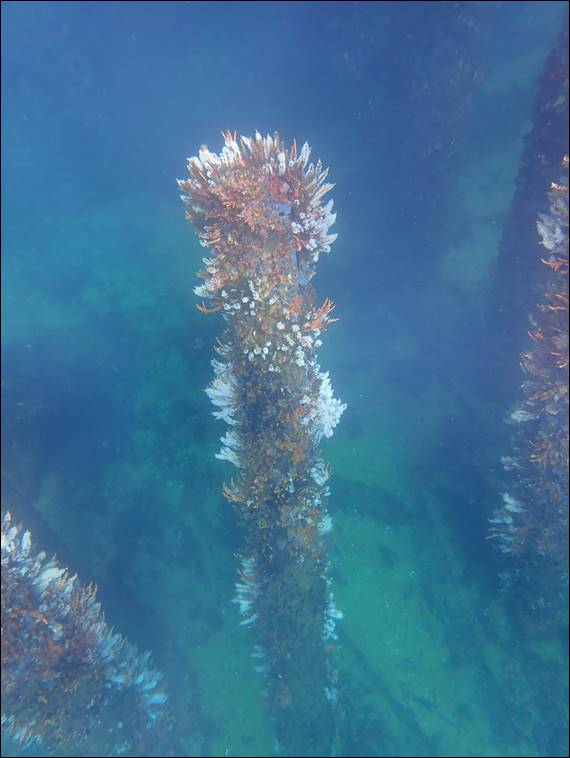
While 8m is pretty deep for a snorkel, the big attraction here are the timber piles of which there are 581. There are also 114 steel piles, which have been installed as part of more recent refurbishments, the most notable being in response to a significant fire in 1999. Another risk to the timber piles are marine borers that can weaken the structural integrity. One way to manage this was to scrape the marine communities off the piles. Then in 2015 a number of the piles were wrapped in a protective marine wrap, to avoid the need to scrap them:
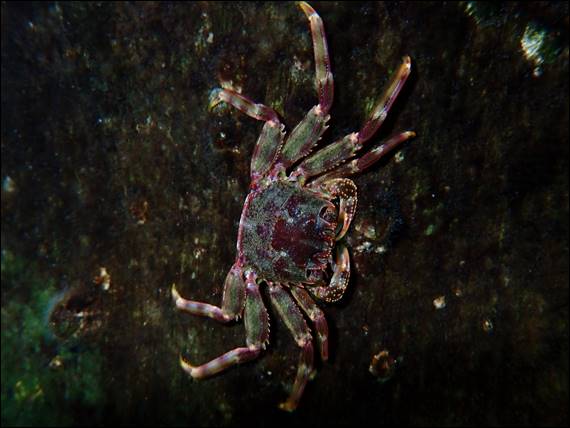
This then allowed the ecosystems that thrive on the piles to start to colonise and flourish long term. The swell made it a little tricky to stay still and take decent images but I had a bash at the less sponge and coral covered parts of the piles near the surface. Above is a Red Bait Crab (Plagusia chabrus) and below a False Tasmanian Blenny (Parablennius postoculomaculatus). Verity from Perth snorkels at her local jetty and last week found what is likely to be one of these fish with extremely long yellow antenna, whereas they are usually quite short:
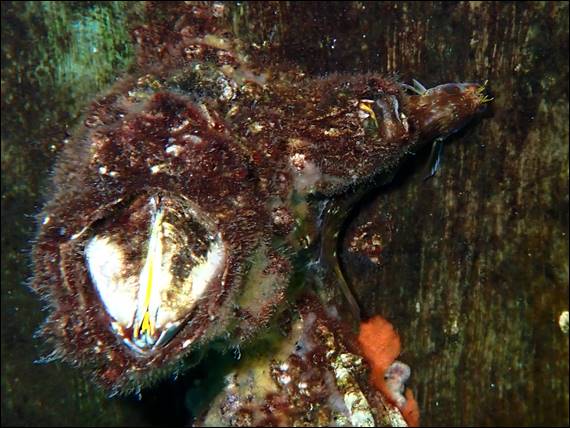
There were hundreds of very skittish False Tasmanian Blenny, but none with such long antenna. They were in the brightly coloured sponges and corals, on bare timber, and at times made a home out of empty barnacle shells. Being Giant Rock Barnacles (Austromegabalanus nigrescens), the largest found in Australian waters and usual found at the near the low tide level. The larvae are free swimming and look like the larvae of a crustacean, which is not so surprising when you find out these static creatures are in fact related to crabs and lobsters:
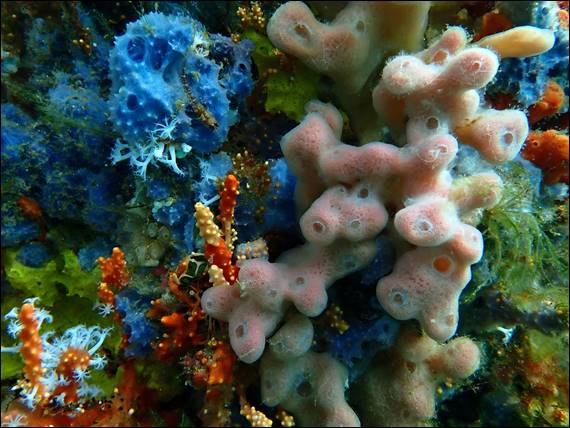
The variety of sponges and corals was stunning. Next time we head out there I may spend a bit more time exploring them, and the creatures that live amongst them. Looking at the collective display, one of the most striking was the Telesto Soft Coral (Carijoa), looking like orange antlers in the image below. The coral is made up of polyps, each being an individual animal, that lives in a tube within a white calcareous skeleton. This is coated by an orange sponge (Hemimycale), which provides protection from predators and rough ocean conditions:
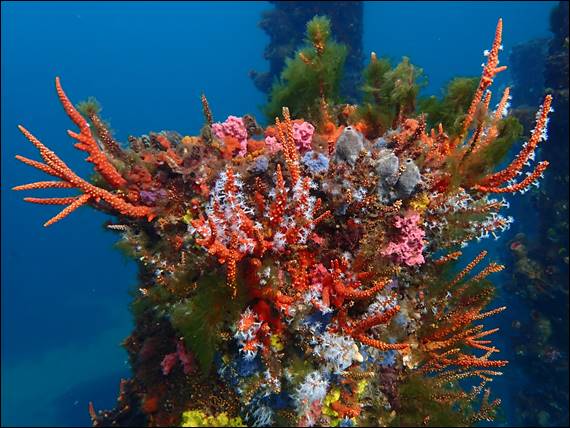
The coral polyps each have eight white feeding tentacles, which sprout out from underneath the orange sponge. When the whole colony is feeding it completely changes the appearance, as shown below. The tentacles are tipped with stinging cells, which provide another defence mechanism this time for the sponge. As such the coral and sponge form a great symbiotic relationship. In this image you can see one of the observation windows of the underwater observatory, from which there is a 20m exclusion zone:
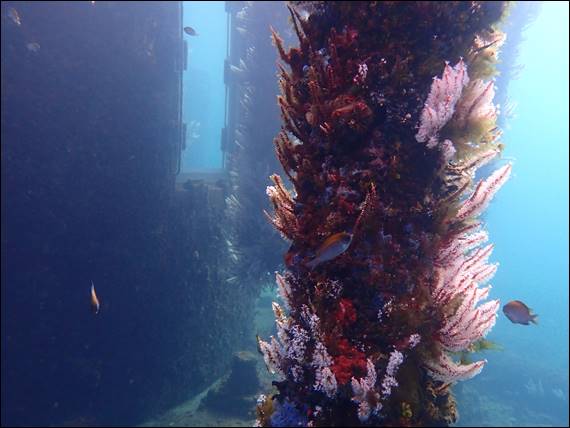
There were lots of fish, many however were low in the water column making identifications hard. Above a few Blackhead Puller (Chromis klunzingeri) circled a pile looking for food. The biggest shoal we saw by far, was a school of Australian Herring (Arripis georgianus). Probably in the thousands, which were somehow keeping a safe distance from where all the fishing lines were dangling in the water. These grow to approx. 40cm. Diving towards them they parted, allowing me to spot a bigger fish. A single Yellowtail Kingfish (Seriola lalandi):
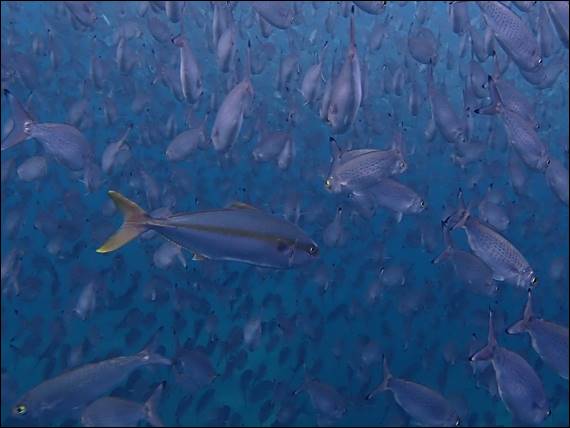
Commonly found up to 1m, these can be as large as 2.5m. Young fish, like the Australian Herring, can form schools of up to several hundred. Juveniles are however yellow with black bands, so this one was an adult. Also detectable by the darker stripe along the top and lighter stripe along the bottom. A camouflage mechanism to make it harder to observe from above and below. Another reason people snorkel and scuba dive here is to follow a sculpture trail, with thirteen nautically themed structures. This one being the Bronze Mermaid:

While I’m not all that interested in these structure, which were installed a couple of years back, they have provided additional habitat for the marine life. Both to grow on and use for shelter, so are a worthy addition. My duck diving was somewhat hampered today. That said I’m not convinced, even when running on a full tank, that I could make it down 8m and stay down to check out the life. There was however plenty to keep us interested occupied in the higher water column, until it was time to get out and head back to shore for a hot brew and bite to eat:
 Sandbagged