It was time for Lisa and I to get away for night for another mini-break. We ummed and ahhed about where to head and what to do, and plumped for a trip to Penguin Island. The last time I went there was with my folks and Elseya back in 2008. Lisa sadly couldn’t join us as she was working. Just a year before that trip the population of Little Penguins (Eudyptula minor), which happens to be the smallest species of penguin, was approx. 1,600. A survey last year clocked in less than 120, indicating a decline of over 90%:
The small 31 acre island is a mere 660m off the mainland, so very accessible. It is hard to not consider that the human activity wasn’t in part to blame for this. That is despite the island being closed during the Little Penguin’s breeding period from June to September. Other factors that are considered to have contributed include changing migration patterns and climate change. Whatever the reason, there are now calls to close the island and keep it as a sanctuary although being so close to chore I’m not sure that will happen:
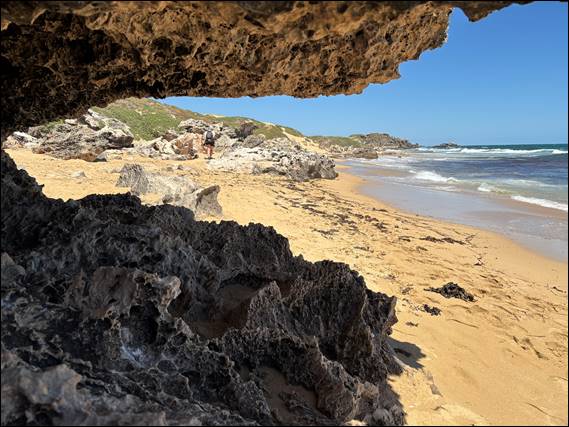
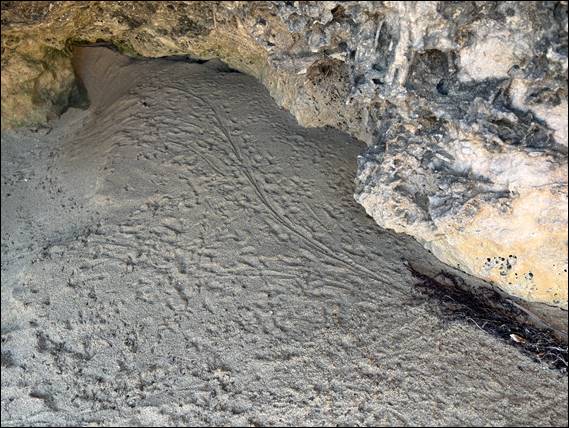
Not surprisingly we didn’t get to see any Little Penguins, not that we tried too hard to find any. Instead enjoying a wander round the mostly boardwalked trail, with short stretches of beach. Along the beach I did check the tracks in the sand to see if I could find signs of their little feet, without success. We did however see a bunch of waders and shorebirds including a few we commonly see down our way, such as Pied Oystercatcher (Haematopus longirostris), Sooty Oystercatcher (Haematopus fuliginosus), and Crested Tern (Thalasseus bergii):
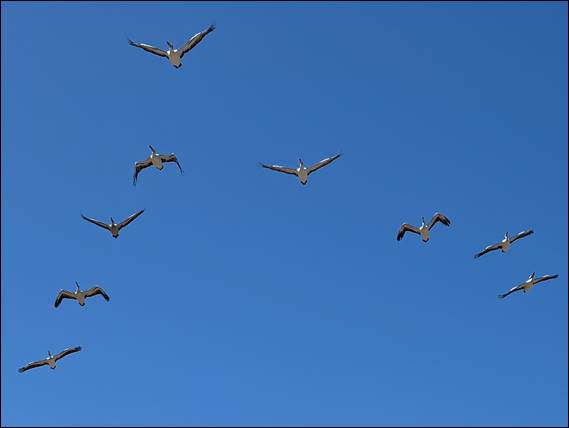
We also spotted a pair of Ruddy Turnstones (Arenaria interpres), and a single juvenile Bridled Tern (Onychoprion anaethetus) that was nestled just of a boardwalk. While these are fairly common coastal birds round most of Australia, I don’t recall seeing them before. And then there were the unmistakable Australian Pelicans (Pelecanus conspicillatus), definitely not an unusual sight other than seeing them in their hundreds and hundreds. One of the signs suggested that there are nine breading sites round Western Australia, and this was one:
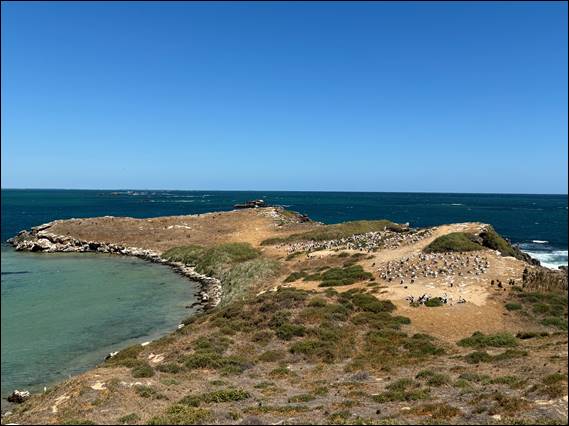
They are colonial nesters. The size of these colonies can vary from ten to a thousand, so I’m guessing this was one of the bigger ones found in Western Australia. Unlike the Little Penguin that breeds in winter, the Australian Pelican surprisingly has no breeding season and can raise their young year round. I’ve read that breeding can be stimulated after rainfall has occurred inland, and in contrast to the other waders and shoreline birds we spotted the Australian Pelican can also be spotted across much of Australia’s mainland:
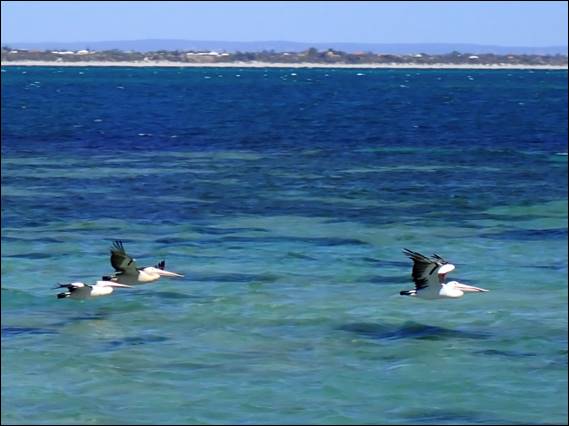
While hard to see in the images we got to spot some young. Their nests are very plain, a scraping the ground lined with a few bits of seaweed of feathers. Usually two eggs will be laid, and a couple of weeks after hatching crèches are formed by the chicks who gather into small clusters. These are also known as feeding pods, which maximises the chances of survival. It is probably fair to say that these social behaviours mean that the Australian Pelican will continue to do OK on Penguin Island, unlike the Little Penguin:

That is unless, or sadly maybe until, the colony is hit by Avian influenza (bird flu) in which case their social lifestyle could back fire on them. But for now it was lovely to see the big numbers, as they continual flew on and off the island. I also jumped in for a snorkel but it was no better if not worse than our local beach, with not one image worthy of inclusion. The dip did at least feel very refreshing. Soon after we caught the last ferry back to the mainland, got settled into our hotel, and headed out for a scrumptious meal to wrap up a lovely relaxing day:

 Sandbagged