The marine environment of the globe has about a dozen amphidromic points. These are generally located in middle of ocean basins, whose shape results in a rotary wave action forming. The circular action results in a centre point where there is effectively a flat spot, similar to the eye of a cyclone. Here there is almost no vertical movement from tidal action. A amphidromic point is right off the coast of Western Australia not too far from where we live. This explains why we have such small tidal variance, ranging from 0.1 to 1.2m:
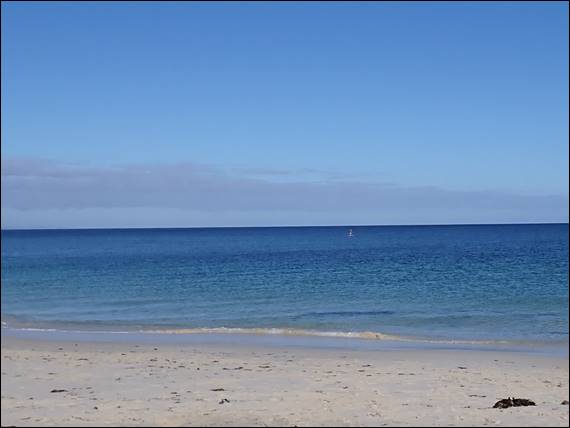
Regardless of the minimal tidal range, I still try to head into the water at low tide. Due to that one meter helping me to stay on the bottom a bit longer. I would normally have been in the water heaps over December and January, but today was my first local dive since before Christmas. Some six weeks back. Purely because the conditions have been awful, and it hasn’t been worth the effort. This morning drawn by the flat looking surface and colour differentiation, created by the underlying darker reef and lighter sand, I gave it a go:
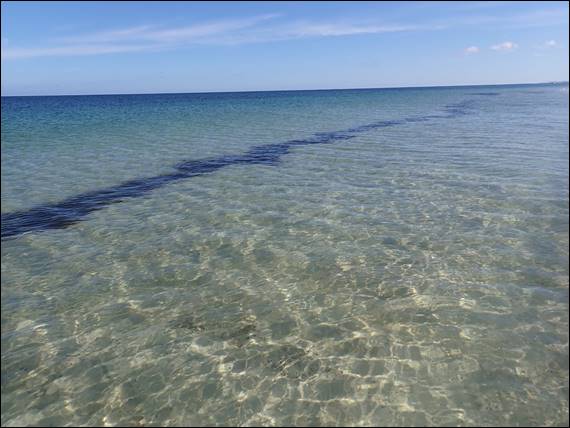
There was still a dark band running parallel to the beach. Sea wrack dislodged by recent higher than usual swells, for this time of the year, now forming an orderly line. A result of the ocean starting to settle down since the rougher conditions, driven by cyclone Sean. The poor conditions have however not been isolated to this one weather system. This time of year we would expect an average swell of 0.5 to 1.3m. But the swell this summer has consistently been over 1 meter, and more regularly than I would like it has reached close to 2 meters:
My rule of thumb is that if the swell has been below 1 meter for three days, the water clarity is likely to be pretty good. This week it has hovered up around 1.5 meters, so I wasn’t completely fooled by the optical illusion of the colour differentiation. I was however really keen to get in the water. And it did feel good, but my reservations about seeing much very quickly became reality. The water was cloudy, but I could make out the bottom so persevered. Ducking down in the hope of seeing some fun finds:
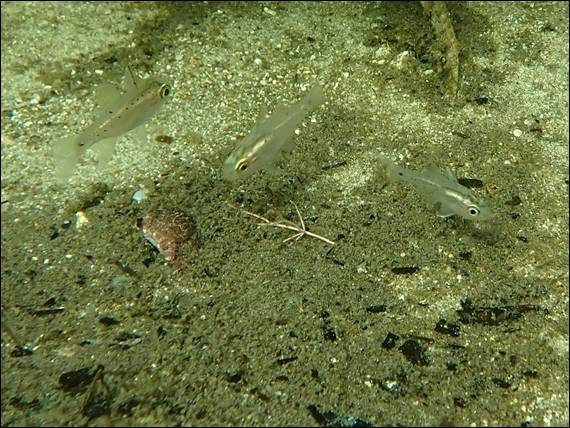
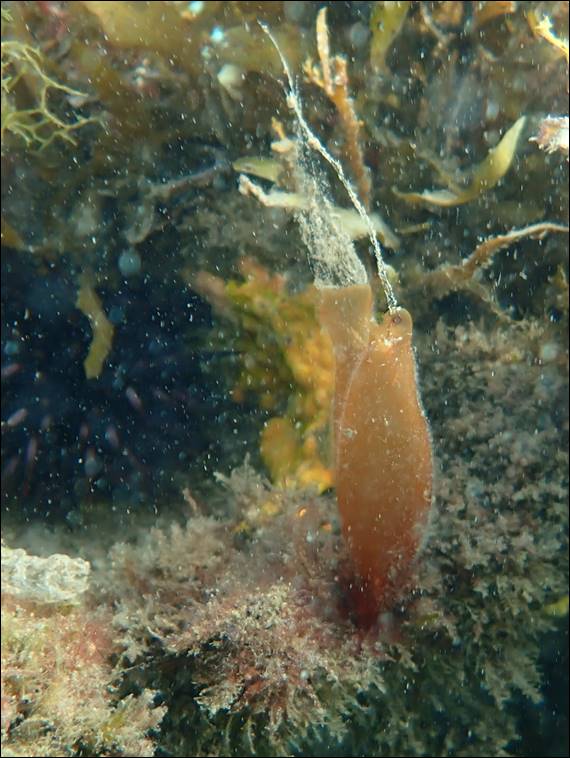
The first underwater image being of Slimy Bags (Gloiosaccion brownii), the scientific name literally translating to ‘glue sacks’. It looked like they were excluding the thick slimy substance held within the elongated balloon shaped sacs, from which they get their name. Particles that had been suspended in the water were stuck to the substance, and there was lots more detritus covering patches of sand in amongst the reef as shown above. The Western Gobbleguts (Ostorhinchus rueppellii) were one of the few species of fish I saw:
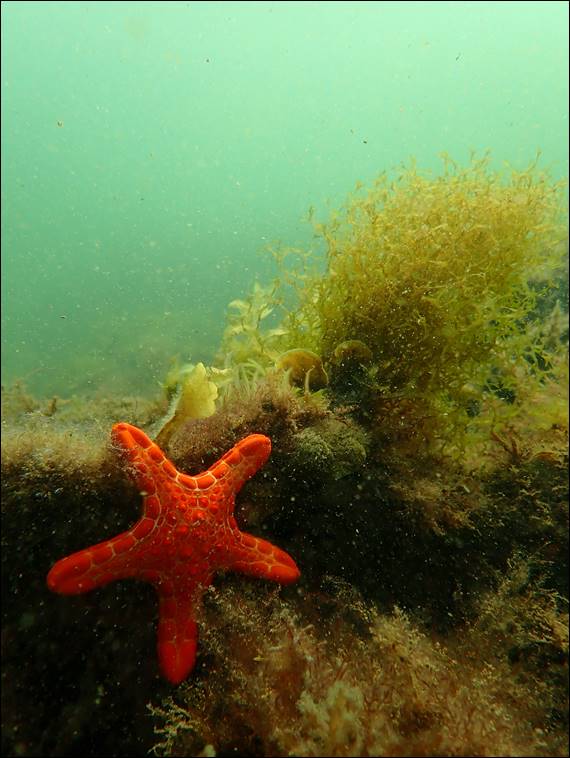
These fish are mouthbrooders, with the male incubating anywhere from 50 to 230 fertilised eggs for about two weeks until they hatch. Most of my finds were seastars. The above Mosaic Seastar (Pentagonaster dubeni), easily recognisable with its bright plates separated by thin light lines, has a backdrop that clearly shows how unclear the water was. And below is a Pale Mosaic Seastar (Echinaster arcystatus). I’m surprised how often I find what is claimed to be an uncommon species. It is however one of the bigger species in the south west of Australia:
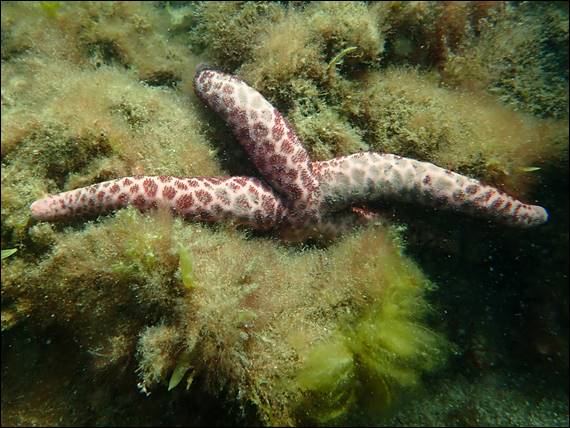
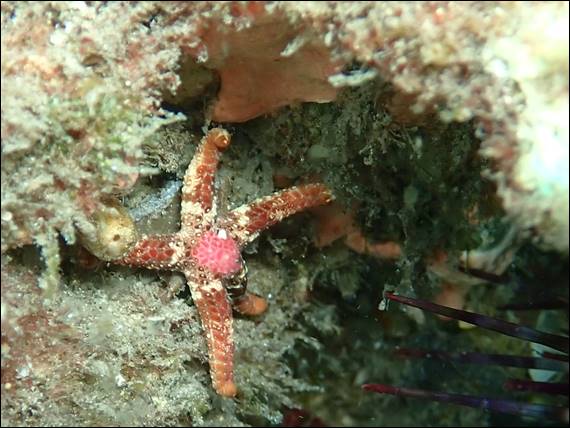
The largest seastar in our local waters is the Eleven-Armed Seastar (Coscinasterias calamaria), reaching up to 50cm. The Pale Mosaic Seastar isn’t too far behind reaching 36cm, with the Mosaic Seastar normally not growing bigger than 8cm in diameter. And then I found the below smaller specimen. You would think the strawberry looking protrusion in the centre of the body would make this an easy identification, but no. The closest match I could find, which I am not convinced of, is the Necklace or Tiled Seastar (Fromia monilis):
 Sandbagged