Walking into Bob’s Hollow yesterday with David I sent an image of the ocean to Lisa, knowing she would be up. In return, as she wandered along the beach to meet the Peppy Plungers, I received an image of glassy calm conditions. One of the other plungers mentioned the water was starting to clearing up locally, although they had experienced that during an offshore boat dive. Whereas I know the waters off the beach take a while longer to clear up. Despite my doubt, and seeing the swell had been relatively low for a few days, I gave it a go:
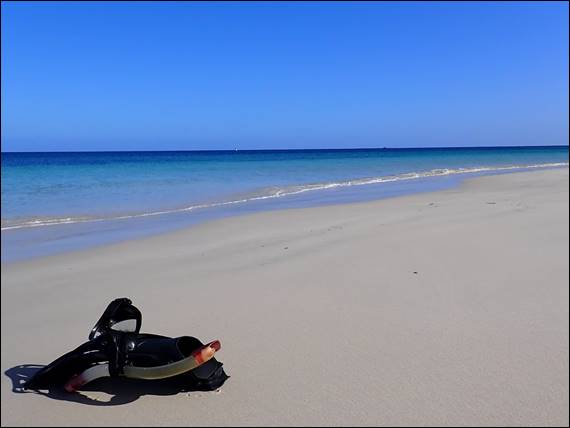
I was also encouraged to go in when I saw the very low tide, which conveniently coincided with the morning. When the winds are general lighter, and the sun is sufficiently high enough to allow its rays to penetrate the water. The very low tide was courtesy of the position of the moon. Friday night’s supermoon resulted in a stronger gravitational pull creating a larger tidal range. Lisa and a few of the plungers were meeting up for a second morning today, this time to go for a swim, so Lisa and I walked down together and then went our separate ways:
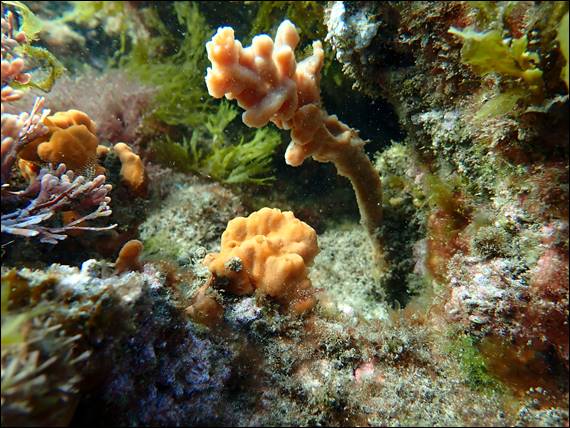
The water was indeed pretty clear. After my dip round the bay, in waters teaming with fish, the local reef seemed very quiet and a little drab. But knowing the better areas to check the fish started to appear, even if they weren’t in the same kind of numbers. This included a single Western Blue Devil (Paraplesiops sinclairi). Not the best image, but the only one I got. I’ve not seen this fish before, which is not surprising because it is known to be shy and is rarely encountered. The large eyes almost give an impression of its surprise to see me:
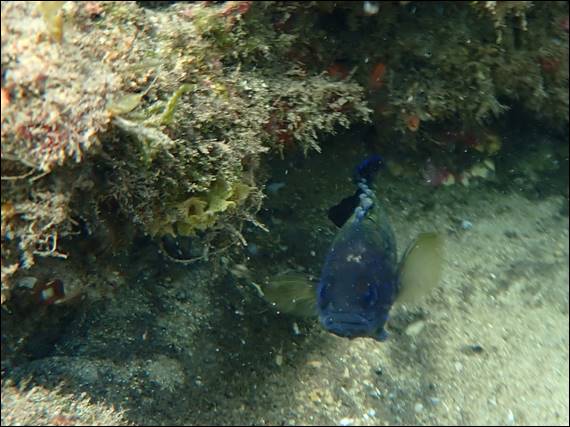
It is often confused with the Southern Blue Devil (Paraplesiops meleagris). Despite the very brief encounter and slightly blurry image, the distinguishing features of the endemic Western Blue Devil were clear enough. Having yellowish pectoral fins, blue edged caudal fin, and significantly reduced number of blue spotting over the face and body. Also in contrast the Southern Blue Devil, has been observed to shows little fear of divers. Allowing them to get relatively close, and only when they get too close does it slowly retreat into a refuge:

The other fish I saw were all familiar, so I started to take images of the many different coloured sponges. However, as is often the case when I duck dive down more treasures come into view. The above is something I have only seen once before underwater, approx. five years back. I say that as this type of urchin is often seen washed up on the beach during winter. Five years back I didn’t spend as much time identify my finds. Naively calling it a collector urchin, which is it not and is in fact a Short-spined Urchin (Holopneustes porosissimus):
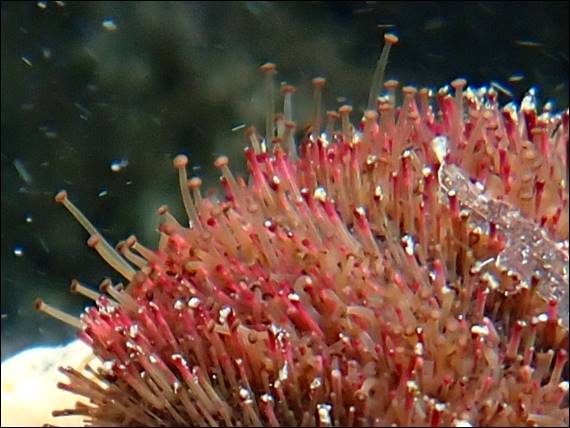
There are over a thousand species of sea urchin globally, many are round in shape but about a quarter of them have evolved into differing shapes. One such type has a flattened body and burrows into and moved below the sand. Now I have an idea of what to look for I‘ll keep an eye out. While the Short-spined Urchin is common and has vivid red tips on its primary spines and purple heads on its tube feet, it is not often seen. It has a habit of hiding away by wrapping itself in algae, something the last one I found was attempting not very successfully:
I mentioned tube feet. These have suckers on the ends that are used to move the urchin about. Controlling the feet by varying the hydraulic pressure of water moving in and out of them, all done with no brain. I’ve included a close up image of the main picture to show these feet extending beyond the spines. The Short-spined Urchin also uses the suckers to pull the algae round itself. There were plenty of sea stars out, which I have included before. The above one however stood out as being distinctly different, and took me ages to identify:
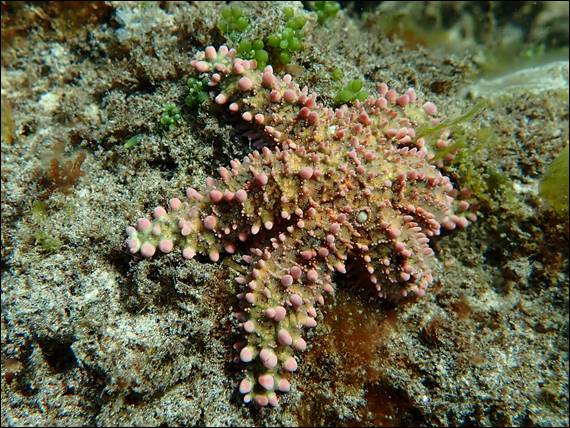
The Five-Armed Seastar (Uniophora granifera) comes in a multitude of colours. The surface can also vary from smooth to being covered in blunt spines or rounded tubercles, as this one is. The range is so vast that the differences have resulted in some being incorrectly described as different species. The Atlas of Living Australia, which pulls on data from various sources, has just over 900 sightings recorded. Only one of those observations was in Western Australia, at the Busselton Jetty, with the rest being in waters off south-eastern Australia:
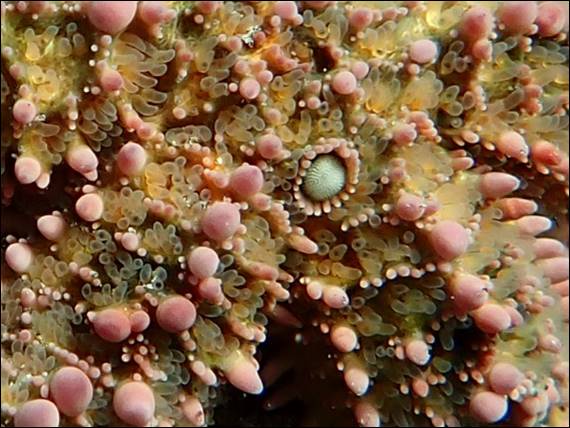
As such I’m pretty chuffed with this find. The other thing that intrigued me about this species was the prominent madreporite. I have again provided a close up of the main picture, to highlight the feature. Usually light in colour, it forms a calcareous pressure-equalizing valve. Filtering water before it is drawn into the vascular system, and also being where water is ejected from. For this species the calcareous surface almost looks like a brain. For my next two images I have also got a close up to allow the amazing detail to again shine through:
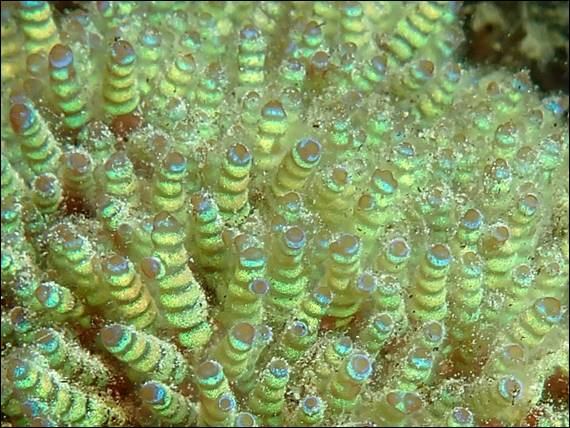
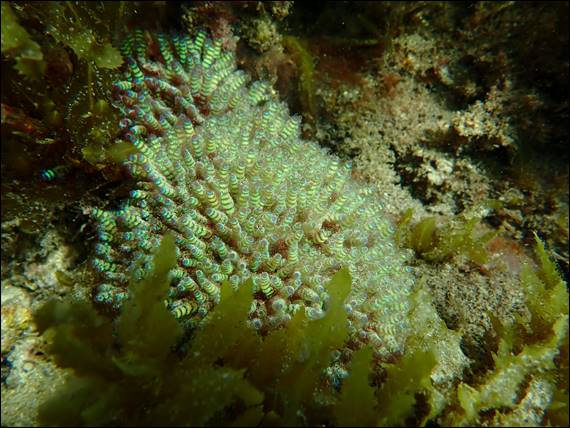
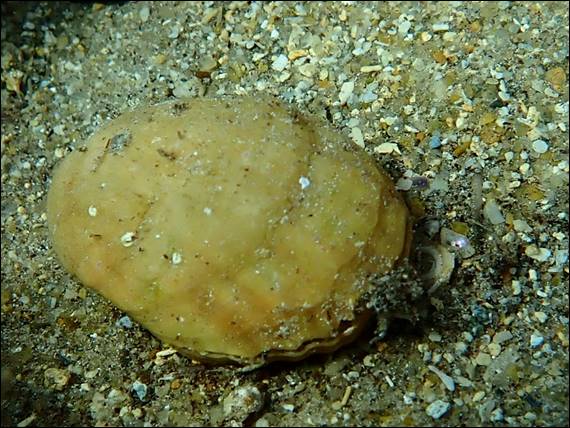
This time however I have not been able to work out what I have found. The fleshy tentacles made me think it may be an anemone, which is what Rongy also thought. This did not assist when I tried to narrow down my research. So for now I’ll have to wait and see if anyone replies Rongy’s request for an identification, from the South West diving community. My final image is of a bivalve I often see. What caught my attention about this picture is it looks to be munching on something. While bivalves are generally filter feeders, some are scavengers and others predators. I’ll have to continue to try and identify this one, to work out it diet:
 Sandbagged