My body clock seems to be getting into the swing of 4:30am wakeup times. This may be in part due to the earlier start time of the dawn chorus. Something I consider a welcome natural alarm clock, while others may view it as a rude awakening. Depending on the species of bird this can begin anywhere from half to one and half hours before sunrise. Meaning it can start well before first light. When the poor, or absent light, means foraging isn’t practical and the males use the time to reconfirming their territories and let females know where they are:

My alarm on Friday was set for just after 4am. Funnily enough with the ring tone set to ‘birds’. However, the real life birds had already done their job. I was already stirring before the alarm had the chance to also wake Lisa up. Hopping into the pre-packed car as the minute hand reached the bottom of the clock face. The agreed meeting time, not by design, worked well to align with first light. As such I was rewarded with the changing colours of the morning sky. Something I assume Howsie was also admiring as he was driving out:

Our meeting place this time was not Capel, but Boyanup as we were heading south to the big stuff. Some months back I had reached out to Kym and suggested a catch-up was long overdue. A weekend was set, which aligned with what Howsie and my calendars foretold would work. Kym’s life is unfortunately somewhat more erratic and unpredictable. Things were looking good until several weeks out. Kym was still getting out and about in nature, enjoying a camping trip with the family. It did however mean he would not be able to join us:
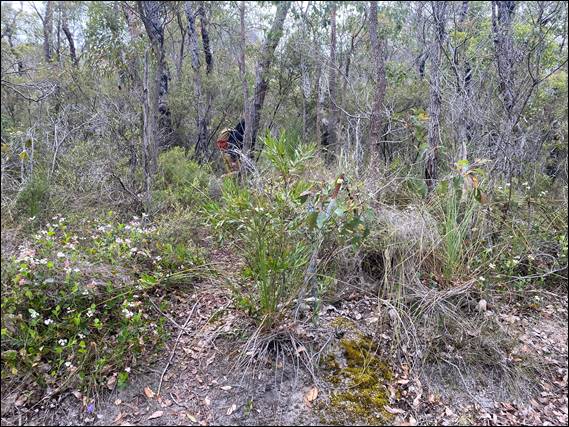
The south coast and it’s inland crags offer a plethora of opportunities that are in stark contrast to our local crags. I have often said to Kym he is spoilt for choice when it comes to rock, and he knows it. Intimidating boulders right in town, looming cliff faces that drop straight into the ocean, through to huge granite domes that rise up from the landscape. All within an hour or less drive from Kym’s house. With such variety it can be a conundrum working out where to spend the time, but this trip was guided by some images Mario had recently shared with us:
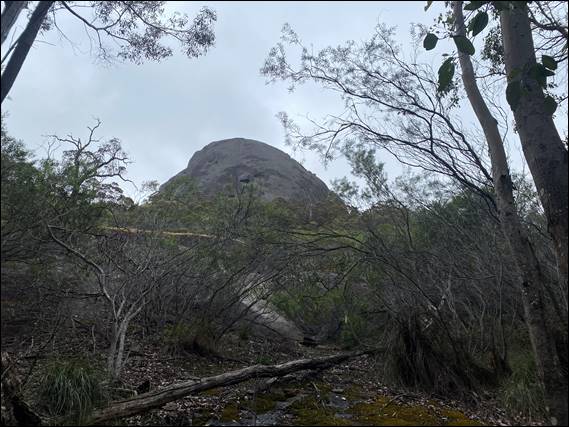
Four hours after leaving home, we were parked up and shouldering our packs for the walk into Gibraltar Rock. Kym you will be pleased to know that this time we found the star-picket that marks the track that leads off the firebreak. We were aiming for one of the many mighty monoliths of the Porongurup Range National Park. Erosion over geological timeframes having removed the material from round these hard igneous rock formations. Now looking like heads watching over the landscape:
Aboriginal beliefs are that this place harbours the spirits of the dead. Jarnaks, which are ghosts or evil spirits, reside here and it was a place to tread carefully and not to stay in after dark. I have come across a similar situation when I lived in Ghana for a couple of years. John, a fellow volunteer and climber, and I were soloing the granite domes. Not as tall as these, but equally impressive in an otherwise flat landscape. The local villagers started to congregate in big numbers and we were asked to come to the village to meet with the elders:
We were led into a dark, musty, and smoke filled mud hut. A small fire emitted barely enough light to see. It took time for our eyes to adjust, and when they did we found ourselves surrounded by solemn looking elderly men. Age and wisdom etched in their faces, and with all eyes on us. It was an ominous situation to find ourselves in. We talked for some time in low quite voices, which seemed to added to the uncertain atmosphere. But they had our interests in mind. Worried about our safety, as the granite hills were a place of bad juju:
Juju is a belief system that can harbour good and bad, and is practised across much of West Africa. Recent statistics from census data suggests a small percentage of Ghanaians hold with traditional beliefs. I was there in the mid to late nineties, when it was suggested that 95% of the population held them. Many of the Muslim and Christian population also maintained some connection or belief in juju. Having lived, hiked, and climbed in several countries and areas with ancient cultures, I have certainly been to locations I have not wanted to stay in:

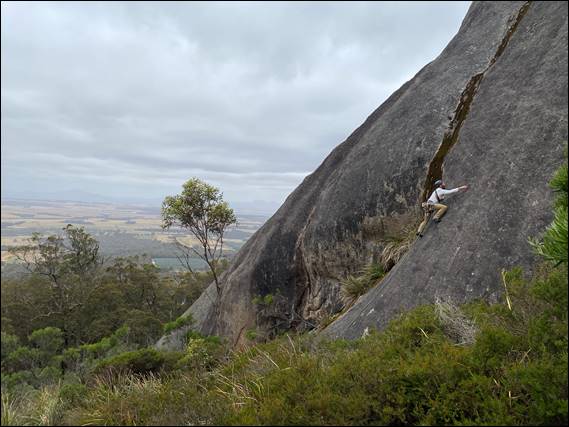
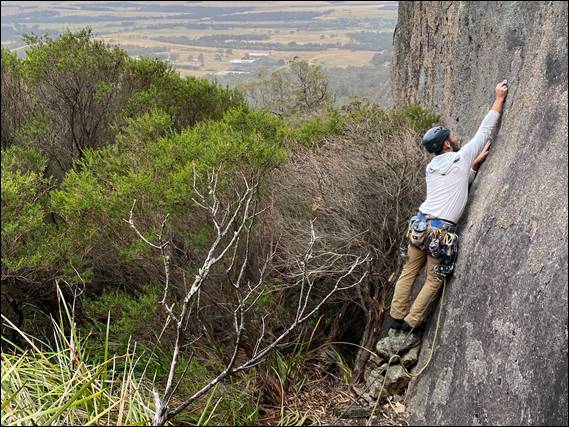
They simply felt ‘wrong’, my skin crawled and I felt like I was being watched. The sooner I moved on the better, and as soon as I did that dark foreboding feeling lifted. With having had such experiences, for me at least there is something in all of this. However, the Porongurup’s emits a good feeling to me, making me feel welcome so I was happy to be here. We scampered further round from the main face in search of a couple of lines on a wall that I had not been too before. My images show the wall, but not too much of the climbing:

With just two of us on these tall, steep, and direct lines it was very hard to get any images of worth. Unlike the two climbs we picked, which in contrast were stunning. Both had been established in the mid 2000’s, and were protected with old school based in carrots. The often bent bolts didn’t inspire, but we used them regardless. Needing on two occasions to test them. Both times being when a hold came away from the rock mass. Due to the steepness of the lines, with often marginal holds at best when this happened it is hard to avoid the fall:
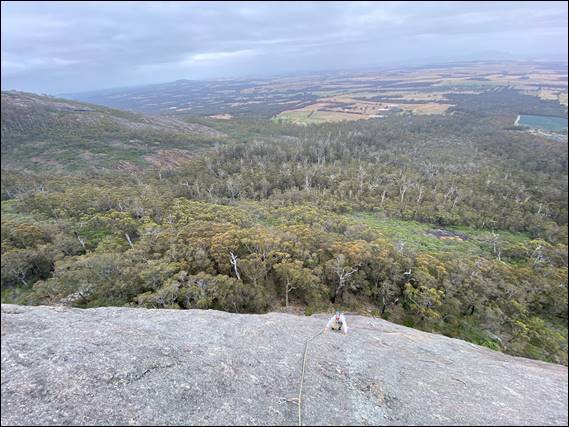
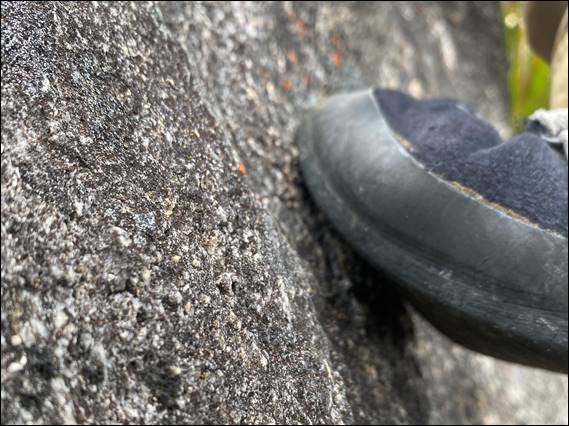
The climbing was epic. We had to get used to smearing and trusting friction, in a way our local crags don’t require us to. It is a strange feeling to push the mid sole to toe of your shoes against a near vertical rock, and trust the friction between the rubber and rock. Often we could hear the crystals of the granite crumble under the stress. Needing to brush the sole off on the other leg, before pushing it back onto the wall. Holds for hands were spaced, instead weighting our fingertips on small crystals and indentation. It was very focused climbing:
After the two lines, I was keen to send Howsie up what used to be regarded as one of the better protected routes here when it was put up in 1999. I climbed Sucked in Ben ten years after then. It felt run out and sketchy, but great. However, we had to watch the clock and get to the campsite by 6pm. So decided on a route I had not been on, which we coincidently happened to climb ten years after that one was established And being a more recent route it was a bolt ladder. Only having 50m ropes with us they were not long enough for two pitches:

To overcome this on those pitches once all of the rope had been fed out, we adopted the alpine approach of simul-climbing. Where we both climb at the same time, the grades on this line were way easier so this felt fine to do this. And not intentionally we climbed the 200 plus meter route in three quarters of an hour. After 340m of climbing we didn’t really feel the need to jump on another route. Leaving us heaps of time to wander round the top to take in the vista and look for anything interesting. Then rapping down where we had a relaxing late lunch, lying under the trees and chilling out before the walk back to the car:

The campsite was a quiet place, perfect for an early night after a long day. Getting back at a reasonable time we were able to set up camp, freshen up, and have dinner all before darkness came in. When in theory it was time for everyone to avoid being in the hills. The owners had made an effort to plant a variety of grevilleas, which were all in flower. Red, pink, and yellow blossoms abound. Reported to be the jewels of the Australian flora, for avid gardeners round the globe. Attracting heaps of birds, and maybe enhancing the dawn chorus:
It was another early start, as we only had one night away and wanted to be on the road home at a reasonable time. Before making the first brew, my gear was packed and tent upended to allow the ground sheet to dry. Not that I needed to do this. Despite the cloudy days, with moisture hanging in the air, there was no a hint of a dew and everything was bone dry. This didn’t make much sense to either of us, but we were grateful to be able to pack away our dry tents just before we rolled out. When only a handful of other campers were starting to stir:

Today we were heading to a place Howsie had not been to before, which had piqued his interest when Mario popped an image of it on our local climbing chat group. Having only been to Marmabup Rock once with Craig a couple of years back I was happy to come here again to explore it a bit more (https://sandbagged.blog/2022/10/16/a-curly-question/). In relation to climbing it is a bit of a hidden gem in the Porongurup’s. Not receiving anywhere near as much attention as Gibraltar Rock, but being equally worthy. One difference being the approach:

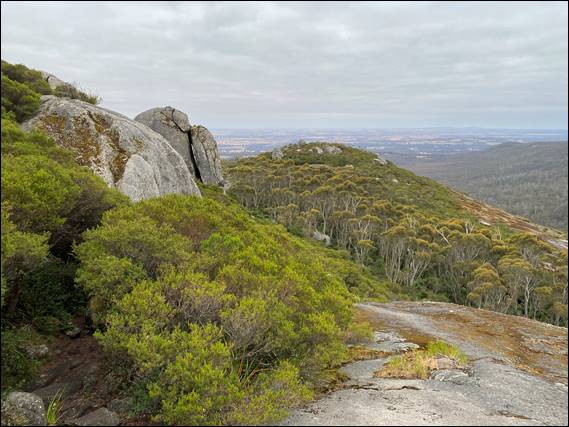
Yesterday we walked to the base of the granite dome, today we had to hike to the top and rap back down. This required getting to the top of the peak called the Devil’s Slide, which sits some 30m higher than our chosen peak. Here a sign tells you the trail ends, but not for us. We still had to descend to and cross the saddle that linked the two peaks. Marmabup Rock is the same elevation as Gibraltar Rock, and provides equally impressive slabs and walls. But it is harder to orientate yourself from the top, as opposed to when you look up from the base:

Craig and I had struggled to identify where the climbs were, mind you that was a very claggy day making visibility poor. Visibility was great today but it was just as cold as that previous visit. The air temperature didn’t break fifteen degrees on this trip, and for today especially there was no escaping the wind chill factor. We had a quick look round at the top but the route locations didn’t feel any clearer. One issue being there is no topo and the routes are not described in order. We did however know how to get to our first route:
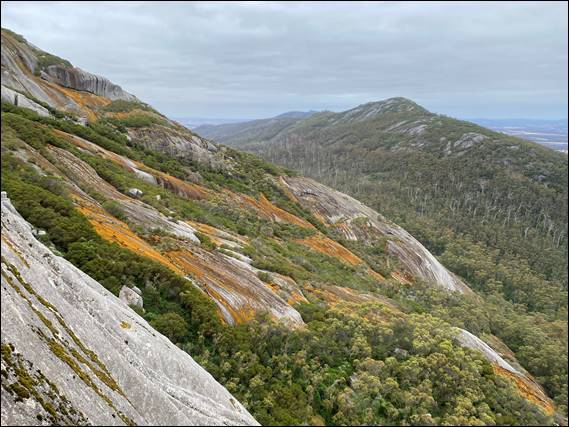
I was keen to hit one of the older lines. But was not keen on taking on the likely bush bash to get round the base of the cliff. Instead we rapped in on the line Craig and I had done. Getting us to the top of the second pitch, which I didn’t mind as the first two are supposed to be a relatively easy scramble. From here I took on the leaning flake, which is the reason we had hauled the trad gear up here. Old school lay-backing. Hands holding onto the back of the often rounded flake, while pushing our feet again the slab to create an opposing force:

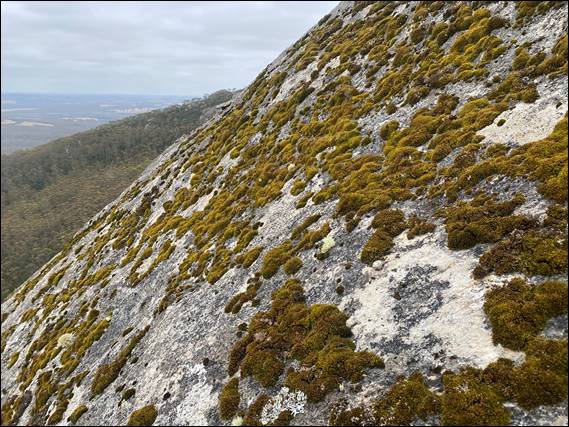
The slab was in places mossy making for a nervous lead, and in true old school style it was bold climbing. With that under-graded feeling due to the boldness, but the moves were about right. It was after all a Truscott and Rosser route, and I have said before that I find their climbs can feel tough. Howsie took on pitch two, being an amazing steep slab pitch. The hard granite not yielding any features or cracks for traditional protection. As such this pitch, like the first two routes yesterday, was of an era when they were created with bashed in carrots:

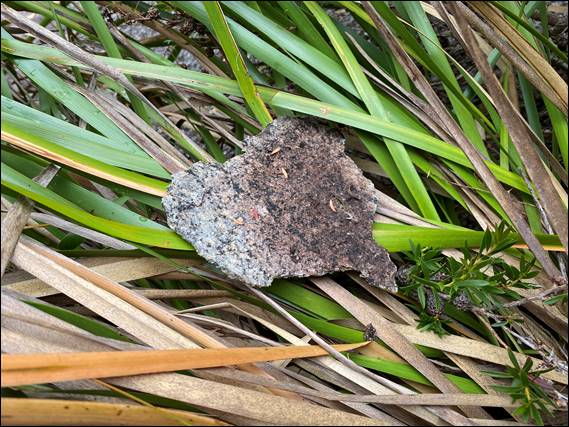
At times the small machine bolt head was hard to find due to the moss, as shown below. Fortunately, the moss was generally only present when the angle of the slab eased. On the steeper territory this allowed Howsie to more easily to see where his next protection was. So he could put all his focus on the delicate slab techniques required. It was a sustained and engaging pitch, a very impressive lead. After which I soloed the last 30m pitch, as in good old school style due to the lower grade there were no bolts that either of us could find:
In order for us to rap down we had to leave some gear on the line Craig and I had previously done. Seeing Howsie hadn’t been on the line before I was more than happy to climb it again, which we did with a Nankeen Kestrel (Falco cenchroides) circling and watching from above. This route was established 13 years after, and is given the same grade, as our first old school climb of the day. Grading is a hard thing, but we both agreed that it was easier in comparison. We had also thought the newer route yesterday was also a bit over-graded:

So is it that modern day climbers are going soft, and we are grading things harder than they should be. This is evident in other places too, for example in Scotland the older climbs given lowly grades can be desperate. Maybe this is akin to the modern age of being, to some degree, overly safety conscious and less willing to take risks. Certainly quite a few of the routes I have established have been suggested to be under-graded, and I wonder if that is really the case. This is not to say that it is true that all newer routes are soft, as we found out:

Grading is a fickle matter, so you should never believe what you read. Much can change from the first ascentist experience to your own. Including your mental state, technical preferences and skill set, ability to find and importantly trust protection, the weather conditions, and of course the rock due to holds falling off. After two very fine and contrasting climbs, we kicked back and had an early lunch pondering our next move. Fortunately we had phone reception and read and reread the details provided, giving us a hint of where to look next:
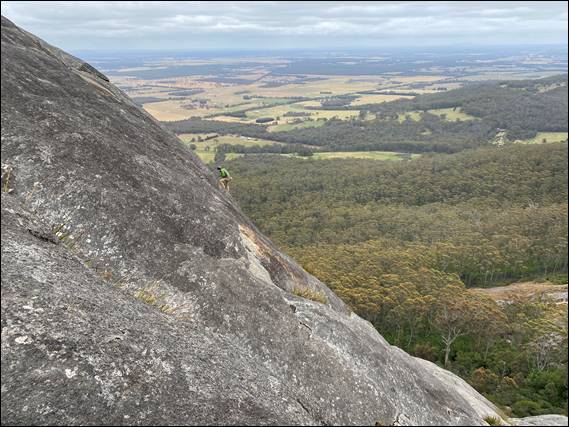
After much looking, we spotted a bolt some way down from the top. Identifying a 40m wall that topped out on the summit and had two climbs. Developed in the ‘modern’ era, which was good as it meant they were not protected by hard to find bashed in carrots. Having fixed hangers. The wall had some blank vertical sections near the top and I could feel my fingers tingle and muscles ach as I rapped down. This led me to picking the lower graded of the two lines. Very funky climbing up some features low down led to an improbable looking finale:
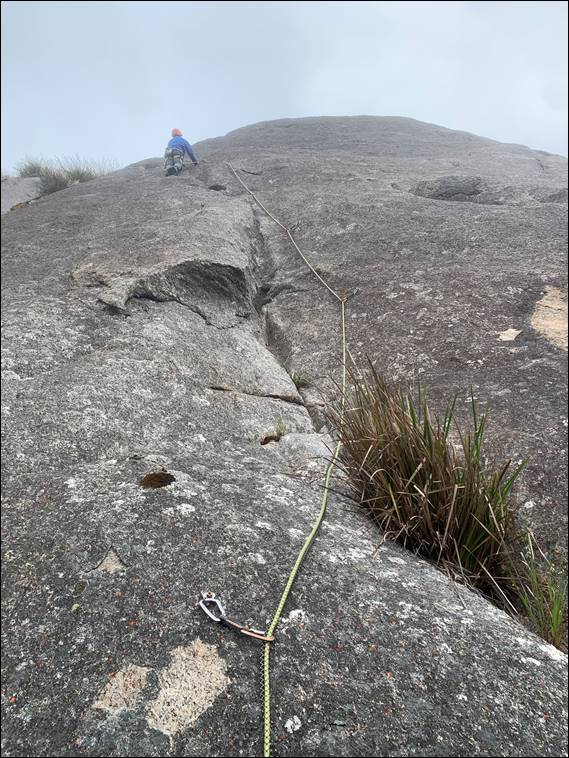
Working the moves I eventually unlocked the sequence. Then just started to curl my fingertips over what was the first reasonable hold for some time, that familiar and very unwelcome crumbling sound came from under one foot. Resulting in finding myself free falling. The on-sight was lost, and while it stung a bit that is climbing. On the plus side we both felt this was a climb for which the modern verses old school grading thinking didn’t apply. The climbing was nails, and we wondered what the next route would feel like:

Being a grade harder it felt an ominous undertaking, luckily for me one that Howsie would tackle. Watching intently it was clear it was pushing him, so my camera stayed in my pocket. At times he looked to struggle to work the moves, in positions and on holds that didn’t allow for a mistake. To his credit he held it together, and pulled off a great lead. Following up afterwards, I was pleased to have the rope above me as at times the holds seemed to disappear. Neither of the lines gets stars but they definitely deserve them:
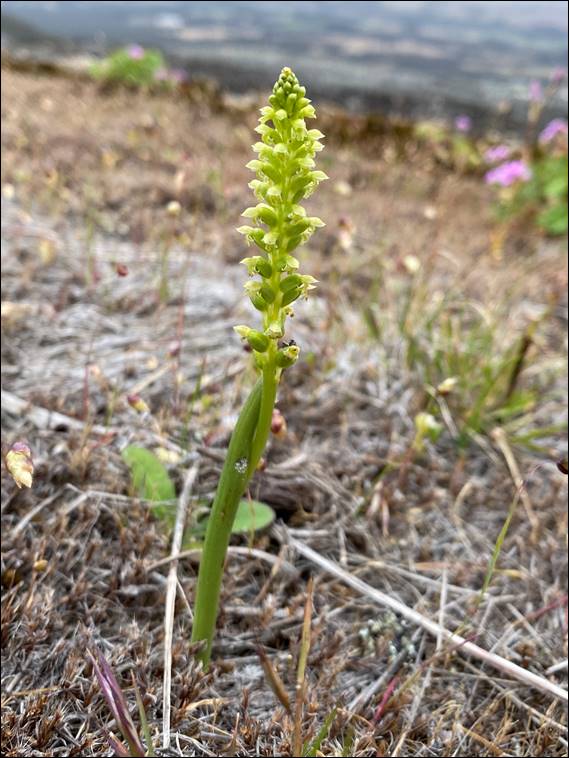
More than happy with our lot, we sorted the gear and had a snack before escaping the biting wind. It had even been too cold for the Sun Orchids. They somehow survive in very thin soils held in place by moss, over the granite outcrops. We saw hundreds if not thousands of them on the walk to and all over Marmabup Rock. However, with not one opening up all day it is hard to pin the species down. Unlike the obvious Common Mignonette Orchid (Microtis media) shown in an earlier image, which was also about but not in such large numbers:

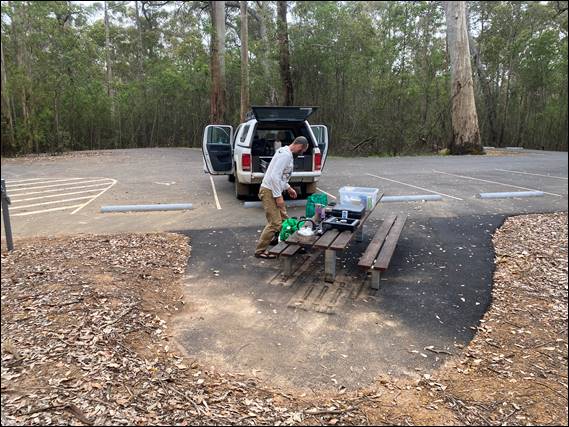
The hike out, being downhill, was always going to feel that much easier despite us being weary after two early starts and long days. The taller Karri (Eucalyptus diversicolor) trees, towering up to a 100m above us, seemed to be watching over us like sentinels. Making sure we got back safe. Keen to come back and find a few of the other routes, which despite our best efforts alluded us today. For now it felt good to take the packs off for the last time. Although before resting up, it was time to prepare some food and the all-important brew for the road:
Route list:
Gibraltar Rock
Dance of the Slab Spiders 65m 19**
The Real A.L Pedro 55 20**
Made in Australia, from Local and Imported Ingredients 220 15*
Marmabup Rock
Rehearsing The Fate of Absalom 110m 17***
Beckey-Gledhill-Swain 110m 17**
Custardly 40m 18
Excess Grip 40m 19
 Sandbagged