Lisa and I headed to Gnarabup for a night away, sticking to our agreement to make an effort and have a minibreak once in a while. Being relatively close it allowed her to partake in the local plunge before we left. Our destination was the number one surfing location in Margaret River, with accessible, reliable, and spectacular breaks. Not being familiar with the coastline here, and after my experience in a 1.4m swell at Wilyabrup, I decided that with forecast of a 2.6m swell on Saturday and Sunday I’d best leave the snorkel gear behind:
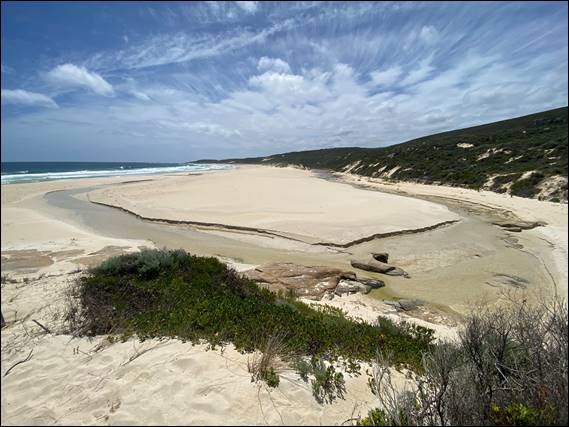
This was also in part due to our thoughts, when we first looked at this place, including hiking along the Cape to Cape track. Our familiarity about the track, like the coast here, was very low. Resulting is us walking south along the beach. Lisa however like to have a bit more certainty about where we are going, and what it might entail. Making the start of the walk less relaxing than it should have been. Next time we’ll make a bit more effort to investigate our plans. After following the beach for a couple of kilometres we reached Boodjidup Creek:
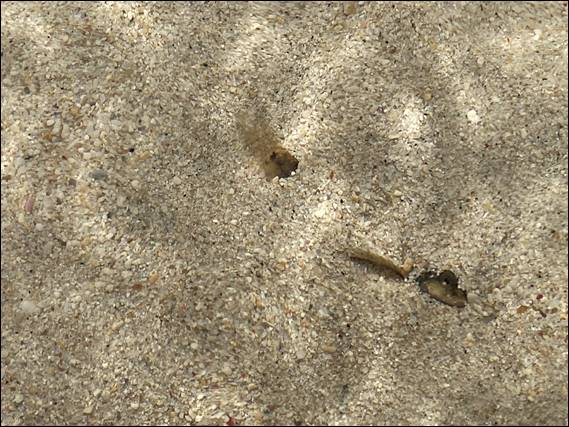
A piggyback for Lisa, over the creek as it flowed into the ocean, along with having reached where the Cape to Cape track met the beach, lightened our mood. Here Lisa chilled out on a rock, as I explored the creek line. My attention was drawn to some small fish, above you can see two of them looking back to me. I believe from their heads and snouts to be South-Western Goby (Pseudogobius suppositus). An benthic fish that exhibits a behaviour of burrowing. Found most commonly in slow-flowing brackish estuaries, coastal lakes and rivers:
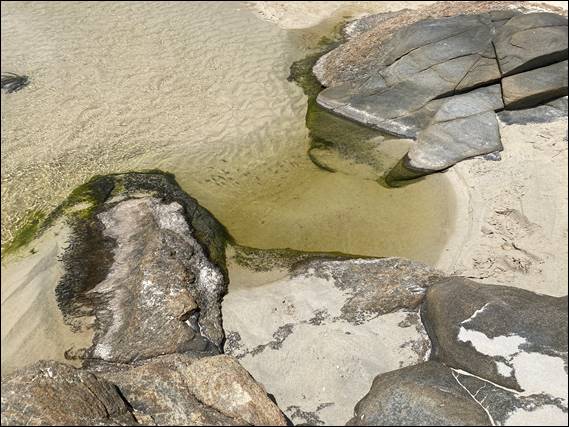
Wandering up the creek line as it meandered its way up the beach and behind the dunes, there were hundreds of small fish. But these didn’t behave in the same way. Not burrowing to hide, but moving in schools and looking for shelter. With longer and more slender bodies, leading me to think they were Common Jollytail (Galaxias maculatus). This species has the largest natural distribution of any freshwater fish species in Australia. And while I said freshwater, they are more commonly found in still or slow-flowing waters within a short distance of the sea:
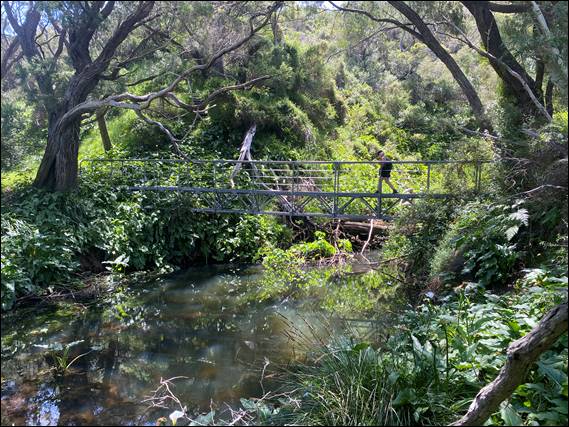
It was time to mosey. While I had been exploring, Lisa had been checking out our route back. Despite having only gone a short distance on the beach, the Cape to Cape track would take us back by going some way inland. Popping out on the coast north of Prevelly, which is a couple of kilometres north of where we started. This meant we had only completed a fifth of the entire circuit, taking up over an hour. It was time to pick up the pace, which started when we followed the weaving creek line until a bridge allowed us to cross it for the second time:
As we reached the bridge, the banks were covered in Arum Lily (Zantedeschia aethiopica) a declared pest in Western Australia. Someone had cut a heap of flower stems off these, and piled them up. Maybe in an attempt to help remove them. However, they have extensive tubers, and can regenerate from just a fragment of the tuber. As such if mechanical removal is not possible, which would require scappling the area and taking every out, then chemical control is required to kill of the tubers. As such their efforts may have been misled:
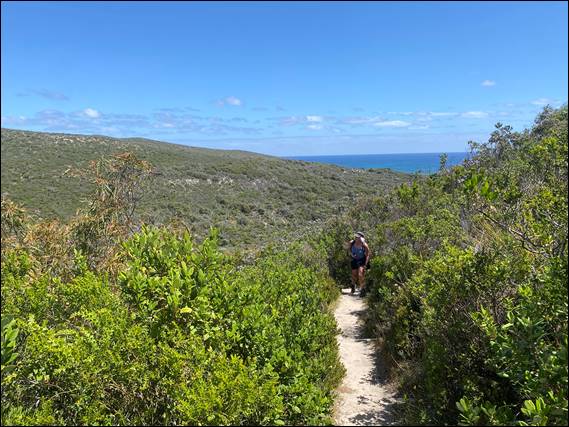
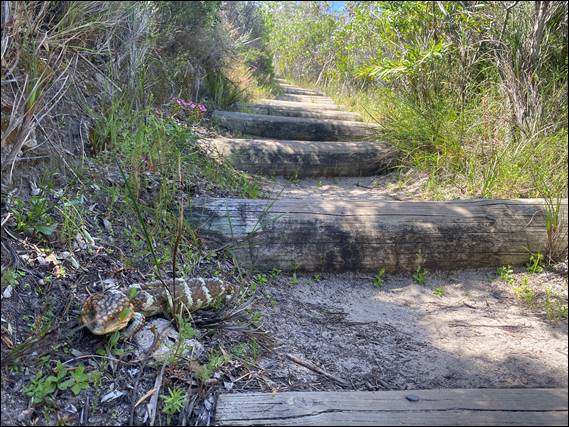
After the bridge a very long series of pine log steps led us up the dunes and inland, leaving the ocean behind us. The wind died down and the bite of the sun could be felt, the heat that came down also brought out several Bobtail Lizards (Tiliqua rugosa). And I quietly hoped there may be a snake or two basking on the path, but it was not to be. Once the sound of the waves were out of earshot, the path took on a familiar form. Several landforms brought back memories to me, but Lisa was not so sure:
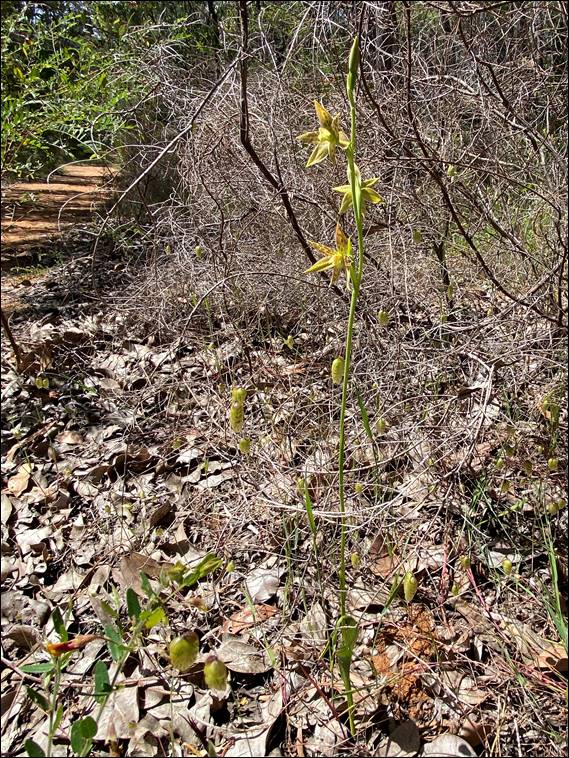
On that last trip we had seen a snake, and we had also come across the Leopard Sun Orchid (Thelymitra benthamiana) for the first time: https://sandbagged.blog/2020/10/18/creepy-crawlies/. Since then I’ve seen heaps of these, and today there were quite a few out, along with several other repeat finds for this season. Lisa’s shoes had filled with sand on the soft track, so while she emptied them I looked about. Spotting a small clump of Coastal Spider Orchids (Caladenia abbreviata). These flower later in the season than most, when their basal leaf often looks a bit withered:
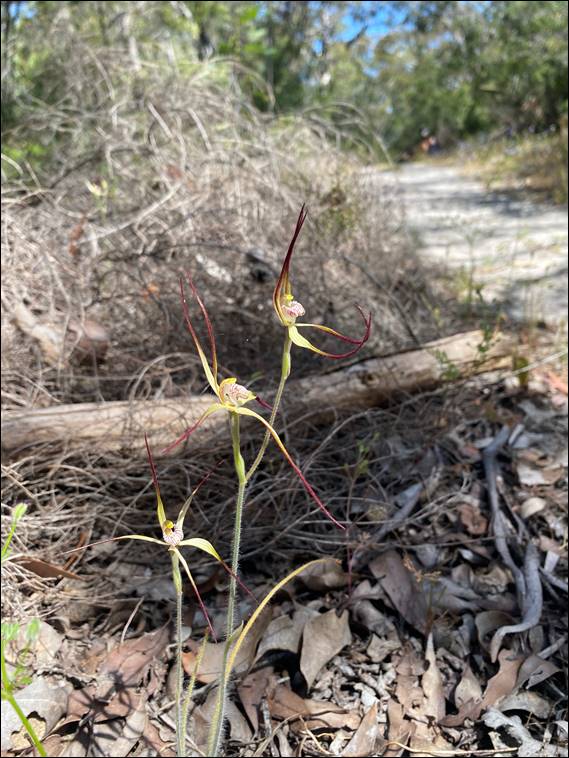
They have been given a Priority Three conservation status by the Western Australian government. This does not mean they are under immediate threat, but they are poorly known and only found in a few locations. Having been first formally described in 2001, by Stephen Hopper and Andrew Brown. The latter of the two being the person who recently helped identify some of my finds at the Capel Nature Reserve. The name, a Latin word, abbreviata means shortened, and refers to the relatively short petals and lateral sepals:
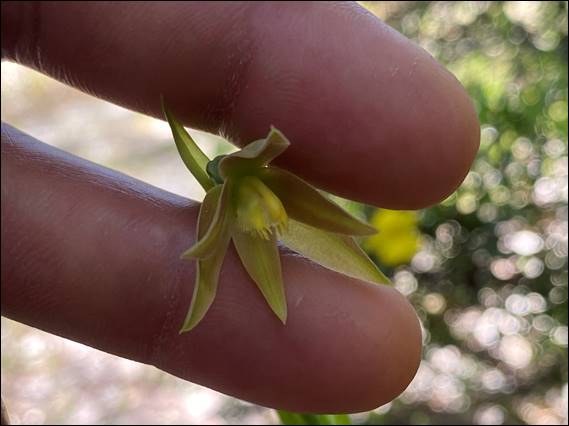
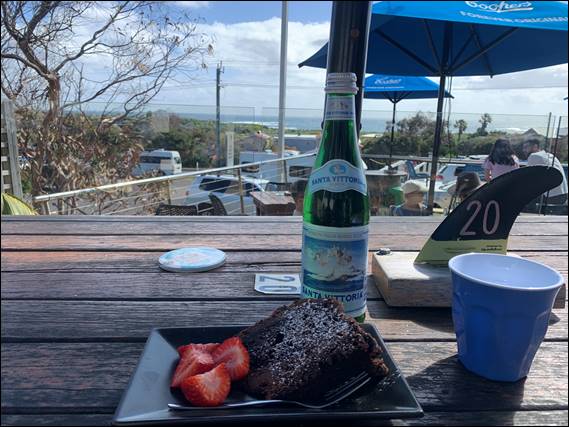
I’ve checked a number of other features that all point to my identification being correct. Sometimes however the most distinct features can be missing, a bit like may be the case with the above Leopard Sun Orchid. With no spots. That said the yellowish green flowers can have brownish spots, blotches, and/or patterns. With all the unexpected finds the approx. next ten kilometres went by pretty quickly. And after that we felt like we could reward ourselves with a snack at a café in Prevelly overlooking the bay, which went down very well:
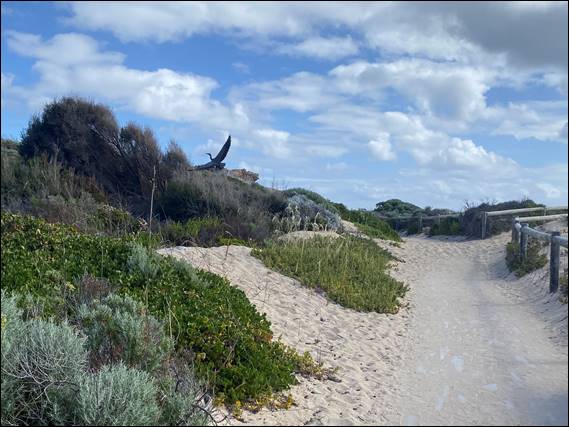
There was still a few kilometre left before we got back, most of which took us on a limestone track just about the beach. Here we saw what we think is likely to have been a juvenile Dugite (Pseudonaja affinis), but it slithered away too fast to be able to catch a picture and check it. And as we looked down hoping to see another, we would have walked past this White-faced Heron (Egretta novaehollandiae) if it hadn’t given its location away by flying away. Being the most common of the herons in Australia, found everywhere water is found:
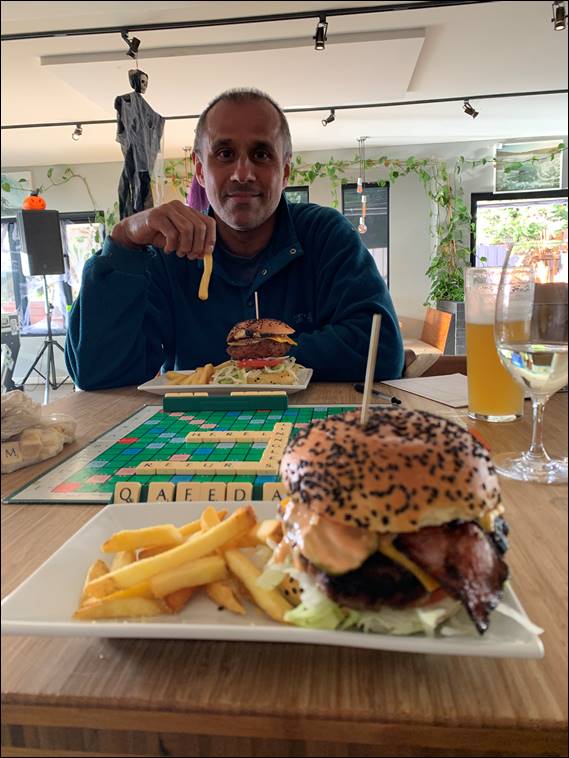
Despite the dodgy start, the walk was a lot of fun and we got to see heaps along the way. And I won’t lie I did enjoy unexpectedly finding orchids, and am quietly hoping now to find more. We felt that fifteen kilometres later it was now time to settle into the room, have a brew or two, and put our feet up for a bit. For dinner the hotel had a bar on site, serving good ole pub food and a decent pint. All of which went down well, as we pulled out the scrabble. Managing to polish off our food, drinks, and game before the Halloween party kicked off:
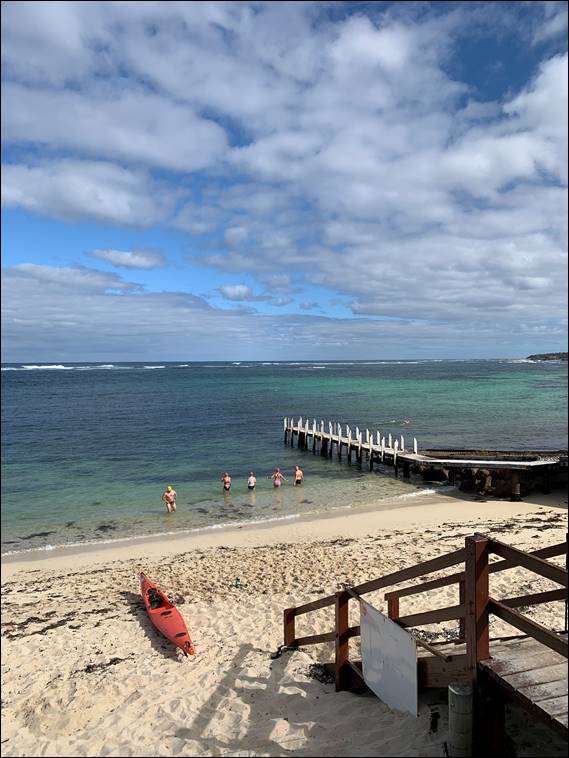
It was a slow start on Sunday, we did however wander down the road to a small café right of the beach. More food was consumed, as Lisa watched people get in off the beach and swim various distances across the bay before returning. Suggesting it is something she will never be brave enough to do, but I am not so sure. I would however prefer to look at the sea life while snorkelling. Being a little annoyed with myself for not bringing the gear, when we saw much of the bay was protected by an outer reef and looked very inviting. Maybe next time:
 Sandbagged