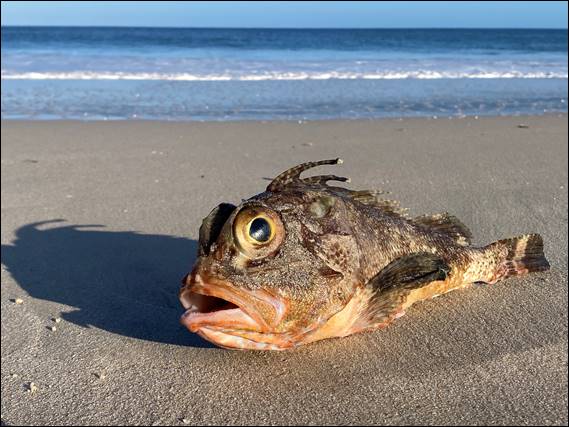
Now that Lisa is back at work, for the fourth and final term of the school year, my usual Thursday and Friday work from home days have kicked back in. Allowing the opportunity to join her morning beach walk on Thursday, when we found this unlucky Bighead Gurnard Perch (Neosebastes pandus). Based on its condition it had been recently washed up. I too have been feeling a bit like a fish out of water, not having been on rock for three weeks. And while I couldn’t save the fish by putting it back in the water, I fix my itch by touching rock:
I was not able to take Friday off, things are a bit busy at work. But there was always the option of a quick climb at Welly Dam, and I knew Howsie wouldn’t be able to resist such a trip. So on Friday, instead of joining Lisa at the beach, Howsie and I were already out there climbing. Needing to get back for a meeting at ten, I had suggested a first light arrival at the crag. This saw me get up at three thirty, and unlike the fish luck was on our side as we drove eastwards. A reddish hue started to form in the sky, which gradually increased in intensity:
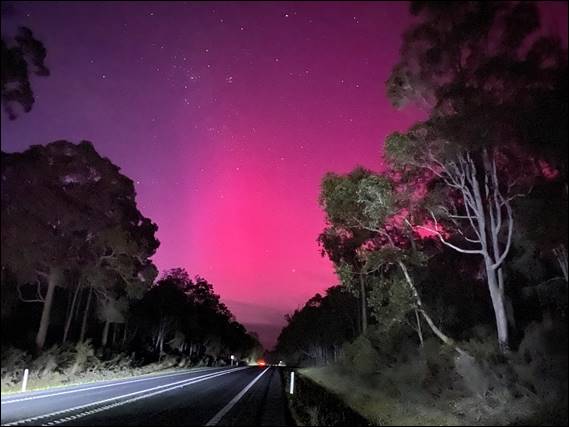
As we continued on the last leg of the journey, we were wowed by a great Aurora Australis light show. Massively more impressive than the one and only other time I have seen it. The camera picks up light waves not visible to us, so the image is enhanced. That said it was still an amazing spectacle, even to the naked eye. We stopped several times to take it in, while other drivers no doubt on their way to work pressed on. Unusual solar activity had been predicted to occur on Thursday, Friday, and Saturday night, not that we knew about it at the time:
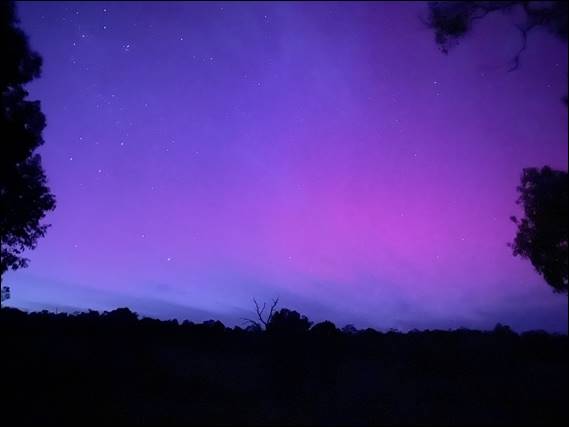
The solar activity releases ‘solar winds’. If strong enough these can reach and affect the immediate space round earth, and subsequently the gas particles in our atmosphere. This is what results in the range of light patterns being formed. Exactly when this will happen is very hard to predict, so you have to be in the right place at the right time to see it, and in our case driving in the right direction. The stunning show lasted for approximately quarter of an hour, by which time we had arrived at the carpark and first light started to take over the sky:

We were both unsure how we would go today, and hence aimed for sensible grades. Being Welly Dam that doesn’t mean the climbing will be easy. Jumping on first lead, I could feel my joints stretch, muscle groan, and body feel a little clumsy and awkward. Howsie also found it a shock to the system. We pondered why it could be that we could head to Queensland and climb so many routes we have never been on, at this and harder grades, without too much of an issue. Yet the well-rehearsed routes here we have climbed countless time can, and still do, hit us hard:
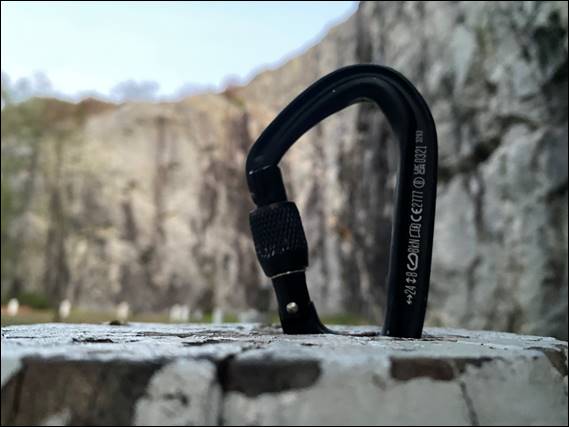
The first route was a good choice because my crag booty haul continues to grow when I found the above bail biner on the last bolt. Someone had probably found the final moves too committing, preferring to sacrifice a piece of hardware to allow them to get lowered back down. Based on how we were feeling we didn’t pull the rope so both of us to lead each climb, but on the plus side and as our bodies warmed up we started to feel more coordinated and comfortable on each successive route. The rock was also mostly in good condition:
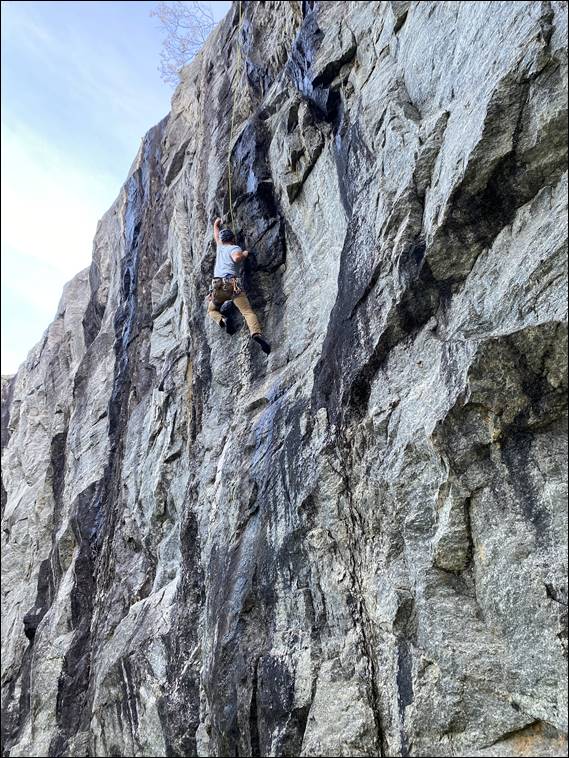
Other than my lead on the above line, on which I was able to avoid most of the wet rock. And it was way better than my last visit here in August, when there were little waterfalls cascading down the faces being fed by huge pools of water along the top of the crag. Today in contrast was wonderful. Birds abound and at the top of one climb a Splendid Fairy-wren (Malurus splendens) hopped within feet of my head. Then on another climb an Australian Ringneck (Barnardius zonarius) greeted me, being equally nonplussed by my presence:
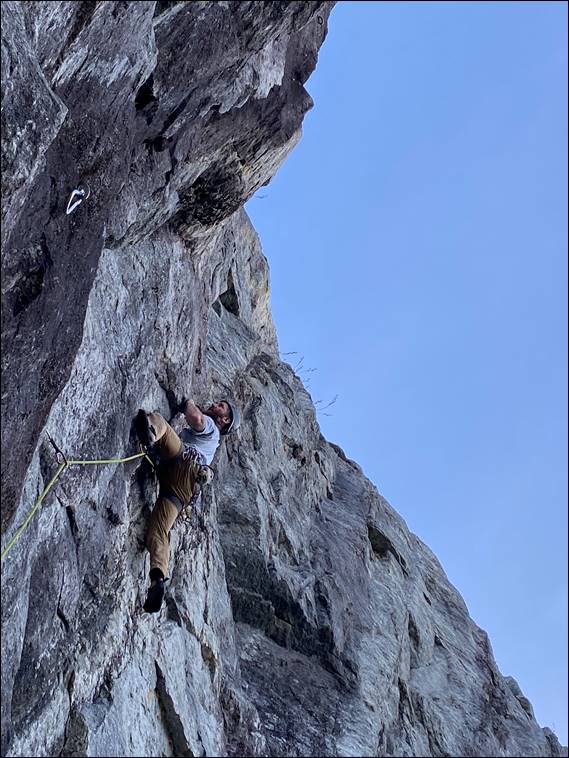
Despite our initial concern we racked up our six chosen routes in two hours. Howsie being on the last one above, and you may notice the a large carabiner hanging of the line next to him. And also the plants sticking out above near the top of the crag. The carabineer I’ll get back to, but the reason for finishing on this route was I wanted to check the plants out. This climb also requires you to top out, resulting in the need to walk back down. Allowing you to check out the top to see what may be growing, and we spent quite some time doing exactly that:
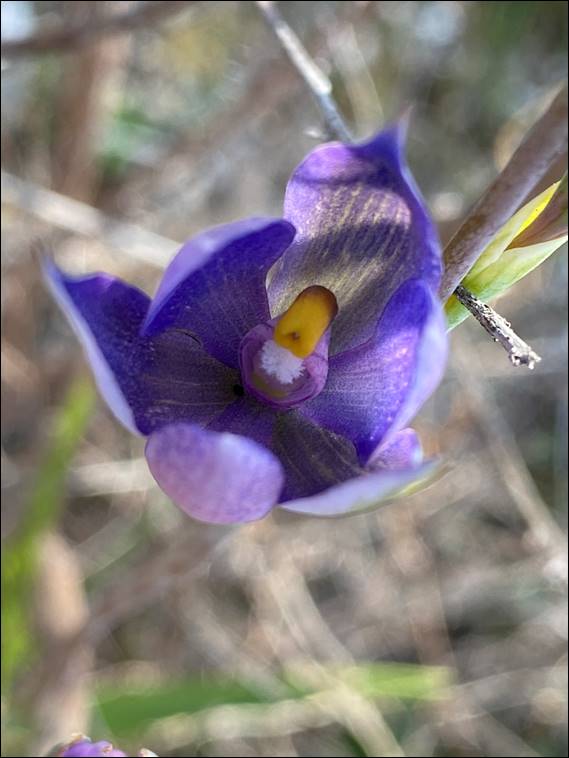
The top was littered with sun orchids, but being so early they had not yet opened up to the new day. I suspect that they were all Plain Sun Orchids (Thelymitra paludosa), whose name paludosa is a Latin word that means swampy or marshy, being the habitat they prefer. This may sound strange, but I mentioned that the top of this crag collects pools of water in winter. And these plants seem to like the, at times very thin, veneer of soil. The soil continues to get water into spring from seepages. In the wet soils we also found heaps of small trigger plants:
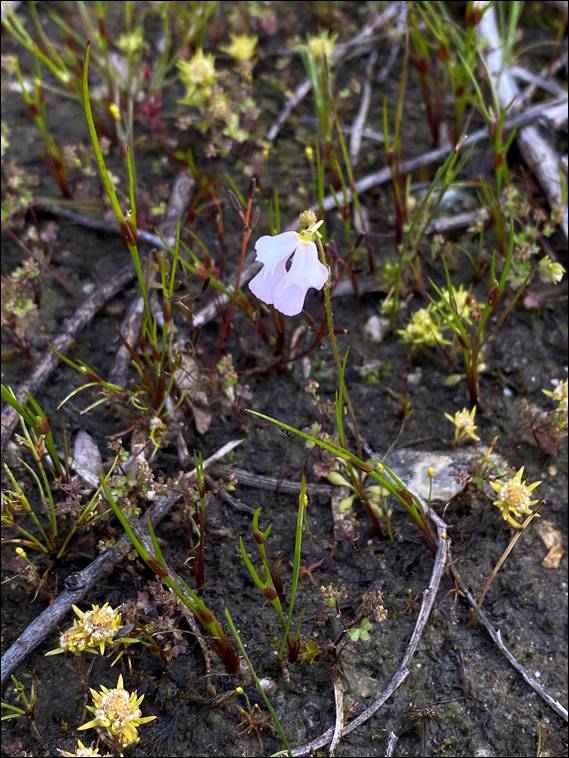
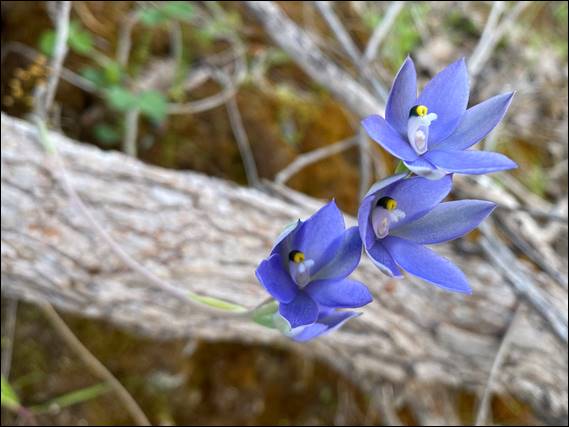
The above is a Book Triggerplant (Stylidium androsaceum), which like sun orchids close up at night. But rather than its petals forming a bud, the top petals fold downwards to partially cover the two lower petals. Closing up like a book. Below is another Plain Sun Orchid, with very different coloured petals to the other image I included. Some species of sun orchids have colour variations but this species takes that to the next level, ranging from blue to violet, pink, and even white. We also found one with alternating pink and white petals:
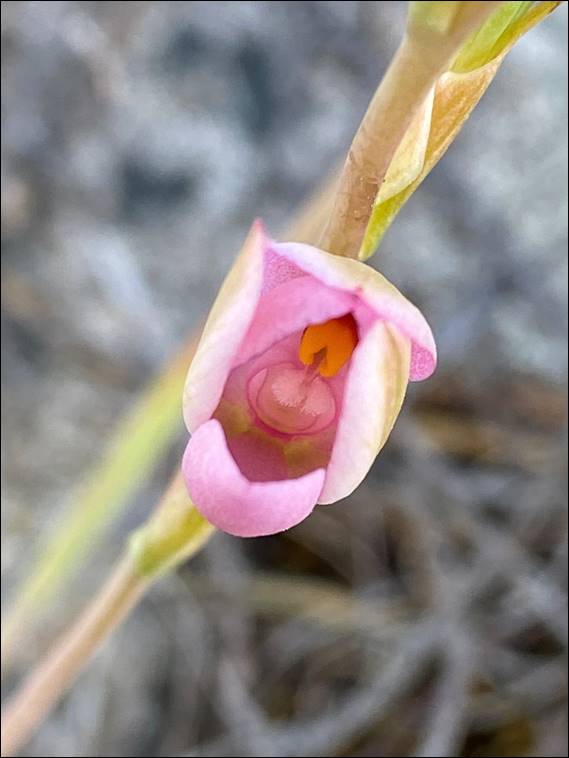
There was a more impressive range of orchids at this time of year than I have seen here before. This included Twisted Sun Orchids (Thelymitra flexuosa), a species I have never come across. Due to the buds being clamped shut, more tightly that the Plain Sun Orchids, I have not include an image of them. We also found lots of small donkey orchids, most likely to be Purple Pansy Orchids (Diuris longifolia). Their flowers were smaller than what I normally find, but were still within the size range that can be found for this species:
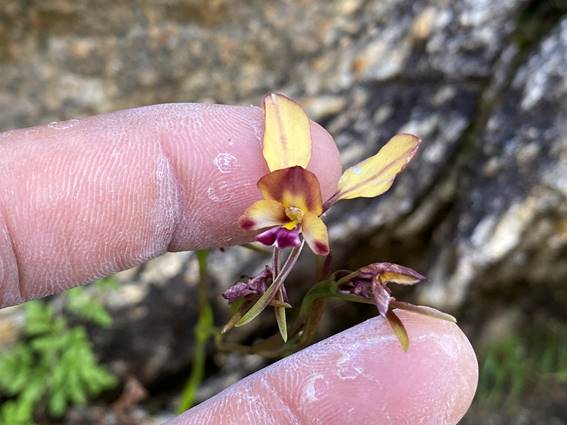
And then there was one plant that was much smaller. It had quite much darker colouration, and the way the dorsal sepal and labellum is held was also in contrast that of a usual donkey orchid. Checking it out with my orchid book next to me I am pretty sure it is Dark Bee Orchid (Diuris insignis), and is my first ever bee orchid sighting. I’m kicking myself that I didn’t take more time to get some better images, but we had spent nearly twenty minutes scouring the top of the cliff and we needed to get back:
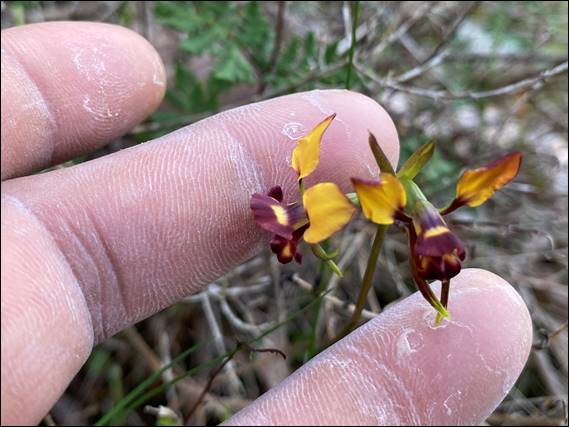
Back down to the base of the cliff, not home just yet. I had sent a picture of the morning skies to Bigge, a friend in Ghana who I played volleyball with for two years back in the late nineties. In between the climbs we exchanged messages and I also sent him a picture of Howsie climbing, and this piqued his interest. Like my first time sightings of a couple of species today, climbing is a new concept to him and had him fascinated. Intrigued by the way we managed to hang onto the rock, which seemed improbable. To help suggested to Howsie we take a video:
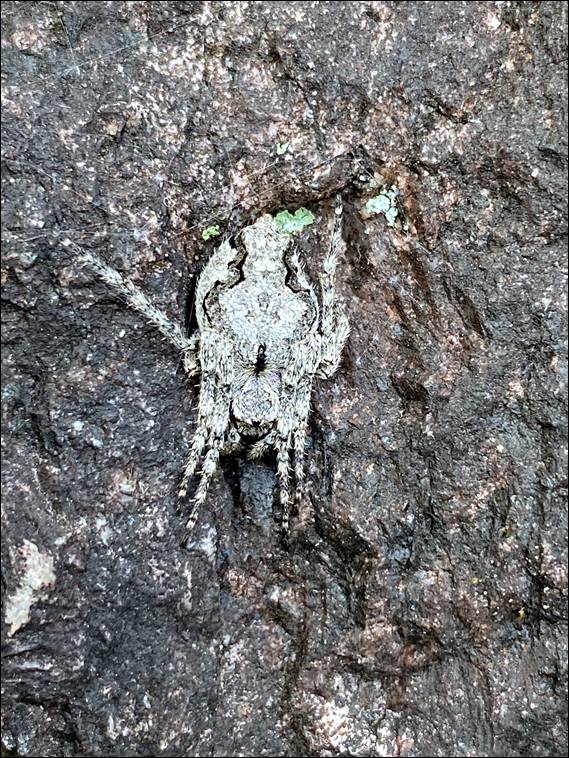
Still having plenty of time up our sleeves before needing to hit the road. That of course meant getting a couple more climbs in, to even the leads up. This led to the following video being sent to Bigge to give him a bit more of an idea of what we do. And us spotting some Dewdrop Spiders (Argyrodes antipodianus) that disguise themselves as water droplets, you’ll find images of them in this previous post: https://sandbagged.blog/2023/11/04/another-long-goodbye/. And the above well camouflaged Orb Weaving Spider (Eriophora transmarina):
You may notice the male Orb Weaving Spider has one leg outstretched, attached to a strand from its web to act as a doorbell should any prey get caught. Howsie took the last allowing him to increase his crag booty haul by grabbing the large carabineer mentioned earlier. With eight routes under our belt it was time to leave. After driving less than fifty meters, we spotted more sun orchids some with open flowers. Being the a third sun orchid species of the day, the Shy Sun Orchid (Thelymitra graminea). It is quite amazing how much we packed into, and saw during, our three hours at Welly Dam. What a wonderful way to start the day:
 Sandbagged