The Glass House Mountains alone contain 24 regional ecosystems. And being spring I was hoping there may have been a heap of flowers. However, as we walked to each crag, often through a different vegetation complex, we really didn’t see too much. My attention was of course aimed at orchids, but I should have done a bit more research in that department before heading out. There are certainly some species of orchids that are similar to what we find in the South West of Western Australia, many are however very different:
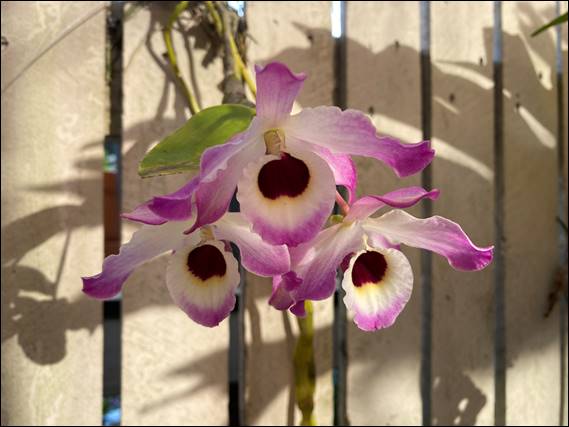
The above is a Noble Rock Orchid (Dendrobium nobile), this species which Mikie and Helen have in their garden is an introduced ornamental species. But does introduce the term epiphyte and lithophyte, which quite a few of the native orchids of South East Queensland are. These terms mean a plant that grows on the surface of another plant and that grows in or on rocks, respectively. Some of the native orchid plant masses are also very different, often with a mass of exposed roots and/or leaves that can be quite fleshy in nature:
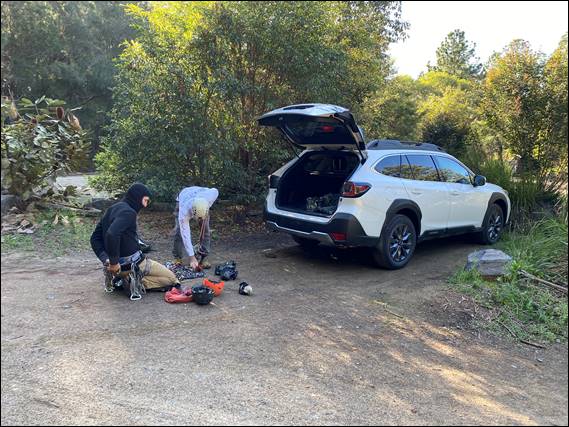
While I didn’t see many, I was lucky to find three native species. I unknowingly took an image of one on my first day out, and have included an image of it in the first post. It will crack another mention later in this post. Day three and it was time for a long route. Mikie had suggested he may only join us for one day on the big lines. Allowing him to spend some time with Helen and the kids. Sarah was also absent, as she is not overly keen on big multi-pitch routes. This meant Rongy had driven up alone last night to join us for an earlier start:
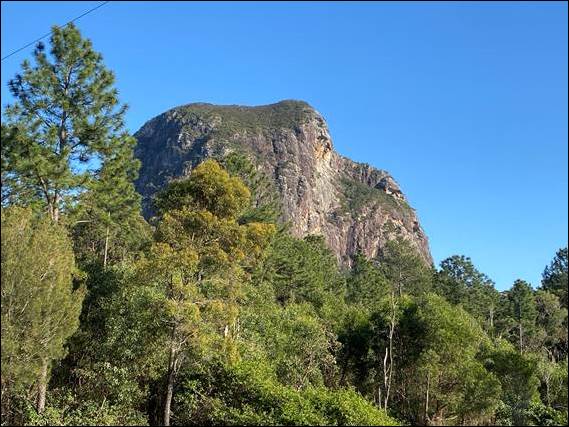
The destination for the three of us so happened to be the third tallest peak in the Glass House Mountains. Mount Tibrogargan at 364m. Despite being the third tallest, it seemed to stand out the most. An impressive peak with steep sides falling away on every side. This illusion of grandeur didn’t just make an impression on me, and culturally Tibrogargan was said to be the father of all the other peaks in the Glass House Mountains. The mother being the tallest peak called Mount Beerwah:
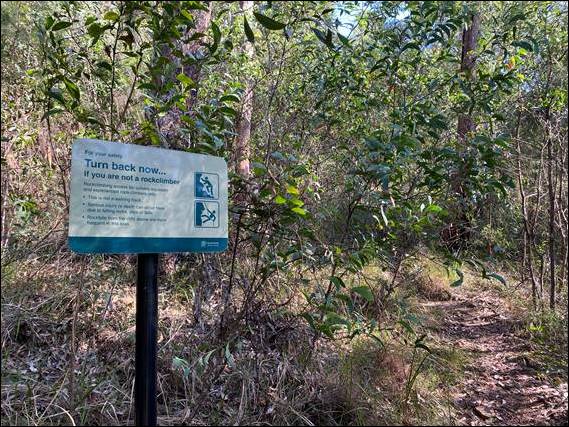
The sides are so steep that in 1799 when Captain Matthew Flinders was exploring the area, he wrote in his journal that ‘the steepness of the cliffs, utterly forbad all idea of ascending to the top’. This was despite having already ascended Mount Beerwah. These steep sides are however a draw card for climbers, and as we walked in I had a giggle when I saw the sign two images up telling non-climbers to ‘turn back now’. On the face of it, it seemed that Queensland had a more outward facing regard of climbing than in Western Australia:
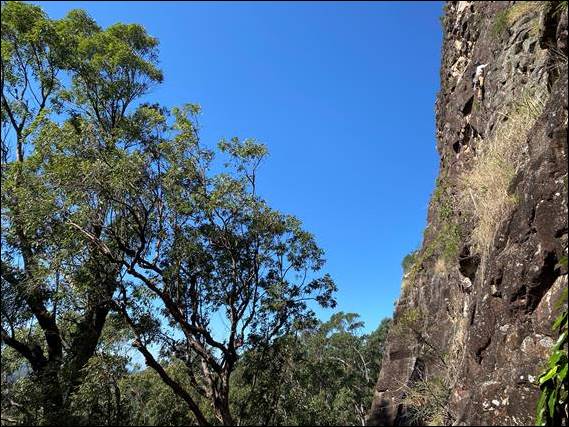
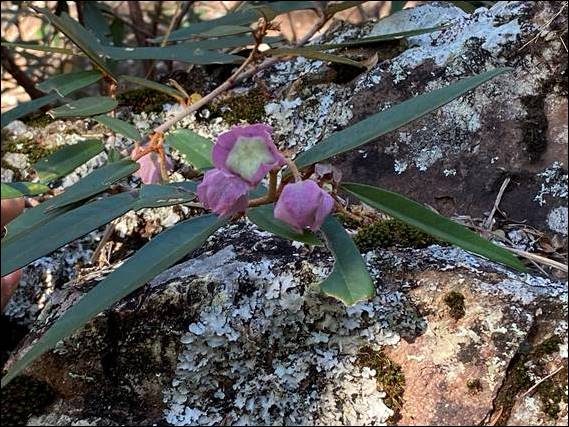
The little pink flowers two images up deserve a mention, I’ve never seen anything like them. As the petals start to open they reveal what looks like a bud of yellow cotton wool. This must fall out or get absorbed when it fully opens, as the flowers then displayed the usual arrangement of a stigma and anthers. I asked a few local people about them but no one could tell me anything about them, and my research has also failed to pin them down. Fortunately Rongy, Howsie, and were able to pin down the route we would aim for, but it did take time:
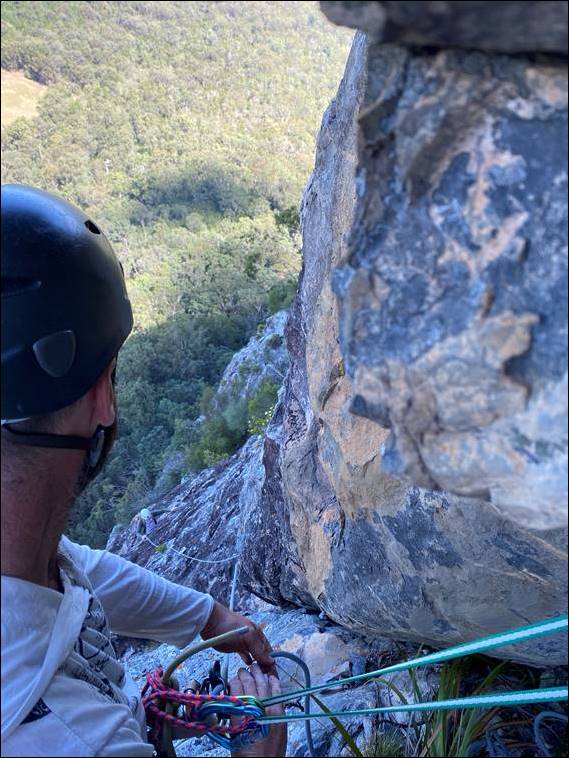
The routes we were looking at were located on the impressive +200m Carborundum Wall. Descriptions of many lines were plastered with warnings that only climbers with good traditional skills and route finding experience should undertake them. Added to that it was a rock we were not familiar with, being different to what we had climbed on in the last two days. Then climbing with three of us would slow things down. The route that drew our attention, was also a little daunting due to the grades but if all else failed we could rap off:
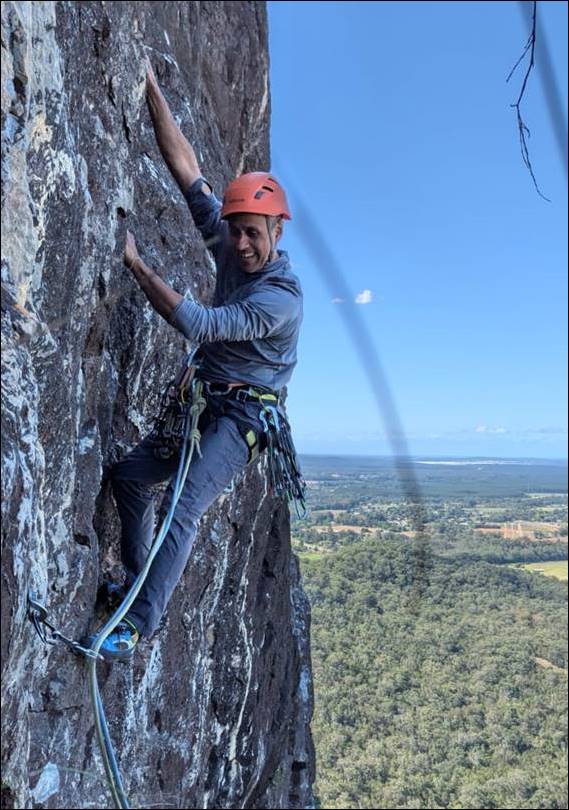
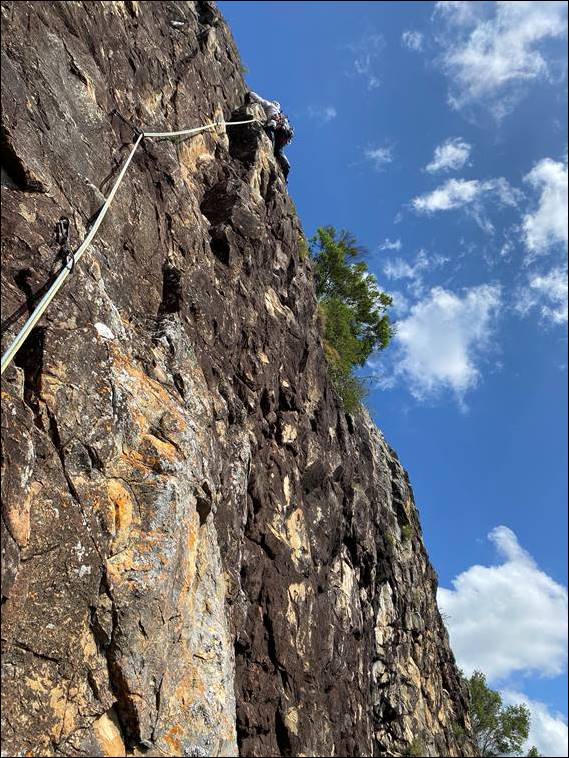
As such we went for it, 245m comprising six pitches with five of them having a grade of 18 (E1 5a/b) or more. Howsie was once more first up, and if the crux on that pitch was anything to go by it promised to be a big day. It may well have been that it was the first pitch of the day. Also it took a while to get used to the sloping holds, which nearly always seemed to be angled the wrong way. Making for nervous moves when the gear was spaced, but after the first two pitches there seemed to be a generous offering of bolts making the climbing less intimidating:
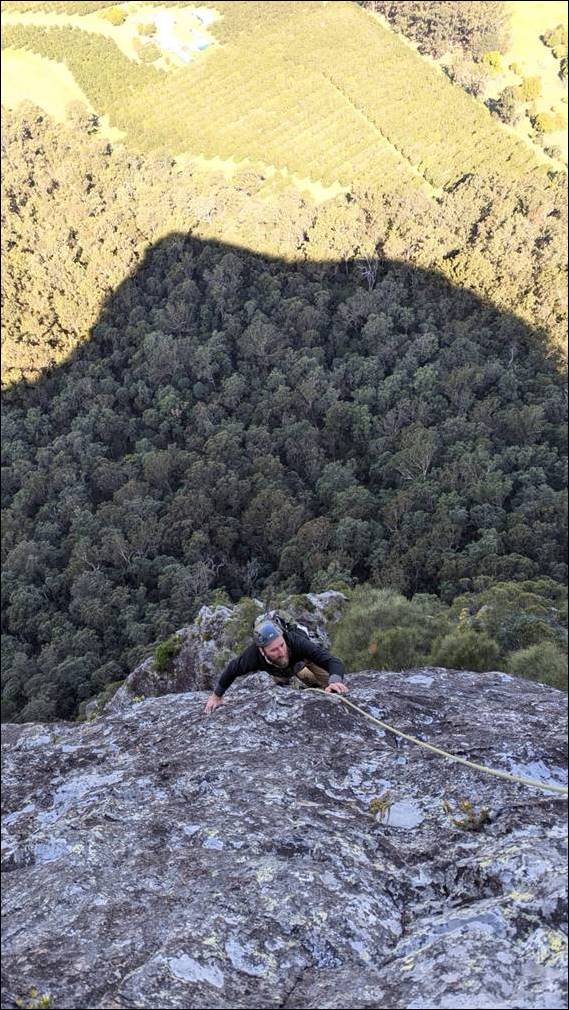
The bolts also meant that finding the route really wasn’t all that hard. The second pitch was the trickiest but with the description given it didn’t take too long to unlock. I think it took longer for me to get my big wall leading head on, than it did to find the way. We lapped up pitch after pitch, and Rongy was the one brave enough to take on the one graded the hardest. And as I have said many a time, grading is a little subjective. Not taking anything away from the quality of the climbing and the route, we felt it was somewhat over graded:
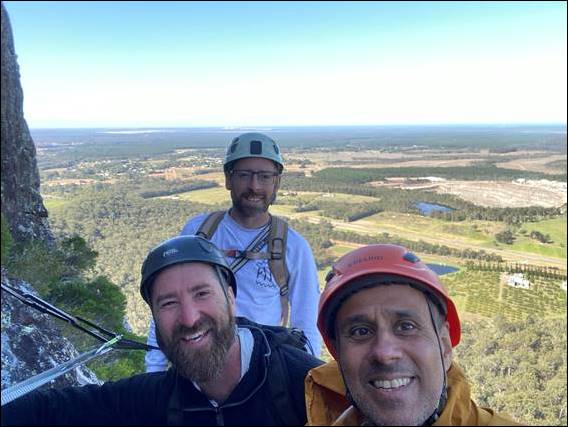
We were in no rush by any means and sat on a couple of the belay ledges to take in the vista sprawled below us. Each pitch taking about an hour for all three of us to ascend, and at the top of pitch six we were still a good 50m short of the summit. We had an option to rap back down the line. Warnings online of rusty anchors at the top of the last pitch might put some off, but upon inspection they looked in good enough condition. We all agreed however that it would be worth the scramble required to enable us to stand on top of Mount Tibrogargan:
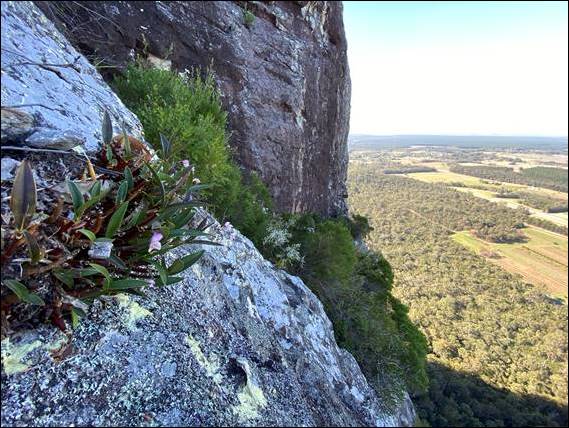
The scramble started up clean rock, which is where I came across the above Pink Rock Orchid (Dendrobium kingianum). This is the flower I took an image of on the first day, shown in the fifth image of the first post. It is endemic to eastern Australia and one of the lithophyte orchids. The scramble then entered thick vegetation and was horrendous, with the occasional loose rock underfoot. We persisted, topping out only to find that there is no clear view from the peak. Still it was worth it, to have a clear area to sit and finish off our food:
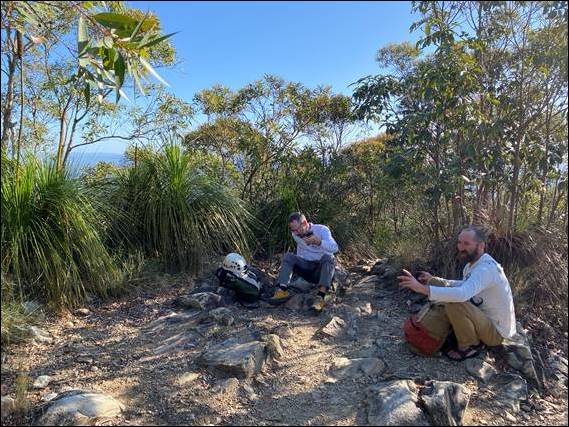
After a well-deserved chill, we started the hike back down the tourist track. And it was a track like no other I have walked down, and was not something I would call your average person walk track. It dropped away steeply, and would be treacherous when wet. The thin veneer of soil having been eroded and washed away due to foot traffic. This exposed a light coloured smooth rock, creating a scar on the peak that can be seen from many miles away. Requiring full on scrambling in sections. Whilst a lot of fun for us, it could be pretty daunting for others:
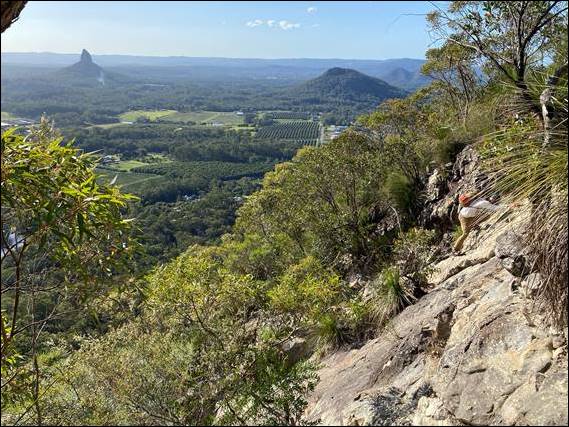
I can see why Flinders and his crew decided not to attempt this peak. After the very long scramble we came across a few people walking up who said they would only go as far as the scramble started. It did however make for a great day out for us, and the walk/scramble of the peak was just as entertaining, in its own way, to the climb up the impressive face. And to boot as we wandered round the base, back to the carpark, I spotted one and then quite a few more White Fingers Orchids (Caladenia catenata):
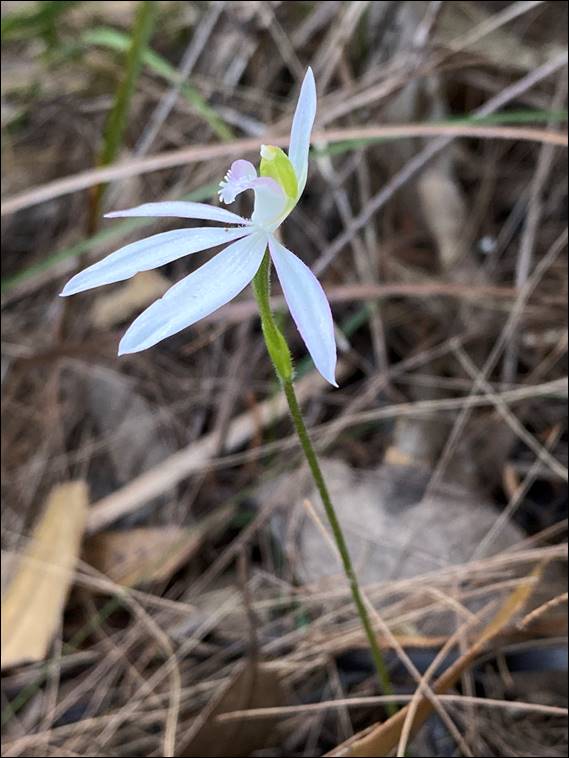
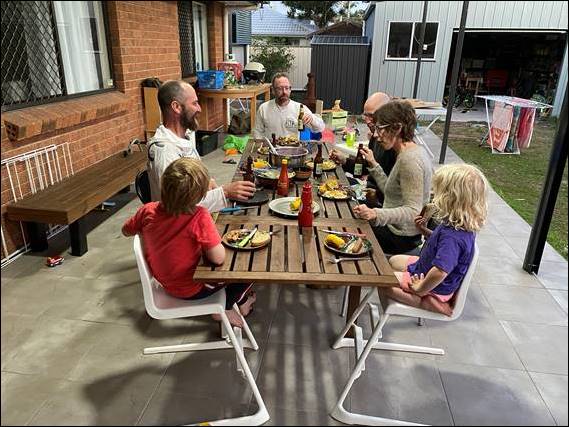
This dainty orchid is endemic to New South Wales, Queensland and Victoria. Reminding me of the Leafless Orchid (Praecoxanthus aphyllus) that is endemic to Western Australia, which I have only just found this year. But unlike our local orchid with no leaf, the similar eastern orchid has a single hairy leaf. It was a great way to wrap up an epic day out, which was celebrated with a BBQ that was well underway when we got back to the house. Courtesy of Mikie and Helen, which was very much appreciated and went down very well:
Having got a big route under our belt, and of the grade that it was, heading out on Tuesday back to the same place didn’t feel quite as daunting. This time Mikey joined us and we intended to climb as two parties. Both on the North East Buttress on routes that were just shy of 200m. We had originally picked two lines hoping that each party could climb both routes. However, we needed to get back at a reasonable time to be able to prepare for the next couple of days, as we intended stay away overnight. So while possible, it wasn’t likely:
As we walked in there was a slight change of who climbed with who, and Mikey and Howsie climbed together. This left Rongy and I to tackle our chosen line, which we had also changed. Our rationale being that if we were not going to have time to fit both lines in we should pick a climb of similar grade. While the face wasn’t quite as sheer as yesterday, most of the eight pitches were steep enough. Bolts showed the path, so it was hard to go wrong. Rongy and I climb pretty efficiently, and even faster when not needing to fiddle with gear placements:
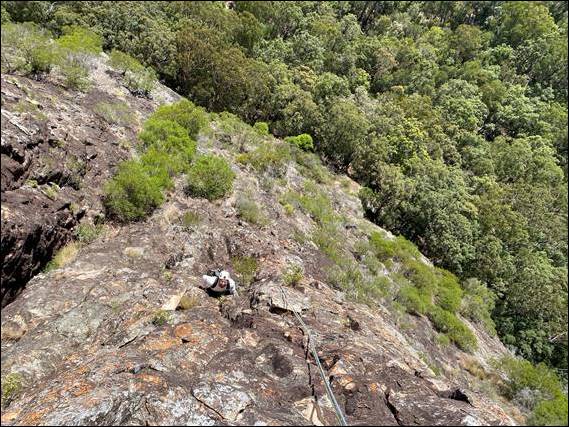
The climbing was really good, and that bit more comfortable now that we were accustomed to the smooth slopey holds on offer. We were not rushing but managed to climb the route and rap back down in a three hours. This would have allowed us plenty of time to wander round and climb the route that Mikey and Howsie were still on. It had however been pretty warm, the sky was near clear and this buttress had no shade. This made Rongy admit to being a little weary, once we had rapped back to the base and not show signs of being keen to press on:
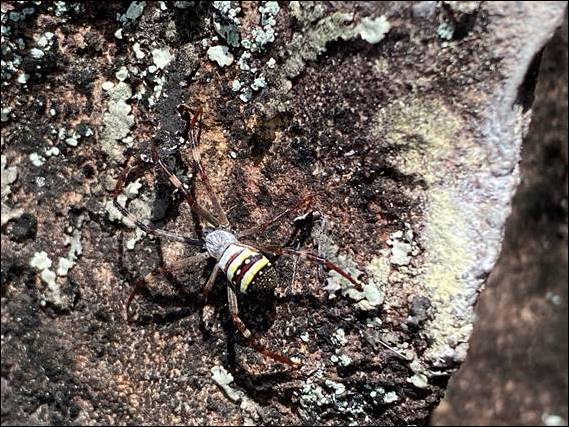
Not too weary to miss this St Andrew’s Cross Spider (Argiope keyserlingi), a common species that is easily identified by the markings and colouration. Cross spiders are so named due to the cross that is woven into the web. The spider will often then sit on the cross with their legs paired together in line with each arm of the cross. The cross is thought to play many roles including making the web stronger, providing camouflage of the spider, reflecting more light to attract prey, and also to deter predators due to the extra mass of silk to deal with:
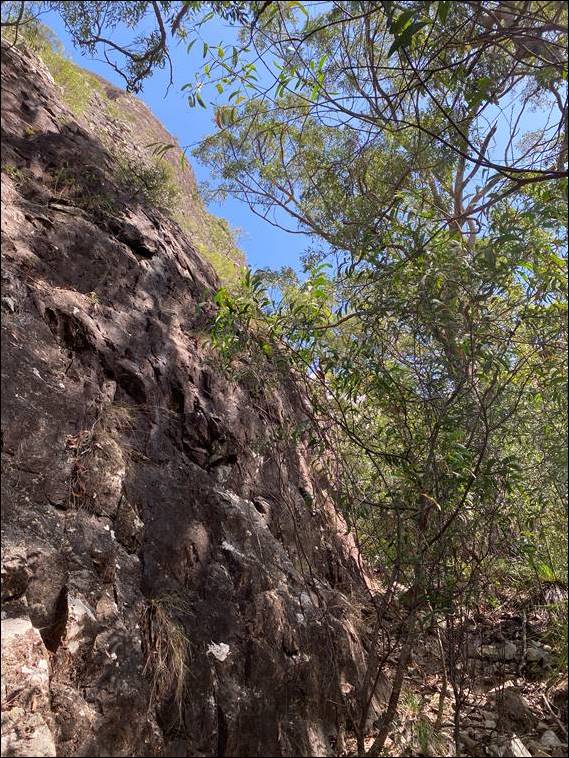
Just below were we had climbed is an area called Candy Mountain. Mostly lower than the tree line, it had very welcome shade. I popped round the corner to check if I could see where the others were, and timed it perfectly to see Howsie just before he went out of sight. It’ll be hard to see in the image below, but he is there right on the skyline. It is a false summit and not the top, so they were a way off. We sat in the shade for a while munching on our food and rehydrating, and once the energy levels were up the short wall beckoned:
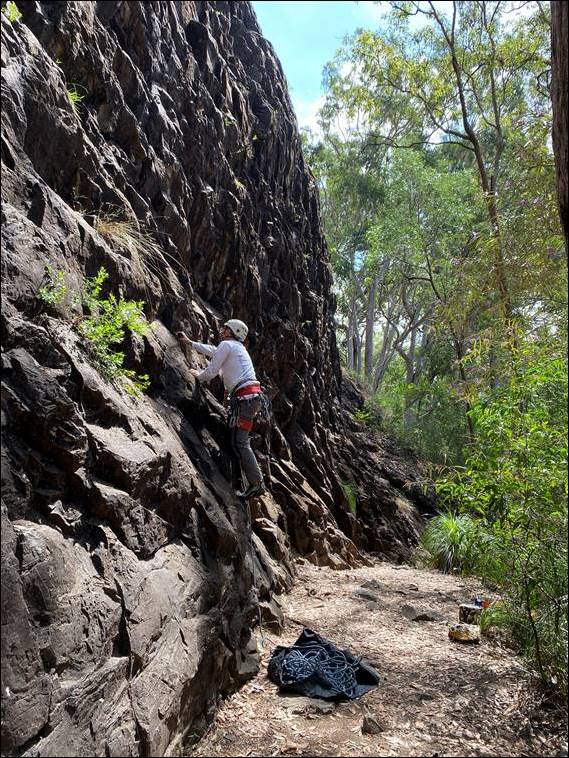
Rongy had climbed here with Sarah, but there were still a few lines that he hadn’t picked off. So we started on them and worked our way rightwards. The short 12m wall provided some entertaining lines. It felt that just because it was a short wall, the grading allocated was more on par with what it should be. Unlike the grades allocated to the pitches on the multi-pitches we had done today and yesterday. Maybe it is an additional layer of precaution applied to make sure people don’t bite of more than they could chew, but it did seem strange:
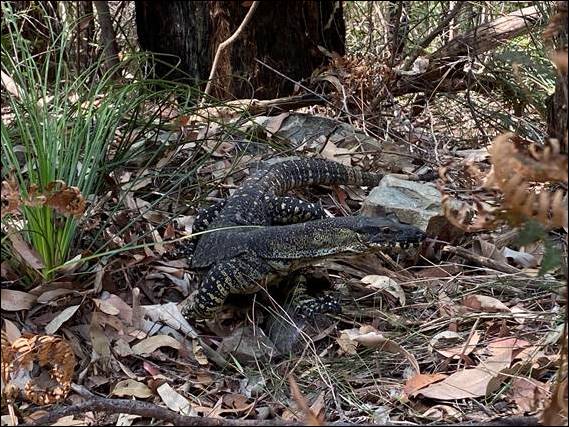
During our session on the little wall we had a visitor, a good four foot long Lace Monitor (Varanus varius). It is the second largest monitor found in Australia, being pipped at the post by half a meter, by the Perentie (Varanus giganteus). They are of the same genus, and Lisa and I have seen heaps of Perentie during our time in the Red Centre. The Lace Monitor can grow to six foot so this one was a good size. Wandering about as we picked off two lines each. On the last one, and for the first time, I felt my arms ache just as Howsie and Mikie arrived:
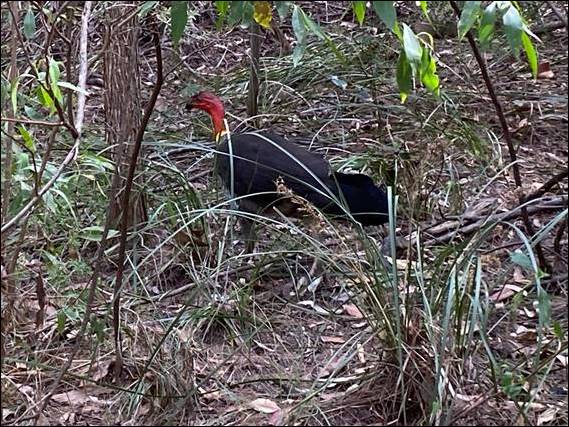
Finishing the line off, we packed up. They, as we did, had a thoroughly enjoyable time on the big wall and were buzzing. It was however now time to make a move. Rongy was heading back to Brisbane, with plans for he and Sarah to meet us at the next crag tomorrow. While we needed to get back to get things ready for a couple of nights of camping out. On the walk out this Australian Brushturkeys (Alectura lathami) was too busy scratching about to notice us. While they are pretty common I do like them, and had to include an image:
Route summary
Mon 16 Sep – Mount Tibrogargan
Carborundum Wall
Airtime Over Pumicestone 21** 245m Howsie/Krish/Rongy (alt)
Tue 17 Sep – Mount Tibrogargan
North East Buttress
Ross Millar Route 19** 180m Rongy/Krish (alt)
Candy Mountain
The Real Rainbow Unicorn 16* 12m Krish
Glove Slap 15* 12m Rongy
One Eyed Wanderer 18* 12m Krish
Old Elvis 17* 12m Rongy
{North East Buttress
Sunburnt Buttress 19** 185m Howsie/Mike (alt)}
 Sandbagged