In centuries, and decades, gone past mass land clearing has resulted in isolated pockets of native vegetation complexes remaining. Sometimes these look orchidy, and at other times they look infested with weeds that have crept in from the surrounding land. Usually agricultural or rural in nature. South of Bunbury the Franklandia Nature Reserve is split by the South Western Highway, the larger area to the west looks pretty good. But the eastern side looks degraded and run down, strewn with litter discarded by people using the layby area:
Not surprisingly I found myself walking about in the bush on the western side of the road, not seeing too much that I hadn’t seen before. A lady was also hunting orchids, and she got a bit of a start when I said hello. And as we exchanged details of our finds, she told me the other side of the road was worth a visit. With clumps of orchids that simply had to be seen, so I went there to see what I could see. And just like a book shouldn’t be judged by its cover, I should not have judged this patch of bush by all the weeds:
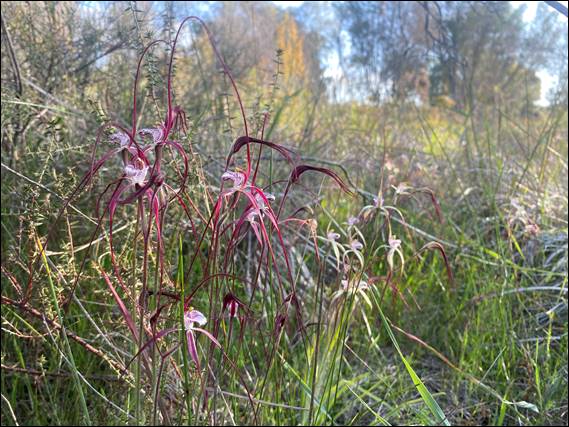
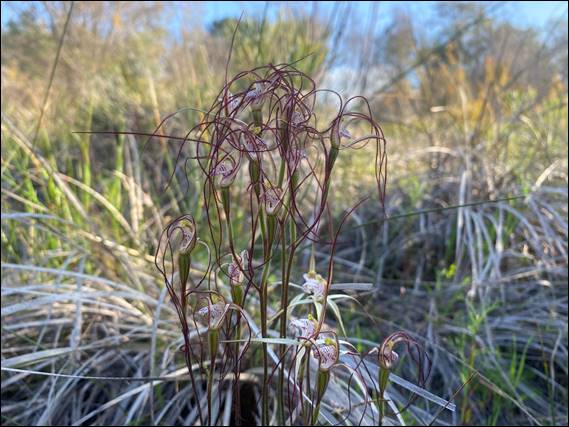
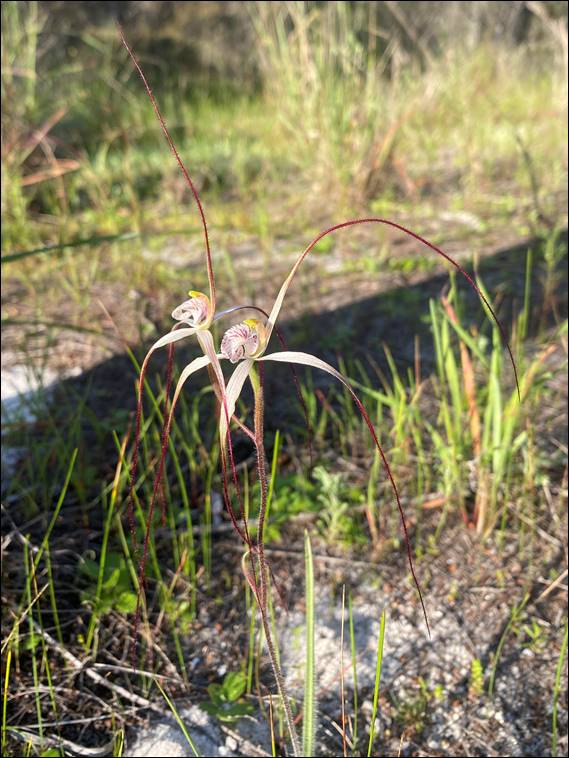
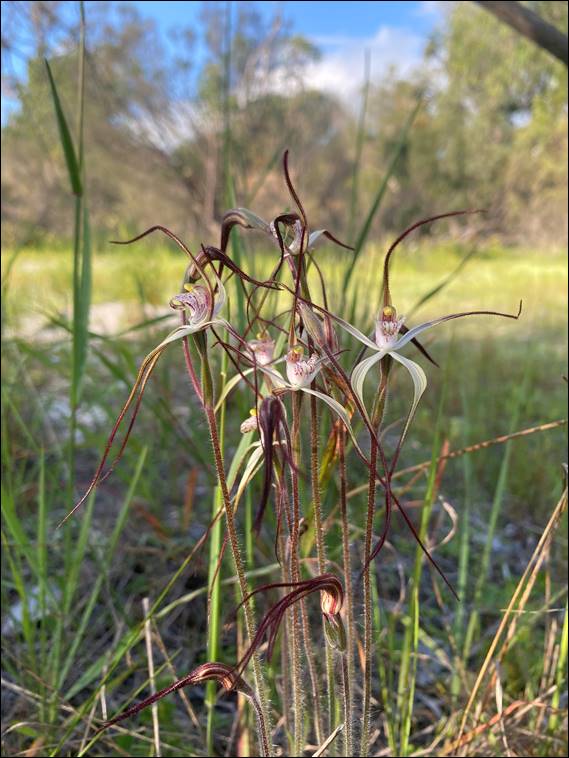
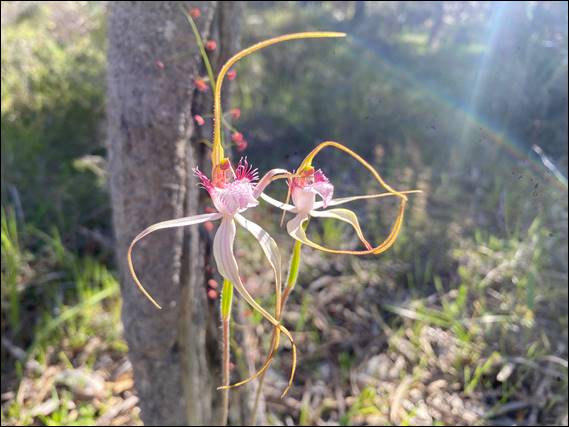
Spider orchids abound, as well as others, but it was the spiders I was keen to see. They resemble the Chapman’s Spider Orchid (Caladenia chapmanii) and there may have been a few of them about. But there were also some different characteristics that made me dig a little deeper. This leads to be to think that the mass of orchids included some Common Spider Orchids (Caladenia vulgata) and possibly Pendant Spider Orchids (Caladenia pendens) of which there are two subspecies of pendens and talbotii, the latter being more colourful:
As such this little patch yielded some good finds, or so it seems. I say that as I recently tested my orchid identification skills for a find I was really unsure about. I went to the Department of Biodiversity, Conservation and Attractions to see what they thought my find in the Capel Nature Reserve had been (https://sandbagged.blog/2024/09/06/its-all-relative/). I didn’t tell them what I thought, and indeed they were a little stumped too. As such they call in the big guns, and asked one of the authors of the orchid book I use:
Although, not the same person I have previously used a few years back to test some of my more curly finds. His assessment was that I had found a hybrid, and it was suggested to be a cross between a White Spider Orchid (Caladenia speciose) and either the Grand Spider Orchid (Caladenia huegelii) or the Scott River Spider Orchid (Caladenia thinicola). It was suggested to be more likely the Grand Spider Orchid, which in itself is critically endangered. So I will now have to go back there and start looking for that one too:
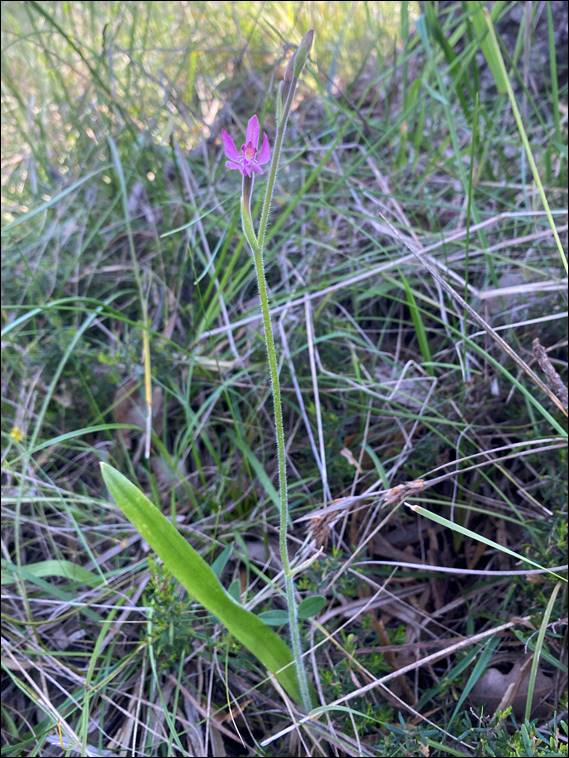
I’ve previously found the Scott River Spider Orchid. The first time was in the Scott River National Park some 70 to 80 kilometres to the south (https://sandbagged.blog/2022/10/05/true-to-its-name/). However, despite its name this species can be found over quite a wide range. After a very successful short walk and on the way home I stopped in to check out another small patch of bush in a place called Gelorup. This one had less on offer but I did come across my first Pink Fairy Orchid (Caladenia latifolia) of the season, almost out in flower, shown above:
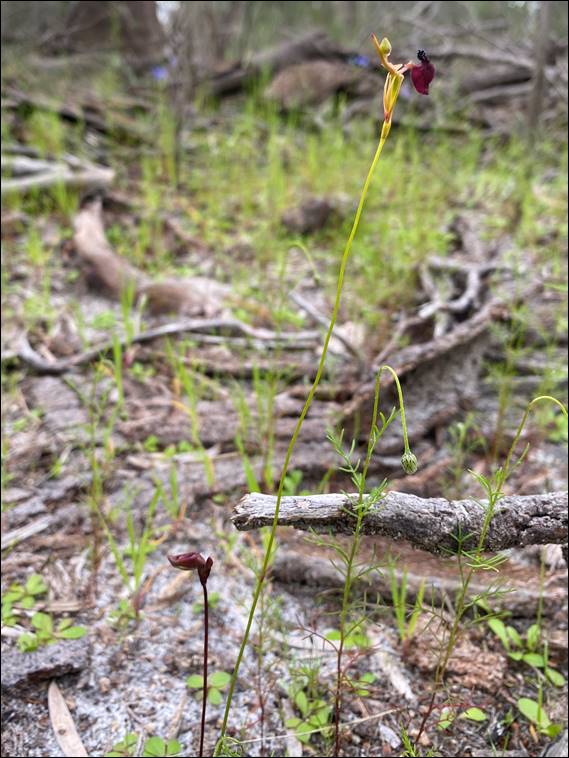
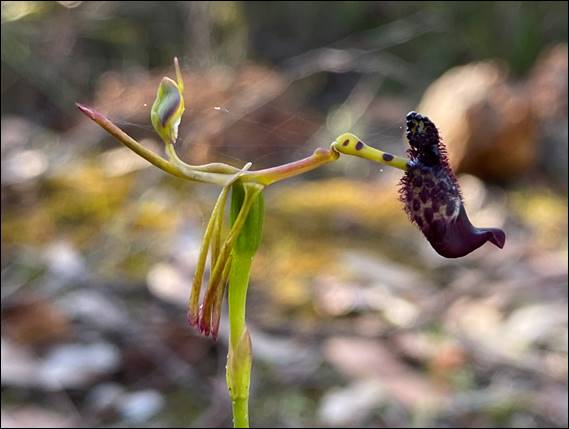
Tuesday I plumped for the Ruabon Nature Reserve, and it seems that we have slipped from winter into summer. High twenty degree temperatures and a weeklong forecast of sun and heat. It has started draw out more orchids, and there were quite a lot of King-in-his-carriage Orchids (Drakaea glyptodon) in flower. Standing taller than the companion Flying Duck Orchids (Caleana nigrita), often found together, but they were a little way of being in flower:
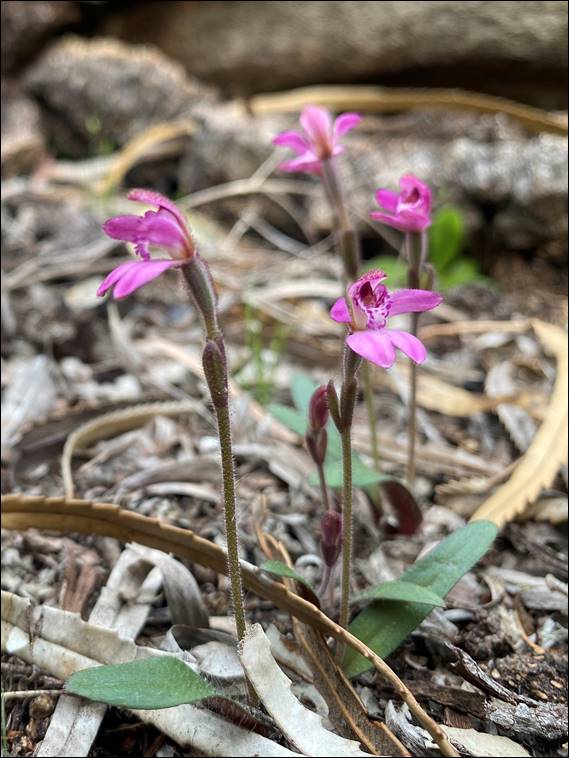
It was not the place to stand still for too long, being overrun with mosquitoes. I braved them for quite a while in the hope of finding more, but the only other sighting to report was the above lonely clump of Little Pink Fan Orchids (Caladenia nana subsp nana). Tiny plants for which I had to get down on my hands and knees to be able to observe, allowing the mosquitoes an easy target. But it was worth it. Later in the season the other subspecies unita will come into flower, having a similar flower shape and size but with a much taller stem:
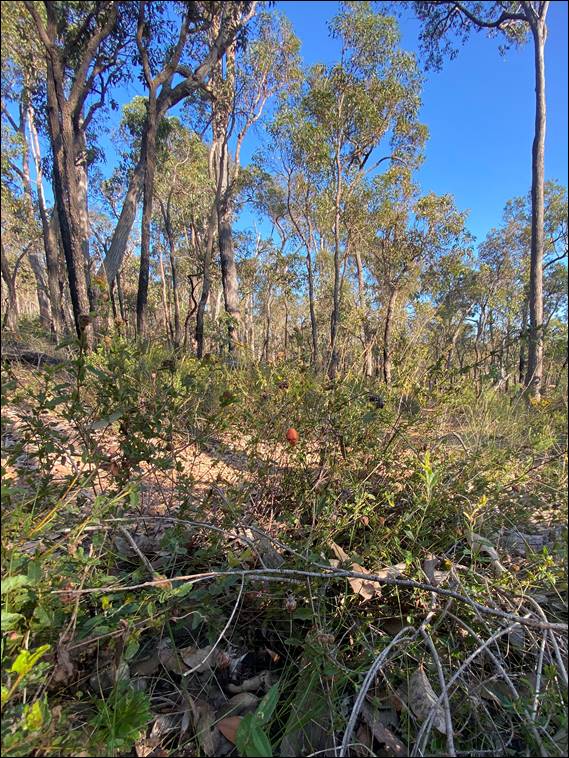
I was eventually driven out by the clouds of winged pests, but content with my finds. Wednesday came and true to my word of last week, I got out again. This time a bit inland to the higher and rocky area of Crooked Brook Forrest. The sun was out and had bite to it; on the plus side it was drier and I wasn’t being forced to keep moving. It seems however this place will take a little while longer to wake up. There was very little on show, to the point I started to take images of even more Dwarf Pink Fairy Orchids (Caladenia reptans):
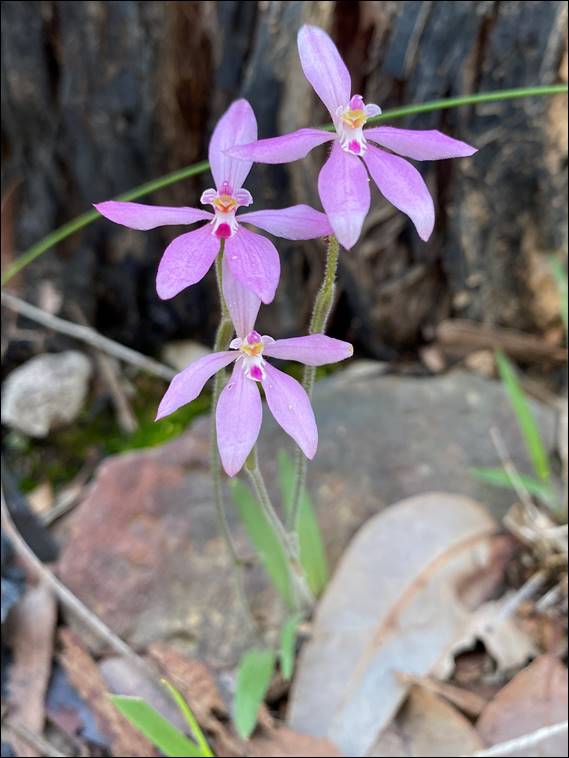
With the three species of Pink Fairies in one post you may get an appreciation of the differences between them. My book has five different ones, including subspecies, of which I have seen four. I’d need to travel 550 kilometres to the north to find the fifth species, which is unlikely to happen. There is a limit to my obsession. I did however walk 5.5 kilometres on this trip, the longest walk of the week, and completed that in an hour. A sign of how quiet it was, although with the pace I kept I did surprise myself when I saw this:
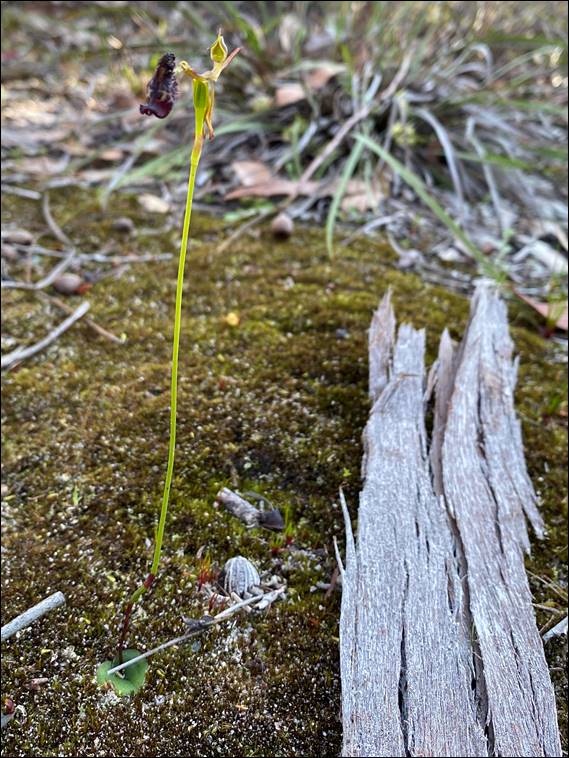
Standing no more than 20 centimetres high with a flower less than an inch in length, I feel it was a good spot and I was a bit lucky to see this Warty Hammer Orchid (Drakaea livida). It was not the plant that had caught my eye, but the 10mm in diameter basal leaf. I may have been keeping a reasonable pace, but still had my eye tuned in for orchidy type shapes and colours. Sounds a bit silly, but Craig noticed this when we walked along the Cape to Cape track a few weeks back. He was amazed at what he missed, after I pointed things out to him:
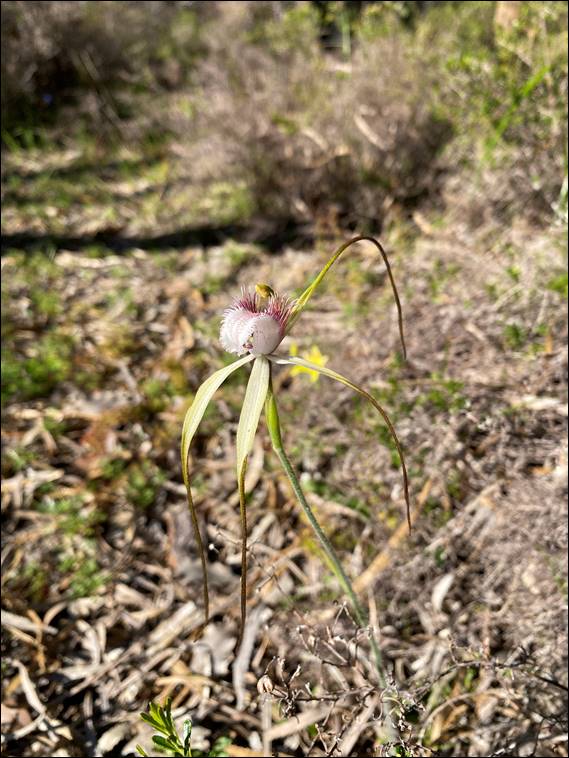
Thursday rolled in and I gave a Tuart Woodland a go, just on the edge of Bunbury. The entire ground looked like it had yellow lights covering it. Cowslip Orchids (Caladenia flava) were out ‘en masse’ and occasionally I came across a white spider or two. I took heaps of images and think I managed to find the White Spider Orchid (Caladenia longicauda subsp longicauda) below, and the second image being a Sandplain White Spider Orchid (Caladenia speciosa). It’s a place that will be worth going back too:
The sun has not only drawn out more orchid species, but also more of the orchid hunters. I heard the little car park at Manea Park was full on Thursday evening. Hordes of people were scouring the paths looking for these delicate flowers. Luckily, as I mentioned at the start, there are of pockets of bush scatter about. I will be visiting those, leaving the more accessible and well known areas to the masses. That won’t however be for another week or so, by which time I hope more species will be out:
 Sandbagged