Despite having had a week off work David hadn’t managed a trip out to explore his new outdoor playground. It seems his desire to get out is near equal to mine, and his fingers were itching to touch rock by the time Saturday arrived. We’d planned a trip out with, in my mind, one focus. To get him back on the sharp end. And there is but one place to go when you need to start from basics. This meant a repeat trip to where I climbed with Craig last weekend, and also attempting the rock hoping path along the coast:
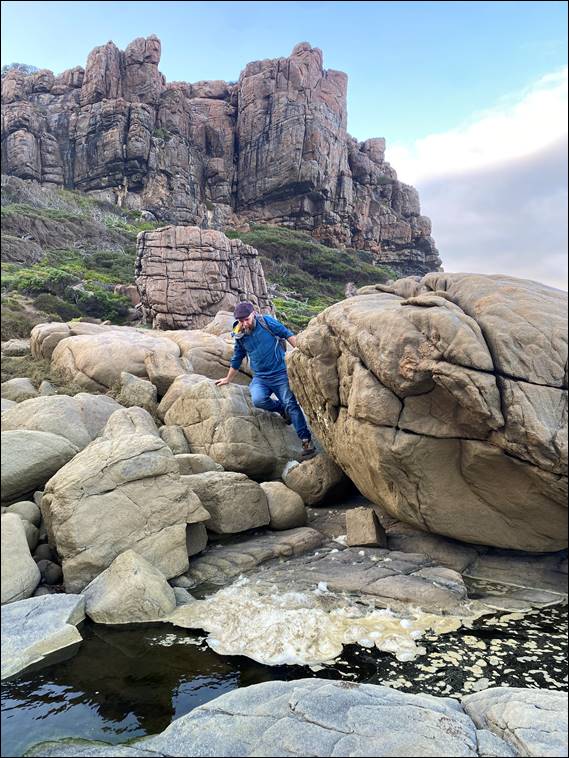
The path wasn’t being smashed like last weekend. It was low tide. The swell was lower than last weekend, although it had only receded overnight. Foamy bubbles, a result from the recent churning ocean conditions along with natural decomposing organic matter, were scattered about and being blown around in the wind. The boulders that were no longer wave washed, had a green hue to them. The residue from the sea foam, which resulted in what felt like icy conditions. We had to be very careful with our foot placements to avoid a spill:

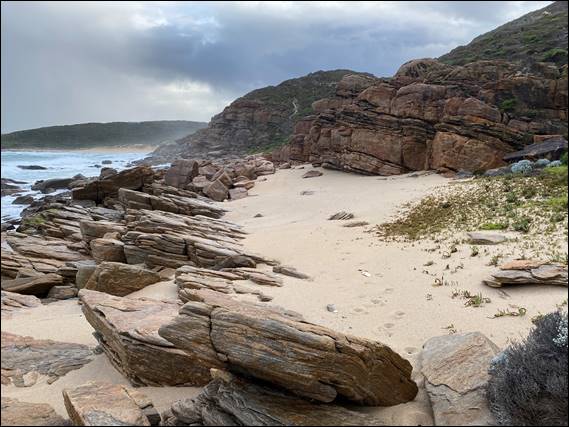
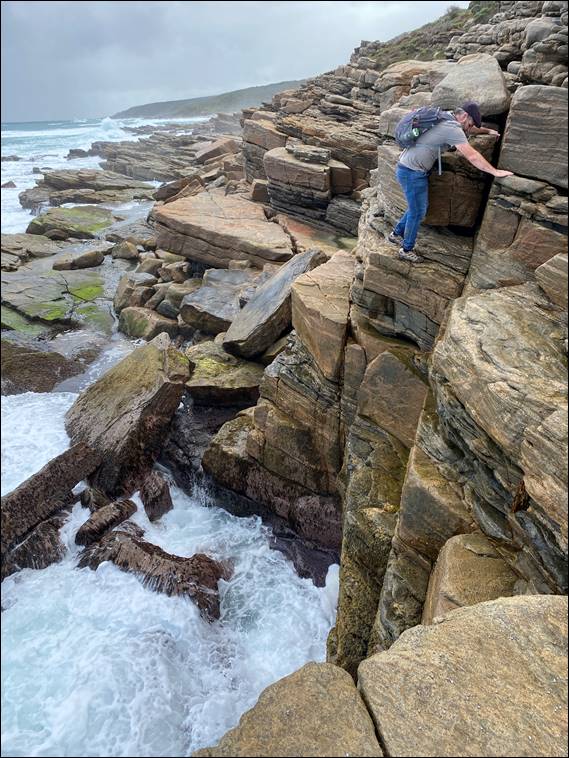
David admitted to not being as sure footed. Fortunately we managed to keep on our feet, but it did mean it was a relatively slow walk in. During which we only had a couple of near misses, which included from my at times over confidence. A bit of time was also spent hiding from a squall that wetted everything up. This conveniently reached the shore at the time we walked past the only shelter of note. There were only two sections, where the conditions were such that, we had to scramble inland a bit more to reach our destination safely:
Back to basics was a bit harsh way to explain the situation. David has plenty of climbing experience, it has just been packed away for too long. You could say it is has become rusty and needs a bit of lubrication. A major block after his abstinence from leading, being the need to rebuild his mental focus and confidence when on the pointy end of the rope. Climbing above your gear and being prepared, if necessary, to take a fall, and trust your gear implicitly can really mess with your emotions. This requires training your amygdala to not do its job:
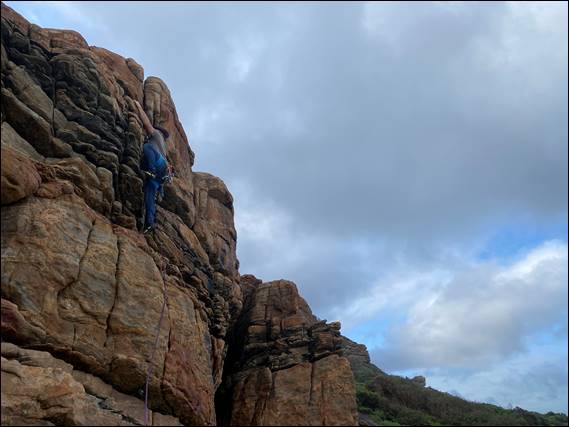
The small in size amygdala plays a big role, as the part of the brain where your emotions are processed. I often say to people when they are looking stressed on rock, to find a stance and focus on their breathing. There is science behind this technique, unintended on my part. It is no different to applying stress management practises, which include meditation, deep breathing, and exercising. The trick is being able to apply that when your amygdala is starting to kick off. This can be helped by offering the right verbal cues, in a calm and controlled voice:
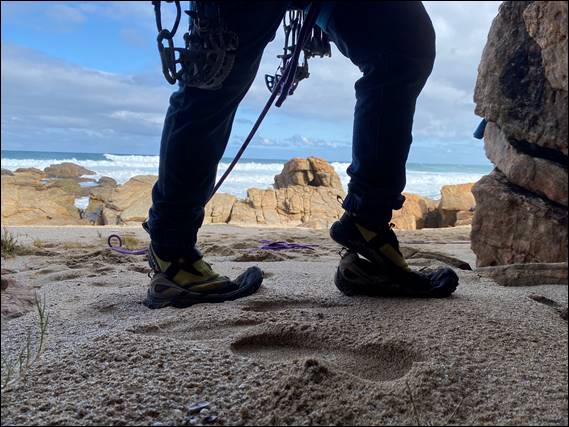
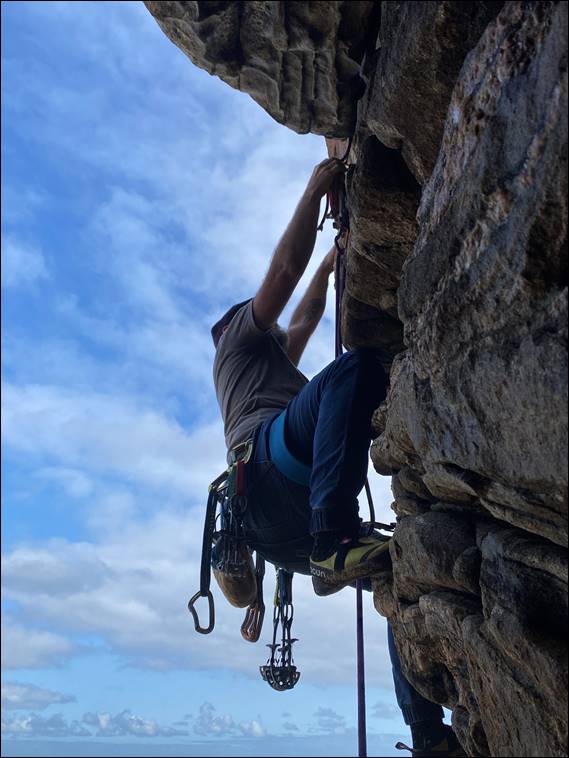
We started at The Playground. Easy lines with plenty of gear and a nice sandy landing below. These all help to make it easier to focus on controlling the brain, by making it feel like fun. It is however hard to avoid your shoes getting sandy, especially when the beach is a little damp as it was today. The sand acts like marbles, eliminating much of the friction between the rock and the rubber on the soles of our shoes. So once again care was required with our footfalls. David made use of his approach shoes to minimise the amount of sand his shoes picked up:
After five leads at The Playground, which got progressively steeper making David need to control his emotions, we wandered across to Lost Buttress. On the way over we came across a, sadly deceased, hatchling Loggerhead Turtle (Caretta caretta). There are four life stages of turtles, being an egg, hatchling, juvenile, and adult. Born in the warmer northern parts of Western Australia between January and May, hatchlings and juveniles live in the open ocean for up to seven to fifteen years, before moving to near shore environments:
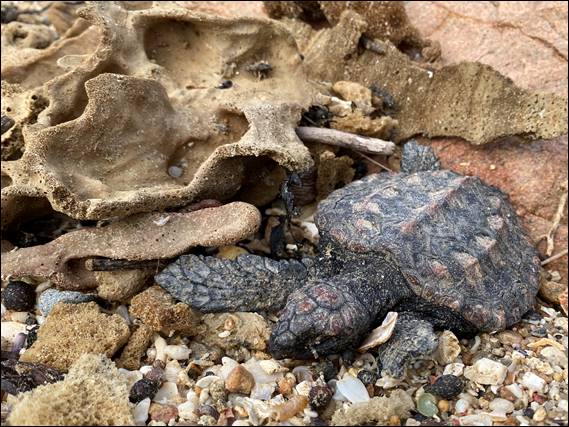
They can be encouraged to move further south along the coastline by the warmer waters in the Leeuwin Current. Then, during winter storms, they can end up being washed up, such as this one, when they are unlikely to survive. This is only one of the many perils needing to be navigated while growing up. There are articles that indicate only 1 in 1,000 hatchlings will make it through the nest couple of life stages to become an adult. On the plus side I’m however pleased to advise that David did survive today’s experience:
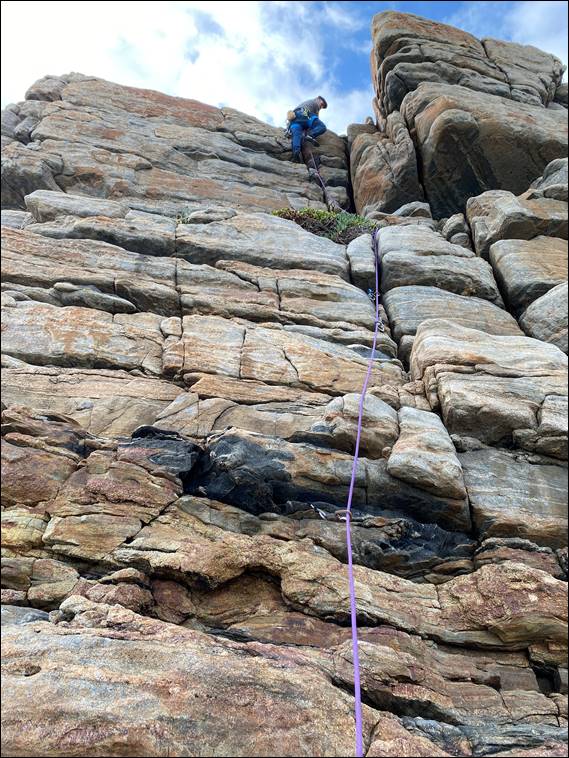
Polishing today off with two more leads at the taller Lost Buttress. These routes made him run out is gear a bit more, and he also got his first experience of the great Australian icon… the carrot bolt. So I feel it was definitely mission accomplished, and I had a relatively relaxed day following up with a rope above me. We were rewarded with an improving day and settling ocean, meaning we could rock hop the entire way back. With David blindly following me on a couple of airy scrambles that sometimes made him stop, needing to placate his amygdala:
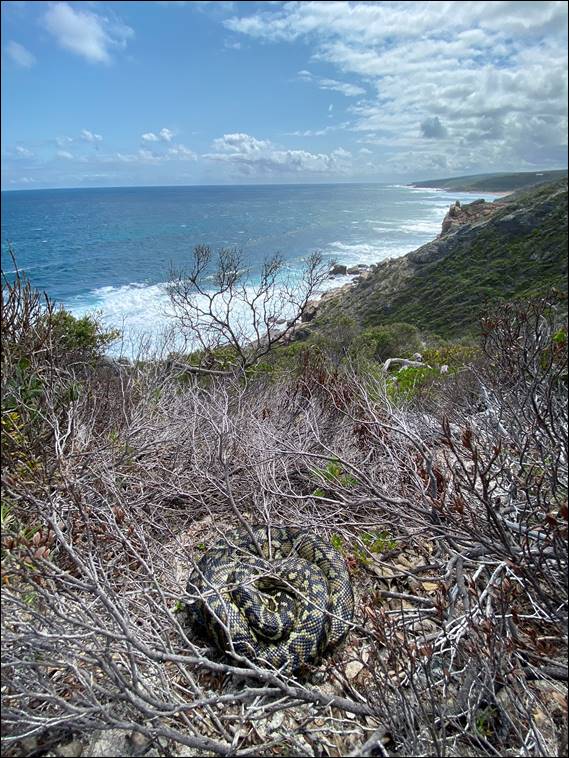
Once the path took us back up the ridge we took a slightly deviated route. Allowing me to show him a few lesser frequented crags. Although the main reason was to get to Driftwood Bay, where two weeks back I hoped we had dropped a piece of gear. It required some bush bashing, and sure enough my missing gear was at the top of the crag. We had to tread carefully through the bush, where David once more got to see a Southwestern Carpet Python (Morelia imbricata) and shortly after also his first Bobtail Lizard (Tiliqua rugosa):
 Sandbagged