This week I only managed two trips, and as things are heating up I’ll have to make an effort and get out for more after work wanders next week. I say that as I soon won’t be able to enjoy my local strolls for a while. Not for too long, but some species flower and disappear quickly. For example that tiny Sandhill Helmet Orchid (Corybas despectans) that I checked weekly at Wilyabrup, flowered and withered within a week. On Tuesday, after Josh at work had shared that he had spotted even more White Spider Orchid’s, so I went to Manea Park:
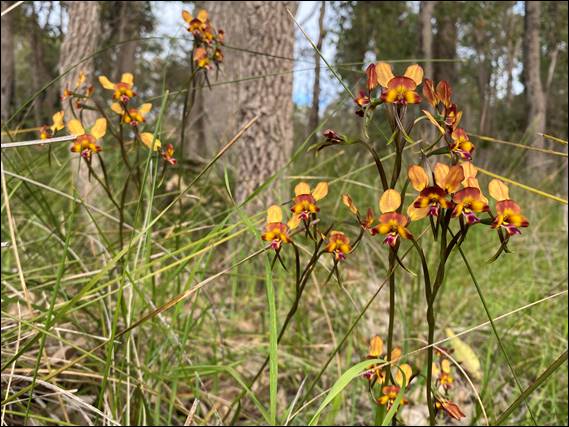
The Sandplain Donkey Orchids (Diuris tinctoria) were out in numbers, along with a few other species of this genus. This particular species have up to five flowers on one plant, where as the similar species that I sometimes get it mixed up with have up to seven. This particular species is also commonly found after periods of higher than average rain, which we certainly had in August. The other orchid out in numbers, as I predicted would happen after spotting my first one just one week back, was the Cowslip Orchid (Caladenia flava):

The trip paid off when I found a single White Spider Orchid (Caladenia longicauda) in flower. My book has fourteen subspecies, so you may be able to imagine my quandary of trying to identify them. However, I feel comfortable in saying this one was a Sandplain White Spider Orchid (Caladenia speciose). The pink tinge of the flower being the clue. This one also had a grasshopper nymph nibbling on the more juicy bits. They belong to a group of insects known as orthopterans, meaning ‘straight wings’, of which there are some 3,000 species in Australia:
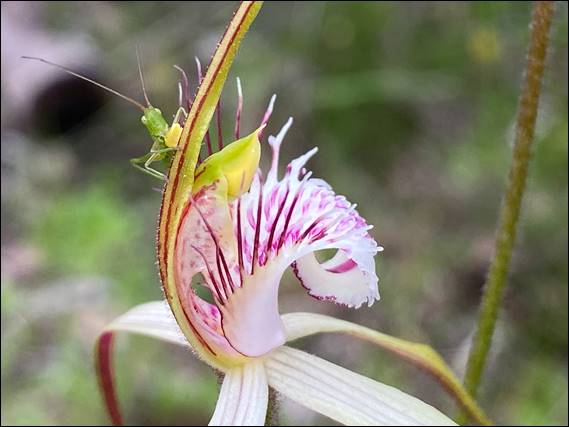
Needless to say I didn’t try too hard to identify it, which is even harder being a nymph. Based on its size this nymph looked to be one of the early stages of development. They moult four to six times over five to six weeks, before becoming an adult. Each time they moult they reach another ‘instar’, which is Latin for form or likeness and is used to refer to a developmental stage. At each development stage they grow and hence need to moult, becoming an adult when they reach sexual maturity:
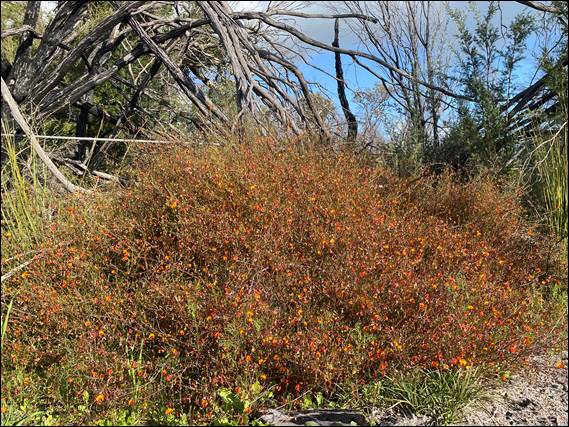
My next trip out was on Friday, and as I was working from home I kept it really local. Heading to the Capel Nature Reserve, where on arrival the above Heart-leaf Flame Pea (Chorizema cordatum) shrub looked wonderful in the late afternoon light. The Chorizema genus has approx. eighteen species, all of which but one are endemic to Western Australia. Many other native peas were also in flower. Many various sizes and colours, but too many to count with over twenty genus in Australia. There were also lots of Sandplain White Spider Orchids out:
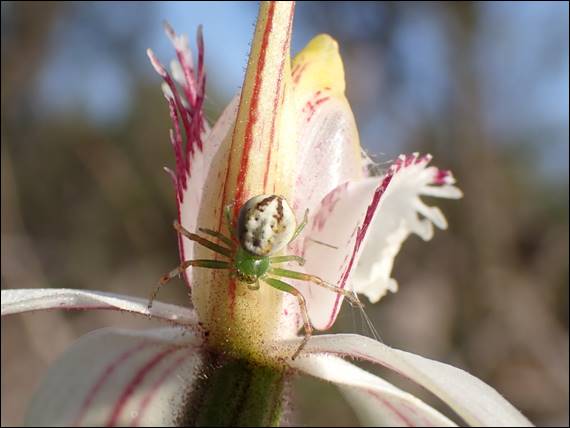
I lost count of how many I saw, all looking very elegant with their tall drooping sepals and petals, and upright dorsal sepal. And there look to heaps more getting ready to flower. While I didn’t look super hard at every flower I did notice the above, not so uncommon sight on spider orchids, being a Flower or Crab Spider of the Thomisinae subfamily. I’ve spotted this species before and unsuccessfully tried to identify it. Despite getting a better image this time, I have still not managed to find a match:
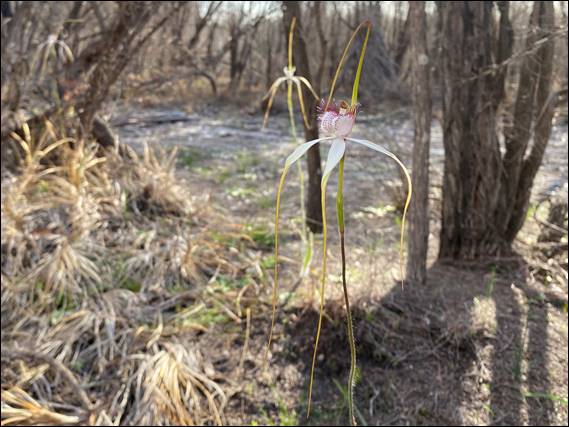
The other spider orchid that this nature reserve has in abundance is the Chapman Spider Orchid (Caladenia chapmanii). Last year this was a species I noted quickly transitioned from flowering to wilting. It was a shame, as it really is a striking and incredibly colourful species. Only a few were in flower, with heaps of large clumps being on the verge of blooming. First identified in 1940 it wasn’t published, so the naming rights were lost. It was finally published in 2001 when it was named in honour of an amateur orchid enthusiast:
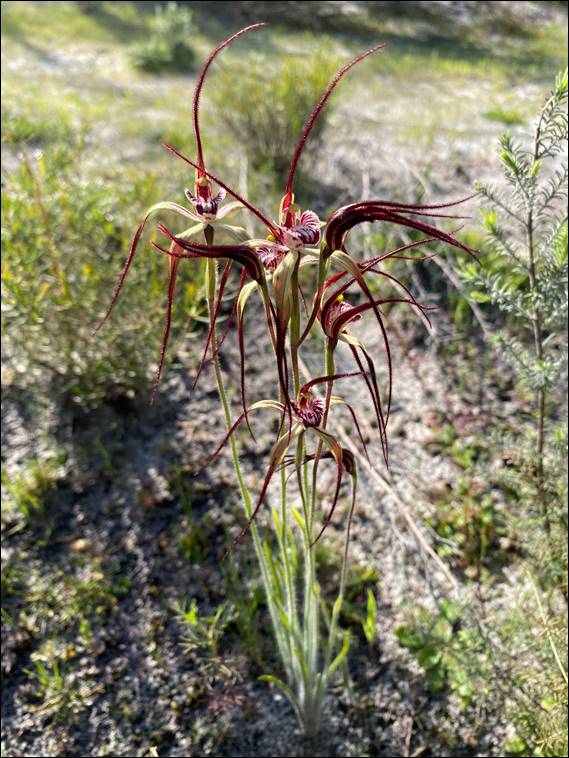
I have found a few orchids over the years that the authors of my guide have failed to identify. However, it takes a fair bit of effort and time to publish a find and be able to claim it as a new species. So I can’t see this amateur enthusiast ever receiving such an honour, at least not while I’m working. I mentioned it was heating up. I meant this metaphorically, due to more and more species starting to appear and be at a stage where I can identify them. Such as this Purple Enamel Orchid (Elythranthera brunonis):
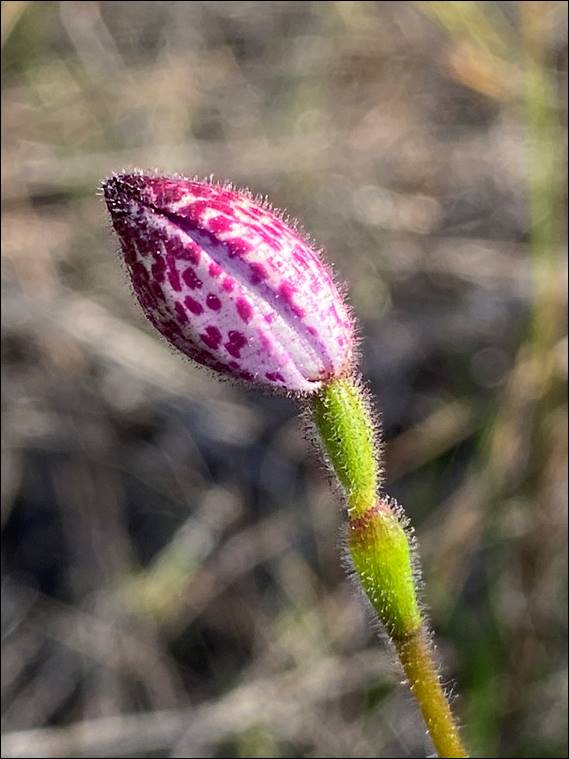
I feel that some orchids are more striking before they flower, and the above is one of them. Not to say it isn’t pretty when in flower, being one of Lisa’s favourites. With spring upon us it is also literally warming up, and drying up. A gradual process that signals to many orchid species that it is time to show yourself. Such as this Flying Duck Orchid (Paracaleana nigrita). It is watching this transition from bud to flower that I may miss, while I won’t be able to go on my local walks. Despite seeing it each season it seems a shame, maybe I have FOMO:
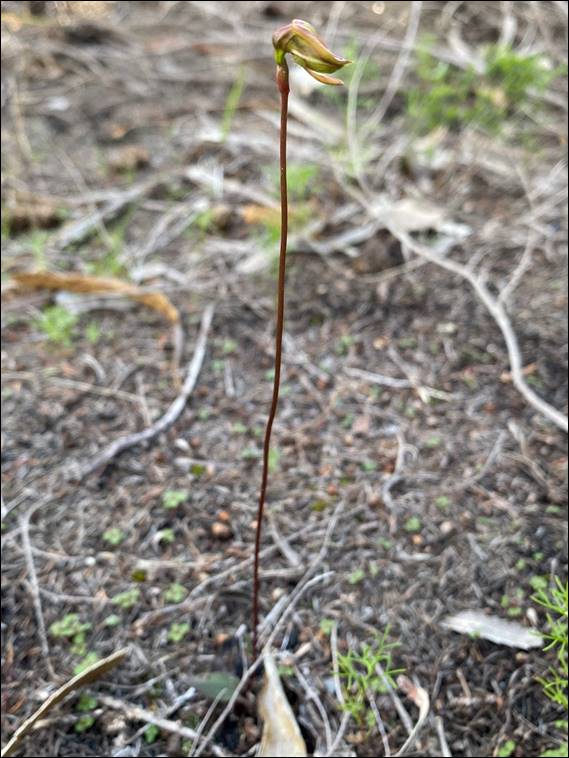
By which I mean ‘fear of missing orchids’. But for now back to the Capel Nature Reserve, where I spotted a different species of white spider. The red labellum and neater fringes making it stand out amongst the countless Sandplain White Spider Orchids. I’ve checked and double checked based on its features, the soil type (deep sands), and vegetation complex (Banksia) in which I found it. The only option is a Giant Spider Orchid (Caladenia excelsa), but is outside of its normal range. If I’m right it is an uncommon find, being listed as endangered:
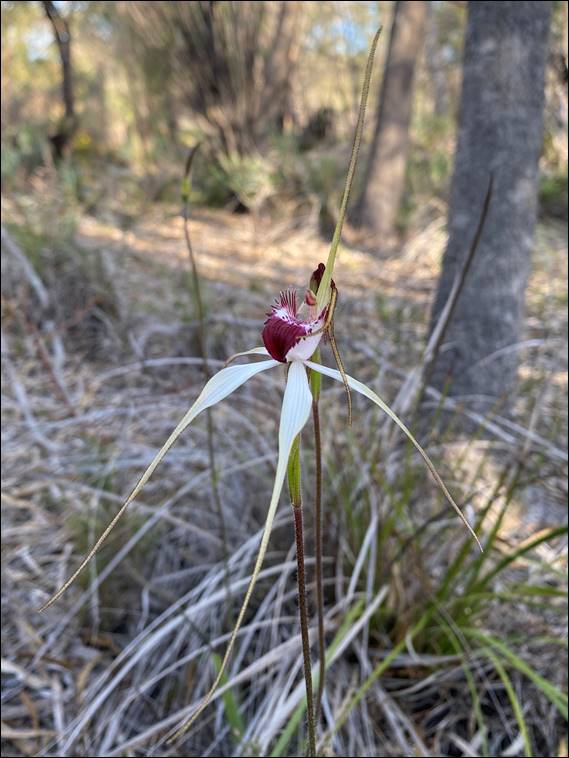
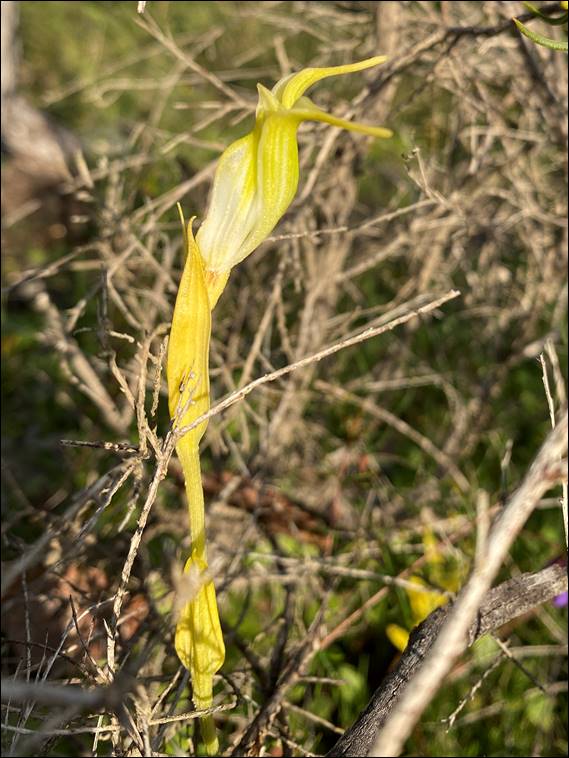
I reckon this is one I should send to the Department of Biodiversity, Conservation and Attractions to have checked out, just to be sure, because if I am right it is a significant find. Significant is of course a relative term and my last find also falls into that category, for me at least. It is the first lutea, being the Latin word for yellow, Jug Orchid (Pterostylis recurva) I have come across. The flowers being devoid of the green and white strips and brown tips, and the stem and leaves also looking bleached out. Another reason to go back:
 Sandbagged