Closing my laptop on Thursday and not being motivated to drive anywhere, I looked at my orchid guide to see what other species flower early. There are a couple of shell orchids that are known to flower about this time, and better still are found in dense heath, Peppermint, and Tuart woodlands. The A class reserve out the back is a Peppermint woodlands, but sadly heavily weed infested. But you will never know if you don’t try, so I wandered round the wide limestone fire break dipping into the bush here and there, and found nothing:
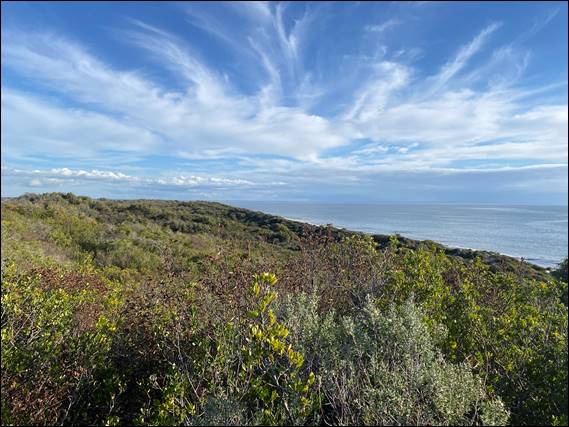
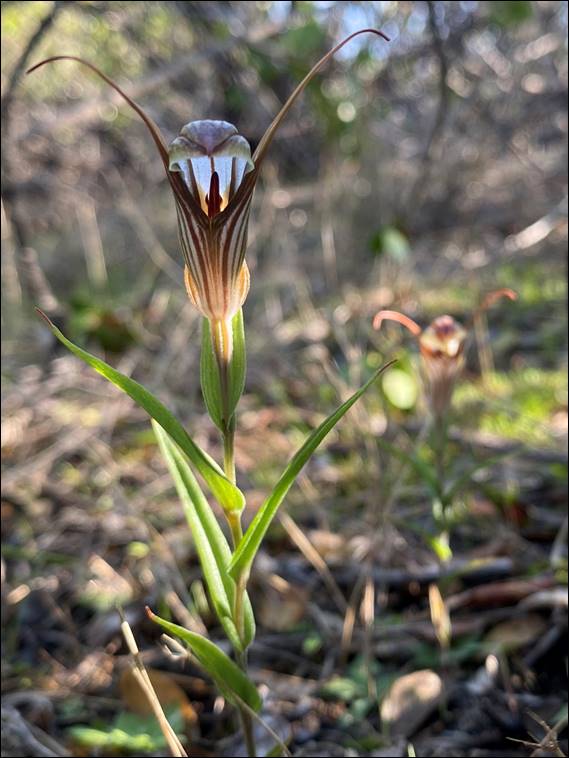
Enjoying a bit of fresh air I wandered further round the fire break, and up to the top of the dune. The weeds hadn’t managed to get hold quite as voraciously this far, yet. So after taking in the ocean views I glanced at the ground, and spotted a heap of basal rosette of leaves. Standing proudly amongst them were two Brown-Veined Shell Orchid (Pterostylis aspera). I was a little excited when I noticed the flowering plants didn’t have a rosette of leaves at their base, thinking that another species would come up:
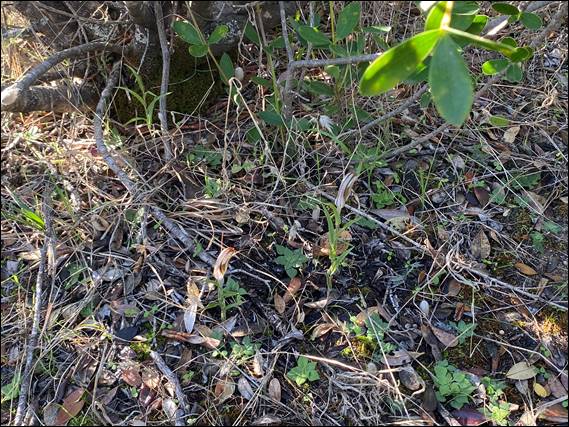
But also no, the rosette of leaves are from non-flowering plants. Flowering plants only have leaves up the stem, and none at the base. It was previously considered to be a form of an Eastern states species called Sharp-leaf Greenhood (Pterostylis robusta). This resulted in it not being formally described and named until relatively recently, in 1989. It is also referred to as a Rough Shell Orchid, due to the hairs on the labellum. This is where the specific epithet aspera is derived meaning rough, harsh, or uneven in Latin:
After my rather aspera tumble off the rock on Friday afternoon (https://sandbagged.blog/2024/06/14/brain-power/), it was touch and go as to whether Lisa and I would manage to get out for a wander on Saturday. Seeing we had missed out last week because she wasn’t feeling great, I really didn’t want to bail on a walk for a second weekend on the trot. Despite not having the most comfortable of nights, I could tell I had not broken anything in my fall, and was pretty sure I hadn’t torn any ligaments or tendons:

With a bit of Dr Google support I reckon I may have sustained a grade 1 sprain of the medial collateral ligament in my right knee; a bone contusion (bruise) on the bottom of my left calcaneous or heel bone; and the most annoying being the bruising along the outer edge of my right foot. This all added up to the need for me to be sensible if we were to head out. Donning my hiking boots, in lieu of my sandals, for better protection and stability. Even though the Knodil Wildflower Walk, just out of Nannup, has easy paths that are mostly level:
We picked this place to avoid the risk of rain along the coast, which never eventuated. But also because the pooches could join us, and a walk in the woods has been very long overdue for them. This resulted in the first half of the short three and half kilometre walk being pretty slow. Needing to stop very regularly to allow them to check out the next scent. This suited me as I was trying to avoid the marri tree fruit that littered the path, called honkey nuts. It was impossible to completely avoid them, and I made the occasional wince when I caught one underfoot:
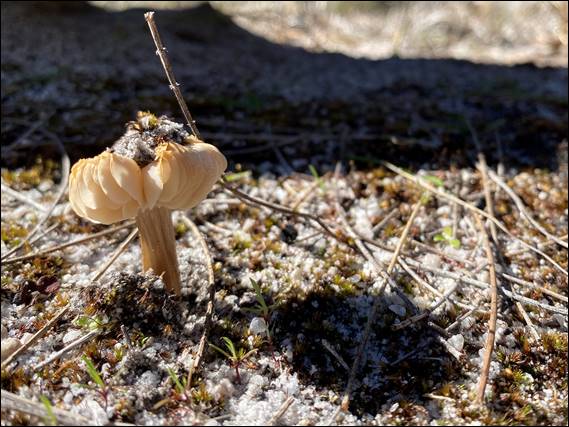
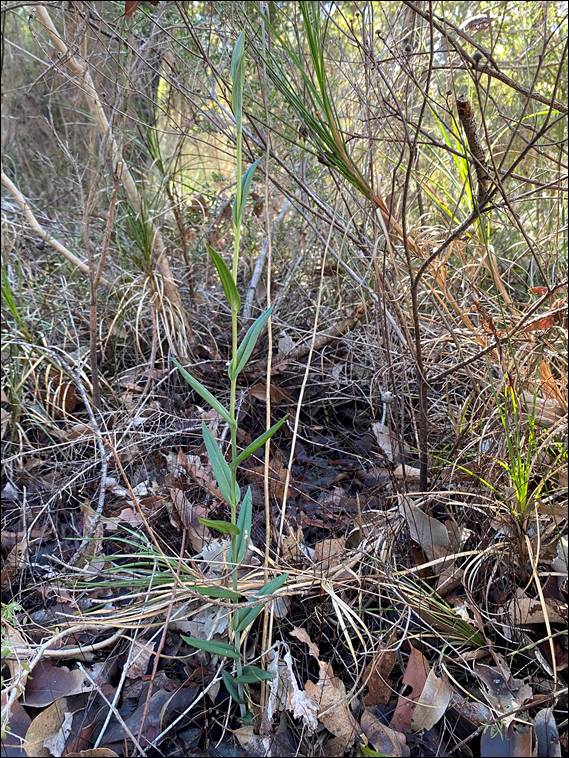
Needless to say I was torn between watching the path and the scrub, and I did a bit of both. Lisa on the other hand had to focus on frequently untangling herself from the two poodles, as they went this way and that seemingly rarely in unison. On the orchid front, and despite finding gazillions of basal leaves, only the Banded Greenhoods were in flower. I did however spy another the distinctive and tall greenhood that will soon bloom. Shown a couple of images up and being the Jug Orchid (Pterostylis recurva). There were also some nice fungi coming up:
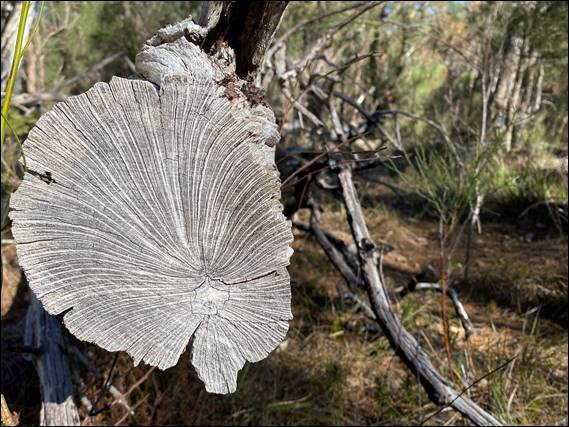
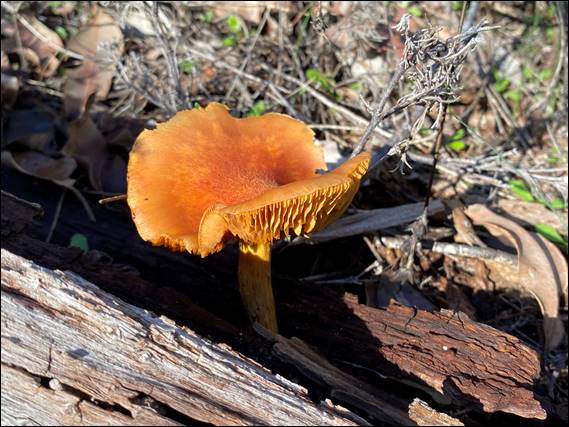
After an hour of checking the creamy white one two images up has me stumped, and I have decided to say the one below is potentially a Scurfy Deceiver Mushroom (Laccaria proxima). This is based on the shape, colour, deep gills, and striated stem. Striated meaning having long, thin lines, marks, or stripes. I was a little surprised with the above large branch, or maybe a trunk, that had been cut to clear the path. Not displaying annual or growth rings, but instead having radial stripes. A mystery for another time, as I hobbled along to catch up with Lisa:
 Sandbagged