Needing to rectify the error of my ways, after I dunked my phone in the ocean or should I say the ocean dunked my phone and me, I scored a five series upgrade. Being lucky to avoid the expense of buying a new one, as Elseya still had her old phone. It was somewhat of a palaver setting up, having to start from scratch, but it is done now. The replacement camera will however have to wait a few weeks. Until then my technological options for taking images will be reduced. Reduced but not hindered, and here is a selection of finds at the Capel Nature Reserve:
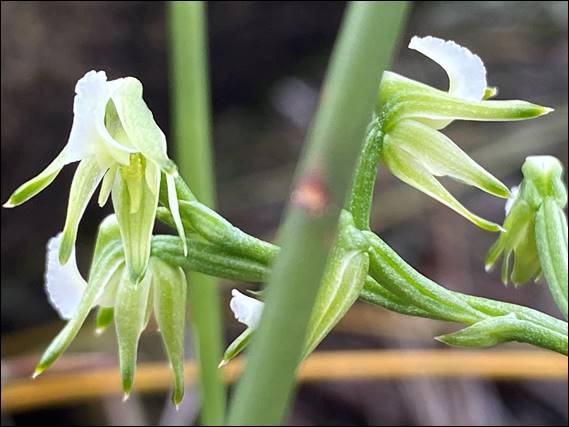
The early flowering bunnies were done, and there wasn’t much else in bloom. I did however luck upon two Scented Autumn Leek Orchids (Prasophyllum sp. ‘early’), one being shown above and the other one not having opened yet. The two plants helped confirm I was correct with my identification of the unopened specimen last week at the Ambergate Reserve. The light green flowers being one of the few differences that can be used, by an amateur such as myself, to distinguish it from the Autumn Leek Orchid (Prasophyllum parvifolium):
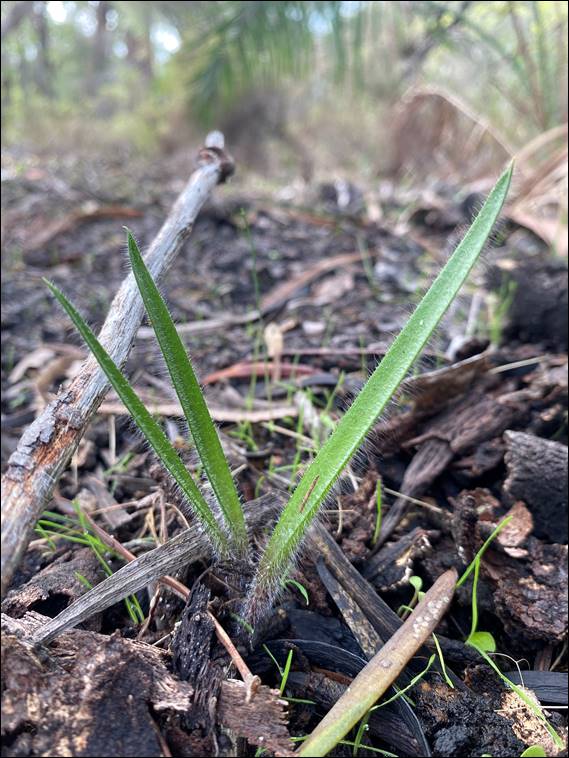
The flower of both species are about 10mm long, but the later blooming Autumn Leek Orchid has more colour, including a longitudinal stripe on the dorsal sepals and petals. This detail is however invisible until the flower opens. As is often the case there were lots and lots of basal leaves, and I have given up hoping that this is a sign of a bumper orchid season. Although the above hairy leaves, with a tinge of purple at the base did make me smile. Being one of the most spectacular spiders, the Chapman’s Spider Orchid (Caladenia chapmanii):

It was also hard not to smile at the many beautiful Painted Sundews(Drosera zonaria), shown above. An endemic carnivorous plant of the south-west Western Australia. It is a perennial tuber found in open woodland or coastal heathland with deep silica sands. I’ve read it only blooms after a bushfire. The tuber was first identified in 1848, but it took 106 years before the first flowering specimen was recorded in 1954. The soil it grows in has also been extensively mined in this area, making me wonder how rare a treat it was to see so many today:
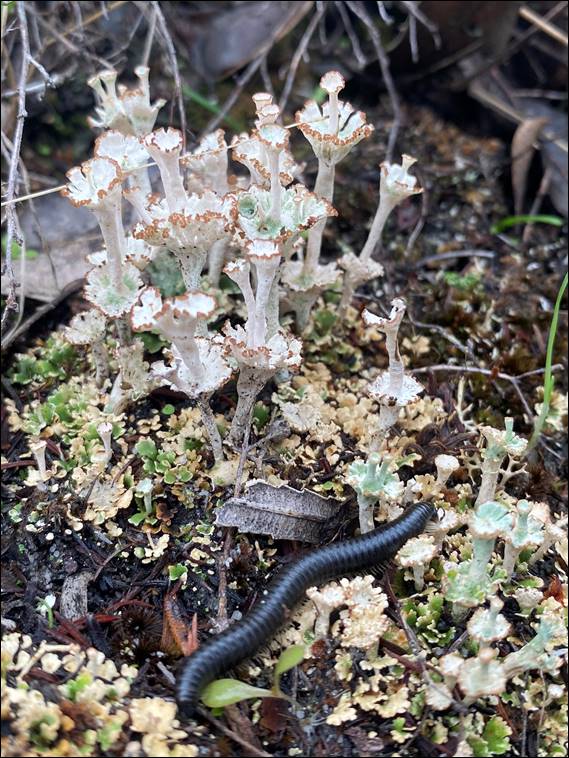
A less uncommon, but equally nice, find was the above Ladder Lichen (Cladonia verticillata) with a Portuguese Millipede (Ommatoiulus moreletii) carefully navigating through them. And today I too had to navigate a bit more carefully through the bush. Avoiding the orchid basal leaves as usual, but also the many fungi starting to push up through the soil. They are likely to be decomposer or mycorrhizal fungi, both of which live in harmony with their environment. The third main type being disease fungi, which extract the energy and nutrients from their living hosts:
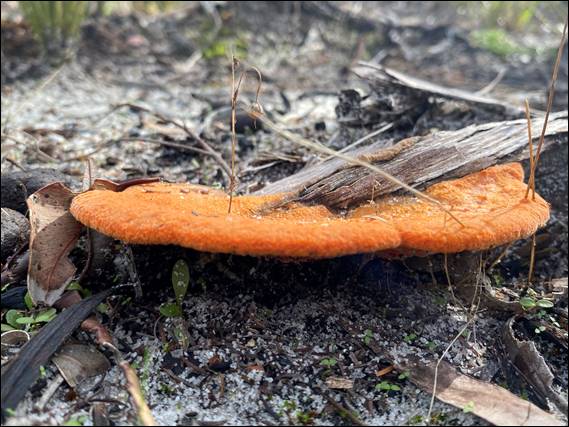
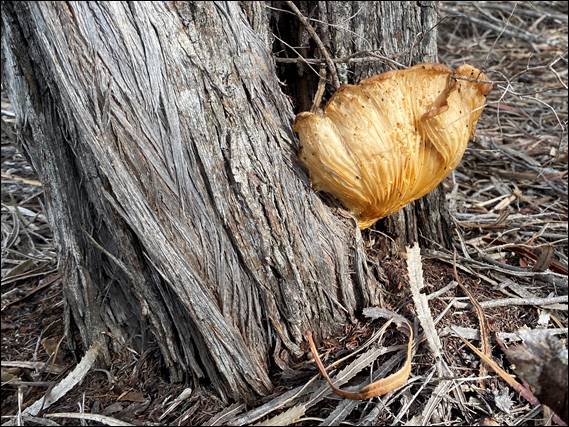
The disease fungi already out included the above Southern Cinnabar Polypore (Trametes coccinea), and also the specimen below. It has several features that resemble the Ghost Fungus (Omphalotus nidiformis). They are found on dead or dying trees, have caps with varying shades of colour, and have deep and well defined white or cream gills. One way to be sure is to go back at night to see if it glows, but I’m not convinced. As such I got Verity to help out once more and it is more likely to be a Brown Oyster Mushroom (Pleurotus australis). So as we might say to someone who tells us they saw a ghost, I am just seeing things:
 Sandbagged