I hadn’t picked up on the silence last Sunday, as I battled hard on the steep unforgiving walls at Welly Dam. Not from the lack of people, but the lack of birds. I thought it may have been as a result of the quicker pace I take when top rope soloing, meaning I’m on rock for a greater percentage of the time. Also that on that trip I had to focus harder than normal, trying not to falloff. Probably from weariness from the recent big trip to Wilyabrup, although also due to the humid conditions. All that said I would normally also notice, as a minimum, the creaky squawks of the Forest Red-tailed Black-Cockatoo (Calyptorhynchus banksii naso) on high:
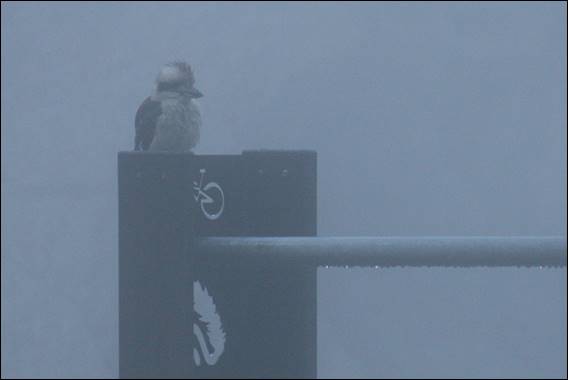
Today we were immediately greeted by four Laughing Kookaburra (Dacelo novaeguineae), like us unafraid of the damp and what started out as foggy conditions. You may recall I previously explained that fog is heavier than mist, and the point of reference for calling it fog is when the distance you can see is less than 1,000m. When we arrived it wasn’t even possible to see the valley below the dam, a mere 200m away. The above Laughing Kookaburra was barely visible, but could be clearly heard. I also spotted two Australian Ringneck (Barnardius zonarius) on the grass next to the car, looking like shadows:
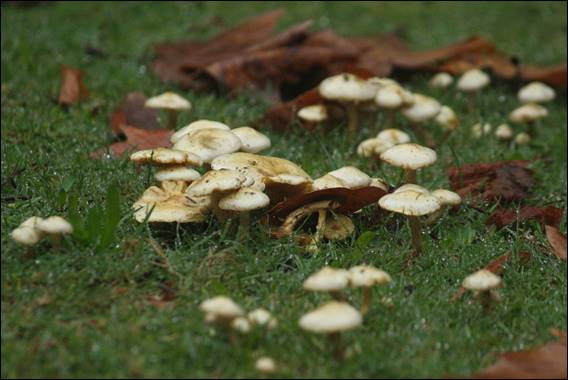
We seem to be in a feast or famine cycle when it comes to rainfall. After the long dry, we had a big dump of rain during the week. With a bigger front heading our way this weekend. Based on the closest rainfall gauges in the area several inches fell. In the four days since my last visit the lichen on the walls had turned from dry dark grey to wet black streaks, at times with water dripping down them. Patches of fallen London Plane Tree (Platanus acerifolia) leaves lay across the lush green grass. And the patchwork quilt was provided another colour, with the moisture bringing out an explosion of Common Agrocybe (Agrocybe pediades):
London Plane Trees were introduced to eastern Australia in the 1850s. The rationale provided by a professor of the Victorian Department of Agriculture in 1889 included: “when there’s most rain, the drip from them is little, and at the moistest season the roads beneath them soon dry up and keep in good preservation”. This was of course true for their climate and also because the roads were unsealed. What was not considered was how they along with other deciduous trees brought over, such as the Weeping Willow (Salix babylonica), would negatively affect the waterways, water quality and even increase flood risks:
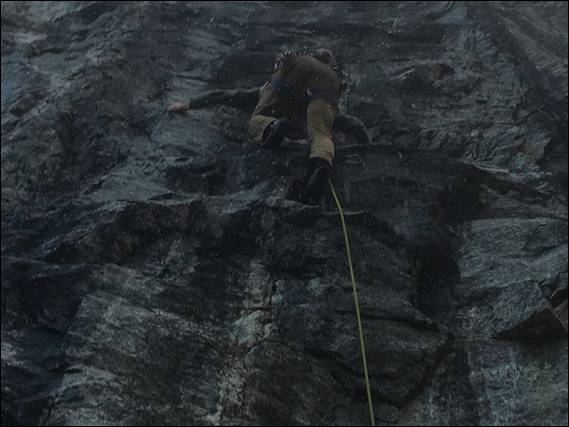
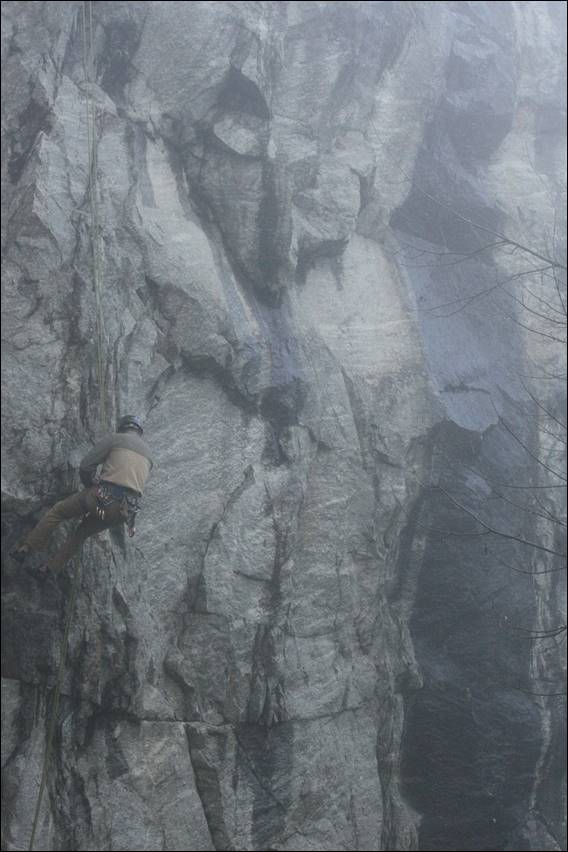
We were only into our second climb when rain started to fall. I watched Splendid Fairywrens (Malurus splendens), hoping about on the grass. Coming within a foot of me. Unconcerned by either our presence nor the damp conditions. And above me Howsie was also pushing thoughts of the wetness to the back of his mind. Climbing on, and having to make use of the now even less secure hand holds. And that added to the rubber on our shoes being cold, meaning that it is not as pliable and as such the contact friction is reduced. Maybe only marginally, but it all adds to a reduced feeling of security:
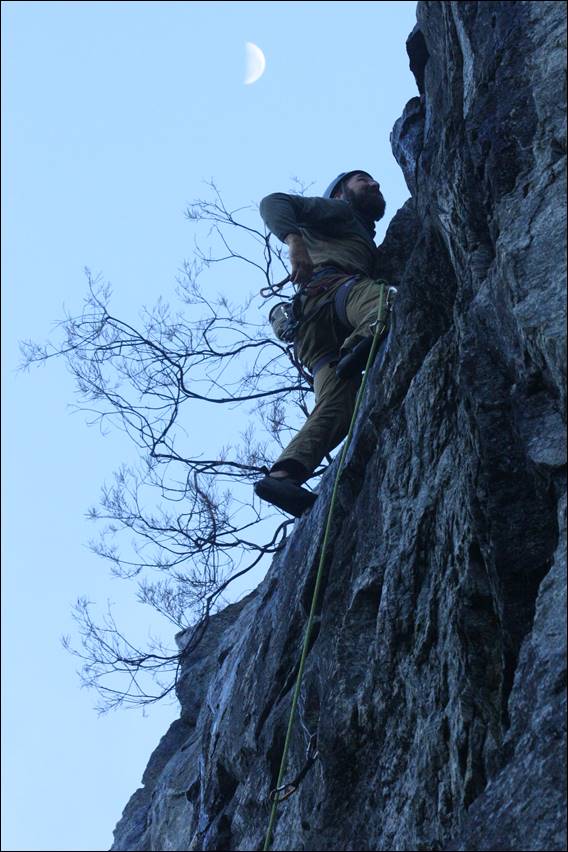
On my climb Howsie mentioned he could hear a bit of a thud when my feet made contact with the rock, whereas it is usually a relatively quiet process. Today was definitely more of a mental, than physical, game. We climbed slowly and cautiously. Maybe holding on that bit too tight, and certainly not maximising our flexibility or ability to reach as we would normally. There is a tendency to stay in a more compact position, which somehow feels safer but then makes the climbing harder. Howsie was rewarded for his perseverance when he topped out. The winds were pushing the fog and rain away, and brought over some welcome clear skies:
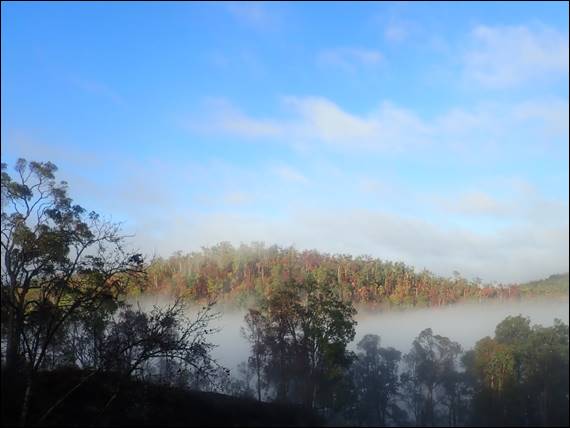
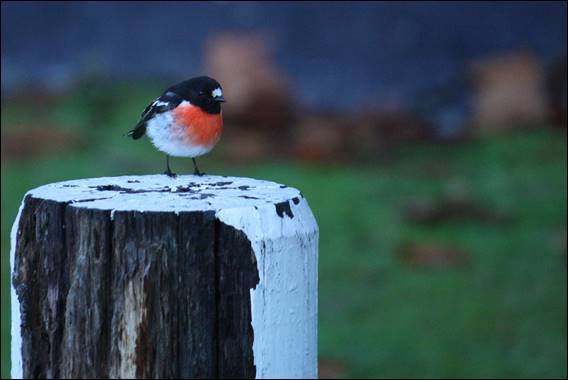
With the clearing skies came another feathered friend being the Scarlet Robin (Petroica boodang). More brightly coloured, but very much subdued compared against the Grey Fantail (Rhipidura albiscapa) that had also come out. They were providing endless aerial acrobatics displays, and when perched they spread their tail feathers into a fan shape at every opportunity. It was almost as if they were showing off. Something we were not doing today, not that anyone else was dumb enough to have got here as early as we had. It was a case of picking the driest line at a reasonable grade, and that didn’t leave us too many choices:
The sun may have broken through, but it made no difference to the wet walls. They remain in shade nearly all day, great for hot summer days but not so good on wet and cold winters mornings like today. We could see the high clouds being sped along by the winds, again this was not help as at ground level it was still. So despite the rain having left us, the damage was done and we were having to climb to the conditions. This on occasion included avoiding using the holds we normally would, being too slick today. So despite the countless time we have been up the routes, it was definitely one of those sessions where things felt different:
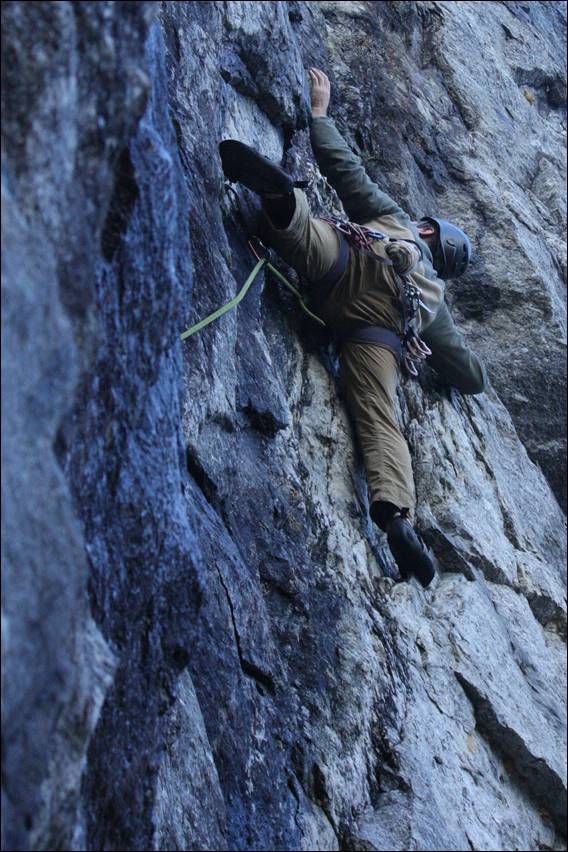
You may be wondering why we had even come out today. The main reason should be abundantly clear, both Howsie and I have a passion for climbing. We are not easily put off by such conditions, and today reminded us of a mad year when we came here before work for a climb almost every week and in all conditions. That was eight years back, and we both felt that we probably couldn’t sustain that now (https://sandbagged.blog/2016/05/14/not-so-early-starts/). While I mentioned another big front would sweep across the South West, I saw a weather window today so we were willing to take a punt and get out fix today. And that we managed in spades, getting up six fun routes in conditions that would put most off:
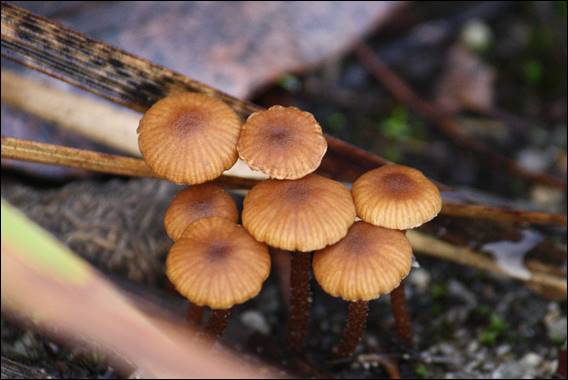
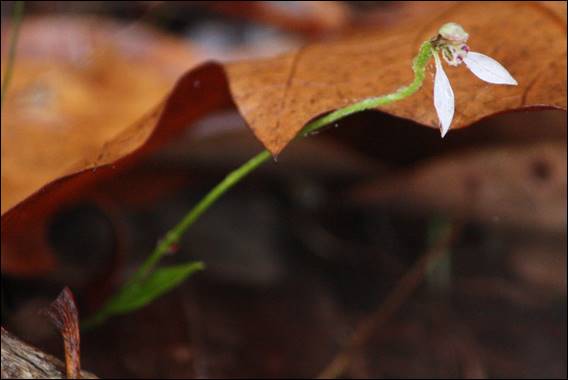
We also enjoyed the companionship of our feathered friends and observing what the changing season brings. The above could be Brick Red Laccaria (Laccaria lateritia) in their early stages. I’ll be honest and that is a bit of a guess, there is no fun in fungi when it comes to trying to identify them. The Swamp Bunny Orchids (Eriochilus helonomos) I had seen were gone, but to Howsie’s delight we found a few more. Their delicate flowers measuring no more than 10mm in length. I was thinking of bringing Sam from work up here tomorrow, which would be a significant step up in terms of difficulty for him. So while Howsie and I are used to this stuff, I thought better of the idea. Unlike we had today, he probably and understandably would not have a laugh about it:
 Sandbagged