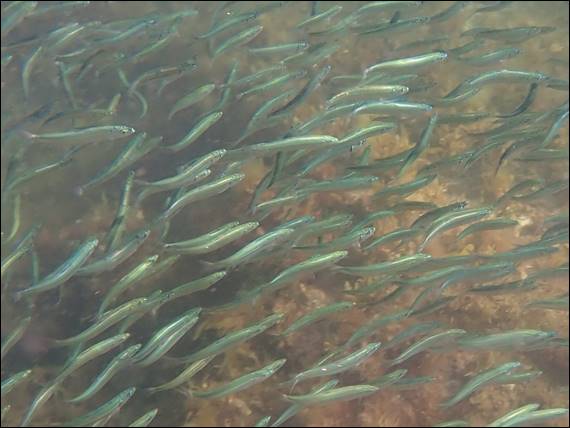
Things took a turn for the worse the day after I experienced unexpected clear conditions, which were so good that they tempted me into the water twice in one day. The next day I was still able to make out what was below me, although things were being stirred up and the marine life must have taken note. Hiding away, maybe due to sensing the change that was coming. So much so that I only kept one image from my dive, being a reasonable school of Australian Anchovy (Engraulis australis) that shadowed me for a part of my swim:
I wasn’t tempted to head back in for five days, waiting once more for things to settle down. It wasn’t quite as quiet in the water but I didn’t spot anything new. The colours of this Delicate Sea Anemone (Heteractis malu) did catch my eye. Despite being found this far south along the Western Australian coast, the distribution map on the Fishes of Australia website indicates the only fish associated with this species of anemone hasn’t been spotted further south than Perth. So I doubt I’ll get to see a Clark’s Anemonefish (Amphiprion clarkii):

While the Clark’s Anemonefish is the only fish known to form a partnership with the Delicate Sea Anemone, the Clark’s Anemonefish is not as selective. Being known to form mutualistic partnerships with other anemones. In this relationship the fish is afforded protection due to being immune to the sting, and the fish provides food in for form of its excrement. A fish that I do see, a lot of, is the Brownspotted Wrasse (Notolabrus parilus). Of late they have not been quite as skittish round me, allowing me to get very close but I have no ideas why:

For one reason or another it was another six days before I wandered back down, and even as I approached the beach I wasn’t convinced. On the plus side I had the beach to myself, not even seeing the footprints from dog walkers or those who come down just to soak in the sound of the ocean. The waves weren’t big, but of a size enough to generate that rhythmical drumming sound. I can feel the water temperature starting to dip, the temperature is slipping down, being more than one degree below the average March temperature:

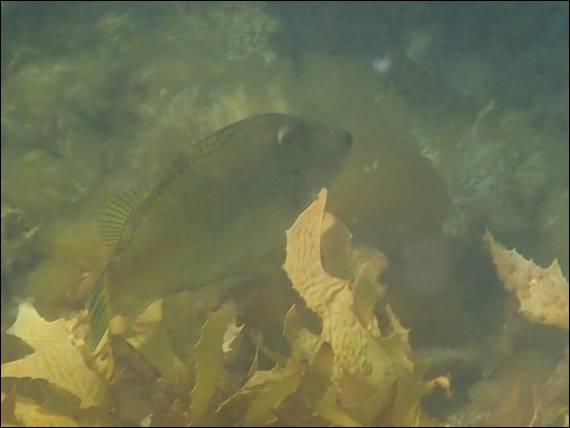
It may not sound like much but it is certainly noticeable, not however cold enough for me to wetsuit up just yet. There was heaps of action in the water today, a stark change from recent times. Several ray, stingaree, squid, and heaps of fish out in numbers. Unlike the Brownspotted Wrasse most kept a reasonable distance, including this Bluelined Leatherjacket (Meuschenia galii). I’ve spotted them a few times hidden amongst, but not as willing as the more common Horseshoe leatherjacket (Meuschenia hippocrepis) to allow me to get close:
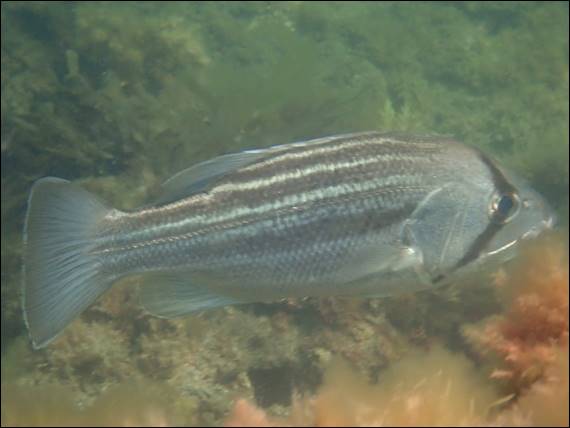
Soon after I spotted a fish I have not previously seen. Anyone that fishes would have known immediately what it was, a West Australian Dhufish (Glaucosoma hebraicum). A third of its potential size being a juvenile, shown not just by its size but also by the horizontal dark bands being wider than the pale bands. I followed this fish for quite some time and it never sprinted off. This surprised me as it is regarded as the “jewel in the crown” of the demersal scalefish in Western Australia, so I though they may have become more wary of people over time:
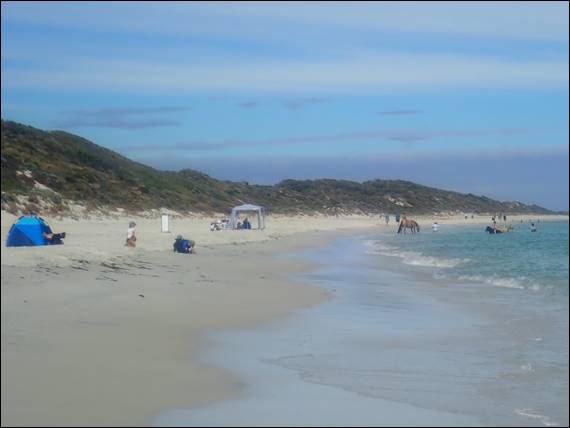
The next day, spurred on by all the life observed in the water, I braved the onslaught of tourists on Good Friday. It was mid-morning and while the beach may look quiet compared to other locations, the locals would call this busy. Fortunately, there were no jet skis or boats about. Ignoring the initial shock of the water temperature I swam to the local reef. The forecast had hinted the swell was on the way up, and that it was. A lone Masked Stingaree came in and out of view, as the large wads of seaweed wrack were pushed back and forth:
I didn’t go out quite as far today, the visibility was down so there was little point plus my bravery levels drop a bit in poorer conditions. I can’t believe I haven’t seen any sea hares yet, Lisa has been telling me about them washing up on the beach for over a month now. I’ve been hoping to spot them, and would love to see one swimming in the open water. One day hopefully, but today was not that day. Furthermore, I can foretell that I won’t be back in the water again for a while based on the visibility today and the worsening forecast. However, swimming to shore the creature below came into sight, been a mere inch long.:

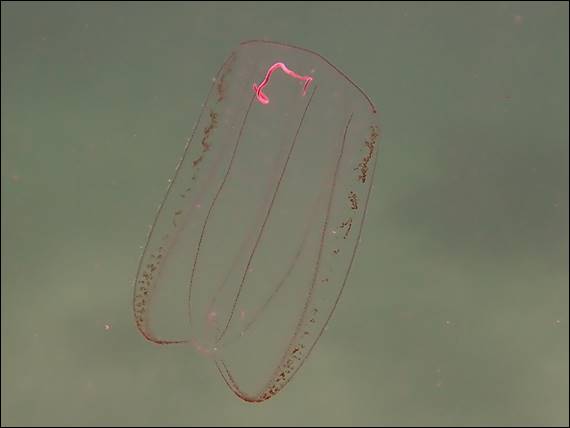
I’ve seen something almost identical once before with orange not yellow filaments, and was suggested it may be a juvenile pipefish (https://sandbagged.blog/2021/02/13/a-splash-of-colour/). Shortly after I spied a Combe Jellyfish (Ctenophores) with a passenger. Jellyfish host a large diversity of parasites, some using them as their sole and others as the intermediate host. There are very few studies to help me work out what this parasite might me, but based on the cylindrically as opposed to flat body shape I’d say it is a Nematode, which is likely to use the Combe Jellyfish as an intermediate host:
 Sandbagged