I’ve not given up on swimming with the fish. Despite knowing there are clearer waters available if I was to jump in the car and drive for about an hour, I do like the convenience of being able to walk three minutes down the road. Last weekend I popped in on Sunday morning, which was the mop up day for the fire fighters after a bushfire had been raging near Dalyellup a mere twenty minutes away from us. I’d seen the smoke when the fire was kicking off when I passed the area as I was driving home from climbing with Mario on Saturday:
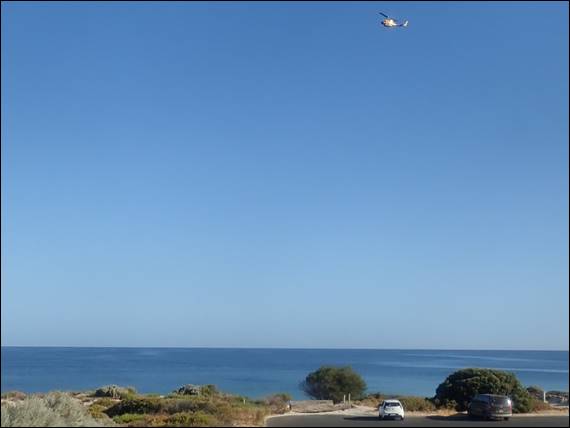
I’m used to seeing the familiar yellow and red life saver helicopter cruise along the coast, and the odd smaller recreational helicopter, but as I walked down to the beach this one looked different. It’s hard to tell in the image but this it was more chunky, and the thickness sound of the blades was deeper. The thickness sound being the phrase used to describe the main source of the noise, created by the blade cutting through the air. This changes based on the thickness of the blade, and thicker blades will assist in providing more lift:
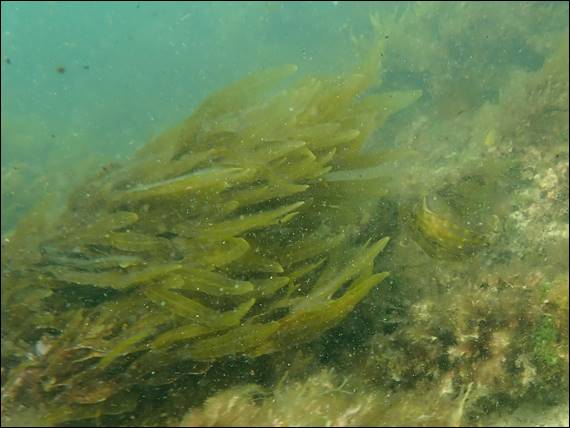
I’ve since identified the helicopter as one of two based in Busselton, capable of carrying ten people and just over two and a half tonnes of water. And it was the water tank and larger fuselage that had made it look that much bigger. I’m pleased to say that despite hundreds of people needing to be evacuated, no one lost their life or homes. On the negative side, and despite the water looking flat as a pancake, the water was very average. And only a few fish were out, like the above juvenile Horseshoe Leatherjacket (Meuschenia hippocrepis):

I did however spot a crab pot that had broken free from its marker buoy, which would have been buried in the sand over time. So I did at least manage to help mop up some of the rubbish that gets discarded. To be fair I have not come across to much rubbish this season, and when I have it has usually been a plastic bait bag or bit of fishing line and tackle. Needless to say I let the ocean be during the week, after that disappointing swim. Although as the weekend approached the swell looked to be easing off a bit for consecutive days:

This piqued my interest and I planned to head in on Saturday, to allow a few days of a gentle swell to settle things down. Then when Lisa said she was heading to the beach after work on Friday, I decided to join her for a dip. She met up with one of the Peppy Plungers for an end of the week bob and bubbles. I left them on the beach and went in the water that again looked reasonably flat. The clarity was better than last weekend, which wasn’t hard, but there was still a fair bit of sediment in the water, and with the fading light I didn’t see much:

I had noticed the ripples in the sand have been changing. In fossils of old sea beds these ripples can provide clues about the conditions in which they were formed. Providing an indication of the depth of water, the size of the waves, changes in tides, and/or even storms. What I noticed most was the height of the ripples near the beach, with deeper troughs and higher crests. This comes about for two reasons, one being the particle size, as this influences how the sand responds to the movement of the water:
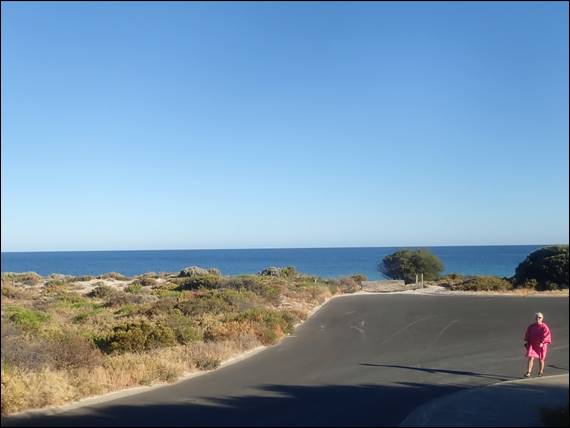
The second being the speed and frequency of the water movement. The deeper ripples indicating faster speeds and more frequent waves, hinting a change in the seasons may be coming. You’d think that the ocean surface may give away this second driving force, but as proven last weekend that was not the case. So on Saturday morning, as Lisa was walking back from her morning bob and I walked down for my snorkel, I was not going to be so easily fooled into thinking the ripple free surface of the water meant it would be any good:
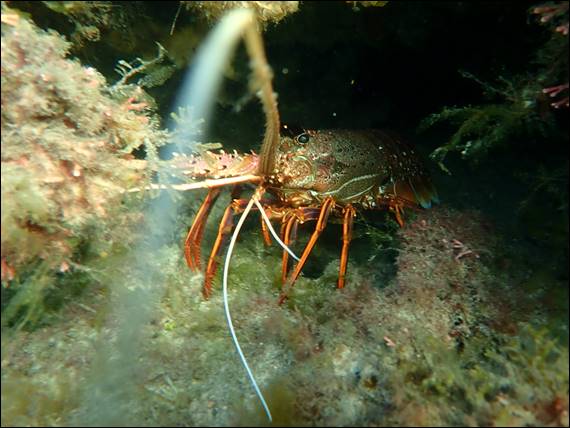
You may wonder why we didn’t go down at the same time, the key reason being I wanted to wait till the sun was a bit higher in the sky. And that along with a complete transformation from the evening before finally provided me with great visibility. I scoured the ground a bit further out, seeing some of the usual suspects but not too much else. There were no curious octopus this time, but the above Western Rock Lobster (Panulirus cygnus) seemed more at ease than these creature usually are with me poking my camera in its face:
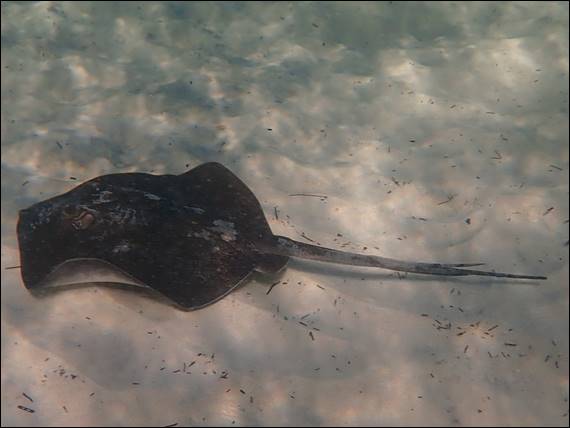
Coming into shore the above juvenile stingray was pacing along. A characteristic that distinguishes stingrays from stingaree is the caudal fin. Stingaree’s nornmally have a leaf shaped tail while stingrays will generally be pointed, there are of course exceptions. The two common species of stingrays in our area are the Smooth Stingray (Bathytoshia brevicaudata) and Black Stingray (Bathytoshia lata). Being a juvenile I’ll need to take a punt and will go with the Smooth Stingray due to the ratio of body to tail length, but am happy to be corrected:
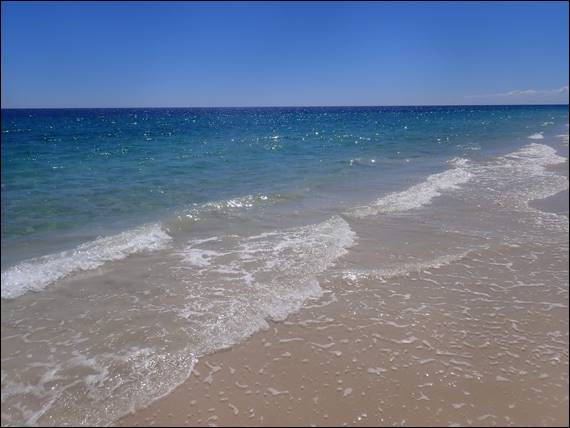
With such great conditions, after a month long break from anything good I was keen to make the most of it so went back down at midday. Things had certainly changed and wind was whipping across the water surface, creating a glitter effect as the sun hit the waves. Despite the rough looking surface, that on occasion swamped my snorkel resulting in me sucking in water instead of air, the visibility below remained beautifully clear. So much so that I spied a Smalltooth Flounder (Pseudorhombus jenynsii):
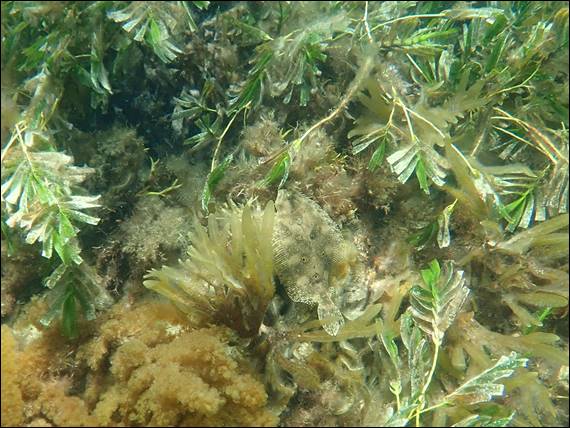
It was swimming over the weed, where it was unable to blend in as well as it can on flatter surfaces. It too had spotted me so swam away and I stayed on the surface following it for some fifty meters. Mesmerised as I watched the unusually swimming technique that resembled that of a ray more than a fish. Eventually it found a big sandy area where it employed its ability to change colour and almost disappear from sight. Here I went down a couple of times to check it out, after which I left it alone to recover from my intrusions:
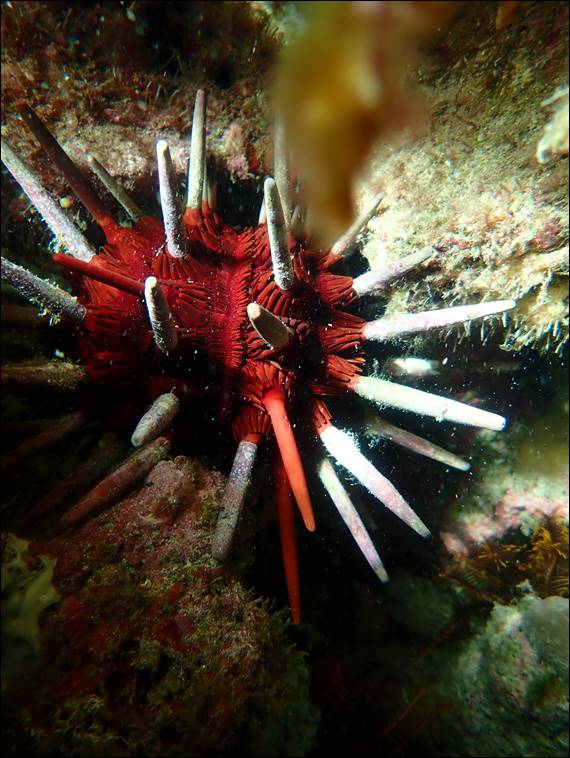
I would have been happy with just that encounter but carried on finding more fish out than this morning. While again the usually suspects they were still great to see and interact with. I didn’t take too many images, but will leave you with this one of Western Slate Pencil Urchin (Phyllacanthus irregularis). What struck me about was the narrower red coloured spins amongst the usual thicker slate coloured ones. I assume they are replacement spines for those it had lost, with some species being able to replace spines in as little as two weeks:
 Sandbagged