‘It’s just out there’, swim out to the pontoon and the same distance again. So I have been told a few times. Lisa was heading out for her Saturday morning plunge, and the crew enter the water right off where the pontoon is located. You could say I decided to try this new bit of reef, which I have heard about for a number of years, on the basis of safety in numbers. If that was lurking in the back of my mind as a rationale, it was a false sense of security. The plungers never go past the pontoon, and don’t always go that far:
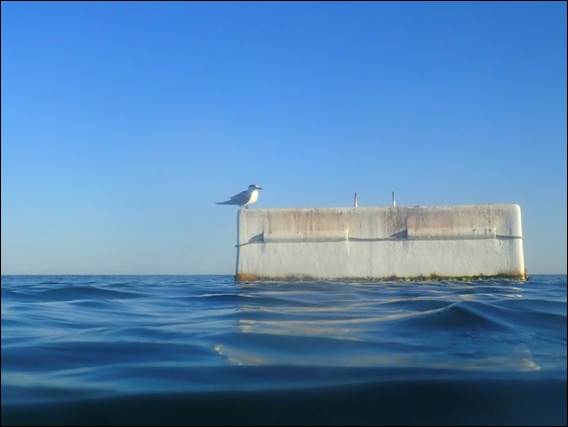
They were waiting on the beach for the full contingency before they went in. The Saturday morning dip being just as much about the social as it is about being in the water. They are a great crew for sure, but I’m not one for chatter so left them there and started a beeline to the pontoon. Here I said a quick hello to a solitary Greater Crested Tern (Thalasseus bergii), both of us happy with our isolation. I looked back to gauge how far I had come and how far I would need to go, and swam on. Leaving the Greater Crested Tern in peace:
With no idea of what to expect other than it was supposed to be good, I swam the same distance again, and again, and then again. The plungers were a mere speck back at the beach and I continued to swim. With easily six meters plus of water below me, I started to allow my mind question how much I was liking isolation right now. A stupid thought, which I pushed to the back of my mind. Eventually the depth started to reduce. I had been told there were some great plate corals and that spurred me on, and then gave me a clue when I arrived:
It was deeper than I expected, or was led to believe. Some bommies came to approx. four meters but much of it was deeper. This was immediately obvious from the green tinge of the view below me. Fifty percent of the brightness beaming down from above is lost in the first meter of water due to both reflection and refraction. Then with depth the colours start to disappear. Following the rainbow colours, red, orange, yellow, green, and finally blue are lost at approx. depths of four, seven, ten, twenty, and sixty meters:
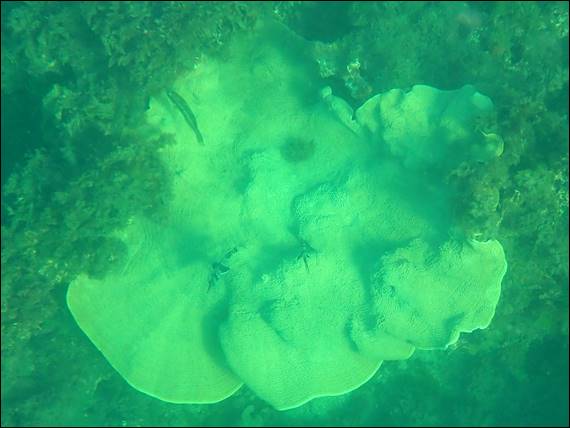
I’ve previously tried to identify these plate corals, having seen them elsewhere. I had considered it may be of the Astreopora genus, but with more resources at my fingertips I believe it may be a Yellow Scroll Coral (Turbinaria reniformis). These form various shapes including singular plates, such as the ones I saw today. Added to that the colour, corallites size and spacing, and distinct rim free of corallites all point towards it. I could immediately see why those chasing Western Rock Lobster (Panulirus Cygnus) would like it here:
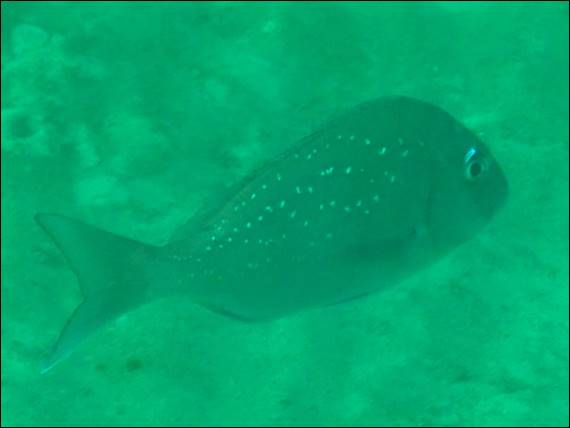
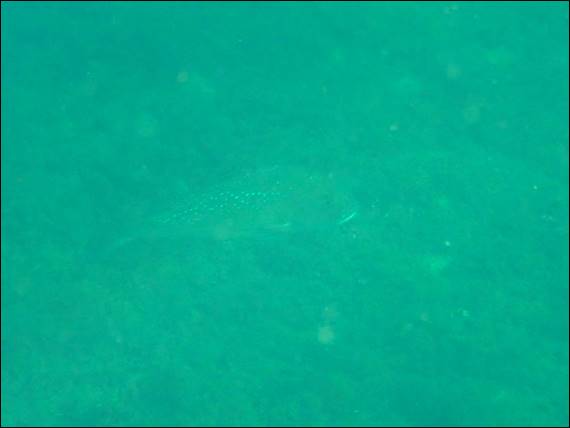
I dove down to the big caves and ledges hoping to find some big but gentle creatures resting for the day, other than Western Rock Lobsters. Sadly, while it was a nice spot and I spent a good length of time checking it out, I didn’t find much. The only fish that I don’t normally see was a solitary young Snapper (Chrysophrys auratus) maybe a foot in length. It kept coming back, each time keeping a health distance. Hence the third image is gloomy, but good enough to check the body shape and see the many small electric blue spots scattered on upper sides:
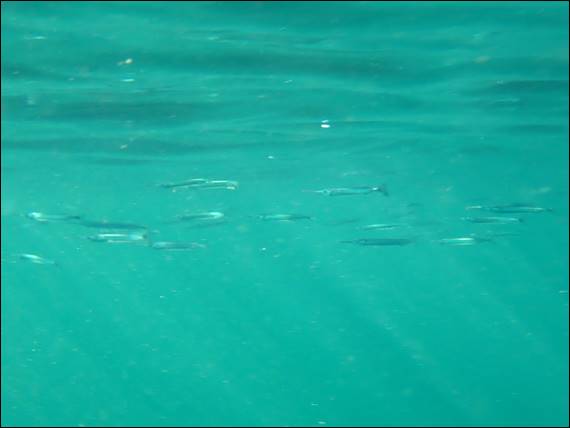
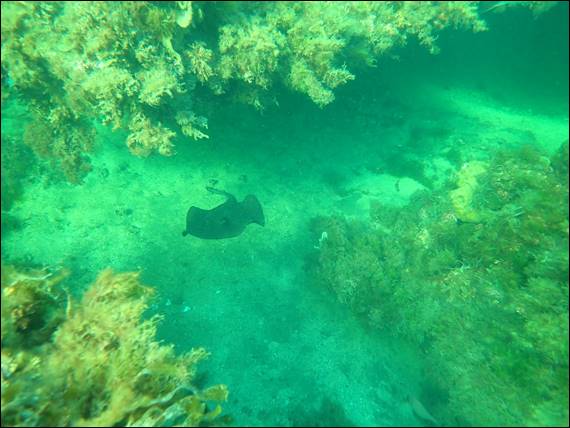
Eventually I started back, and here I came across smaller young Snapper, as shown two images up. Snapper are one of the most popular food and sport fish in southern Australia, growing to four feet, weighing up to twenty kilograms, and living to forty years old if they manage to avoid being caught. The ones I had seen were obviously very young. A school of young Southern Garfish (Hyporhamphus melanochir) also appeared. Keeping their distance, and like the Snapper I had seen these too were well below their full size of close to two feet:
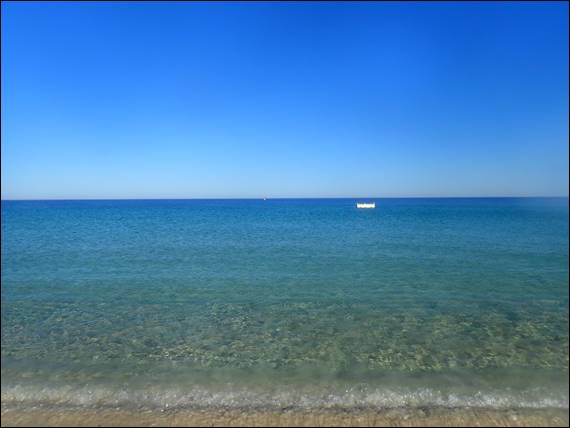
Back at shore the plungers were, as I had left them, on the beach. If it wasn’t for the wet bathers and hair I could have questioned if they had even been in. I asked them how far I had gone, and was surprised to hear that they through I had been as far out as the above boat that had just arrived. I’m not sure I’d go back there, maybe one day but I’m not in a rush. Seeing the winds were staying light all day, I asked Lisa if she fancied having a second plunge in the afternoon and she surprised me by saying she was keen for a snorkel:
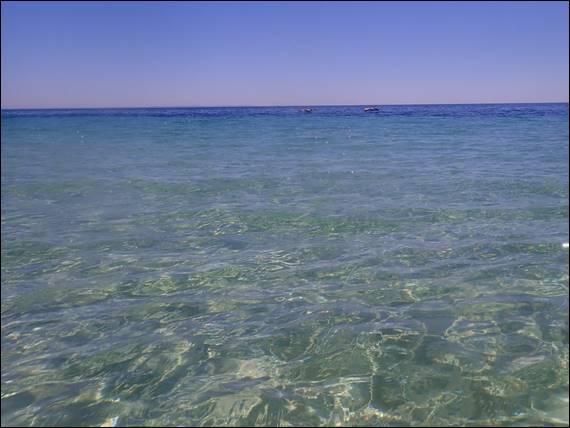
It has been several years since Lisa has been out for a snorkel. The fear of bitey things having crept up and put her off, which is why the plungers have been so good for her. Going into the water with a social crew has put her mind at ease, and given her confidence about being back in the water. As Lisa and I say ‘if anyone can a Pelican can’. So it felt like the right time for her to get back into snorkelling when two Australian Pelicans (Pelecanus conspicillatus) glided over the water, check the image above, just out from where we stood:
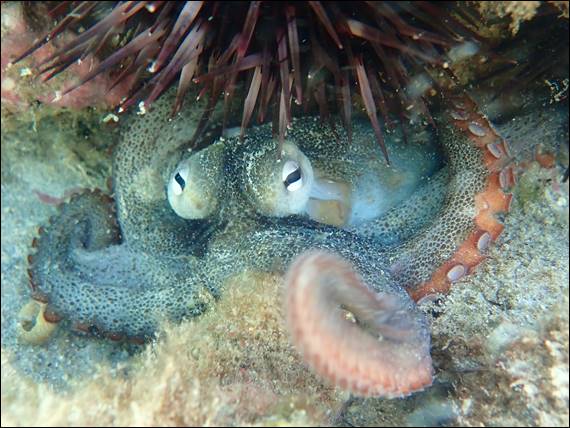
This time we were not intending to be in deep water, but the term deep is relative depending on where your comfort zone is. Lisa had already said she probably won’t go as far out as I would, which was fine. Almost immediately we saw fish clear as daylight, in the much shallow waters than I had been that morning. When I spotted a Western Rock Octopus (Octopus djinda) it provided a great opportunity for Lisa to have a bash at duck diving, so she could get a closer look. And just like the one I found last week this one also surprised me when it reached out:
I normally snorkel with my head under water the entire time. Swimming with someone else changes that. There is the need to occasional pop up and check where they are, and at times call them over because you have found something cool. In the shallow water I did this one time, and out of the corner of my eye I saw fish, with a body shape like young snapper, jump clean out of the water. This occurred several times. Fish will usually jump like that if they are stressed or feel threatened, the big question is what made them feel that way:
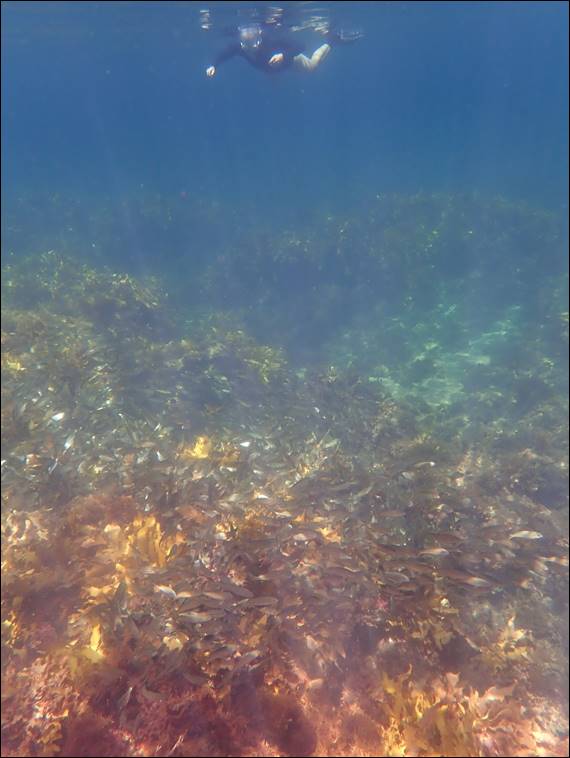
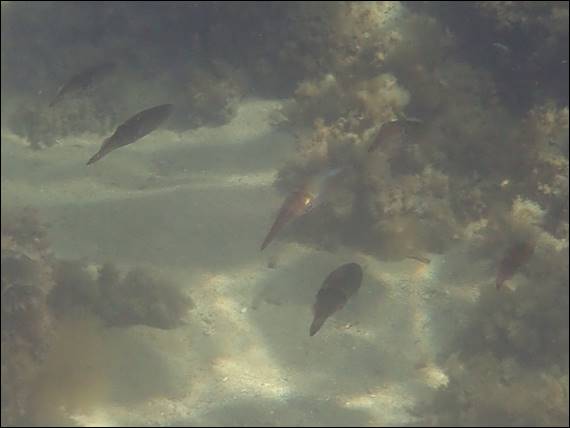
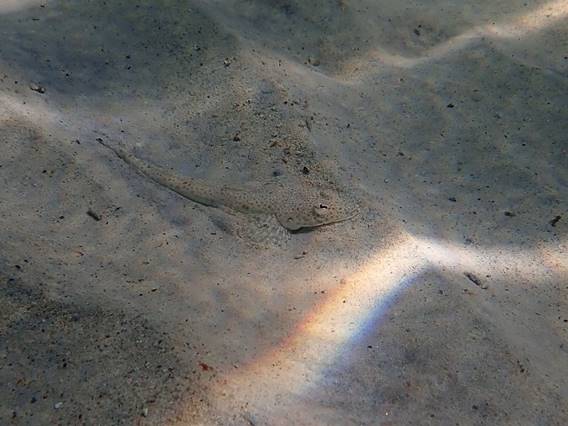
I thought that would put paid to Lisa’s snorkel, but it didn’t. Maybe because it was some way from where we were. She did however stay closer to shore, as I swam out, missing out on the shoal of Southern Calamari Squid (Sepioteuthis australis) a couple of images up. But when I came across a huge school Western Striped Grunter (Helotes octolineatus), and too her credit, she joined me several hundred meter out. We made our way back to shore where we saw a juvenile Northern Sand Flathead (Platycephalus endrachtensis), this time with a black fleck visible on the tail:
With the added height advantage of being on the beach, we could see a shape where the fish had been jumping. Someone was out there snorkelling, whether they were there before and the reason for the jumping fish we will never know. They stayed there for a long time and seemed to going down to check the area out heaps. So this morning that’s where I went, and was greeted by relatively barren ground. Not as deep as past the pontoon, but deep enough to distort the colours, with ground that really wasn’t that interesting:
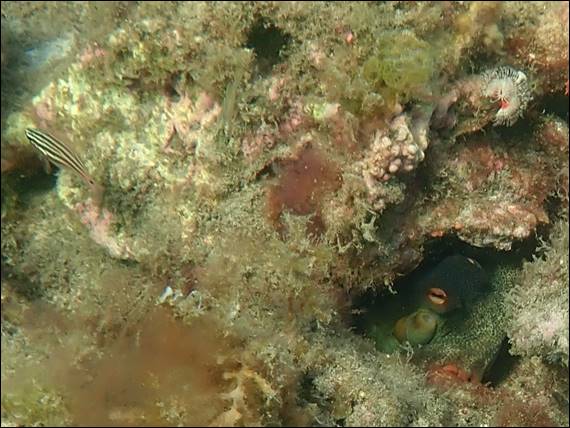
I gave it time to see if I missed something. Scouring the area and going down to check out the limited small bommies. Nothing jumped out and I eventually gave up, wondering what had caught the attention of the person we had seen. It took me a while to orientate myself and work out where my usual patch of reef was. Here I was rewarded with plenty to see. Included yet another Western Rock Octopus, this one was however content to watch me from the safety of its daytime hidey-hole. Making no effort to reach out and make contact:
 Sandbagged