It’s normally ‘thank god it’s Friday’, but this week I was more looking forward to Thursday. Not because Thursday was my Friday, it wasn’t and I worked the full five days this week. It was due to the stars aligning providing the lowest swell, along with light winds, and clear blue skies. We’ve also tipped into the forties again, and being my working from home day I could break my time at keyboard and screen up with a couple of refreshing dips in the water. Only the slightest ripples were evident, and the water was beautifully clear:
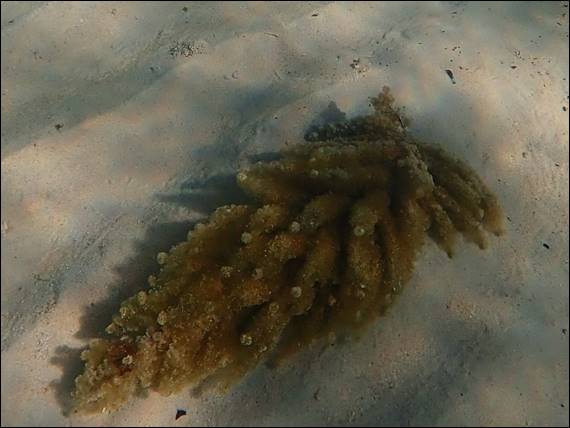
My first find was within ten meters of leaving the shoreline, above. I almost missed it, as you may have. A Smalltooth Flounder (Pseudorhombus jenynsii) was doing its thing, being perfectly camouflaged on the sand. I took the above precautionary snap before positioning myself to go down and take a closer image, by which time it was gone. Leaving me to identify the species from afar. Fortunately, the four spots in a square and two along the middle near the tail, which may not be too obvious without the full resolution image, gave it away:
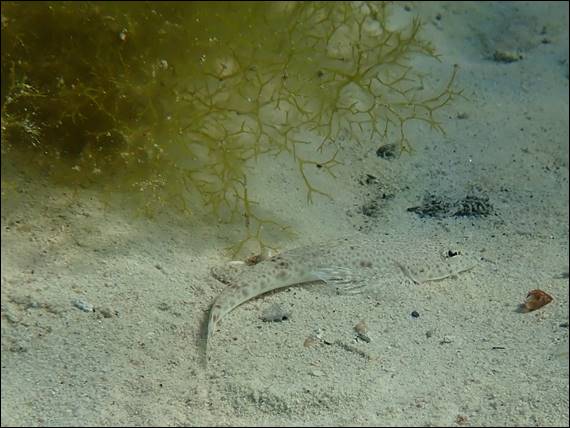
Flounder’s camouflaging techniques extend beyond its flatness, being able to change colour. In addition the eyes protrude from the body, allowing it to see when it buries its body under the sand. They start life like a typical fish, with eyes on either side of its body. As it matures and flattens one eye gradually moves across to join the other one, and which eye moves depends on the species. The Smalltooth Flounder being a ‘left-eye’ flounder, meaning the right eye has moved to the left side of the body and once there each eye can move independently:
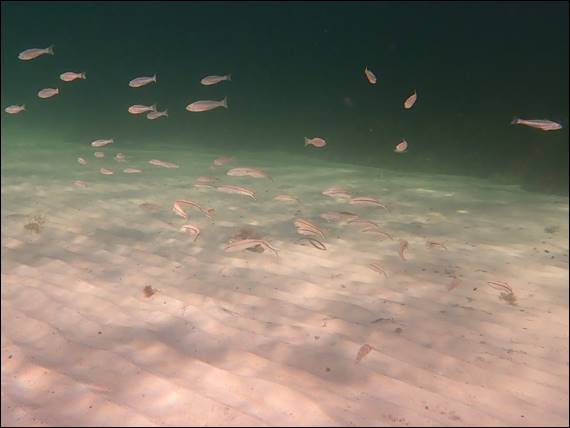
My second find was a juvenile Northern Sand Flathead (Platycephalus endrachtensis), equally well camouflaged on the sand, although the closer image I got gives it away more easily. This species is recognised by black stripes on the tail, which is where it gets another one of its names, being a Flagtail Flathead. These weren’t evident, most likely to its young age. It did however portray the expected brown spots on the head and body with a sandy background colour. It is one of the smallest Australian flatheads, growing to a foot and half in length:
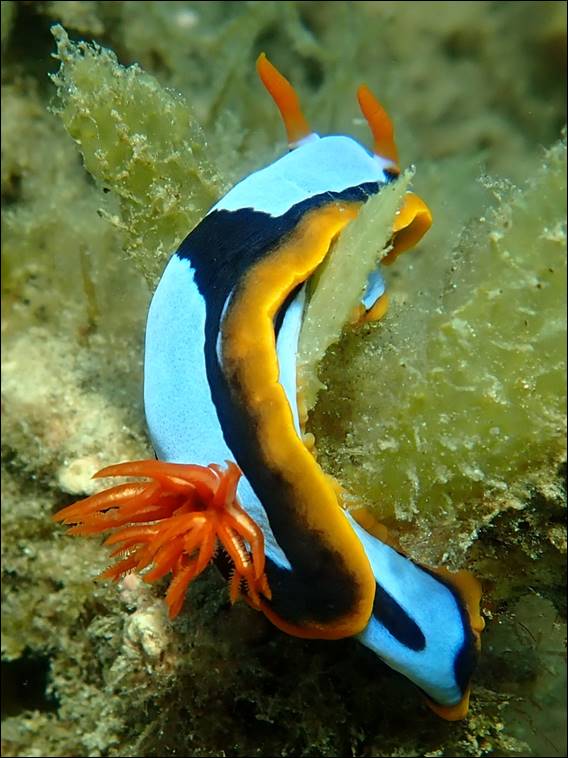
The water column above the sandy bed was filled with Southern School Whiting (Sillago bassensis), while below juvenile Blue Spotted Goatfish (Upeneichthys vlamingi) are starting to get visibly bigger. Eventually, I made it to the reef and here I was greeted by a Western Australian Nudibranch (Chromodoris westraliensis). This stunningly colourful creature was making absolutely no effort to be camouflaged against the drab background. Reported to be the most common species of the Perth region, this was my first sighting:

It made me wonder how many species I have found. There are hundreds of species in the waters of Western Australia, spread across 10,194 km of coastline ranging from temperate to tropical environments. So after trawling back through my records I happy to find that I have now recorded fives species during my shore free dives. Previous species being the Red-Netted (Goniobranchus tinctorius), Black Dendrodorid (Dendrodoris nigra), Short Tailed (Ceratosoma brevicaudatum), and White-Margin (Glossodoris rufomarginata) Nudibranchs:
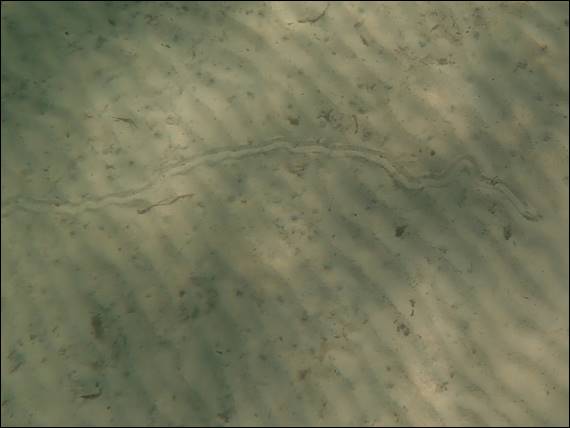
I’ll leave you to search my blog if you want to see my images of these other species. Meanwhile my journey continues and I had left the reef and started back across the open sandy bed. Where I went down to check out what was making the above trail. I believe it was a Variegated Pheasant Shell (Phasianella variegata) snail, but can’t be certain. They tend to graze on seaweeds and seagrasses but are also found on reefs and coastal shores in shallow depths up to 5m:
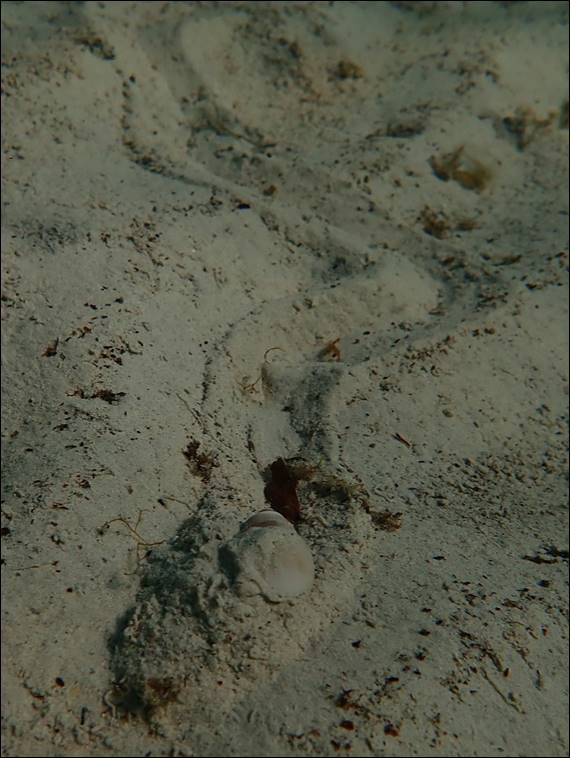
The morning and afternoon dives were spectacular, and along the way I spotted Giant Cuttlefish (Sepia apama), Southern Calamari Squid (Sepioteuthis australis), Southern Eagle Ray (Myliobatis australis), Western Shovelnose Stingaree (Trygonoptera mucosa), and fish galore including two Striped Catfish (Plotosus lineatus) bait balls and a curious Dusky Morwong (Dactylophora nigricans), which swam up to me. I was also quite taken by the hundreds and hundreds of Lugworms (Arenicola marina) egg sacs littering the seabed in the deeper waters:
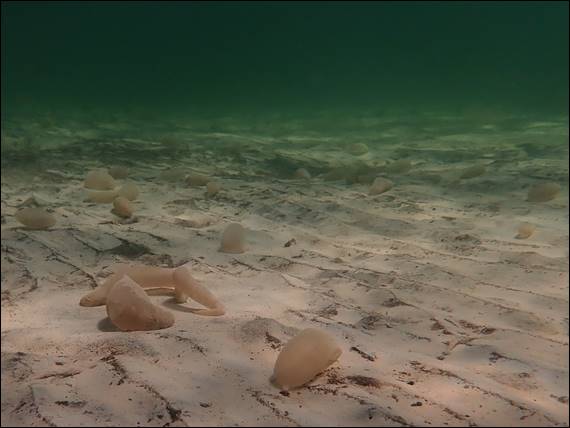
Friday came and the visibility was equally good. I didn’t think there was any way I could top what I had been lucky enough to see the day before. Going in the water isn’t however just about what I see, although that is awesome. It is also a great way to chill out, quite literally on a forty degree day, and a wonderful way to free the mind. There wasn’t anything new to report on the sand, but soon after getting to the reef this Southern Eagle Ray (Myliobatis australis) appeared and allowed me to swim alongside it:
I was in the water a little earlier today, due to an early’ish meeting that I wanted to prepare for. This worked to my advantage when I stumbled across a school of Yellowhead Hulafish (Trachinops noarlungae), dancing the open waters. I’ve often seen them lurking the darker recesses of caves and overhangs, resulting in poorer quality images. This time the yellow on their heads and distinctive shaped tails flashed as the light hit them, adding to their energetic movements. Putting the docile Western Gobbleguts (Ostorhinchus rueppellii) to shame:
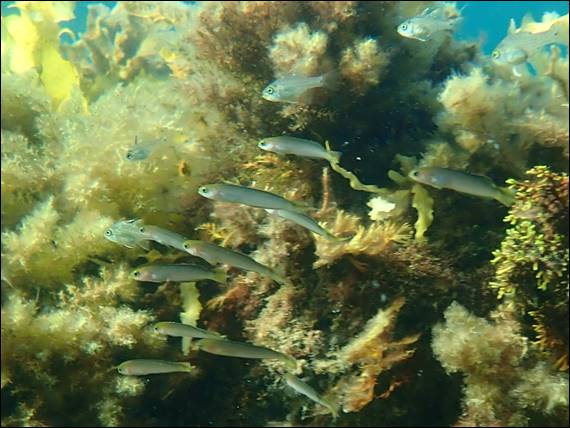
In a past post I have pondered whether this creature was a Pustulose Wart Slug (Phyllidiella pustulosa) or Mimic Flatworm (Pseudoceros imitatus). This time I can say with more certainty it is a Mimic Flatworm, the colours may be similar but the patterning and shapes on the body are quite different. While the Pustulose Wart Slug has a fuller body, which this one looks to have, when I got home and looked more closely there are in fact two Mimic Flatworms. It is possible they are mating which occurs via hypodermic insemination through the body tissue:

Sounds painful so I’ll not go any further on that topic. There wasn’t anything else exciting or more to the point different from yesterday. As I headed back across the deeper waters over the sand, I drifted further out due to the great visibility and came across a bit of reef that I hadn’t looked at before. It didn’t seem anything special from above, but went down just in case. Quite by chance spotting the unmistakable eye of a Western Rock Octopus (Octopus djinda), a curious one that reached out and wrapped it tentacle round my camera:
I went down three times and on the first two occasions it reached out. Being in approx. four meters of water I struggled to stay down too long, so sadly I didn’t get to test how far it may have gone in interacting we me. It was now definitely time to get back to work but even that couldn’t bring me down from the high of that encounter. Later in the afternoon I was back in the water and the fish were everywhere. I have however only included one image, which captures five species with a cautious looking Globefish (Diodon nicthemerus) in the middle:
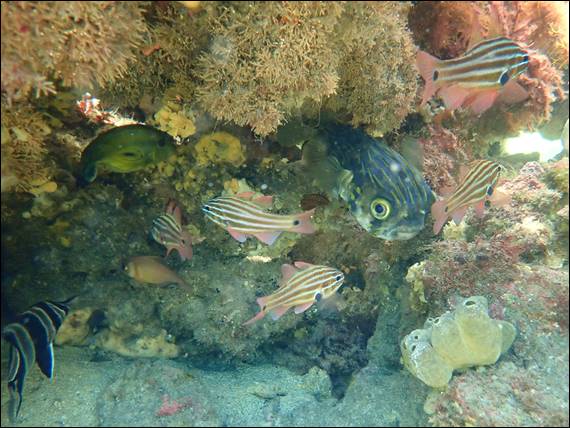
The four species shown above have all coped recent mentions, other than possibly the Horseshoe Leatherjacket (Meuschenia hippocrepis). And then I was blown away when I spotted the distinctive head of a Green Turtle (Chelonia mydas). While these are found worldwide it is a rare sight to see them off our small stretch of Western Australia’s coastline, and only my second. I was even more chuffed when, unlike my last encounter, this one lazily swam away before injecting a burst of speed and disappearing:
 Sandbagged