Dumping my gear out of the car after my morning climb, which I only did to test drive the car (not), I felt the need to get my head under water. The images of our local beach that Lisa had sent me this morning, while I was climbing, looked great but I also knew the winds would shift round fairly soon. It seems that she and I think alike. Having sent me the images because she thought I would be pondering whether to go in the water off the cliffs. Lisa was right, and I was almost sold prepared to risk getting in between sets of the swell:
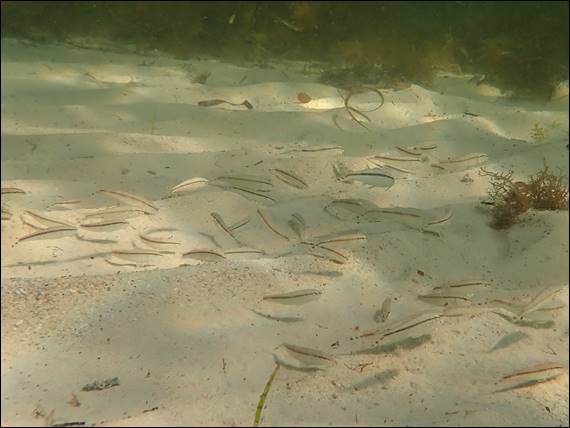
Walking down to the beach it was no longer flat, but the water still looked fairly clear. Clear enough to see the few stingers that were still battling the increasingly less calm upper surface, and also the above school of juvenile Bluespotted Goatfish (Upeneichthys vlamingii). I see the adult of these fish on almost every dive, but rarely include images of them. They check for food in the sand using sensory barbels, located on their chin. Despite trying multiple times to sneaking up on them, as they are foraging in the sand, the adults never hang about:
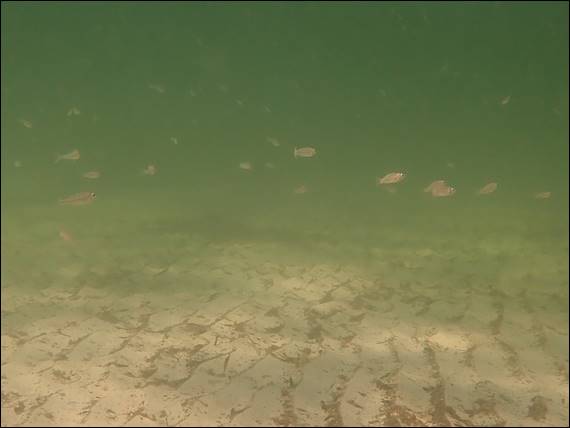
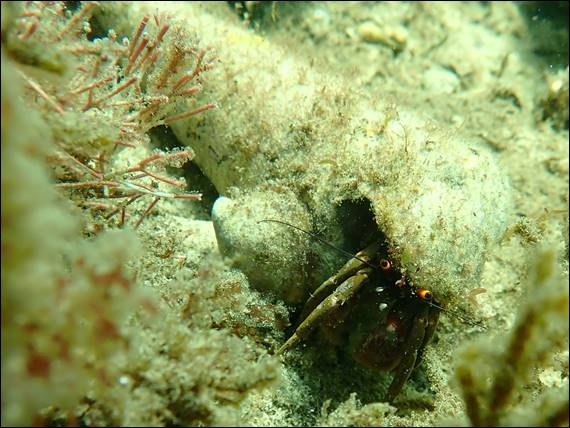
The juveniles seemed less skittish allowing me to get a bit closer to them, but being smaller the yellow barbels are not visible in the images. The open sandy areas were starting to get a bit more churned up, but I spent a fair bit of time there as it was filled with lots of unidentified juvenile fish. Another creature I usually fail at getting too close to before they hide in their homes, are Hermit Crabs (Paguroidea). I saw quite a few today in the reef, thinking the black eyes on luminescent orange stalks would make it possible to identify them, but alas not:
Back in the sandy bay, and as I was heading towards the shore, I spotted something I have been hoping to see for a few years now. I’ve only seen a group of juvenile Striped Catfish (Plotosus lineatus) a few times, and they are great to observe. I do not recall ever seeing an adult but the juveniles are the fun ones. They can form a dense school of hundreds of fish, packed tightly together in a ball. Then as they move close to a feature, which could be a reef or clump of weed, they form a shape that resembles it:

Even when the mass of fish is pushed about by the swell they somehow manage to stay together. I spent a heap of time watching them and took this short video to show them in action. Due to the changing wind, the detritus previously on the bottom was starting to lift into the water column, and I struggled to stay still. So the focus in this clip isn’t the best at times, but it will give you any idea of why I can spend quiet a lot of time watching them do what they do:
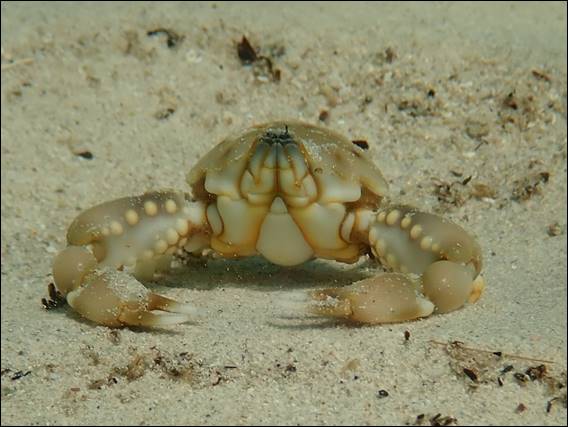
Very happy with my last find I left the Striped Catfish behind, only to spot a Granulated Pebble Crab (Leucosia pubescens). You might be forgiven for thinking it was on dry land from this image, but it was wandering along the seabed. This is my first sighting and they are very different from the crabs I normal see, including being much smaller. The shell being no more than three centimetres across. Many species of pebble crabs, like most crabs, are nocturnal burying themselves under the sea bed during the day. Luckily for me this one was out and about:
 Sandbagged