With a full moon looming tonight, when the gravitational pull of both the sun and moon gang up on us, the tides have been gradually getting bigger. To be fair the tidal range doesn’t change all that much where we are, but with a lower than normal low tide much of the reef was poking above the waterline. Sadly the winds have been whipping up each afternoon. Therefore, while the water looked flat and the sun didn’t have to contend with a single cloud in the sky, the visibility wasn’t wonderful:

This post will include images from two trips out that way. During the initial swim out I came across a few reasonable schools of Western Striped Grunter (Helotes octolineatus), Grey Drummer (Kyphosus bigibbus), and Australian Herring (Arripis georgianus). But once out at the bommies, caves, and ledges, life on the reef became relatively quiet. I was however happy to see a Southern Garfish (Hyporhamphus melanochir), even if it was a single fish. this fish that can often be seen swimming just under the surface, where it is catches insects:

I also spotted a sandy area littered with egg sacs from Lugworms (Arenicola marina). The worms themselves have alluded me, but their casts are always evident. They create U shaped borrows by sucking sand in through their mouth and excreting it out in the form of cast. So like Sea Cucumbers they vacuum the sea bed and help to maintain a healthy ecosystem. From these borrows the female Lugworms will also create these balloon like jelly sacs, which becomes a nursery for her fertilised eggs. The bags are attached at one end so sway about with the swell:
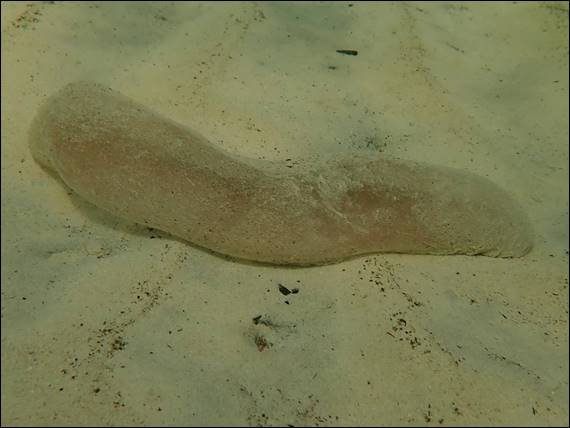
Another find on the sandy bed was this Cone Shell. Globally there are approx. 600 species, with a quarter of them being found in Australian waters. It is a shame I didn’t get a better image, but the pattern looks akin to Geography Cone (Conus geographus). Found widely in the waters round northern Australia, and as afar down the west coast as approx. Geraldton. Although with warming temperatures it could possibly have made its way further down. Regardless of which one I found it was wise to steer clear of it, as their sting can be fatal:

With the full moon tonight the low tide had crept as low as it would go before it once again commences its upward journey. Sadly the wind was blowing a hooley yesterday afternoon. Lisa advised me that there were ‘proper’ waves off Peppy Beach when she and her fellow plungers went for an early evening dip. In addition as I walked out in the morning the banks of clouds were out to sea, with their wispy edges fingering their way towards the sun. Despite a potentially sediment ladened water column and limited light I kept walking:

My destination being a part of the reef where the bommies were taller, standing above the seabed five to six meter down. As the strength of the sun fluctuated in response to the movement of the clouds, my vision was not always able to penetrate the water to the side and also below me. It would have been enough to put most people off. However, like when I climb you need to be able to control your fear or miss out. Not that there was a whole heap to miss out on today:
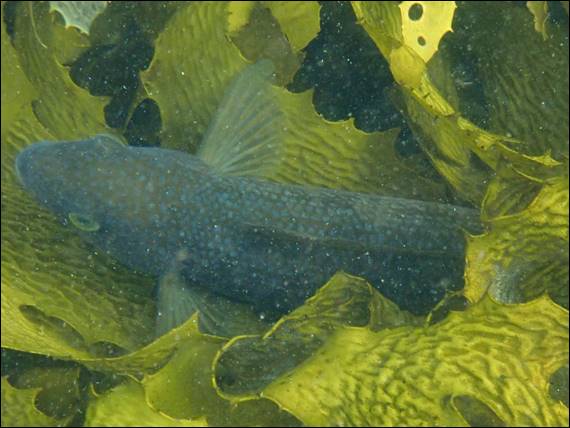
In-between diving down to check ledges and caves, a few of the familiar fish I see dart about in the kelp covering the bommies kept me occupied. The kelp forests of the southwest is extremely important to the ecosystem of our local waters. Providing the main food source for the marine food web, but also an important habitat for many species of both fish and marine animals. Such a great habitat that it can be near impossible to see what lies beneath, so I have to be quick to take a snap when a fish pops it head up:
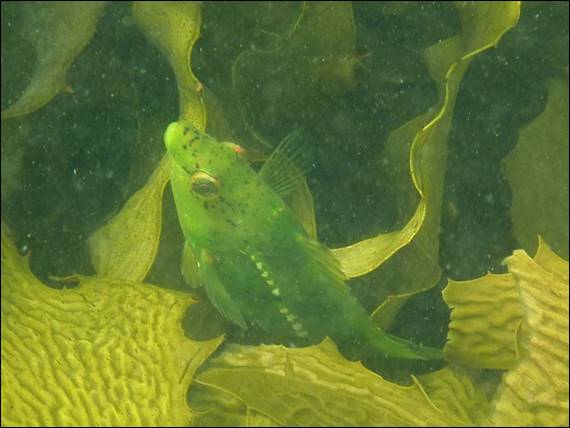
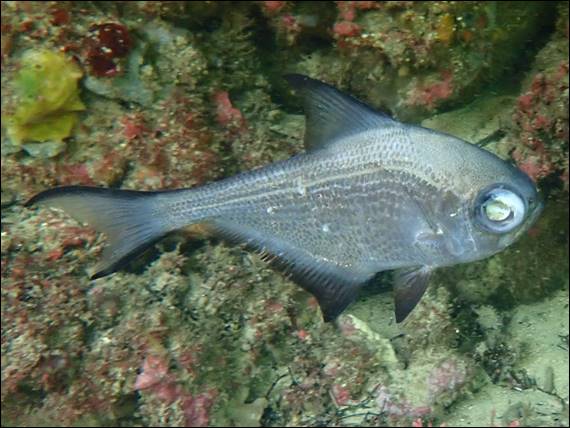
Two images above is Herring Cale (Olisthops cyanomelas), with a nice close up showing the a brown body and blue dots making me think this fish may be transitioning from being a female to a male. And above another nice close up of what I believe to be a juvenile Castelnau’s Wrasse (Dotalabrus aurantiacus). The bright green with black flecks hinting I could be right. The last image is of a Bigscale Bullseye (Pempheris multiradiata), one I could easily creep up on to get the image, as it has either had a scuffle or has been infected such that it has lost sight in one eye:
 Sandbagged