In theory I would have arrived back on dry land yesterday, after sailing in the Bass Strait and climbing on Deal Island. Instead I’m still, surprisingly, enjoying three weeks off work while staying at home. With no trips planned or taken other than some local jaunts. Lisa is equally bemused by my lack of tetchiness and hankering to get outdoors and do stuff, and both she and I were concerned this may have been an issue. It has helped that I have had the occasional mornings out on rock, and also that the conditions have been reasonable for frequent snorkels. I have also used the time at home to reset my indoor climbing wall:
It seems that resetting my wall occurs by default approx. every three years. Within half an hour placing the last hold, Lisa’s Facebook sent her a “memory” from six years back to the day. Which was when my wall was first completed and ready for a climb, although the second resetting project was not exactly three years in, it wasn’t too far off. Doing it myself this time was a mammoth fifteen plus hour task. I had split the task over quite a few early mornings, before the shed heated up like an oven. Mornings selected based on whether the water conditions were inviting me in or not. The water has been inviting some mornings, although it has at times also been deceptive:

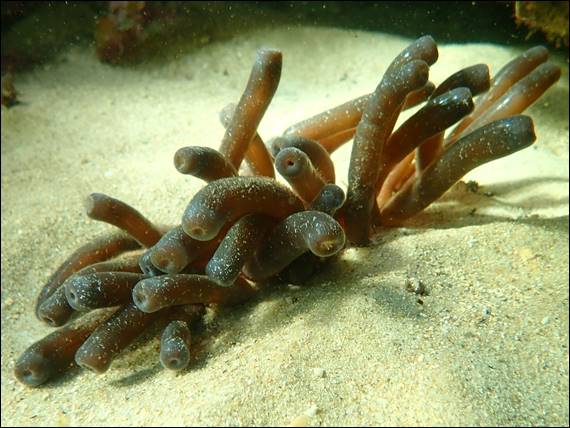
The first two images are the only ones I have kept from my near hour long swim off the beach from the Capel River mouth. The water looked reasonable but a combination of wind, swell, and cloud made it not so great. The first picture is of Finger Zoanthid (Zoanthus praelongus), which for some reason reminds me of a fictional creature in the 2005 King Kong film. They were giant slugs, called Carnictis, but the mouth looks very vaguely like the Finger Zoanthid when its tentacles are out. This generally occurs at night, when they draw in plankton and particulate matter from the water column. Some Zoanthid species have however, like Carnictis, been observed to eat meaty foods for example krill and bloodworms:
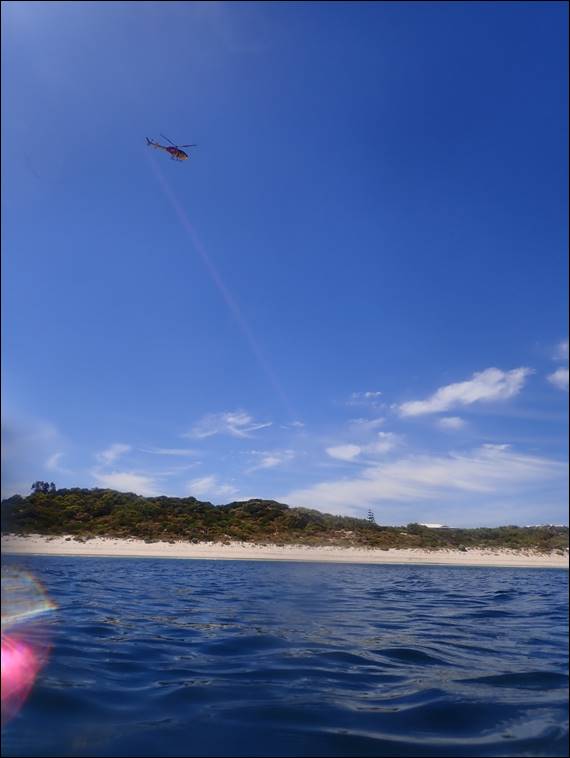
The second image was of a Troughtons seastar (Pseudonepanthia troughtoni), easily identified by the skin texture and colour. One that is endemic to the coastline of southern Australia and Tasmania, but I can find very little information about it. Although the Museum of Victoria claims it is rarely seen and little is known of its biology. The image above and the next two are from a different swim this time off our local beach. Lisa later advised me I was in the water when a 1.5m unidentified shark was observed swimming northward along our beach. I wonder if that is why the Rescue Helicopter was flying as low and slow as it was, but sadly I didn’t see the shark. I did however see theses European Fan Worm (Sabella spallanzani):
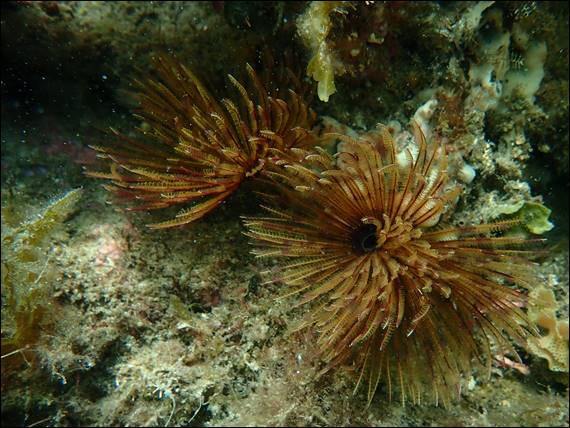
It has many different common names, and as the name I have used suggests it is an invasive species. Being first observed in Albany in 1965. Probably brought in on the hull of ships, and having now spread round much of the southern coast and also up the west and east coast. Based on molecular data, research indicates the spread of the species along the Australian coast all originated from that single introduction in Western Australia. On the plus side there do not seem to be any impacts, other than possibly interfering with nutrient cycles where dense colonies exists. However, as I have alluded to enough times we manage to interfere to a far greater extent when it comes to nutrient cycles both in waterways and the ocean:
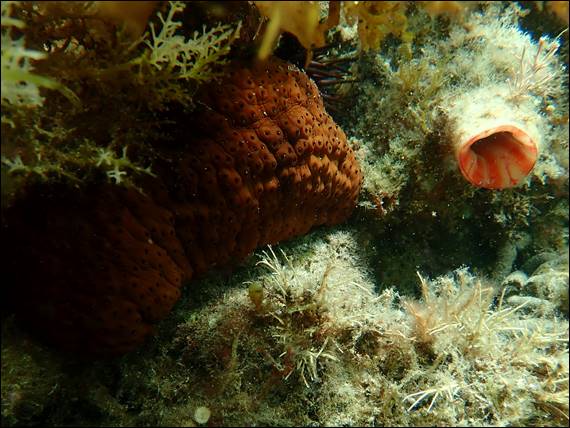
To the left of the above image is Red-mouthed Ascidian (Herdmania grandis). My reason for including the image, was because Dan had read up on these creature after reading a past post of mine, and found out that they eat their own brain. This is not entirely true. To reproduce they release sperm and eggs into the water, and fertilised eggs then become a larvae that resembles a tadpole. The wriggling movement of this larvae is controlled by the cerebral ganglion, which forms a basic brain. As the adult is a sessile creature, attaching to a substrata, the “brain” becomes redundant when the larvae transforms into its adult form. As such the brain along with other body parts are absorbed, so it is kind of eaten:
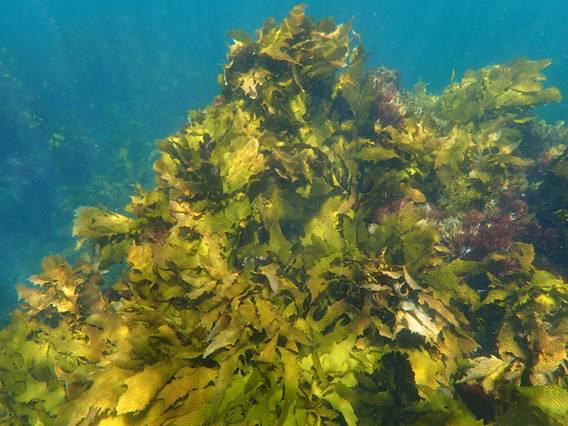
The above and next few mages are from a far more successful snorkel that was past “The Point”. To get here it is a short one kilometre plus walk from the River Mouth carpark, and a place I should go to more regularly. With way more intact reef and as such far more places to explore. Where I went in the reef was approx. 200m out and the water swimming out was murky, but once at the reef things cleared up nicely. On the way out I spotted yet another Flathead, of which there are some sixty odd species in Western Australia. This one being the Southern Bluespotted Flathead (Platycephalus speculator):
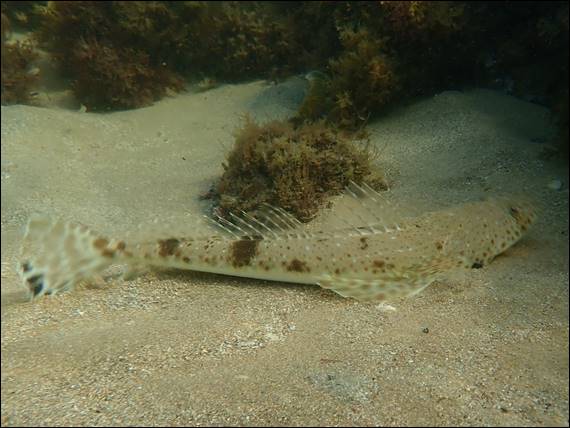
I’ve not included the best image, which was just before it decided to get away from me. But this image does however clearly show the black spots surrounded by white on the caudal fins, as well as the dusky brown blotches on the pelvic and caudal fins. Which is how I was able to identify this species with confidence, but not without a fair bit of checking out the different species. My next sight was another Cobbler Wobbegong (Sutorectus tentaculatus), but much smaller than the adult I recently spotted. They tend to sleep during the day. But this one did not have a very secure position, and the swell was pushing it about. I watched as it was tumbled over the reef and eventually found a place under the weed to rest up:

With heaps of places to dive down too, I didn’t find any other big fish resting up for the day. But did enjoy checking out the Zimmers Sea Fan (Mopsella Zimmeri), which can be found in various colours of red, yellow, white and orange. This coral creates a rigid and flat fan shape, that resembles a tree and can be as big as one and half meters tall. These were sadly tiny in comparison. The polyps, which are the living part of the coral, create the structure by secreting a calcareous sclerites. A fancy name for plates that form an exoskeleton. The polyps then live in this structure and pop out from the branches, extending their eight tentacles into the water to capture zooplankton:
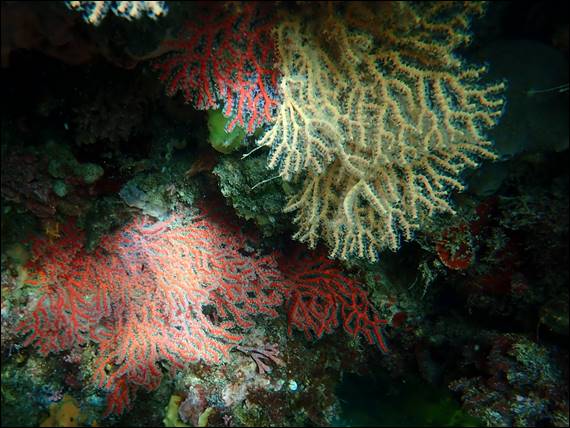
The polyps can be seen sticking out all along the branches in the above image, looking like leaves on a tree. During this dive I was lucky to spot two Blackspotted Catshark (Aulohalaelurus labiosus) on separate occasions. There twenty to thirty species of Catshark in Western Australia, but this is the only species I have been lucky enough to come across. Being an endemic species to the south-western Western Australia it is a nocturnal fish, so I was lucky to see them out and about and took this video as one of them swam below me. They do not grow too big only reaching a couple of feet in length, so this one with be an adult:
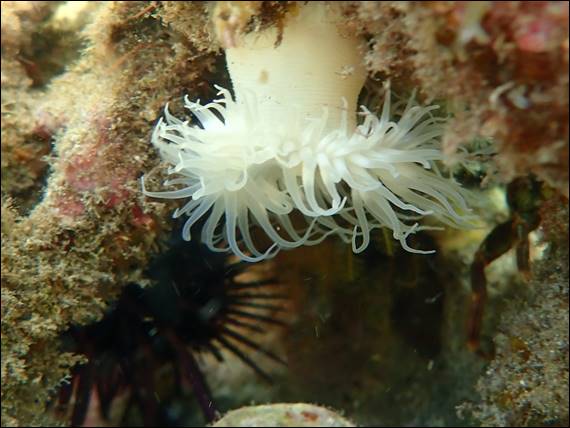
The last image is from another not so great dive off our local beach, of a white sea anemone that I have not identified with a small crab lurking in the background. The reason for including one more image is however to allow me room in this post to confess that I had incorrectly identified the large mollusc I recently saw. It was not a Giant Triton (Charonia tritonis), but a Giant Conch (Syrinx aruanus). The former having a pattern on the mustard yellow foot, and the latter not. It did mean that I had found what is reported as being the world’s largest living snail reaching close to a meter in length. But it does not feed on Crown-of-Thorns Starfish but polychaete tube worms:
 Sandbagged