Despite seeing the New Year in, my body clock wouldn’t allow a lie in. So bright and early Lisa was off for a walk with the poodles and I went for a dip at my usual spot. In contrast to yesterday’s hustle and bustle on the shore and in the water off Castle Rock beach, our beach was practically deserted. A school of Weeping Toadfish (Torquigener pleurogramma) escorted me from the sand and over the reef. After wondering whether I see many fish from different orders, these are from the Tetraodontiformes order:
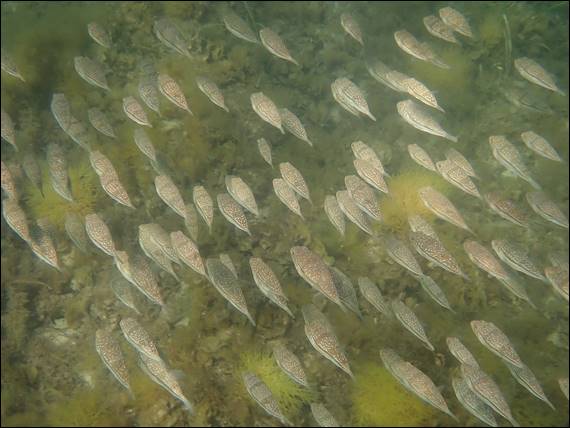
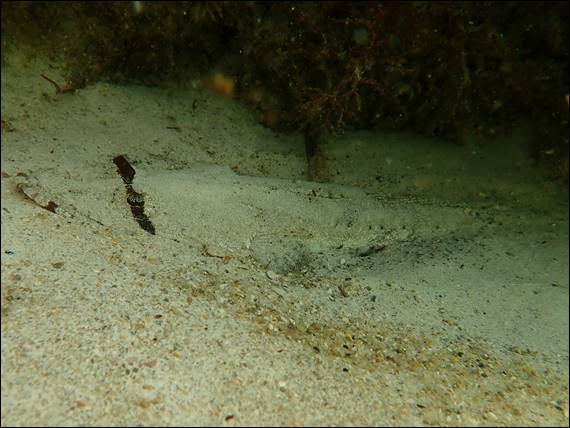
The common name for this order being puffer fishes, some of which are poisonous. This includes the Weeping Toadfish and it is not a fish to be eaten by humans or pets. Like our beach the water was relatively quiet, and I didn’t see too much that was out of the ordinary. Although during one of my descents to the sea floor, I spotted the creature below that was an inch and a half long at the most. I wondered if it was a limb that had been detached from a sea star, but the shape does not look right. It may be a Bristle Worm (Polychaetes):
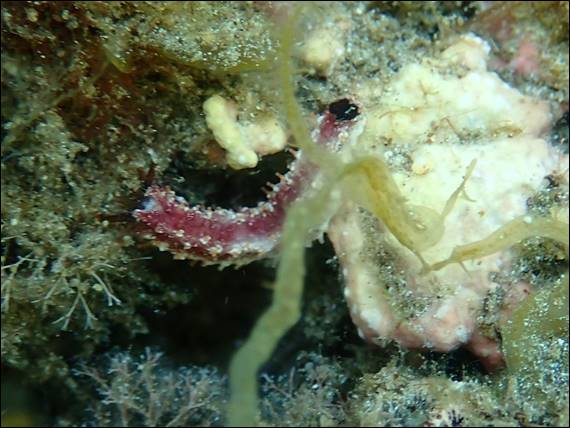
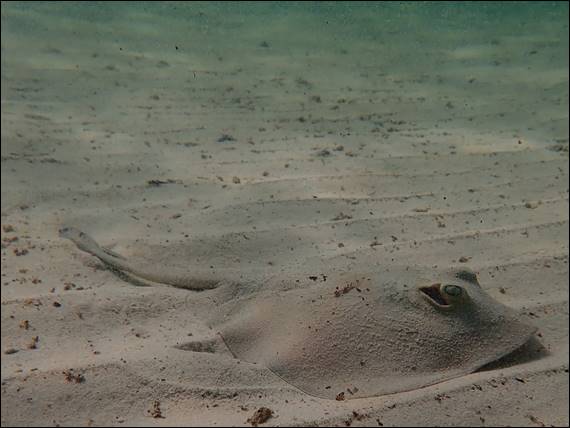
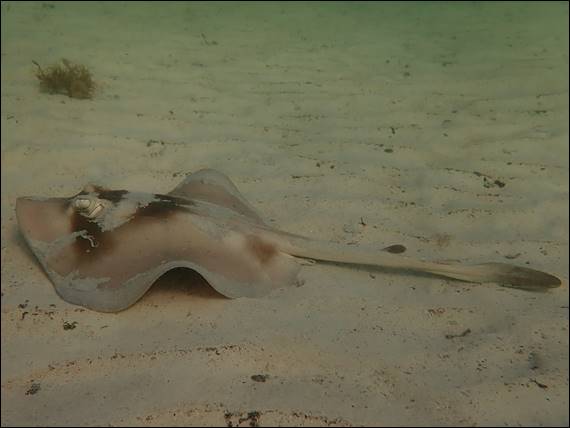
The images I got simply were not good enough to conclusively identify it, and there are no obvious matches from my searches online. My pictures of the following ray were however good enough for me to work out that this was a Sparsely-spotted Stingaree (Urolophus paucimaculatus). In the image below it has a light coating of sand over it, but watching it glide away the dark edging round the tail fin was evident. They are all along southern Australia but the populations in the west do not usually display the spots from which it gets it name:
Today came in a bit cloudy, which meant the visibility could be a bit rubbish. As such I headed to Wave Walk, where the reef comes in close to the shoreline and the water is shallow. My theory being that with reduced light I’d still be able to see OK. Unfortunately while the swell was slight, it seemed to be enough to mobilise the sand and it really wasn’t much cop. But once in there was no point in getting straight out and I scoured the reef, where I literally bumped into huge pockets of Comb Jellies (Ctenophores):
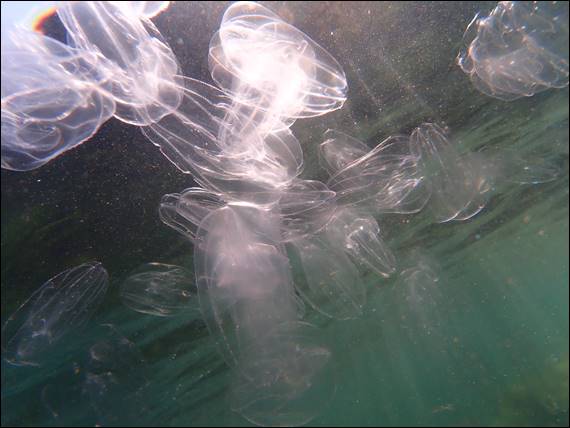
These do not have stingers, but some species are still voracious predators. Preying on other jellies, with some comb jellies able to expand their stomachs to half their size to enable them to absorb their prey. I was about to head back in when during my last intended duck dive I spotted another flathead. Thinking it was probably the same species as the one I found off the river mouth beach. However, the dark band, a bit like war paint, across the eyes had me wondering. And it was different being a Longhead Flathead (Leviprora inops):
I popped my head up to see which way the beach was. Being a little disoriented due to it being pretty murky, so much so that it was hard to see what was below me or indeed what may be off to the side. A couple were standing on the beach looking out, directly towards me. So I did a quick 360 degree scan and saw a fin pop up just a few meters away. I watched it and no caudal (tail) fin followed the dorsal fin. That told me it was likely to be a dolphin, as their caudal fin is horizontal. So I started to breathe easy again:
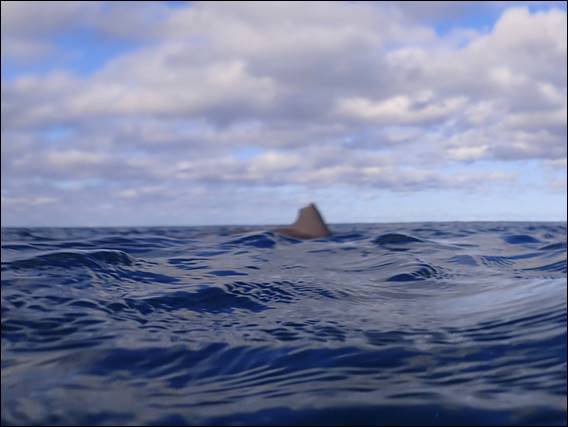
Despite being really close and getting a great view of the Bottlenose Dolphin (Tursiops aduncus) and it’s calf, this was the best image I could get. The two of them went up and down in unison, like synchronised swimmers. Circling round me but not making any obvious moves to swim away. Eventually they started along the coast and even though they were swimming at what looked to be a very leisurely I had no hope of keeping up. Soon enough they were out of sight and I was alone again in the gloomy water:
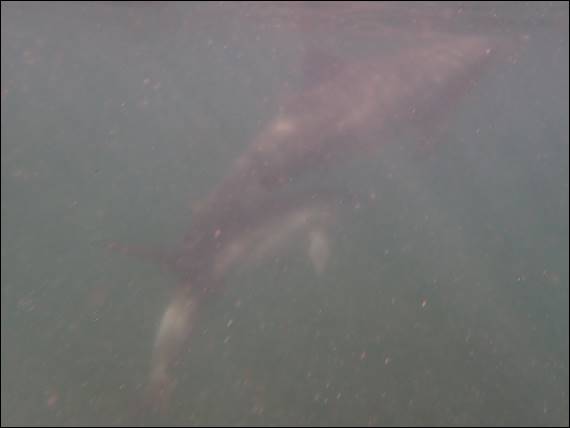
So I thought. In trying to swim after the dolphins I had gone out a bit deeper and the water looked to clear up. Enough to see the seabed where I spied another ray. The markings had me intrigued and sure enough it was yet another species being a Masked Stingaree (Trygonoptera personata). Unlike the Sparsely-spotted Stingaree this one had its namesake markings over the eyes, with another dark mark centred on the disc. It is also endemic to Southwestern Australia between, with Geographe Bay being its most southerly range:
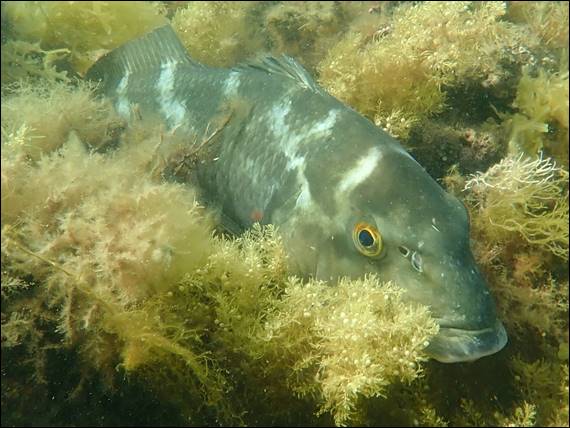
With renewed enthusiasm I checked out the reef, which was further out but started to shallow. I spotted more fish all too quick for me take any images, so I just watched them including what I though may have been a spectacular Senator Wrasse (Pictilabrus laticlavius). Sadly I have no evidence, so instead here is an image of yet another near full size one meter long Dusky Morwong (Dactylophora nigricans). These fish have been reported to get used to humans to the point they will let you get quite close, which this one certainly did much to my delight:
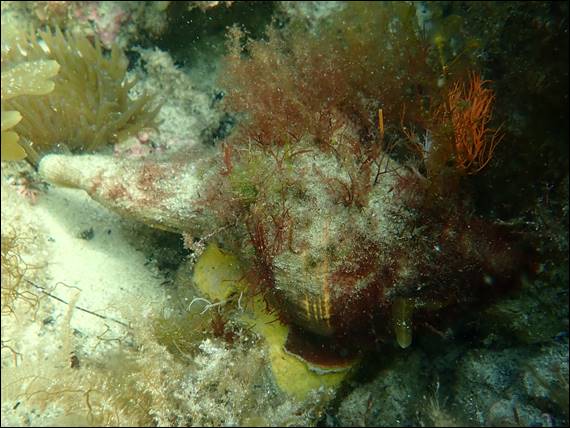
One last find to report, and another slow moving one that allowed me to go down and take lots of images. I was drawn by the large shell, from which a yellow foot of a mollusc came out. Attached to the upper surface of the foot the operculum was clearly visible. A bit like a trapdoor used to full seal it’s protective house when the mollusc retracts inside the shell. The shell had a bit of an ecosystem living on it. Various weeds growing out of detritus stuck on the shell, and a Six-armed Cushion Star (Meridiastra gunnii) hitching a ride. Based on the shell shape this looked to be a Giant Triton Snail (Charonia tritonis), one of the largest marine snails reaching up to two feet in length:
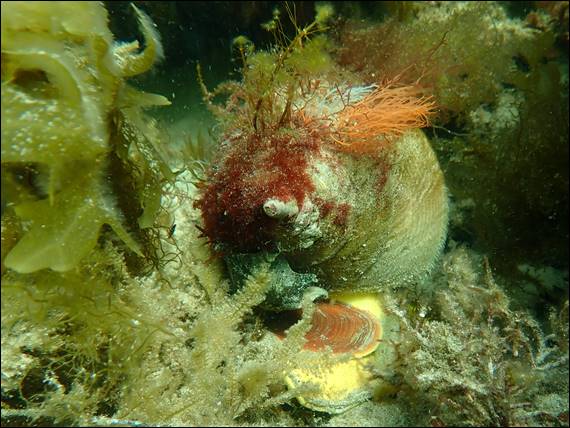
This one was probably half that size, but a great find. The unseen shell has a beautiful pattern and was highly sought after, to the point the snail became rare and endangered so it is now protected. These snails feed on Crown-of-Thorns Starfish (Acanthaster planci), which are a naturally found species on the great barrier reef but can kill ninety percent of the reef they live on. As such a Giant Triton Snail breading program was initiated for the great barrier reef. In the hope it would keep in check the number of Crown-of-Thorns Starfish, and the impact they were having on an already struggling coral reef, by increasing the numbers of this protector of the reef. I’ve since worked out that this was a Giant Conch (Syrinx aruanus), but I liked the facts I found out above so haven’t changed them:
 Sandbagged