Dog walking doesn’t stop at Peppy Beach just because it was Christmas day. I again joined them, jumping in at a new location. But the ground was pretty ordinary and there were no extra presents waiting for me under the water, other than thick patches of stingers. Heading back after the walk and snorkel the beach was already starting to fill. It would no doubt be a busy day on the beach, so I was happy to head home. However, later on Lisa was keen to get to the beach herself. And to my surprise she messaged me saying it was pretty well empty:
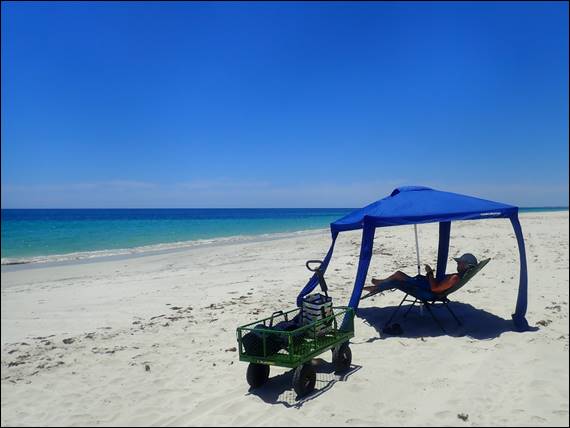
Encouraged by the lack of people I popped down shortly afterwards, with the intention of having a second dip. Not put off by the stingers of the morning, nor the onshore wind that was starting to chop up the water. In fact the small consistent waves that seemed to get a little bigger as I swam, resulted in the stingers no longer guarding the upper water column. They were instead lurking near the sandy seabed, away from the chop and me. And being waves driven by the afternoon wind, as opposed to swell, the water was reasonably clear:
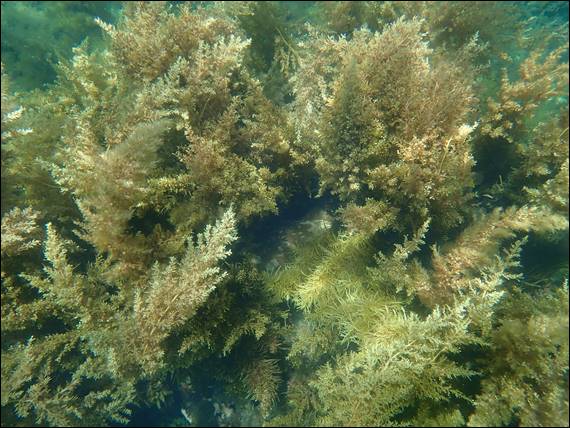
Like the morning there was not a lot to report on, and I spent most of my time popping down to get a really good look at what I spotted above. The mottled pale brown pattern could only mean one fish, a Cobbler Wobbegong (Sutorectus tentaculatus). Better still, it was a full sized adult of approx. a meter long. This nocturnal hunter was resting peacefully, and wasn’t put off by my persistent dives to get a really good look. Also called carpetsharks due to the patterning and also the distinctive barbels near the mouth, both clearly visible above:
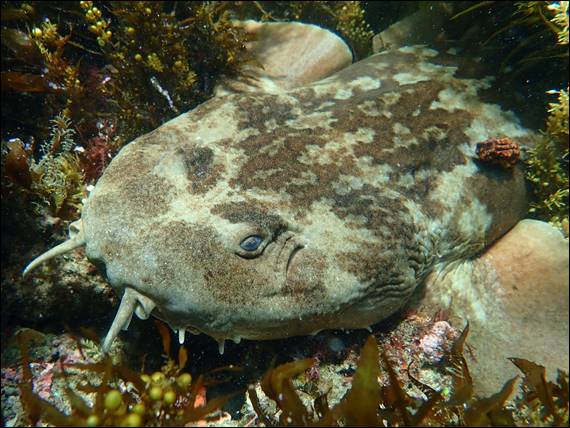
The name Wobbegong is also said to be due to the distinctive barbels, which for some species are very tassel like. Coming from one of the many Australian Indigenous languages and said to translate to ‘shaggy beard’. There are twelve species of Wobbegongs, most grow to less than four feet, but two reach about ten feet. While not one of the big species, being an adult it was the biggest Cobbler Wobbegong I’ve come across. Making me pretty chuffed that Lisa had encouraged me to pop down for a second dip:
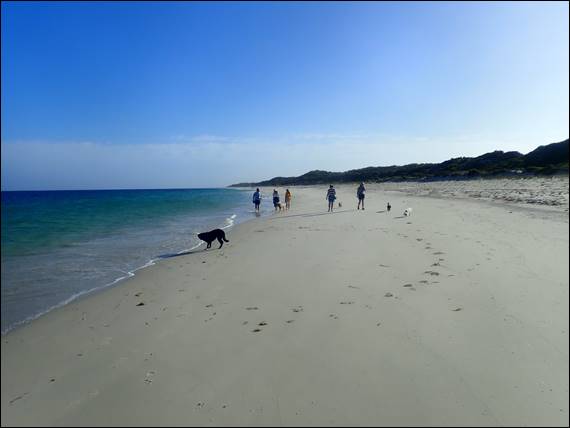
So much so that I joined the dog patrol the morning after the big day. While others ready themselves to deal with the crowds of people at the Boxing Day sales, I prepared myself for the hordes of stingers. Luckily they were short lived and close to shore, and I was soon bobbing about looking for anything that looked unusual. Not such stood out but I went down anyway, and I’ll take a punt that this was a False Burrowing Anemone (Actinothoe glandulosa). It’s the closest I could get to a match, and as the name suggests this species doesn’t burrow like most other anemones do:
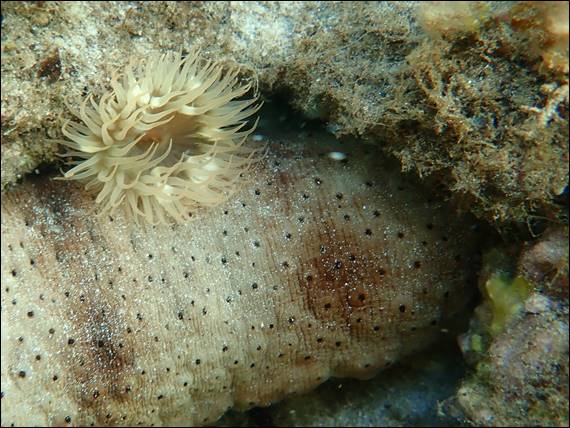
It does however have a column that it embeds into the substrate. A common anemone on the temperate reefs off the south west of Western Australia, and often found in clusters. The next image also includes a Rough Sea Cucumber (Australostichopus mollis), known as the vacuum cleaners of the sea. At night they suck up the sand to get whatever organic particles there may be, and excretes long strands of clean sand. The reason for taking the image was however the iridescent juvenile McCulloch’s Scalyfin (Parma mccullochi):
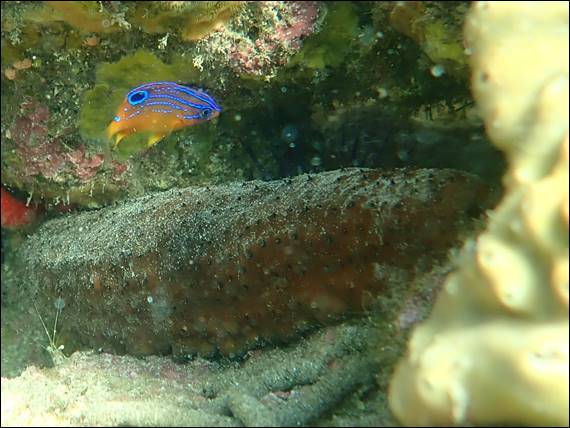
I also noticed afterwards that there was shrimp poking its head up in front of the Rough Sea Cucumber. I can find no common name for the shrimp, but believe the scientific name is Palaemonetes atrinubes. This marine shrimp is closely related to the freshwater South-west Glass Shrimp (Palaemon australis), which is found in the connected rivers and drain but also way inland. My next find I can’t even provide a guess for, other than it resembles a bivalve mollusc. I was drawn to the discarded Bicoloured Razor Clam (Pinna bicolor) shell:
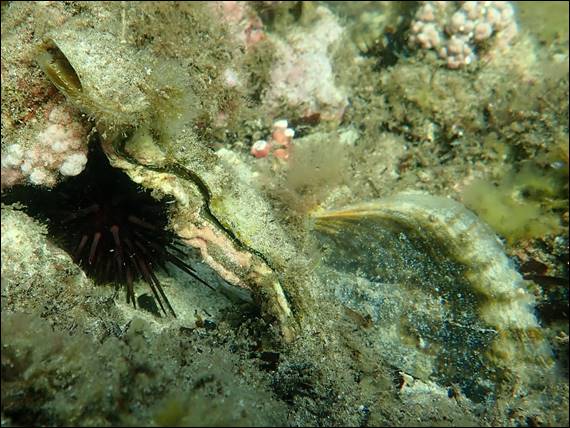
Once I was down I noticed the distinctive opening of what looked to be a bivalve. It detected unusual movement in water when I got too close and snapped shut. But it did not have an obvious shell and the two halves were certainly not similar in shape, as I would expect for a bivalve. But like a Bicoloured Razor Clam it looked to have the base borrowed into the sand for stability and possibly a degree of protection. One last underwater Boxing Day find being a Horned Blenny (Parablennius intermedius):
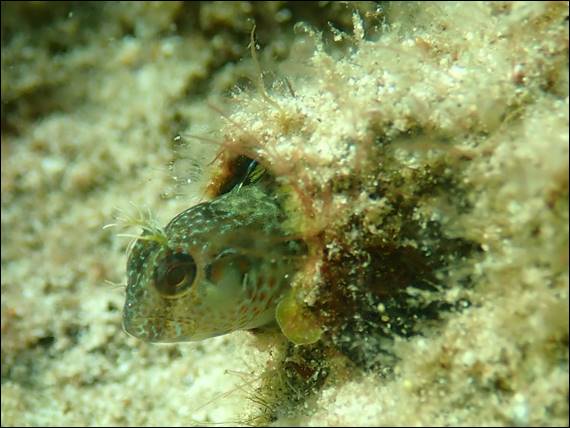
It was poking its head out by no more than a centimetre of what looked to be an old tubeworm home. Then as I poked my head out of the water a small flocks of Eastern Reef Egret (Egretta sacra) skimmed across the surface. There was also a solitary Greater Crested Tern (Thalasseus bergii), right on the shoreline hoovering about looking for a feed. No doubt thinking the chances of a catch were heightened due to some people fishing, or more likely as the burley they had thrown into the water was attracting fish in the shallows:
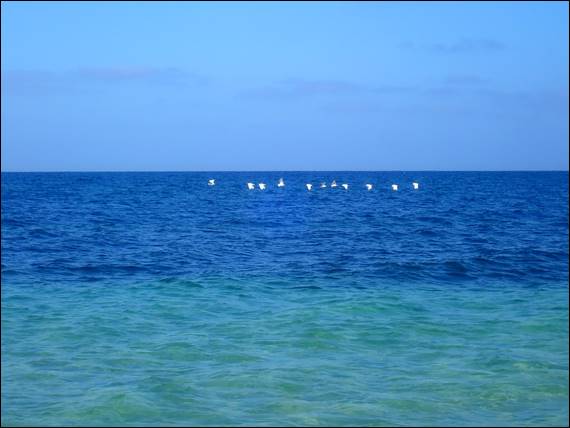
Terns may be related to gulls, but they have straighter pointed beaks, forked tails, and a much more graceful flight patterns. We watched it bob about and then hoover before diving down to catch a fish, too fast for me to get a focused image. Previously called sea-swallows due to the forked tail and smooth flight. Despite some great finds down out end of the beach, today I decided to head to the north eastern end of Peppy Beach where the Capel River flows into the ocean during winter. The water was flat and inviting:
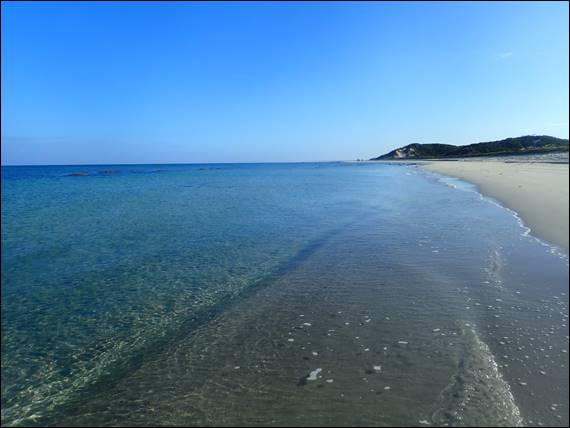
But being summer, the rivers in this part of Australia have very limited if any flows. The Capel River is fed by groundwater year round; so while there was no sign of a river mouth on the beach a pool of freshwater persists in the river year round. It was pretty smelly today, no doubt coming from the breakdown of algae coming from excessive eutrophication. A result of the nutrients that have been washed down from the upstream farmlands, now festering in the stagnant pool of warm water. That wasn’t so inviting:
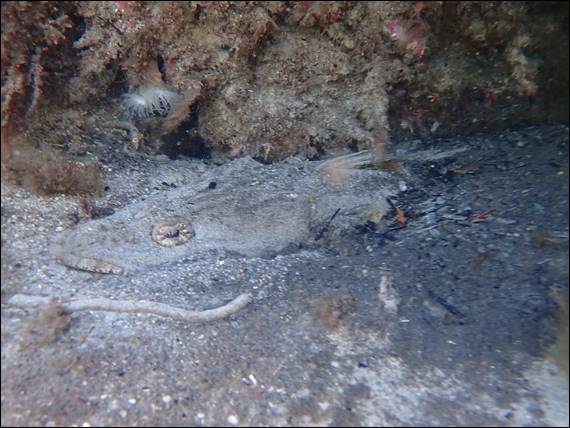
To get away from the smell I quickly popped my head underwater. There is some great ground here two to three hundred meters out. I spotted heaps of fish as I went out, and once in the good stuff I was diving down to every crevice and cave I could see. Above a Rock Flathead (Platycephalus laevigatus) was barely visible, and as I took the image it shot off. However, my next find has to be the best to date. Not one but two adult Port Jackson Sharks (Heterodontus portusjacksoni) under separate ledges, so I couldn’t get an image with both:
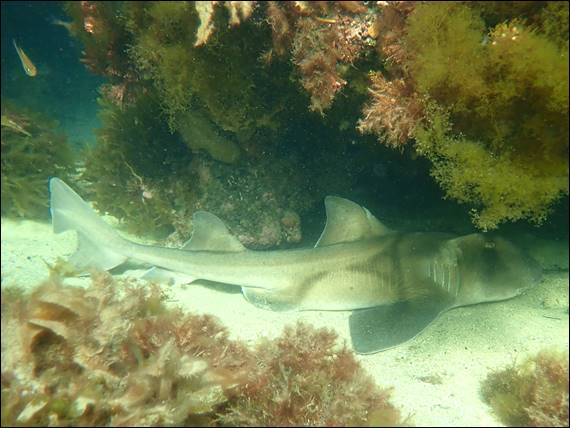
This was the larger of the two, and I’d guess close to four feet long. They can grow to a bit over five feet but more commonly males grow to two and half and females to three feet, so this really was a big one. Like the Wobbegong, it is another nocturnal feeder, and was happy for me to go down a couple of times to take a few images. But unlike the Wobbegong after that they both decided to move on. Fortunately, they did not view my actions as threatening. Like Wobbegongs, they are not considered dangerous but if provoked have been known to defend themselves:
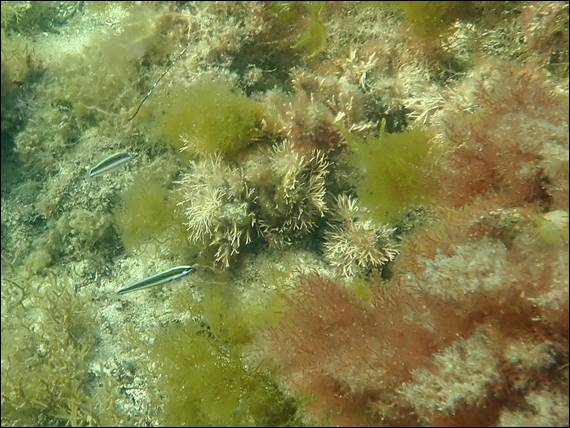
Fair to say I was buzzing after that find, and will be for some days to come. It didn’t however stop me taking a few more images. I’d seen the above small fish a fair bit and decided to try and identify them. They are reputed to be one of the most abundant wrasse species found within their range, although the wrasse I see the most has to be the Snakeskin Wrasse (Eupetrichthys angustipes). I’ve seen the female a few times but I can’t recall ever seeing the male, both of which look very different to the above two juvenile Western King Wrasse (Coris auricularis):
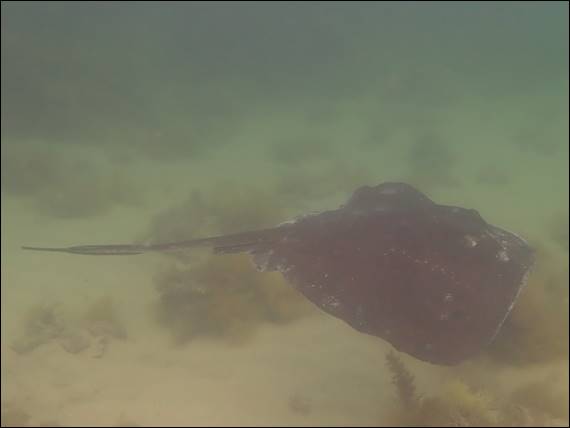
Clouds were forming overhead as I headed in, so the above image isn’t the best. I was however very pleased to see a good sized Smooth Stingray (Bathytoshia brevicaudata) glide past me, so have included it. These gentle giants can be up to four meters long and two meters wide, this one was no more than half that. I’ll leave you with one last image, well a series of images. I purposely floated above to avoid my find darting away. Being one of two motion pictures I got of a Western Rock Octopus (Octopus djinda) doing it’s very best to hide from me:
 Sandbagged