With time on my hands and limited options for driving anywhere, it has been time to explore a few more local sights. Since my last day at work for 2023 on Thursday, I’ve managed to get into the water five times. Each time sampling a new part of the coastline off Peppy Beach, and in part assisted by tagging along with the dog walking crew with Lisa. That is until I spot a section where I decide to jump in, leaving them to carry on without me. The first dip on Friday morning was extra special as a dolphin lazily swam past me. So close I could have reached out and brushed its smooth and rubbery feeling skin:

I refrained and thought I had taken a video that included looking right into its eye, but I must have been too excited and didn’t press the button to start recording. Swimming round a new location was lovely, not having favourite spots to go to and just exploring with no idea of what I might find. I did like the bright yellow encrusting sponge below, which I believe may be a Crella (Pytheas). This sponge is no more than a few centimetres thick, but is still laced with pores and channels through which the water is circulated as detritus, plankton, viruses, and bacteria are filtered out:

Sponges, like corals, do not move about comprising a collection of aquatic invertebrates. Other than that they are completely different in just about every way, including their anatomy, way of feeding, and in how they reproduce. Corals are also much more complex organisms made of many cells, while sponges comprise very simple creatures. However, both are important to the marine ecology and have adapted to many variety of conditions. There are some six to seven thousand and eight to nine thousands identified species of corals and sponges respectively:

I often chose where I duck dived down due to an interesting looking bright sponge. However, with so species I have failed miserably in trying to identify anymore. The above Western Rock Lobster (Panulirus cygnus) was an easy identification, but I only took the image as I endeavoured to digitally capture the Southern Roughy (Trachichthys australis). Normally a nocturnal fish it was refuging under this ledge until I disturbed it, after which it used several lobsters as shields to avoid the lens. Heading back in a number of juvenile Bight Stingaree (Trygonoptera ovalis) were scouring the shallows and were also not keen on the camera (or more likely me) but didn’t have anything to hide behind:
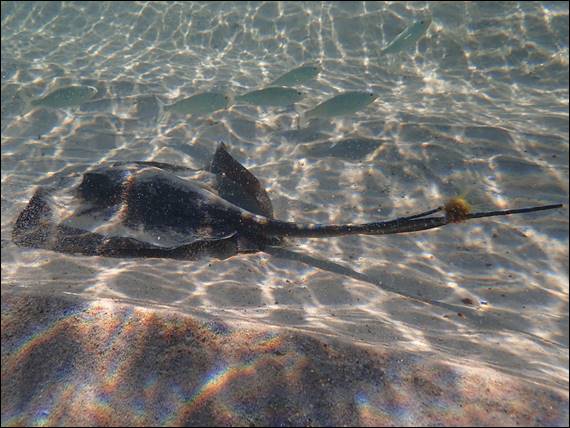
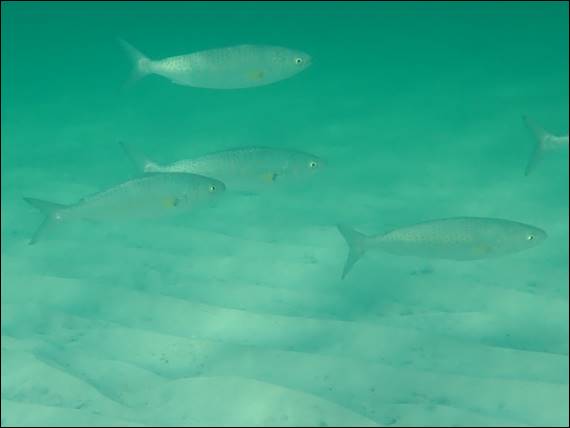
I liked the above image and persisted, due to the Bight Stingaree being followed by a small school of Australian Herring (Arripis georgianus). A fish that is sometimes mistaken with the below juvenile Western Australian Salmon (Arripis truttaceus). These fish when fully grown reach up to one meter and can weigh a tad over ten kilograms. And are very popular recreationally due to their fight, so much so that there is an official salmon run season. But their flesh is considered less desirably being strongly flavoured, a bit oily, coarse, and on the soft side. As such when fished commercially, they are mostly used for canning:
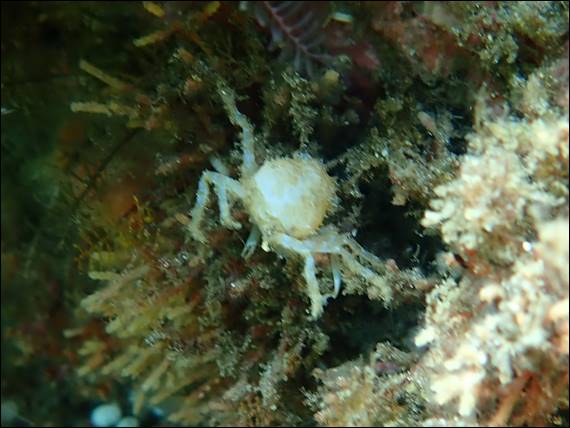
During one dive I spotted what looked to be a exoskeleton of a Pebble Crab, but which species I have no idea. All crustaceans moult, when their hard protective shell becomes to small for them. It’s an energy consuming process, and involved four stages, which includes starting to preparing a new initial soft shell under the old one, dissolving and making use of some of the calcium carbonate from the old shell, shedding the old shell and then finishing off the new one. A process that can take hours and it is at that final stage the crab is most vulnerable:
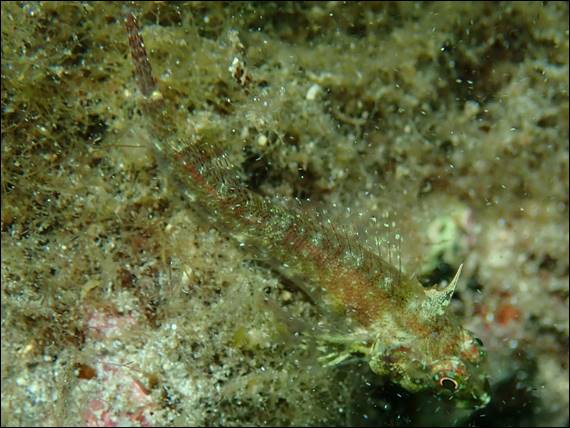
I can’t even recall what I had spotted when I went down and noticed this small fish right by my hand. Seemingly too scared to move, I took a quick snap, already with an idea that I had seen a Threefin. It is either a juvenile male or a female Blackthroat Threefin (Helcogramma decurrens), the adult male being easily identified and quite stunning (https://sandbagged.blog/2021/03/14/barren-ground/). This fish is in some ways similar to a Blenny, which is worth mentioning as you will see later. Although these have three dorsal fins, which you may guess is where the name comes from, and relatively large scales, not that I got close enough to inspect them:
And just for something a bit different, I’ve included a Feather-star (Crinoids). Related to and just like starfish, brittle stars, sea urchins, and sea cucumbers, they are an animal not a plant. There are not as many species to choose from as corals or sponges, but I’ve still managed to fail. This may be due to them often being overlooked, despite being found all over the place. Therefore, I haven’t found too many images to compare it against. Juveniles are attached to a substrata by a stalk, which they lose when they become adults allowing them to move about and even swim:
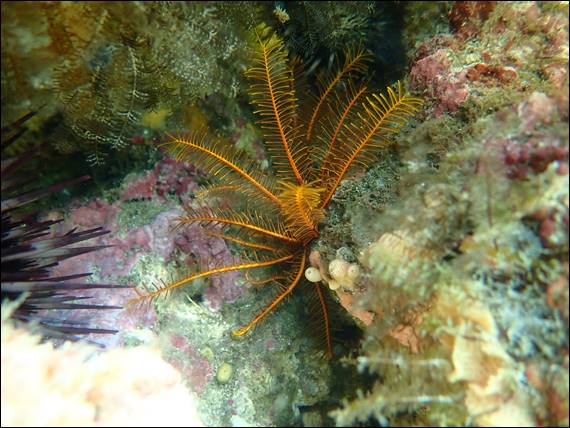
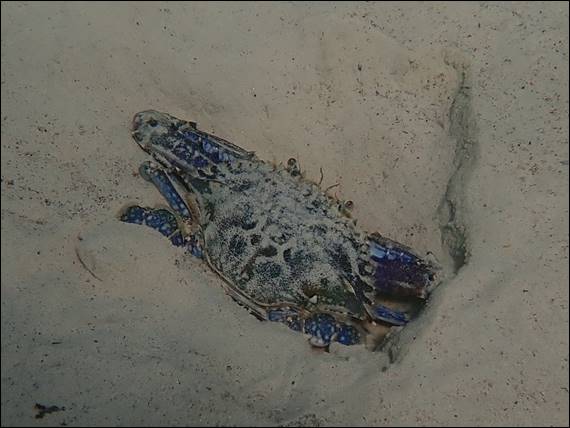
In fact they can be quite quick have been observed to move along a surface at five centimetres per second. After each dive I swim across a few open sandy areas in search of rays, but as yet I haven’t spotted any other than the Bight Stingaree. A creature that I do however see often in these areas is the Blue swimmer crab (Portunus armatus), sometimes just their eyes poking out. They have evolved to be on stalks allowing them to look out for predators while buried. Other times they quickly bury themselves before I get to them, but this one allowed me to sneak up on it:
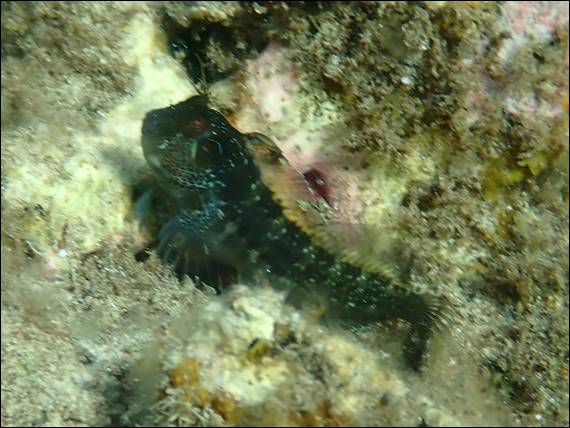
I spotted this fish from above, the distinctive shape intrigued me so I dove down someway away and snuck up on it. And while not the best quality image it was enough for me to know it was a Blenny and definitely not a Threefin, but which one? There are more species than I realised, and it has been one of the hardest fish I have to try and identity to date. Maybe because it is likely a juvenile, based on size, and many fish will change their appearance significantly as they mature. The fringe of tentacles above and behind the eyes, which had an orange iris, along with the pale bands and spots along its body makes me think it may be a False Tasmanian Blenny (Parablennius postoculomaculatus):
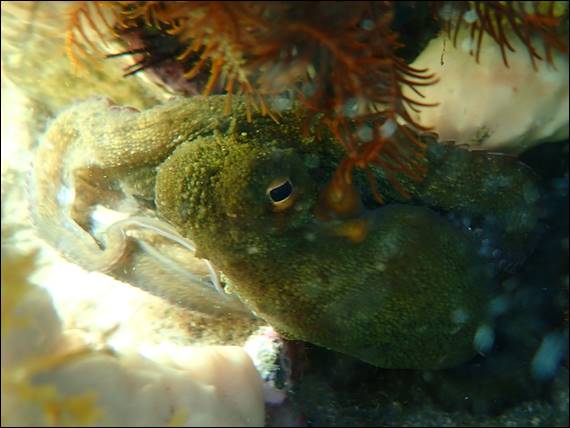
Today I was very happy as I saw my first octopus of the season. It moved at speed, dropping against a rock and using its amazing skill to change skin colour and texture. Going down, it shot off and went against some weed and changed again. Next time I went down it disappeared from sight. An octopus’s skin contains thousands of elastic sacs that contain pigments, called chromatophores. There are a variety of pigment colours in these balloon like sacs, and an intricate network of nerves and muscles control how much of each colour is visible by blowing up or deflating the sacs. There is more to it, in terms of skin texture and also an ability to create iridescent colours and even reflect the surrounding colours:

But I’ll leave it there, and have included two images of the Western Rock Octopus (Octopus djinda) after I found it again hiding in the very place I first saw it come from. I was also a little sad to read they only reach an age of three years. A primary reason being that the process of reproduction is a cause of death. Males will live a for a few months after mating, and females pass away shortly after the eggs have hatched. From the time of laying thousands of eggs in a long chain the female won’t feed again. This may last for up to a month, during which she will blow water over the eggs to prevent algae growing on them and she will also defend them against predators:
I also managed a dip at Forrest Beach today, which is a short ten minute drive away. Lisa was meeting a friend so I tagged along to try my luck in the water there. Here I spotted an adult Bight Stingaree (Trygonoptera ovalis), at its maximum size of approx. two feet. Nestled in a seagrass meadow of Posidonia sinuosa. Despite only being about ten kilometres down the coast from us, we do not get much of seagrass. It is however a valuable plant for identifying the health of the bay. The amount of algae on the grass, which can be seen below, helps to work out the level of nutrient enrichment. Nutrients coming from our urban and agricultural drains:

Seagrass meadows are critically important as they provide refuge, a source of food, and a nursery for many marine creatures. If we lose them, many other species will also suffer, including the much sought after Western Rock Lobster. Seagrasses and also take up a significant amount of carbon dioxide worldwide, and as such are being developed as valuable ecosystem in the global carbon market. So it really does make sense for us to protect them, but most people are oblivious of what is happening below the surface:

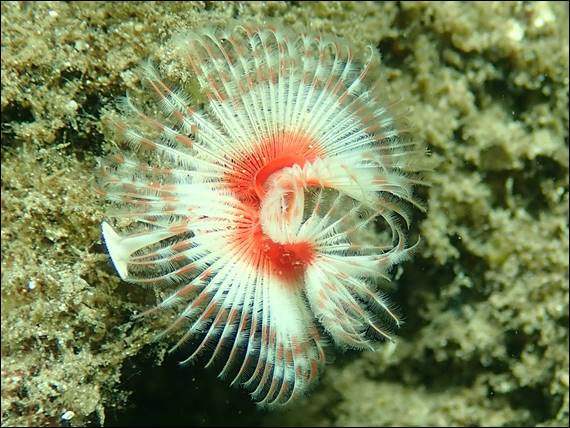
Well seeing it is Christmas Eve I better end this one on a more colourful note. And what better way than to include a splash of an orange sponge, but I have no idea which species. The area had loads of them, sticking up a bit like termite mounds and adding to the quite different feel of diving Forrest Beach. And finally a beautiful Red Tube Worm (Protula bispiralis). One that allowed me to dive down and take numerous images, without retracting the featherlike filters back into its cylindrical shell:
 Sandbagged