Several years back I heard of a fabled location called Orchid Valley, a place with a name that simply screamed out to be visited. Several of my work colleagues knew about it, as we have water resource monitoring stations located in the vicinity. They just happen to have been lucky enough to maintain the stations at the right time of the year to spot a few orchids. It is not too far off the approach to take to get down to Albany, and seeing I was going south to catch up with Kym and his family this weekend I tagged on an extra day onto my trip:

After a bit of research I identified a few places I wanted to cram in on the Friday. First and foremost Orchid Valley, aiming for a Mettabinup Nature Reserve that is dissected by Flora and Fauna Road. Then I’d head to Mondurup Reserve on the edge of Mount Barker, which has a Facebook Group that claims it has a very good diversity of flora with some forty plus orchids species having been found there. Finally, ending my road trip at the old faithful of Mount Trio Bush Camp, in the Stirling Ranges:
With some five hours of driving ahead of me, and three stops for orchid hunting I allowed myself a generous eleven hours so I could have a good sticky beak at all three locations. Mettabinup Nature Reserve has no facilities, being simply a block of land that is designated a nature reserve, and importantly for my service provider it has no phone reception. So without any walking tracks I had to be careful that I kept my car in sight, and that I didn’t wander off into the bush and lose my bearings as I have many a time before:

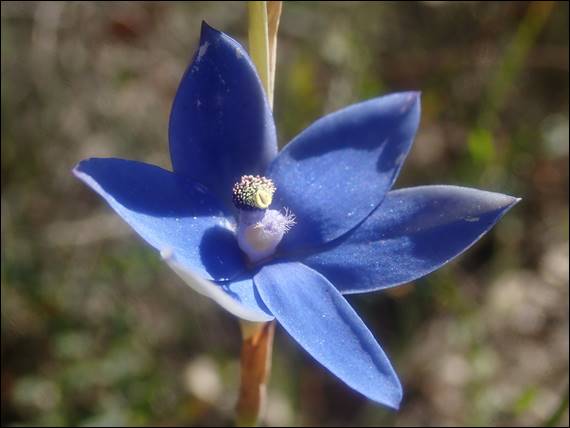
There were certainly lots of flowers in bloom, such as the above Everlasting Daisy (Rhodanthe chlorocephala ssp. Rosea). While there were not too many orchid species in flower, I spied one or two of each of the usual suspects including Purple Enamel Orchids (Elythranthera brunonis), Cowslip Orchids (Caladenia flava), and Blue Lady Orchids (Thelymitra crinita). The Sun Orchids (Thelymitra spp.) were out in the greatest numbers, and despite looking at the finer details I have struggled to work out which species they were:

It took a while to find anything new, which wasn’t wilted. Patience eventually paid off when I came across a few of the above Christine’s Spider Orchids (Caladenia christineae). Looking more dainty than the white spiders I have found in my local area; with narrower, shorter, and more stiffly held petals and sepals that have a light coating of red hairs at the tips. It was a nice area and I whittled the allocated time away keeping a close eye on the ground, finding just one Dragon Orchid (Caladenia barbarossa):

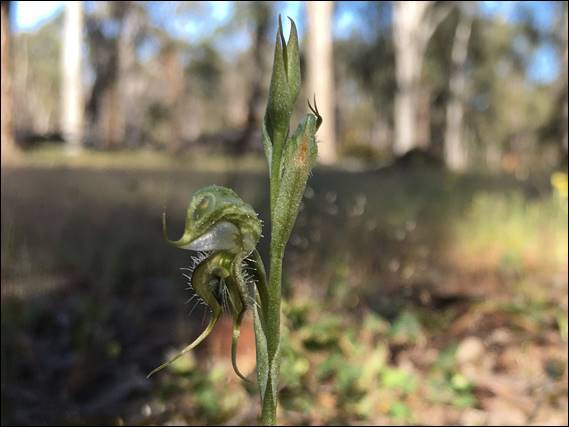
Dragon Orchids, like the various species of Hammer Orchid (Drakaea spp.) uses trickery to ensure pollination occurs. Luring the male thynnid wasps into trying to mate with the labellum by emitting a particular scent. I also found just one Hairy Rufous Greenhood (Pterostylis ciliata), a strange looking species of the greenhood genus. Named due to the fringing hairs of the labellum resembling eyelashes, with the name ciliata coming from the Latin word cilium meaning “eyelash”:
To be fair it wasn’t a bad tally, but I do feel that I had probably come here a bit late in the season. And as I have previously said the 2023 orchid season has been a bit on the lean side. I also fell-foul of this at my second location, Mondurup Reserve. Here there were walking tracks and I wandered a bit further afield from the car. And being just on the edge of Mount Barker I had phone reception, so if I did go off track I could work my way back. However, after an hour of ambling on and off the tracks it was clear that I wasn’t going to see anything new:
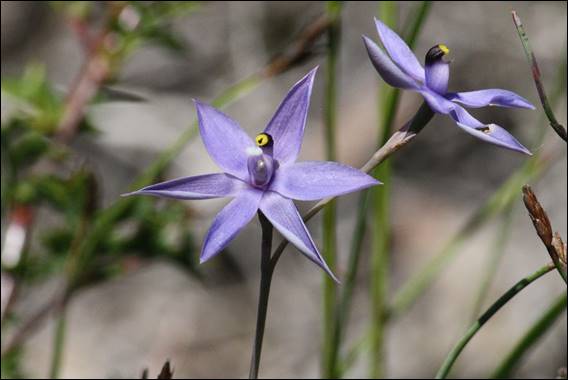
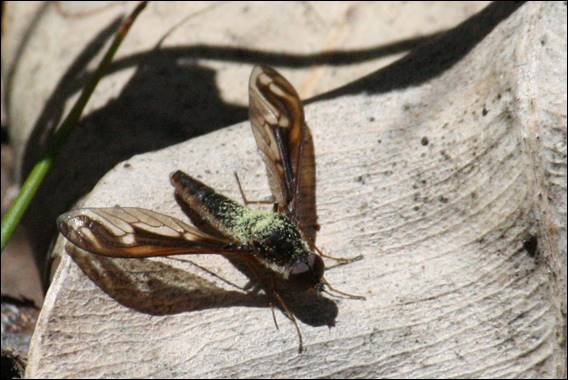
The above is likely to be the Slender Sun-Orchid (Thelymitra pauciflora), and it is possible I also came across the Shy Sun Orchid (Thelymitra graminea) and Scented Sun Orchid (Thelymitra macrophylla) at the first two locations. I am simply not proficient enough to distinguish between them and be confident, and equally I won’t attempt to identify the following insect. I did however like the fact that it was busy carrying pollen around to help make sure we would have flowers to look out for next season, whether orchids or not:
Due to the shorter second stop, I arrived at Mount Trio Bush Camp that bit earlier than anticipated. And while the campsite has expanded as a result of becoming very well-known and popular, it was fairly quiet and I had the camp kitchen all to myself as I made a welcome brew and kicked back supping on that. Arriving earlier than intended allowed me to wander round the nature trail, and also the adjacent National Park for ages. Since my last visit here the National Park had recovered from the fires a few years back and the bush was thick:

I must have spent over three hours scouring the area. The most commonly found species being the White Fairy Orchid (Caladenia marginata), it was everywhere and in great numbers. I did come across a few of the ones I have previously listed above, with the Dragon Orchids coming in second in quantity. But I was too late to see any of the local Spider Orchids (Caladenia spp.), other than the White Fairy, Cowslip, and Dragon Orchids that despite their quite different petal and sepal configuration, and shape are in the spider orchid genus:

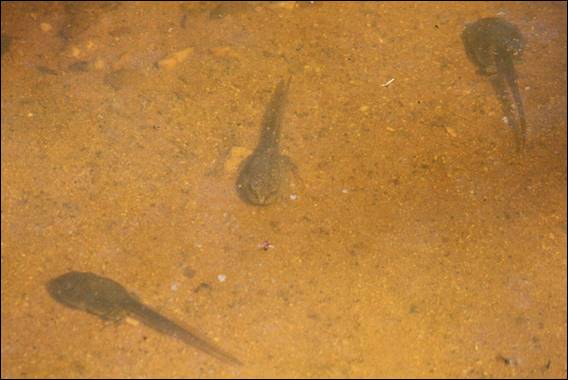
It was probably the least number of orchids I have found at the bush camp, and not for trying. I went to all the places that are off the beaten track where I have previously had a lot more success. However, it was definitely still spring time with tadpoles lazing about in the small pools that remained in the creek line, and the occasional Western Grey Kangaroo (Macropus fuliginosus) with their joeys. Seemingly becoming used to people milling about in the bush, as they allowed me to walk round where they were grazing without being spooked:
I have to admit that I lied above about the spiders, as I also came across a few Green Spider Orchids (Caladenia falcate). This was previously called the Fringed Mantis Orchid and it does look very similar to a Forest Mantis Orchid (Caladenia attingens subsp. attingens), which we get in my local area. As to why it is no longer called a mantis I don’t know. That was the lot for Friday, and unfortunately I had been so busy looking for orchids in the bush that I missed my chance to catch up with the owner, John, before he headed down to Albany:

It was a quiet night, and there were only a handful of campers about. Providing a very different atmosphere to the usual visit that Lisa and I have had during spring school holidays in years gone by. Without Lisa about I hit the sack early, and was up having a bite to eat before anyone else stirred. Even as I drove out a bit before 6 only one or two people were milling about. The reason for such an early departure being I had organised to meet Kym and Ron at Cheyenne’s Beach Caravan Park at 8:30 and was keen to check out a reserve on the way:
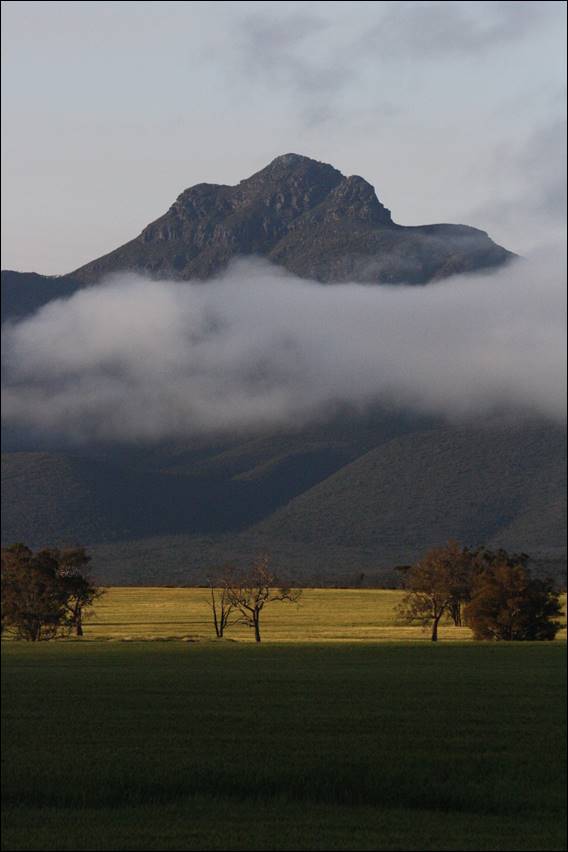
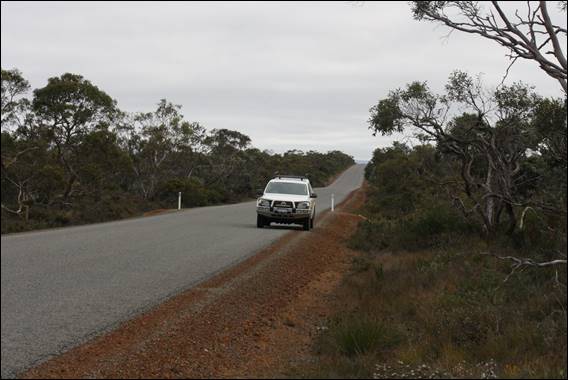
The clouds couldn’t make their minds up, allowing the lofty peaks to poke out and the sun to hit the ground on and off. But as I drove south to South Stirling Nature Reserve all the peaks where hidden from sight by a thick blanket of clouds hanging heavy in the sky. Like Mettabinup Nature Reserve this place didn’t have any facilities. So taking a punt I stopped at one of the lowest points on the long straight road, on the assumption that there may be more moisture about to aid some orchids in lasting that bit longer:
The Sun Orchids were out, as they seemed to be everywhere. But it was the Swamp or Albany Daisy (Actinodium cunninghamii) that stole the show, these intricate and delicate flowers were beautiful. They are called a daisy, but are in fact related to the gum tree family Myrtaceae. Being the only flowering plants in this family that is formerly named. Usually found in winter-wet areas in near-coastal areas in the south-west of Western Australia, with the majority of sightings listed on the Atlas of Living Australia being round the Albany area:

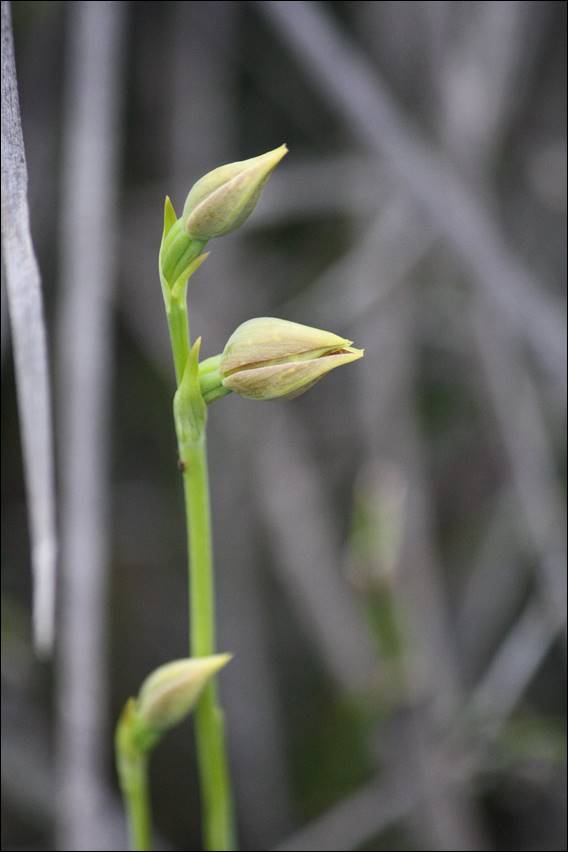
I also spotted the Common Mignonette Orchid (Microtis media), and just one specimen of the Leopard Orchid (Diuris pardina), below. Sadly, as the it was still relatively early and the sun was hidden away the flowers were closed up. The distinctive upwards pointing, green, and fleshy leaf wrapped round the base of the stem, and speckled pattern barely hidden in the bud gave this one away. So all up despite my complaining about not seeing too much I managed to tally up a baker’s dozen of species. However, now had to truck on to get to Cheyenne’s Beach Caravan Park on time:
 Sandbagged