October is a bit of a hot month for celebrations for us, with three major milestones in Lisa and my life all making an appearance, and if I sneak the 1 Nov into that period it becomes four. Lisa’s birthday is first up, and luckily for her it always falls in the spring school holidays resulting in her being off work. I too took Friday off, so we could spend the day together. Opting for a bike ride towards Busselton, for a mid-morning feed at a small but relaxing café that is a little of out the way from the hustle and bustle of the main town:
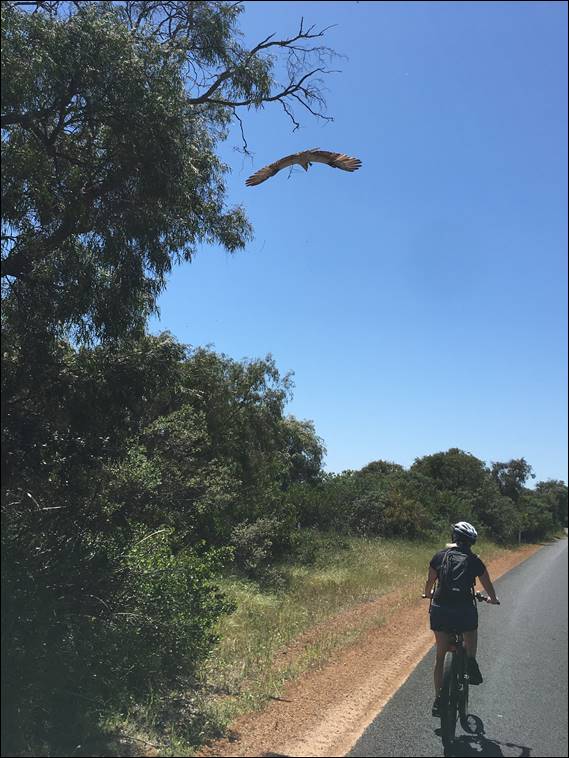
It is a forty plus kilometre round trip, so not to be sneezed at considering we haven’t been on the bikes for a long time. Quite some months back I forced myself to cycle round a local circuit, to build up some cardio fitness. However, after a couple of times it fell by the wayside. While Lisa can’t even recall when she was last on her treadly. I’m happy to report that we had a scrumptious feed, played a few games, and enjoyed the bike ride made all the more special with a couple of lucky spots along the way:
As can be seen in the first image, when we cycled under a big bird of prey that was perched just off the roadside it alighted. Providing my second close up encounter with a Eastern Osprey (Pandion haliaetus cristatus) within a week of each other. Lisa and I survived the bike ride despite the distance and the temperature, which was starting to creep into the high twenties on the return trip. While I full expected to have tree-trunk legs today they were fine, and based on all that I feel it is fair to say that our fitness levels are not too shabby:
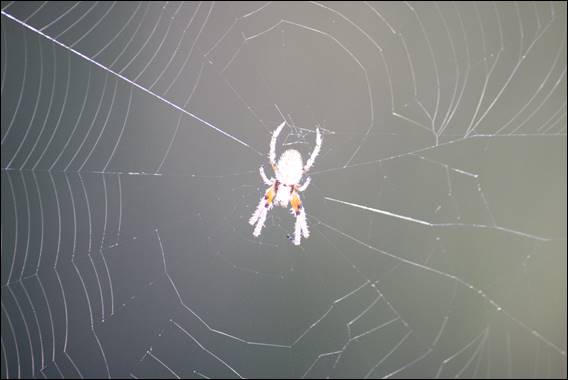
Today was forecast to be another warmer than average spring day, which prompted me to head out early for a stretch of the legs round Ambergate Reserve. Early enough to be the first there and only as I got back to my car, two hours later, did another car finally roll into the carpark. Being early the sun was low making it a little tricky to scour the scrub, and as I was the first person out today the path was crisscrossed with spider webs. I’m not entirely sure how may spiders hitched a ride on me, but I was continually collecting more webs as I walked round:
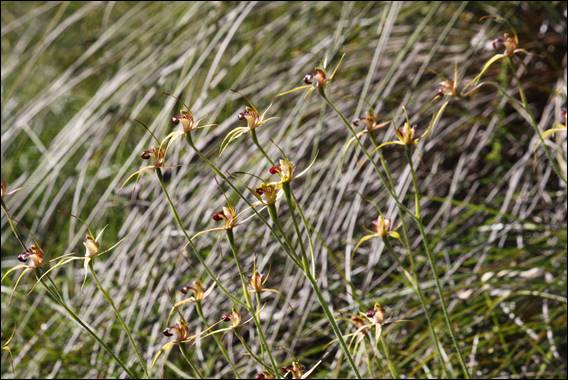
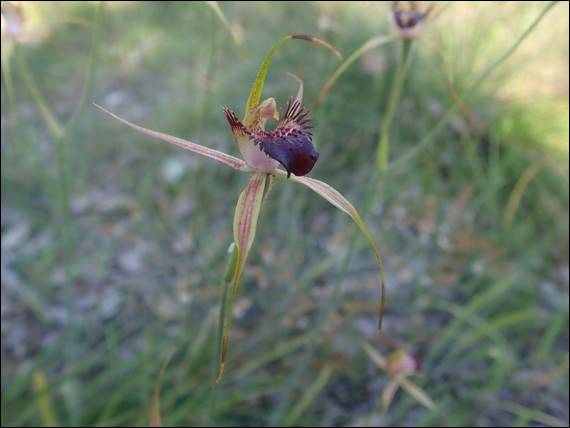
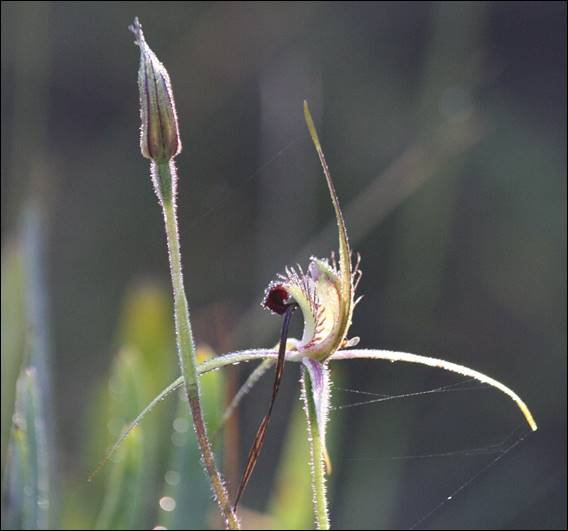
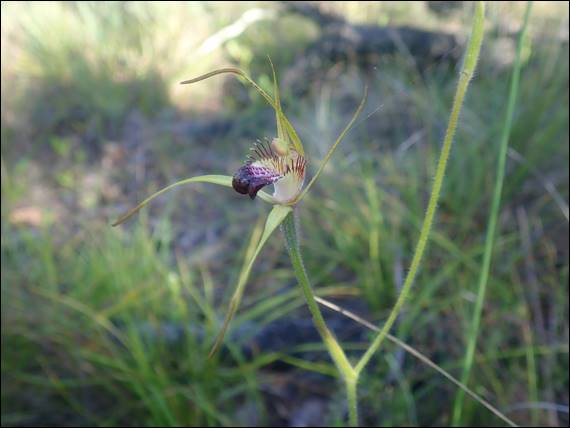
The eight-legged variety were not the only spiders out, and as can be seen by the second image there were a bounty of spider orchids. That was by far the biggest single collection I spotted with some 30-40 flowers, but they were also scattered all over the place. I looked at each closely and took way too many images, checking them out again at home but I’m struggling to figure out if they were all the same species. I’d suggest they were, being the Karri Spider Orchid (Caladenia brownii), which named after one of the authors of the orchid guide I have, Andrew Brown:
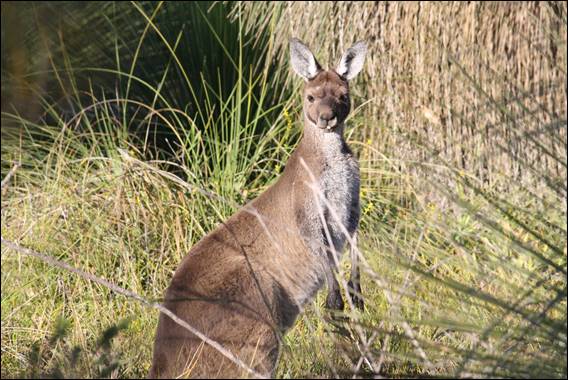
The spider shown in a web, which I did not walk through, is more than likely a Garden Orb Weaving Spider (Eriophora sp.). This is based on the body shape, size, and areas that the hairs are not covering, i.e. the femur (the section of the leg closest to the body) and the maxilla (the sides of the head). There are however over 100 species found in Australia, and with the quality of the image I got there is no point in trying to narrow it down. It seemed that Western Grey Kangaroos (Macropus fuliginosus) were finding it a bit too early to be disturbed, and they seemed a bit sluggish:
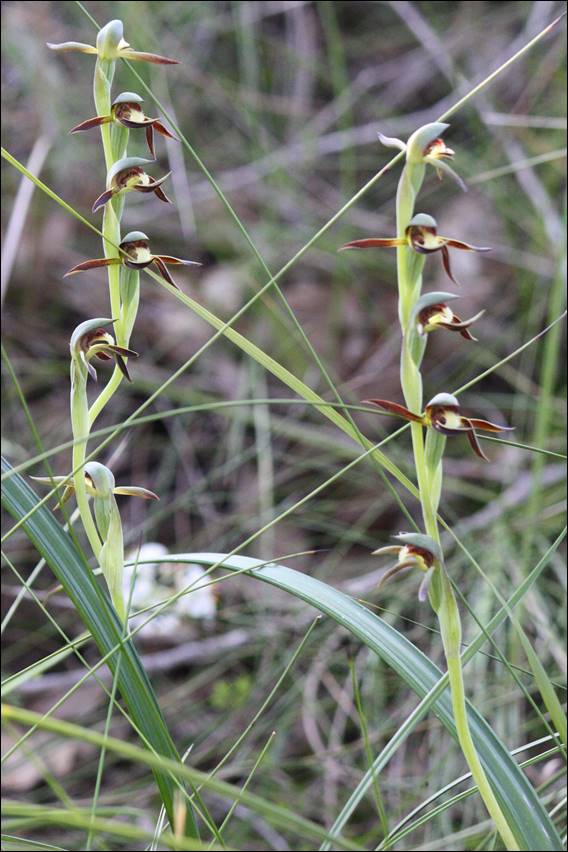
They would normally bound off as soon as they became aware of me, but at this hour of the day they seemed content enough to simply and lazily hop a few metres and then carrying on grazing. Needless to say I did find other orchids in addition to the proliferation of spiders, but of the others I spotted there were only one or a few of each species. The Rattle Beaks (Lyperanthus serratus) a couple of image up reminded me a bit like the kangaroos I spotted, standing to attention to look at me but not really caring or moving:
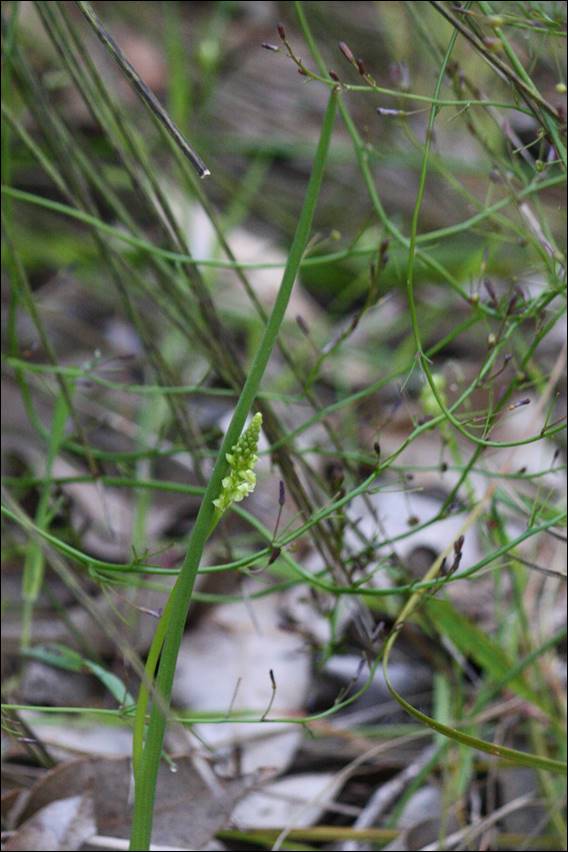
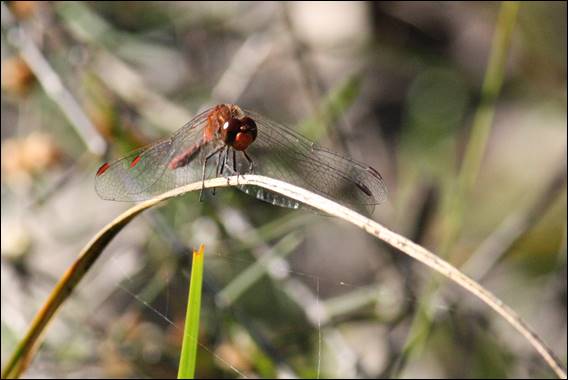
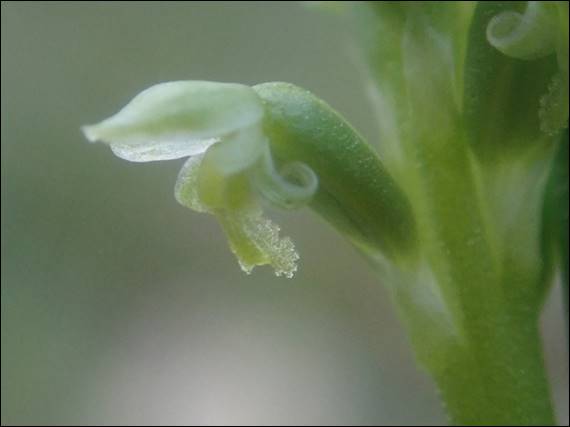
There were a number of dragonflies about, but above was the only red one I spotted. And if I am right, it may be that this was the only male I spotted, probably being known as either the Red or Wandering Percher (Diplacodes bipunctata). A small species with a wingspan of a couple of inches, but one that wanders all over Australia. Another small find, of which I only found one, was the above Common Mignonette Orchid (Microtis media subsp. media). As mentioned in my last post this species has an elaborately fringed labellum, as shown below:
This walk comprises four sections, each being a little different. The first is money section, if you are after orchids. They can be found in the other three segments but from my experience they are generally in lesser numbers. Some of the others sections have far denser understorey making it tricky to see what might be there. The third section was burnt some time ago and has still not fully recovered. I’m not sure if it was a controlled burn, but it looks like it may have burned a bit too hot and if I am right the seed base in the soils may have been damaged:
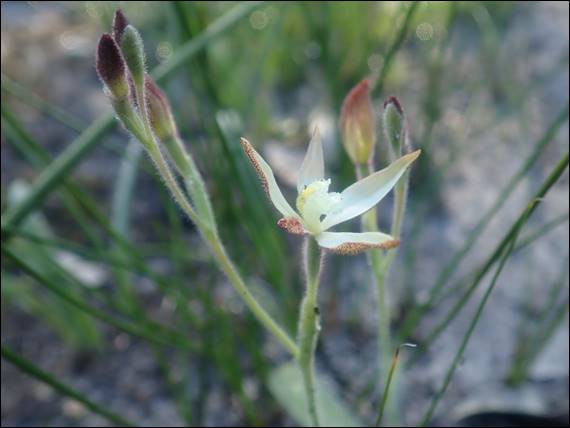
In this blackened section I did however spot one small clump of White Fairy Orchid (Caladenia marginata), which is one of the species that is said to do well after a summer burn. Mind you last season I spotted this species in great numbers in the money section, which I have not known to be burnt in the many years I have been coming here. It is said to have unpleasant odour, which is used to attract small native flies, although I didn’t notice it myself. With all the understorey burnt I spotted movement at the base of an exposed and burnt trunk:

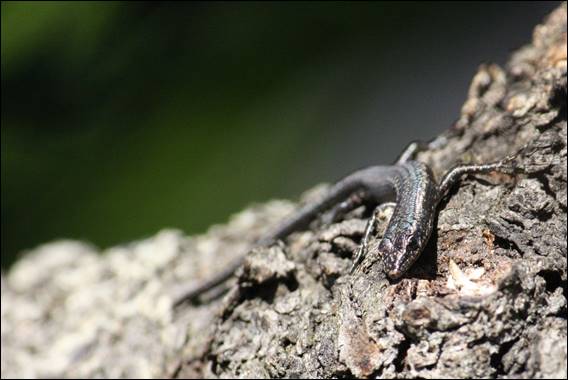
I waited patiently standing motionless for five to ten minutes, although my eyes drifted about looking for anything else of interest. The only other movement I saw was the below Buchanan’s snake-eyed skink (Cryptoblepharus buchananii). Way less timid than the above find, and happy for me to take some close up snaps making it easy to identify. That said based on the scale configuration, shape, and size of the head plus the meaty foreleg with long toes, I’m prepared to guess it was a King’s Skink (Egernia kingii) that had been cautiously watching me and refused to come out of its home any further than shown above:
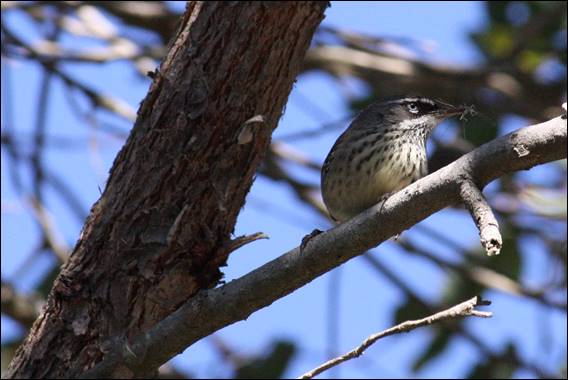
I was also being carefully watched by a myriad of birds. As the morning wore on, and the temperature began to rise, the dawn chorus became less prominent. I still caught the sound of song for the whole two hours, which drew my eyes to where it came from and on occasion a bird would perched long enough for me watch it. The below White-Browed Scrubwren (Sericornis frontalis) providing me with the best opportunity. While it is the most common of the five species of scrubwrens found in Australia, it varies in appearance in the differing geographical locations it is found. With this race, maculatus, with its speckled breast being restricted to the southern coastal areas of Western Australia:
I’ll leave you with a selection of my spider orchids images, and if anyone is game to suggest that some may not be the Karri Spider Orchid (Caladenia brownii) shout out:

 Sandbagged