Being early spring I try to temper my expectations when I head out for a wander. This week managing two visits into nature, intentionally squeezing them in as I won’t be out and about as much as usual for a couple of weeks. However, before I managed my first excursion Pat from work, who is keen to get out on rock so you may hear about him again, sent me an image asking if I knew what he had found. I did and it reminded me of when Lisa and I used to work at Ooraminna Station Homestead some 40km south of Alice Springs, where I used to take tourists on nature walks:
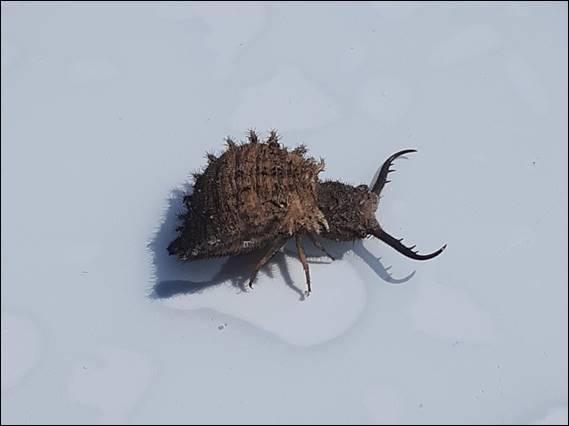
Being what is commonly called an Antlion (Myrmeleontidae), although with approx. 2,000 species worldwide I won’t even attempt to work out which one it is. The family name originates from two Greek words of mýrmex and léon, meaning ant and lion of course! As you may have guessed their primary diet is ants, and I can only assume the term lion is used due to their ferocious ability to capture their prey. The species I am familiar with do not however hunt them like lions, but trap them in the conical pits they dig in sandy soils. These pits are no bigger than 5cm deep and 7.5cm wide at the top:
The steepness of the sides are enough to result in the ants falling to the base, underneath which the Antlion, with its scary looking mandibles, waits. If an ant looks like it might escape Antlions have been observed to flick sand at it to make it loose its footing, and tumble back down. Antlions are the larva stage of this insect, which can last years and during periods of no food they can stay dormant underground for many months. When they eventually transform into their adult phase they become airborne as Lacewings, whose life span is much shorter at 25 to 45 days:
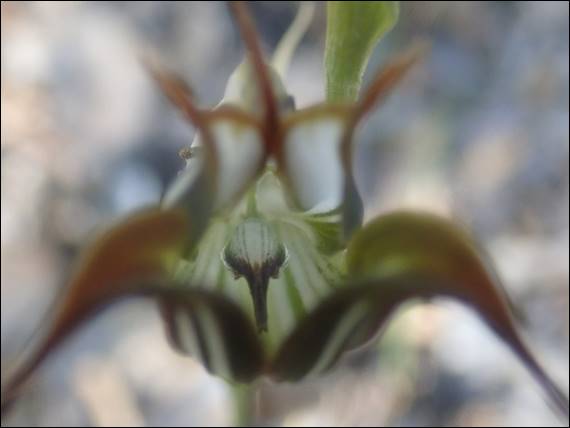
During my nature walks at the homestead, and those for my own pleasure, I have only had success in finding an Antlion once. Pushing my hands round and under the pit and sieving the sand out through my fingers, so it was really cool to the one Pat found. I’ve described the insect luring and trapping nature of Greenhood Orchids several times, but unlike the Antlion I thought they did not consume the insect merely use them to facilitate pollination. Done by forcing them to escape the trap and brush past the stigma to deposit any pollen on them and then the anther to collect pollen from the flower. The above and below images are taken from the top of the same Jug Orchid (Pterostylis recurva):
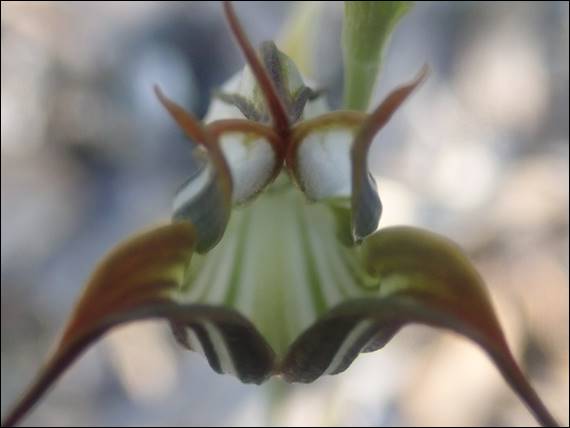
Taken before and then after I managed to trigger the labellum, by giving the flower head a little shake. This was enough to trick the sensitive-to-the-touch labellum into thinking an insect had landed on it. In the second image it has sprung towards the back of the flower, an action that traps the insect and forces it to crawl up past the stigma and anther to escape. For those keen I have found a website that has some great imagery of this, and a theory that the plant-insect relationship could include the need to trap and kill a gnat after pollination (https://www.foxeslair.org/foxypress/shell-and-jug-orchids):
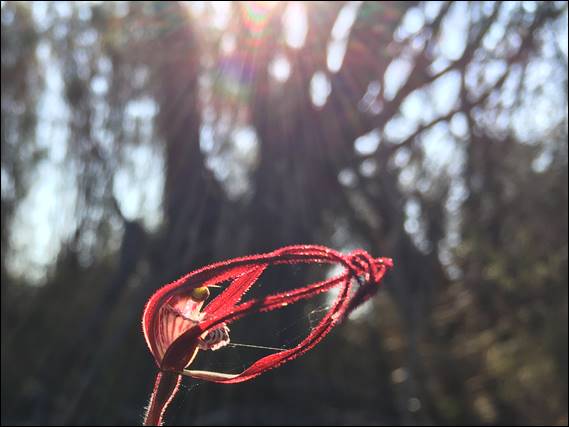
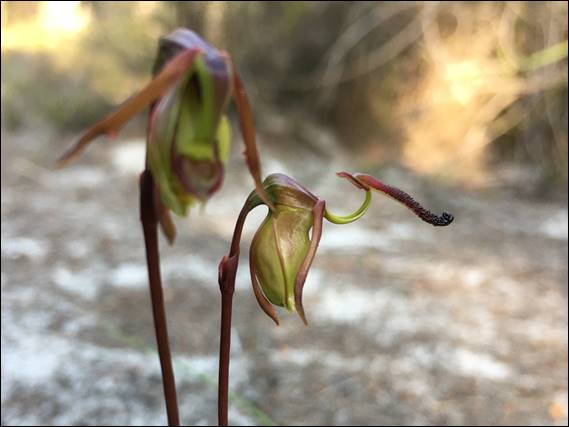
Other than the first image of the Antlion the others until now and below are from a wander at the Capel Nature Reserve on Thursday. Knowing how mosquito ridden this place can be I wore closed in shoes, which is a rarity for me. This helped minimise the number of successful strikes these pesky insects managed to get. Things had certainly progressed here. The first image is of one of the many Sandplain White Spider Orchid (Caladenia speciosa), and below is the only Flying Duck Orchid (Paracaleana nigrita) I found in flower. But the above orchid, which was just starting to come out in numbers, is the one to go here for. The Chapman’s Spider Orchid (Caladenia chapmanii) is, in my opinion, one of the most spectacular spider orchids:
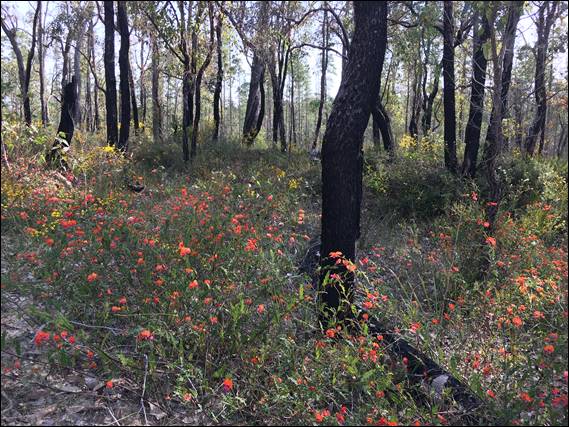
There were others I spotted at Capel, which I was equally excited about but I am also trying to refrain from repeating the use of the same orchids in too many posts. So onto Friday when I popped out for my first wander of the season round Crooked Brook. Josh, also from work, had been here last weekend and reported that there wasn’t heaps to see yet. It is however in many ways a different landscape to the places I visit more regularly on the more sandy coastal plain, plus a fair bit more had come out at Capel in a relatively short period, so I was keen to give it a go. The lower storey vegetation was certainly full of colour:
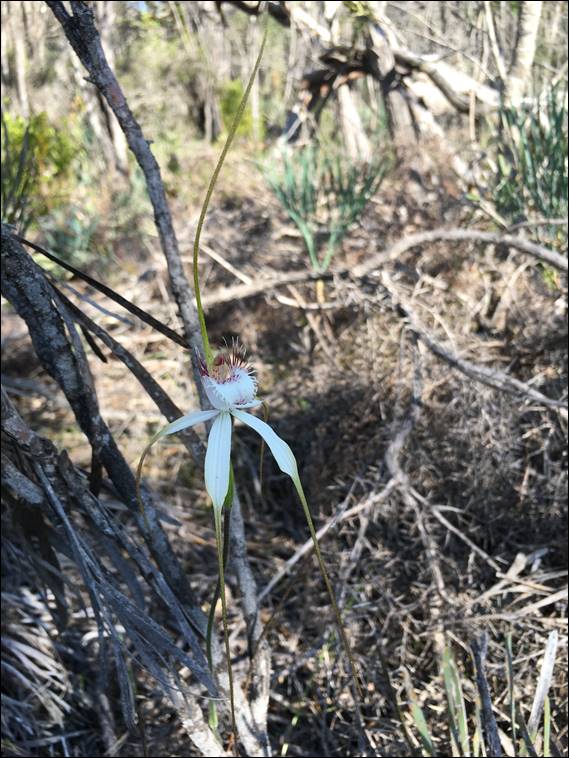
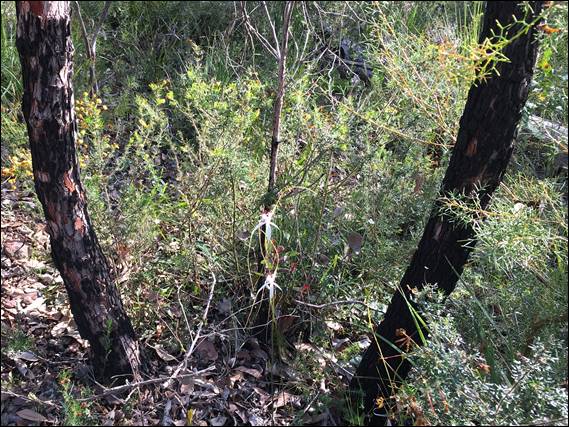
I’ve popped the next image in now even though it was the last species I spotted. Having confessed previously that I struggle with identifying White Spider Orchids, based on the very long petals and sepals I’d suggest this find was a Splendid White Spider Orchid (Caladenia splendens). While they tend to prefer winter wet areas, they are also found at the fringe of granite outcrops were water seepages can occur. So its presence in this more rocky and granitic landscape is plausible. It was the only White Spider Orchid I found, and I didn’t even spot any spikes to indicate more may be coming up:
The reason I went out of sequence with my images was because of what was on one of the flowers. Called Flower or Crab Spider, there are three Australian subfamilies and I was able to get good enough images to narrow this one down to the Thomisinae subfamily. The eight eyes that are in two rows of four, are raised above the head on tubercles, and can rotate independently of each other. This subfamily is more drab in colours than the other two being Stephanopis and Tharpyna, but this usually aids with their camouflage, with some species able to change colour to match their home:
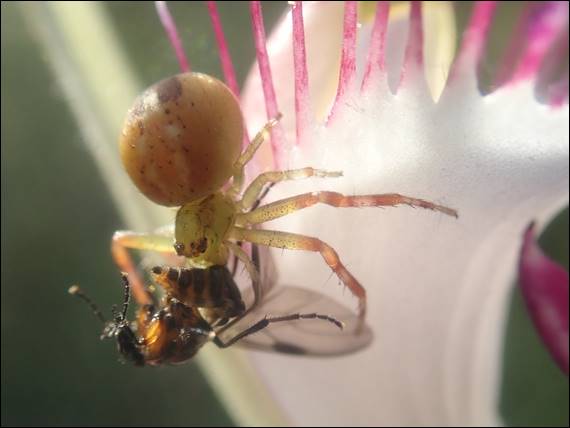
They are territorial creatures and you will generally only find one spider on a flower, other than when they are mating. They will normally remain on their chosen flower until it has wilted, and then find another one to claim as home. The colour of this one obviously did not match its chosen home, which may be why I was lucky enough to spot it. At night they hide on the underside of the flower out of sight from their own predators, and by day they becoming the predator. Sitting patiently waiting for prey, they are known as ambush hunters. Using their spiny front legs to grab their prey and then quickly bitting into its head to deliver its venom:
This one had managed to catch a bee. From the shrivelled appearance of the bees abdomen and swollen abdomen of the spider it is fair to say the feeding process was well underway. Comprising the injection of digestive juices to liquefy the bees internal tissues, that can then be sucked up like a soup. So the name Flower Spider is obvious, but why a Crab Spider you may ask. Two reasons, the legs curve forward in a crab-like fashion but also due to the much smaller back legs they are able to, and do, move sideways. I think I’ve managed to narrow this one down, at first thinking it was Diaea cruentata, however it looks like this species was transferred from the genus of Diaea to Australomisidia in 2014. Making it Blood Spattered Diaea(Australomisidia cruentata):

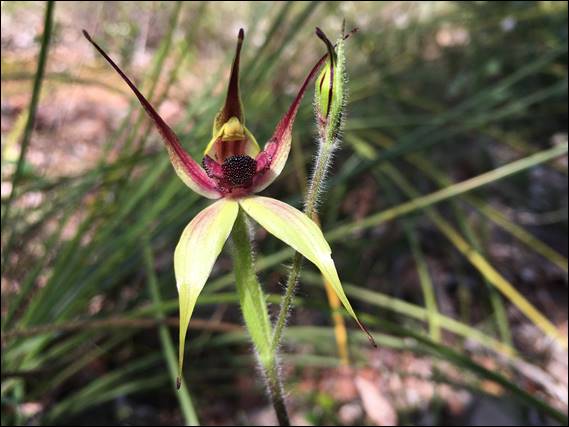
There were of course quite a few other orchids out and I managed to spot two Leaping Spider Orchids (Caladenia macrostylis), easily identified by the cluster of deep purple calli in the middle of the flower. I’m not aware of another spider orchid that has this feature. Above I kept the Jug Orchids (Pterostylis recurva) as the hero of the image, to allow people to get an idea of the angle I was taking images of the inside of a Jug Orchid during my walk in Capel. However, also captured in the above image are five Bird Orchids (Pterostylis barbata), if you can spot them all, which were the most prolific orchid in flower of which I found as many as twenty:
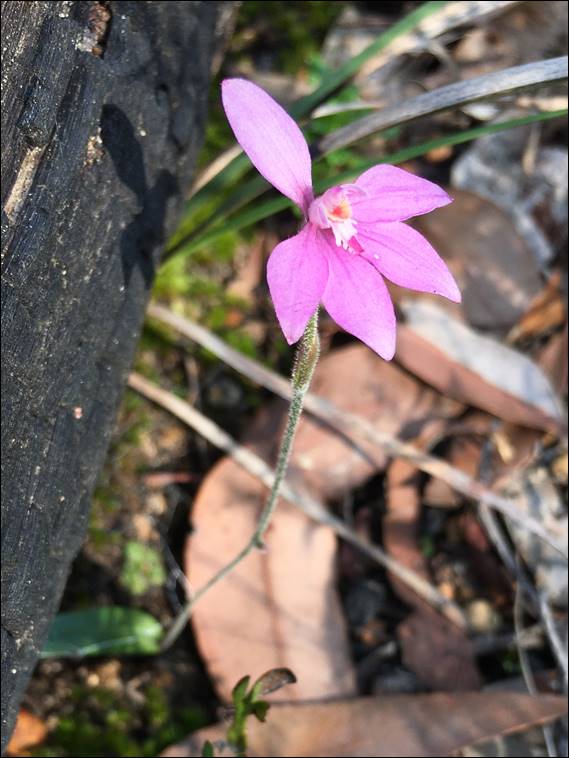
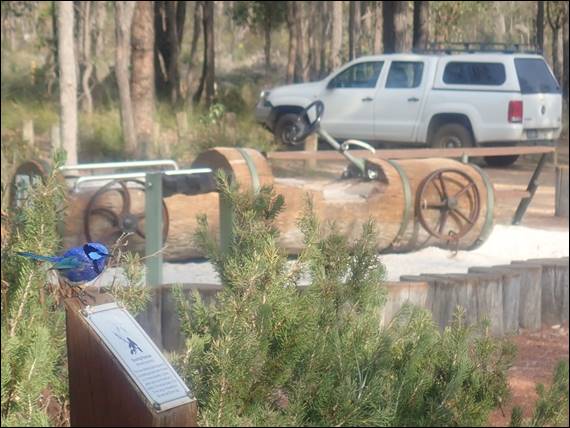
I also spotted a few Little Pink Fairy Orchids (Caladenia reptans), which can be found in clumps but I wasn’t that lucky today. They are often up against the trunks of live or fallen tree, maybe as there is more moisture available. Although there is also a theory it is because of the protection these locations provide the small delicate flower. While I had tempered my expectations this week, I was certainly not disappointed and it is fair to say I was more than pleasantly surprised. Then to top things off, just as I got near the car, a male Splendid Fairywren (Malurus splendens) that would normally not stay still for more than a few seconds sat atop a post for ages:
 Sandbagged