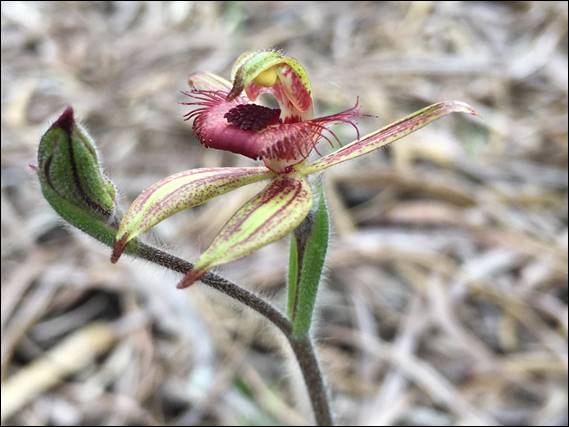
After a lazy start to the day I got itchy feet and convinced Lisa it would be nice to take the poodles out for a walk, or should I say sniff, round Manea Park. From the start I was not expecting to see much, and certainly not thinking that I would see enough to write up a post. That changed within the first hundred metres, but I’ll keep this post brief. My main reason for it is this beautiful Dancing Spider Orchid (Caladenia discoidea). A first time find for me, and being easily distinguished by quite a few features including the way the short petals are held horizontal:
Soon after we stumbled across the below lovely Silky Blue Orchid (Caladenia sericea), the term sericea meaning “silken” or “silky” in Latin. But not referring to the flower or its petals but the leaf. While there has not been a year that I have not seen this orchid the first time I spot it each season, it still feel special. I was surprised at how many species were in bloom, and we also saw the Robust Snail (Pterostylis dilatata), Jug (Pterostylis recurve), Hare (Leporella fimbriata), Midge (Cyrtostylis huegelii), and Banded Greenhood (Pterostylis vittata):

I don’t think I will see too many really cool fungi this year, as we really have not had a wet winter despite some big storms that brought isolated heavy rainfall events. And I can’t add this next one to my list, as it is not a fungi. Strawberry Slime Mould (Tubifera ferruginosa), is often found on wood and may look like a fungi but it does not send a mass of hyphae (a bit like roots) into the surface below it. Rather comprising a structure made from something called plasmodia, which have no cell walls and as they are not fixed to the surface, it can move:
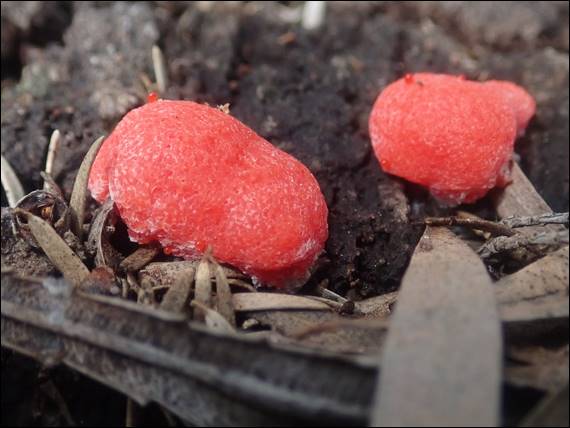
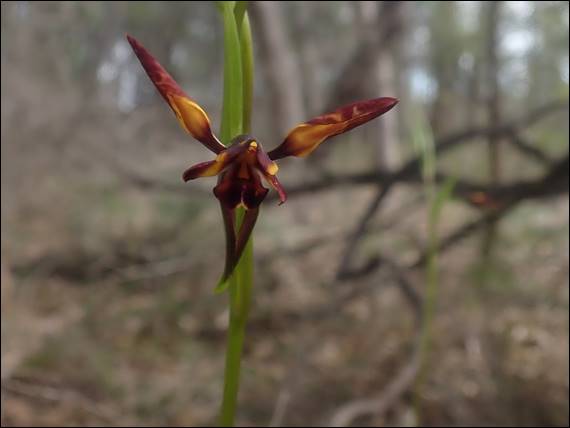
This movement is used to engulf whatever may be considered food such as bacteria and spores, a bit like the way a single celled amoeba feeds. As we headed back towards the car with the dogs all sniffed out we spotted orchid species number seven, the Kemerton Donkey Orchid (Diuris cruenta). I had seen the stems previously but was not sure what flower it was or indeed whether they were an orchid. However, the deep colours of the flower of this species gives it away. It is also where it gets its name with cruenta meaning “stained or spotted with blood” in Latin:
Before we got back to the car Lisa found a small acacia bush with a heap of Jewel Beetle (Stigmodera gratiosa) feeding off the flowers. There are seven Australian species in the genus Stigmodera but it is the native Western Australian species that were particularly sought after. In 1978 this resulted in these beetles being the first invertebrates in Australia to be protection under the Western Australia Wildlife Conservation Act 1950. The reason being that their carapace were highly sought after by collectors and used for jewellery:

 Sandbagged