We’ve moved office, all of 700m down the road from where we were before. This might seem a little odd but the old building was well, old. Things were falling apart, the technology was a bit dated, and the office design didn’t match the so called “modern style”. So in May of this year we moved into our swanky new office. For me an office is an office, although I am not entirely convinced the “modern style” suits the way I’m wired. So I look forward to working from home on Thursday and Friday that little bit more now:
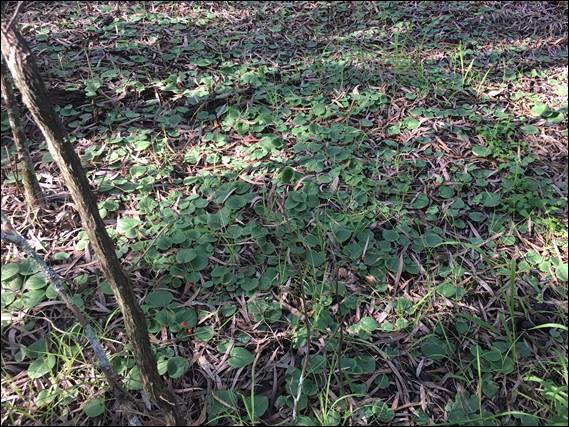
That said mid-afternoon today I found myself driving into Bunbury and parking near the office. Another keen orchid hunter from work, Josh, had checked out a small patch of bush a short walk down the road. He’d mentioned the myriad of basal leaves littering the floor, and he was not wrong. At the time he also shared an image of something I pondered for a while, thinking it could be the common Midge Orchid (Cyrtostylis huegelii), or possibly the less common Mosquito Orchid (Cyrtostylis robusta):
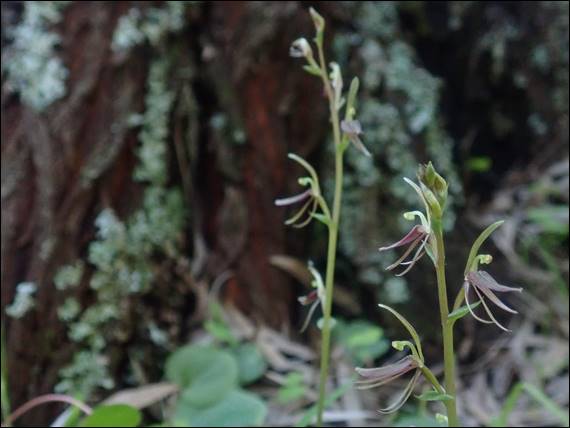
The key way to tell these apart is the labellum, with the Midge Orchid’s being narrower by a mere 1mm and a darker shade. I’m fairly sure based on what I saw today, along with the height and number of flowers on some stems that it may be the less often seen Mosquito Orchid. But that was not why I drove here today. During a second visit here Josh had, just a few hours earlier, shared an image of something far more exciting. The Helmet Orchid (Corybas recurvus), a genus I have had on my wish list for a while now:

These have similar but smaller leaves to the Mosquito Orchid and the two orchids are often found together. The Mosquito Orchid can often flower in great numbers and it was today, and while the Helmet Orchid forms large colonies of leaves only a few will usually flower. The name of the Helmet Orchid comes from the way the flower is held, with the Latin word recurvus meaning “recurved” or “curved backwards”. The first formally described specimen was coincidentally found at my favourite peak in the Stirling Ranges, Toolbrunup, in 1991:

As I wandered about I spotted a few spider orchid leaves, so this will be a place to head to over the coming months and see what pops up. Also while we are having a wet spell there are other colourful finds that impressed me. Small sprouts of Orange Coral (Ramaria anziana) were pushing their way through the leaf litter, above. Distinguished by their thick upright orange branches that split into tips, which start to turn yellow. Quite a few were close together, which aligns with this species that is known to be gregarious or growing in clusters:

Unlike the above Yellow Brain (Tremella mesenterica), which is a true parasitic fungus that feeds on wood-rotting fungi of the Peniophora genus. The Yellow Brain is a sign of the recent wet weather. Appearing during wet spells and then becoming a thin film or shrivelled mass within a few dry days with no rain. Not dying but patiently waiting for the next rains when it once again takes the above brightly coloured fleshy fungus eating form. We’ve had a lot of rain this week, mostly from one big front and that has drawn out big numbers of frogs:
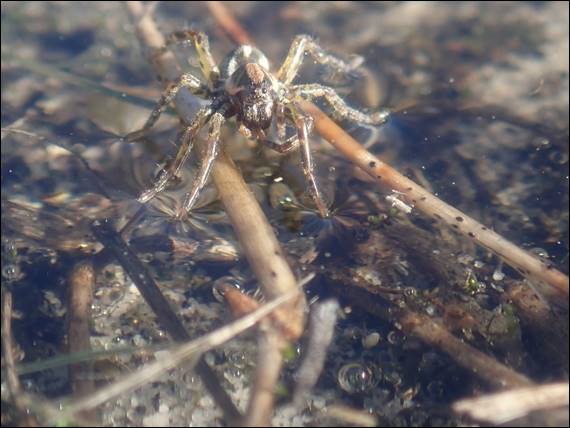
I didn’t see any frogs, but did spot the above spider skating across the water. I thought it may have been a species of Water Spider (Dolomedes), but the configuration of the eyes did not match up. Water Spiders have the two rows of four eyes, whereas this spider had a bottom row of four with two rows of two above. This configuration is akin to Wolf Spiders (Lycosidae) and the body pattern also matches this family, which gains its name from an Ancient Greek word “lycosa” that means wolf. An apt name because this spider stalks its prey, like a wolf:
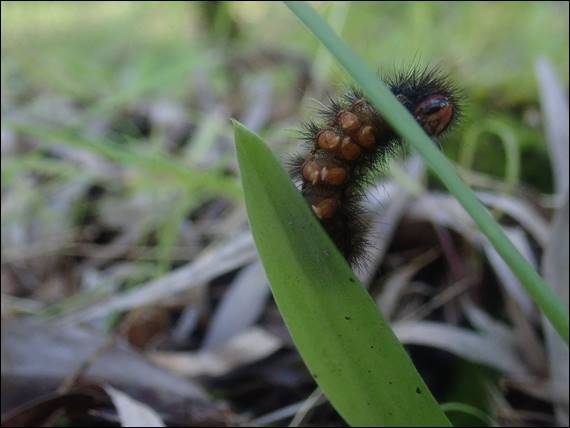
As occurs when I get lost in nature time had slipped away from me, and it was time to leave the frog chorus and head back to the car as I had a few errands to run in town. Like the above caterpillar, which I have not even tried to identify, I kept a beady eye out on all the leaves. Stumbling across one particular patch of Helmet Orchids that was ablaze with flowers, a sight that based on all my readings of this species is not something that is usually witnessed. And to think all these wonders are a mere stroll down the road:

 Sandbagged