With the second day of the weekend being glorious, it was a shame to waste it being inside all day so we went for a wander. The last couple of trips out with the poodles have been north to Manea Park in Bunbury, only 25km away but being just round the corner from the office it feels a little bit like I am heading to work. Another option we have that is only 30km away is to head east to Crooked Brook, the trip however takes us right past Lisa’s school so the journey there makes it feel like a school day for her. So instead we went 70km south to Nannup:

Wandering through the near silent forest with hardly a whisper of a wind in the air, was a stark contrast to yesterday’s experience with the incessant noise of the crashing waves. Lisa corralled the poodles, whose noses were to the ground most of the time. Following the scent of most interest every so often suddenly stopping, resulting in nearly falling over them. I meanwhile ambled along with my eyes fixed on the vegetation along the side of the path. The first item that caught my interest being a small cluster of Cup Lichen (Cladonia):
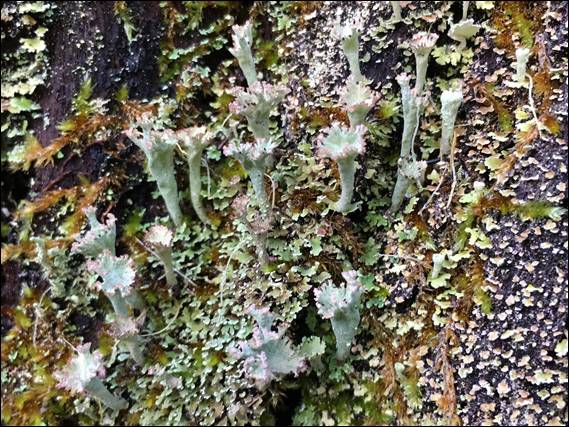
Despite the obvious fringed cup I can’t identify the species, noting Australia has approx. 3,500 species of lichen. They are classified as a fungus but are in fact unlike any other organism on earth. Being a creation of a mutually beneficial relationship between a fungus and an alga or cyanobacterium. The fungus is the protector of the alga or cyanobacterium, anchoring it to whatever it is attached to. Through this anchoring the fungus absorbs water and nutrients, while the cyanobacteria or algal uses photosynthesis to change these elements into energy in the form of carbohydrates for the fungus:
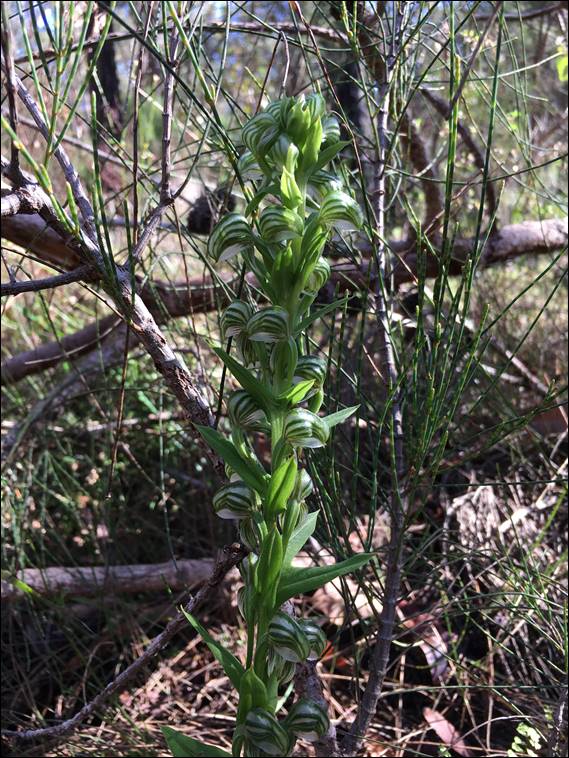
This partnership allows lichens to live in the harshest of environments, including the dry arid interior of Australia. Where despite searing temperatures and low rainfalls they form large and amazing patterns on the surface of rocks, which have often drawn my attention. Moving on, the less impressive and simple striped pattern of the Banded Greenhood (Pterostylis vittata) is what gives this species of orchid its name. Quite simply the Latin word of vittata means “striped” or “banded”. My reason for including the above image is that this common orchid is normally described as having 2 to 25 flowers, but the above specimen had in excess of 30:
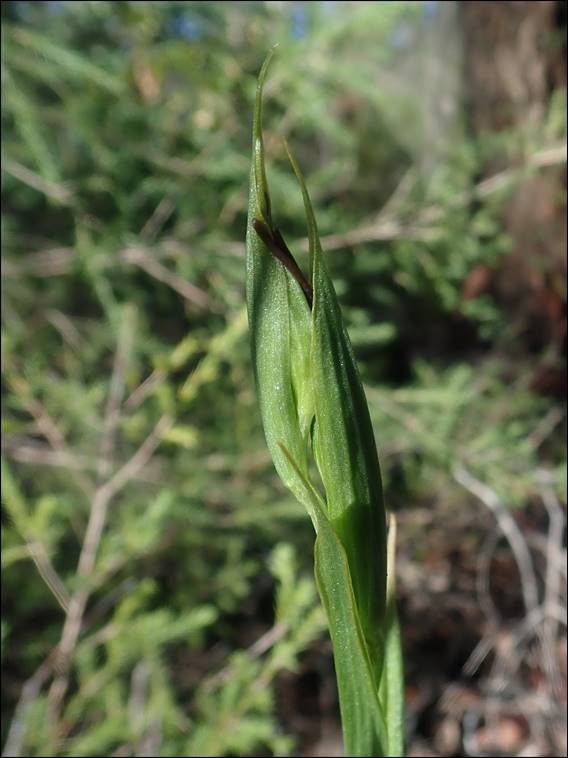
The Greenhood genus Pterostylis has approx. 300 species, and like many other genera of orchids they have an underground tuber and are terrestrial herbs. However, what distinguishes Greenhoods from other orchids is the hood-like “galea”, which is the botanical name for a structure shaped like a helmet. The dorsal sepal and two lateral petals of the flower are fused together to form this hood, and it is a common feature of all Greenhoods. Although the hood of Jug Orchid (Pterostylis recurva), which is yet to flower in the above image with the end of its two distinct brown sepals poking out, sits more to the rear of the flower than on top of it:
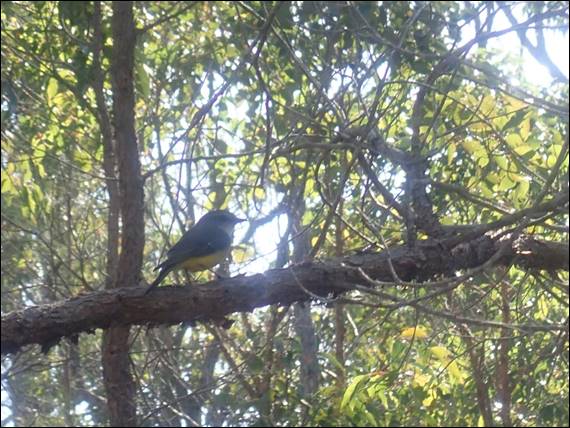
The silence of the forest was broken by the occasional bird song, heard but unseen. But at one location where was a clattering of a dozen of more small birds as they flew back and forth across the path. I believe they were Western Yellow Robin (Eopsaltria griseogularis), which gets its species name from two Latin words of griseus and gula meaning “grey” and “throat”. These birds were included in the first collection of local fauna assembled for the newly founded Zoological Society of London in the 1830s. What made me question my identification was they are not commonly found in small groups, although in autumn and winter they are known to join hunting flocks as they prey on insects:

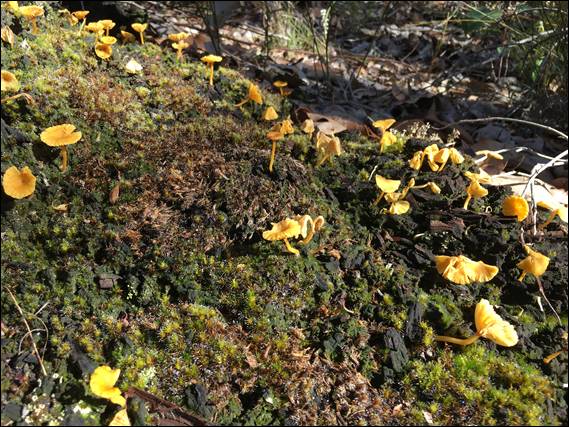
The colour yellow theme continued with these Yellow Navel (Lichenomphalia chromacea). Small fungi that are no more than 20mm high with caps that spread to a diameter of 30mm. The deep and delicate gills under the caps being clearly visible, due to their caps forming an “innie” belly button a bit like the Cup Lichen I had found earlier. The caps also seemed translucent, so looking from above the pattern of the gills could be seen. Whenever I saw them their colour sprung to life against the mat of green algae or as below bryophytes, on which they are often found:
The last image is of another Greenhood, and the third orchid we spotted during the walk. I find snail orchids a tad tricky to identify, but I’m learning and took account more notice of a few features such as the basal rosette of leaves which gave this one away. We found Slender Snail Orchid (Pterostylis crispula) at a couple of spots, but this was the best find. A heap of the plants were growing in the detritus at the end of a fallen trunk, and their green contrasted nicely against the burnt blackened wood or it would have if the sun wasn’t in the wrong position. The hood of these orchids are clearly visible, covering the top of the plant and looking a bit like a peaky cap:

 Sandbagged