There was a fair bit of procrastinating this week. The total rainfall for June was inching its way upwards in the statistics table, as I had predicted in my last post. Due to the uncertain conditions, I lost count of how many times I checked the regular weather app alongside the BoM isobar maps. Looking, or was it willing, for even a glimpse of a weather window to appear. Even then it was a last minute decision to head out on Saturday morning. Driving down clear patches lingered to the east, in the opposite direction to where I was heading:
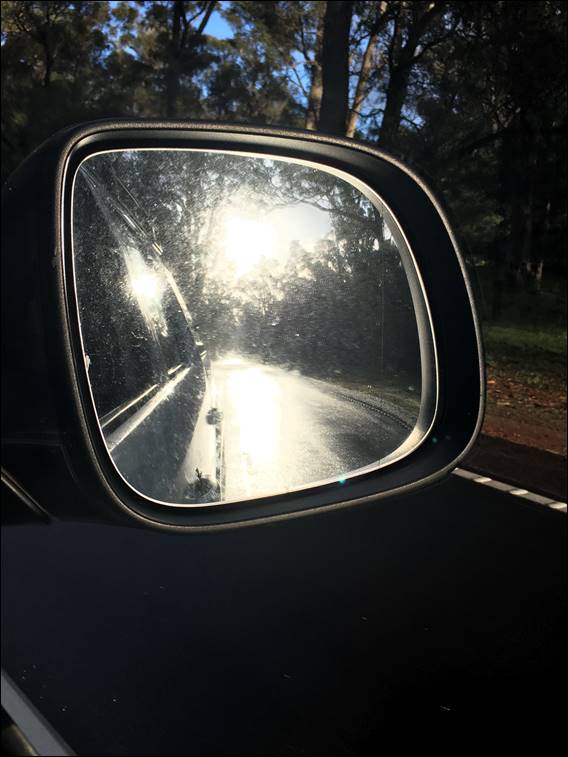
Ahead of me, to the west, dark clouds loomed fronted by stunning displays of rainbows. Then, as I drove into the belting rain the rainbows disappeared from sight and I pondered my decision. I admit that at times I can be a little stubborn. If I have an idea or plan, even when things suggest it may not be the wisest, I can at times forge on regardless. Today was one of the those times, and not surprisingly I was heading out alone. Less surprisingly and despite not getting to the carpark until just past nine it was empty, as was the crag for my entire visit:
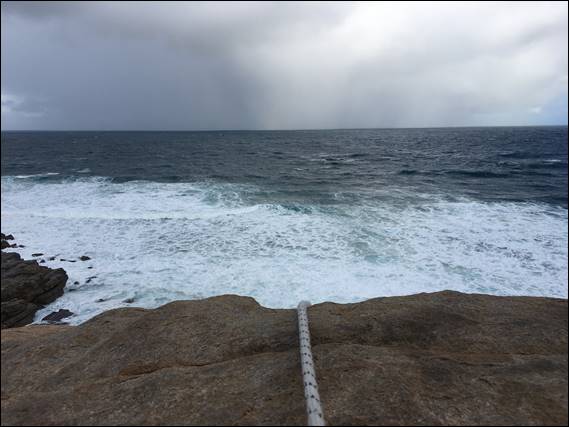
It was already a bit nippy, and made all the more chilly by a stiff north westerly wind that was whipping across the face of the crag. Quick to take the rope on a sideways adventure as soon as I let go of it, and at times making me hold on that bit tighter for the more delicate moves of my chosen climbs. On the plus side, I had ventured past the rain and while dark clouds were out to sea it looked like things might improve. My destination was primarily based on the ease of setting up, and the first anchors gave me access to seven routes:
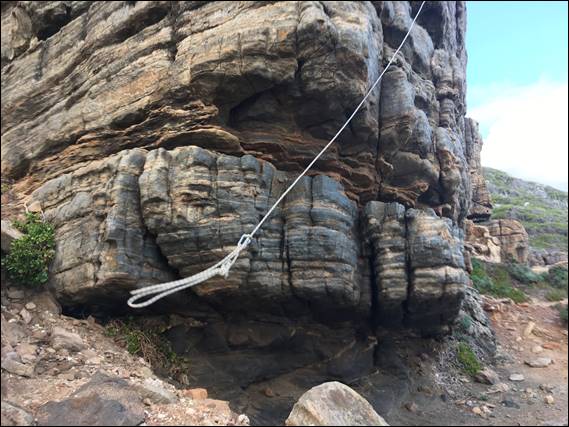
Being appropriately dressed for the conditions, and being able to keep moving due to not needing to faff with the ropes between routes, I soon warmed up and acclimatised to the conditions. While not everyone’s cup of tea, being on a coastal crag in such blustery conditions provides a very exhilarating experience. One I was thoroughly enjoying and not wanting to end too quickly, so I kept knocking off climb after climb. One went up a huge partially detached flake, which is being monitored for movement using these two steel pins:

On a much bigger scale, there are seven major and eight minor lithospheric plates that make up the earth’s crust. Australia has its own plate, not unlike a few others continents but what makes it different is the rate at which it is moving. Shifting by approx. seven centimetres per year. When I first started surveying some thirty years back it probably didn’t matter too much, as positioning systems generally provided an accuracy of five to ten meters. However, with technology advancements and dare I say our obsession with detail and accuracy, it matters heaps:
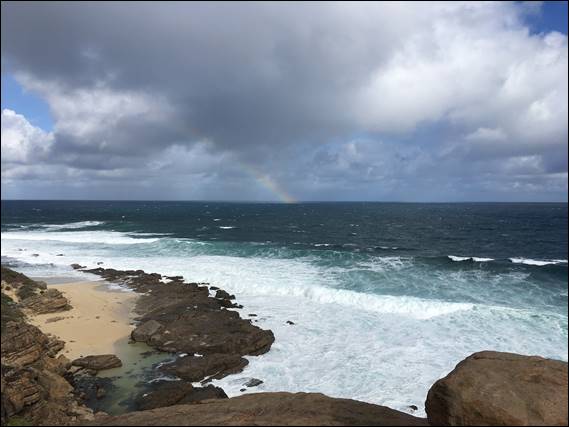
Today I was definitely observing the woods and not the trees, taking in the whole experience and situation rather than focusing on each of the individual components that made it so wonderful to be out. That may be why I didn’t stick to my predictable formula for top rope soloing of two laps on six lines. Instead bagging two laps on nine lines and a single lap on both Glory and Hope to finish. The last two being very purposeful, and even though my quick inspection as I rapped down the lines indicated I would be unlucky, I wasn’t:

My spirits weren’t even damped when the rope became stuck, as I tried to pull it up after my last climb. Instead rapping back down to free it, before scrambling up an easy slab to make it 21 instead of the usual 12 ascents. It was now time to wrap up the climbing, although I had one more stop in mind. A quick check in the bush before I hit the sealed road that would take me home. Wanting to see if the orchid leaves, which look so much like helmet orchids leaves, had transformed into a more substantial plant:

They hadn’t, but I was rewarded with some great fungi, including a very fine specimen of Rhubarb Bolete (oletellus obscurecoccineus). The above fungus was first found and named in South Australia as recently as 1997, and observation recorded on the Atlas of Living Australia have only included one sighting in Western Australia, in the metro area. That said I have read Russula lenkunya, which has not been attributed a common name, is considered a native fungus to Western Australia. As for the fungus in my last image I have no idea:

 Sandbagged