Instead of hours on rock this weekend; hours have been spent futilely delving into the world of fungi. The reason for not getting out for a climb, and not worrying too much about it, being that Craig opened up his indoor wall to allow a few of us to pop over on Saturday afternoon, for a bit of a social and indoor boulder session. I took advantage of a morning at home to jump on my pushbike and head to the Tuart Forest National Park, part of which is right on our doorstep. Tuarts (Eucalyptus gomphocephala) are only found along the Swan Coastal Plain of the south west of Western Australia, favouring the limestone soils found along the coastline:
However, over the last two hundred years, many of these areas have been cleared resulting in our local national park being the largest remaining tuart woodlands. Reputedly having the biggest surviving specimen of these majestic trees that be as old as 600 years, reach 33m in height, and/or have a girth of up to 10m. That said, even here, the tuarts were felled. In some areas they were cleared to make way for pine plantations, to fuel the demand for plywood. These plantations are no longer in operations, and all that remains of that past industry is the Ludlow forestry mill and settlement:
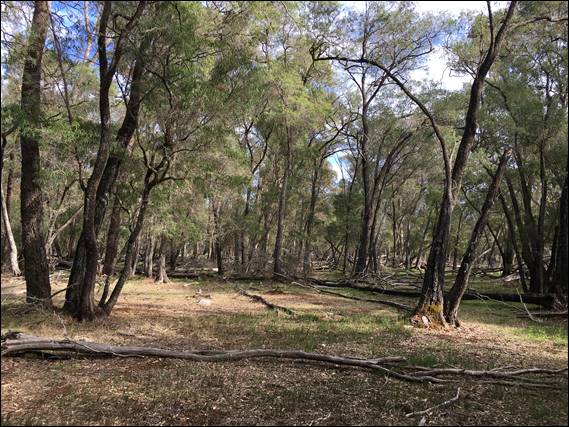
As the image above shows while there are some giants still about, much of the landscape is a far cry from the glory that existed before colonial intervention. In addition to the changed upper storey vegetation status, the groundcover has also massively changed with key threats coming from Bridal Creeper (Asparagus asparagoides), Arum Lily (Zantedeschia aethiopica), and pasture grasses. As such the once amazing floral display that could be witnessed here at particular times of the year, are no longer anywhere near as spectacular, varied, or widespread. That didn’t stop me having a wander to check for orchids today:
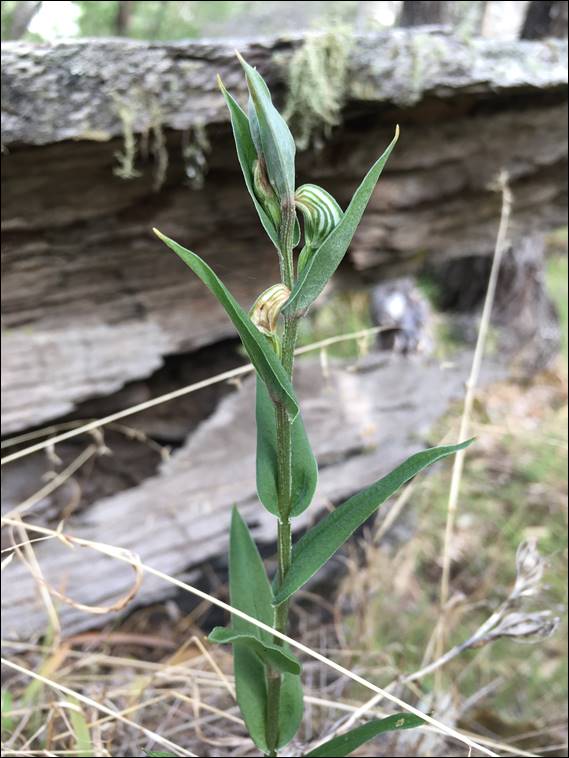
The only signs of orchids I found were two Banded Greenhood (Pterostylis vittata), a common greenhood in these parts and the first one to come into flower as the new season approaches. They were taking advantage of an elevated position, above the weeds on the ground below, by growing in soil and detritus that had collected in a rotten fallen tree. And, as alluded to before, I had more success with fungi. Albeit in finding them, not identifying them. This is not a huge surprise as there are about 5,000 known species of larger fungi in Australia, and if you count all types of fungi there are potentially quarter of a million species:
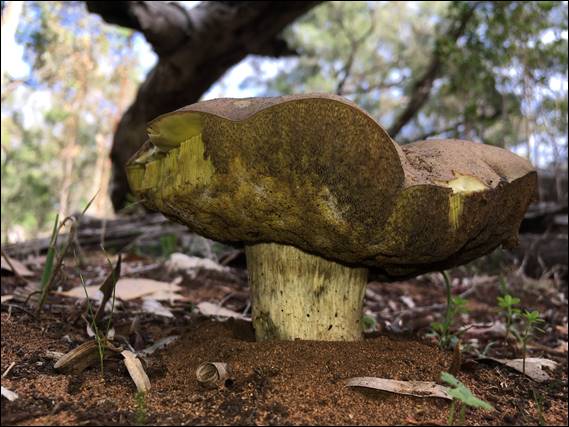
This didn’t stop me having a crack at identifying what I found. The image of first one had me a little confused, thinking it was a species of Bolete mushroom. These are distinguished by having a thick cap with a spongy body that has pores instead of gills. However, this type of cap is not unique to Bolete mushrooms, and after much pondering I believe it is more likely Slippery Jack (Suillus granulatus). These are associated with pine plantations, and seeing the area has been used for pines I’m taking a punt that these are still lingering here. But I do not believe it is the species luteus, which is more common to the south west, as there was no ring on the stem:

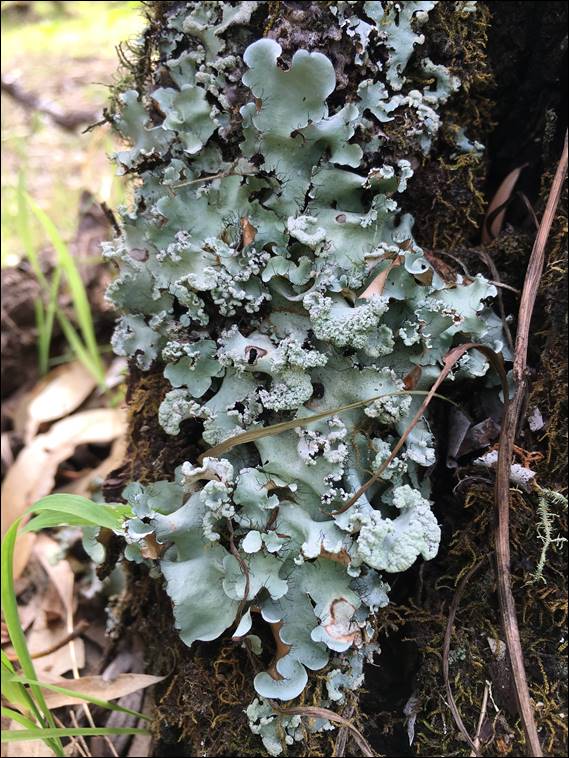
I’ve slotted in an image of what I believe to be a species of Leafy Foliose Lichens, which is made of flattened thalli. This means their structure does not have components of a leaf, stem, and roots. They attach to their host using root like structures called rhizines, but are not harmful as they do not take any nutrients. Walking round the woodlands, the occasional bigger tree still stood proud. Tuarts have wide straight trunks, making them a great resource for the durable hardwood timber industry. While protections are now in place to conserve what remains of this species, they can and are still felled with strict conditions:

Despite checking the many fallen logs, looking deep into the dark hollows. I didn’t spot any creatures, other than the birds in the trees and on one occasion a mob of kangaroos, as they bounded away after I disturbed them while they were resting up. Insect wise it was also very quiet, and the best I could find were the many relatively small spiders hanging in their webs. The only species I spotted was one of the elongated spiders, being the Long-Jawed Orb Weaver (Tetragnatha Latreille). These spiders when disturbed straighten up their body and legs, and resemble a stick that has been caught in the web:

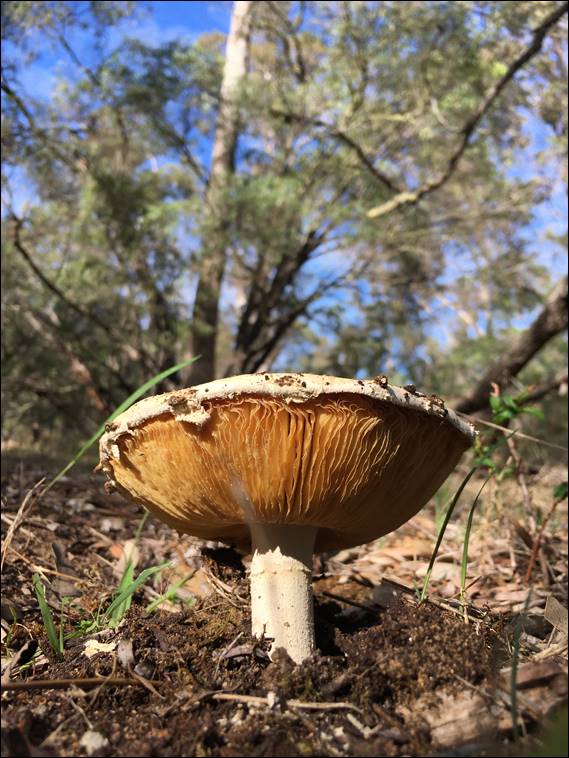
After an hour or so, I could take the mosquitos no more. So made my way back to where I had dropped my bike, keeping a hopeful eye out. But all that I found were more fungi, and so it seems fitting to finish with two more images. Based on the texture and pattern of the cap, the above looked to resemble a type of Scaly Sawmill mushroom from the Neolentinus genus, while the deep and straight gills of the one below looking to be like a species of the Russula genus, but I have not been able to get any closer than that. I’m not too upset though as, whether right or wrong, I’ve also read that many of the fungi located in the Tuart woodlands are yet to be named:
 Sandbagged